5 Minute Decision Rights Matrix for Design Teams
5 Minute Decision Rights Matrix for Design Teams

A decision rights matrix, in the project memory sense, is a short, source-backed decision record that links each design decision to its rationale, owner, and the artifact it changed. Capture one right after every substantive design call, not weeks later. Tools like The Intent Ledger build these as ILM Records, drawing on practices similar to Architecture Decision Records (ADRs), so a five-minute note in a review becomes a traceable entry instead of a lost thread.
TL;DR:
- Record decisions immediately after they are made, focusing on choices with serious alternatives or potential for future revisits to ensure valuable traceability.
- Use a minimal six-field template that includes decision, alternatives, constraints, rationale, owner, and outcome for most work, expanding only for high-stakes decisions.
- Assign a dedicated owner and systematically update status, linking decisions to artifacts and reviewing the log every two weeks to prevent outdated or incomplete records.
- Capture decision rationale in real time during sessions to avoid reconstruction from memory later, using tools that automate meeting note integration when possible.
- Tailor the complexity of the decision matrix to team size and project risk, scaling from three lines for solo work to full ten-field records for regulated organizations.
Table of Contents
- Core Fields for a Decision Rights Matrix Template
- Which Decisions Are Worth Recording?
- How to Capture Decisions Without Slowing Down the Work
- Keeping Ownership and Status Current
- Why Preserving Decision Rationale Actually Pays Off
- Three Copy-Ready Decision Record Examples
- Maintaining the Matrix Without Letting It Rot
- Resolving Disputes Over Who Owns a Decision
- Scaling the Matrix for Different Team Sizes
- What Adoption Actually Looks Like in Practice
- Try The Intent Ledger for Your Next Project
- Sources
- FAQ
Core Fields for a Decision Rights Matrix Template
A decision rights matrix earns its keep through structure, not length. Skip the fields and you get a diary entry. Include the right ones and you get something a teammate can query six months from now when nobody remembers why the sidebar moved.
The full field set, borrowed loosely from ADR conventions and adapted for design work, looks like this:
- Decision: the specific call made, phrased as a statement, not a question
- Alternatives: the two or three options actually considered, not a hypothetical list
- Rationale: why this option won, including tradeoffs accepted
- Constraints/assumptions: budget, timeline, technical limits, or client mandates that shaped the choice
- Owner: who made or approved the call
- Date: when it happened
- Status: proposed, accepted, superseded, or rejected
- Linked artifacts: the Figma frame, CAD model, repo file, or ticket affected
- Related requirements: which spec or user need this decision serves
- Outcome: filled in later, once results are known
Most teams don’t need all ten fields every time. A minimalist six-field version works for daily use:
- Decision
- Alternatives
- Constraints
- Reasoning
- Owner
- Outcome
That shorter format mirrors what practitioners call a decision log, and it’s the version most designers will actually fill out under deadline pressure. Save the full ten-field version for decisions with real cross-team stakes or compliance exposure.
Pro Tip: Start every team with the six-field version. Add fields only when someone asks “why didn’t we track X” twice. That’s your signal to expand the template, not a hunch.
Which Decisions Are Worth Recording?
Not every choice deserves a record.
Record a decision when it meets at least one of these conditions:
- It had real alternatives that were seriously considered, not just brainstormed and dropped
- It affects another team’s work, timeline, or budget
- Someone is likely to revisit or challenge it later
- It carries compliance, accessibility, or audit weight
Research on value-based design rationale documentation backs this selective approach: a targeted method captured roughly 46% of the full documentation volume on average while still preserving what readers actually needed later. That’s less writing for the same recall. Skip the “we tried three blues” note. Keep the “we switched from a modal to a drawer because three client stakeholders needed simultaneous access.”
How to Capture Decisions Without Slowing Down the Work
Capture happens in the room, not in a retroactive summary written on Friday afternoon. Waiting even a day means the reasoning starts to blur, and someone ends up reconstructing “why” from Slack scrollback.
Here’s a workable sequence for embedding capture into existing rituals:
- Assign a scribe role per session. Rotate it. Whoever runs the review or critique jots the decision the moment it’s made, not after the meeting ends.
- Attach the record to the artifact immediately. Link it to the Figma frame, the CAD component, the repo file, or the ticket it changed, so anyone opening that artifact later finds the reasoning attached to it, not buried in a separate doc.
- Group edits into a session, not individual clicks. A single design session might touch a dozen layers, but the rationale usually applies to the bundle, not each tweak. Treating the session as the unit of capture keeps the signal clean.
- Link to the requirement it satisfies. This gives you both forward traceability (why did we build this) and backward traceability (what requirement drove this decision).
- Make it queryable before you need it. A record buried in a chat log is useless during a debugging session six months out. A tagged, linked record is not.
Proximity matters more than most teams assume. Records stored close to the artifact they affect get referenced far more often than records filed away in a separate wiki nobody opens. A tool built around automating meeting note capture can remove the manual scribe step entirely, turning the conversation itself into the source record.
Pro Tip: If a decision comes up in three separate meetings before it’s finalized, link all three conversations to the same record. That thread is often more valuable than the final answer.
Keeping Ownership and Status Current
A decision rights matrix rots fast without an owner attached to each entry. Assign one person, not a team, as the accountable name on every record, and rotate a reviewer role so the capture work doesn’t fall on one exhausted lead every sprint.
Borrow the status lifecycle from ADR practice: Proposed, Accepted, Superseded, or Rejected. When a decision changes, don’t edit the old entry into oblivion. Mark it superseded and link to the entry that replaced it, along with a short changelog line explaining what shifted. AWS’s prescriptive guidance on architectural decision records recommends exactly this kind of ownership and changelog discipline to keep decision logs auditable rather than aspirational.
One governance habit worth stealing: a two-week outcome check-in. Two weeks after a decision ships, the owner fills in the Outcome field. That single habit is what separates a living record from a document nobody trusts.
Why Preserving Decision Rationale Actually Pays Off
Lost reasoning is expensive in ways that don’t show up on a budget line until it’s too late. A thesis study built on 13 interviews and artifact review found that when past design reasoning disappears, teams duplicate work, miss deadlines, and sometimes reintroduce problems that were already solved once. The fix wasn’t more documentation. It was making documentation and people work together as navigable sources of reasoning, which the study frames as a multilevel governance problem, not a filing problem.
The real cost of a missing decision record isn’t the record itself. It’s the meeting you have to hold again to re-decide something you already decided.
The value-based documentation research mentioned earlier points to the same conclusion from a different angle: targeted capture cut documentation volume by roughly half while keeping the parts readers relied on. In practice, that translates into fewer duplicated trade studies, faster onboarding for new hires who can read the “why” instead of asking around, and risks that surface during review instead of during launch week.
Three Copy-Ready Decision Record Examples
These are deliberately plain. A good record reads a little unglamorous, because it’s written in the moment, not polished for a stakeholder deck later.
- UI decision: “Switched primary navigation from a top bar to a left rail.” Alternatives considered: tabs, hamburger menu. Rationale: left rail supported the client’s planned feature expansion without a redesign. Owner: Priya. Date: March 3, 2026. Outcome: pending 30-day usage data.
- Architecture decision: “Adopted a modular component library over a single monolithic Figma file.” Alternatives: shared master file, per-project duplication. Rationale: modular library reduced merge conflicts across three concurrent projects. Owner: design system lead. Date: January 14, 2026. Outcome: cut handoff time, confirmed after one sprint.
- Process decision: “Moved design critique to twice weekly instead of once.” Alternatives: async-only feedback, weekly single session. Rationale: faster iteration outweighed the meeting overhead for this project’s timeline. Owner: studio lead. Date: February 20, 2026. Outcome: not yet measured.
Adapt the format loosely. In Notion, this becomes a database row. In Figma, a sticky note thread linked to a comment. In a repo, a markdown file sitting next to the code it explains. The one rule that doesn’t bend: never rewrite the rationale after the fact to make the decision look smarter than it was. A record written for legacy purposes is a case study, not a decision log, and readers can usually tell the difference.
Maintaining the Matrix Without Letting It Rot
A decision rights matrix that isn’t maintained becomes worse than no record at all, because people start trusting a log that’s quietly out of date. Build maintenance into the calendar, not into someone’s memory.
Schedule a monthly audit, fifteen minutes, where whoever owns the log scans for entries stuck in “Proposed” status past their review date. Anything untouched for 60 days gets a status update or gets marked stale. This is the same discipline recommended for keeping a project decision log audit-ready, and it prevents the log from becoming a graveyard of half-finished thoughts.
Archive aggressively but never delete. A superseded decision still has value as a trail showing how thinking evolved, especially when a client asks “why did you change direction” eighteen months into a project. Keep superseded entries linked to whatever replaced them rather than removing them from the record.
Version the template itself, too. If your team adds a field or drops one, note when that happened so old entries aren’t judged against a standard they were never written to meet. And resist the urge to retrofit historical entries with new fields you wish existed. Backfilling creates the exact post-hoc spin that undermines trust in the whole log.
Assign a rotating “log steward” role, monthly or quarterly, so upkeep doesn’t become one person’s unpaid side job. Teams that treat maintenance as a shared, scheduled task keep their logs alive far longer than teams that leave it to whoever cares most.
Resolving Disputes Over Who Owns a Decision
Disagreements over decision ownership usually surface at the worst possible time, mid-project, when two leads both think they had final say. The fix isn’t a bigger meeting. It’s clearer default rules written into the record template before the dispute happens.
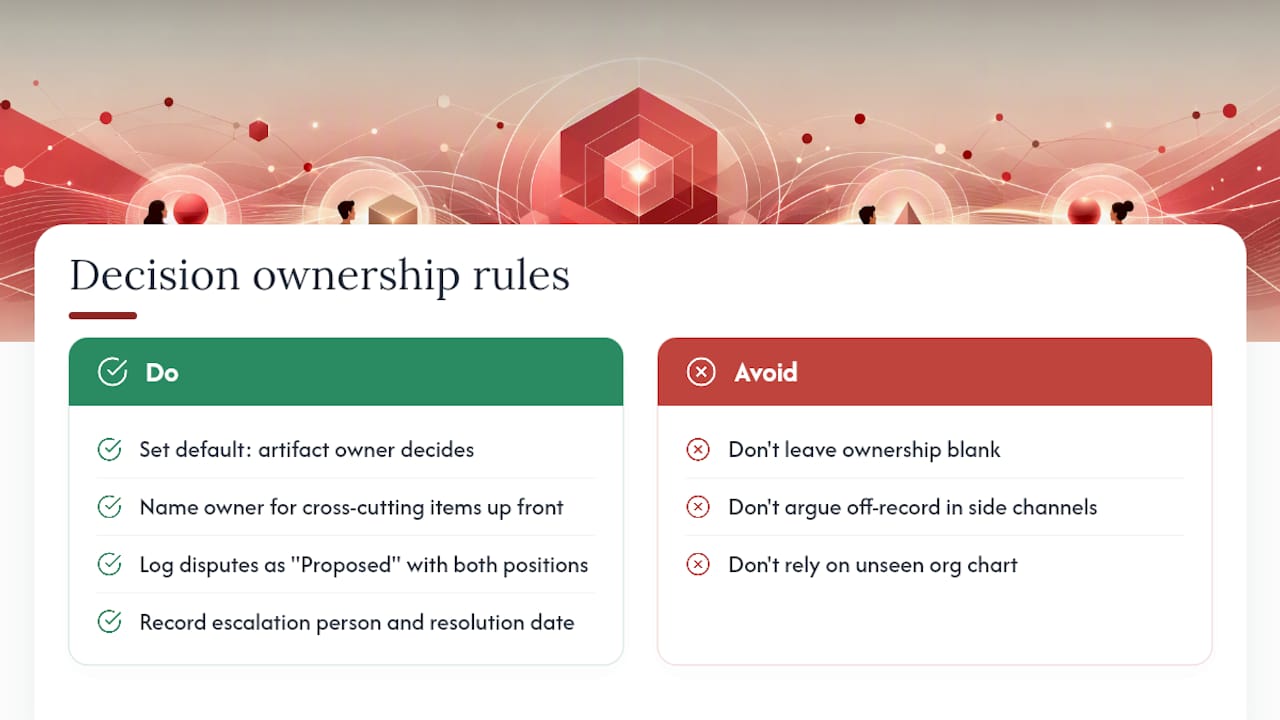
Set a simple default: the person who owns the artifact owns the decision about that artifact, unless explicitly delegated otherwise in writing. A visual design lead owns typography calls. An architect owns structural system choices. Cross-cutting decisions, the ones that touch multiple owners, get a named “decision owner” field filled in at the start of the session, not assigned retroactively once there’s a disagreement.
When two people genuinely disagree on a call, don’t let the record sit blank while they argue it out in a side channel. Log the decision as “Proposed” with both positions noted in the Rationale field, then set a deadline for resolution. This keeps the disagreement visible instead of hidden, and it gives whoever ultimately decides a paper trail showing both sides were actually considered.
Escalation should have a clear ceiling. If a studio lead or project manager needs to break a tie, name that person in the record itself, not just in an org chart nobody consults mid-crisis. That single line, “Escalated to: [name], resolved [date],” does more to prevent repeat disputes than any policy document.
The goal isn’t eliminating disagreement. It’s making sure a disagreement produces a record instead of a grudge. Teams that skip this step tend to re-litigate the same decision every few months because nobody wrote down who actually had the authority to close it.
Scaling the Matrix for Different Team Sizes
A six-field template that works for a two-person freelance project will suffocate a 40-person studio, and a full ten-field ADR-style record will feel absurd for someone documenting solo client work. Match the format to the team, not the other way around.
For freelancers and solo designers, skip the owner field entirely since it’s always you, and shrink the record to three lines: decision, why, and what you’d reconsider if the client pushes back. The main value here isn’t governance. It’s protecting yourself when a client asks “why did you choose this” four months after a project wraps.
For small studios (2 to 10 people), the six-field minimalist template is close to ideal. Ownership matters now because more than one person touches the work, but formal review cycles are overkill. A weekly five-minute scan of new entries during a standup covers most of what a studio needs.
For mid-size teams and multi-project studios (10 to 50 people), add the constraints/assumptions field and start tracking related requirements, because decisions increasingly ripple across projects and teams. This is also where a rotating steward role starts paying for itself, since no single lead can track every decision across every active project.
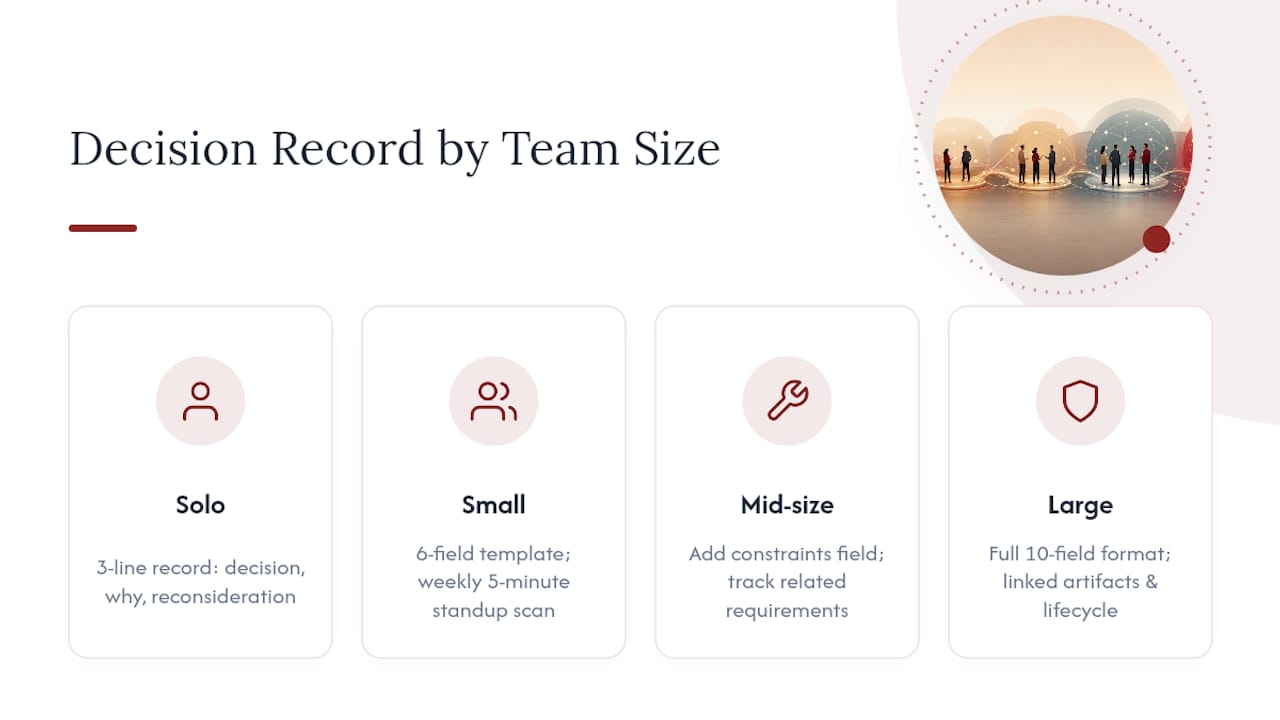
For large or regulated organizations, the full ten-field format earns its complexity, particularly the linked artifacts and related requirements fields, because audit and compliance reviewers need traceability that a six-field log can’t provide. This is also the tier where the AWS-style changelog and status lifecycle approach becomes less optional and more necessary.
The mistake most teams make is picking a template size once and never revisiting it. Reassess the format every time headcount roughly doubles or a project adds a new external stakeholder group. The record should grow with the risk, not with a fixed policy written on day one.
What Adoption Actually Looks Like in Practice
Most teams don’t fail at decision documentation because they lack a template. They fail because capture happens after the fact, once memory has already started reshaping the reasoning into something cleaner than what actually happened.
The bigger risk isn’t skipping documentation. It’s writing it days later, when the record quietly becomes a justification instead of a decision. Tracing a decision back to the actual conversation, rather than a tidied-up summary, is what surfaces risk early: a client objection buried in a transcript, an alternative someone raised and dropped without real discussion. Teams that build capture into the workflow itself, not as a separate chore, are the ones whose logs still get read a year later.
— Rajas
Try The Intent Ledger for Your Next Project
Project memory software can serve as an alternative to writing decision logs by hand after the meeting ends: it turns the meeting itself, whether that’s a critique, a client call, or a design review, into the source record. ILM Records ingest meeting notes, transcripts, and critique feedback, then structure them into decisions, rationale, risks, and open questions traceable back to the exact conversation they came from.
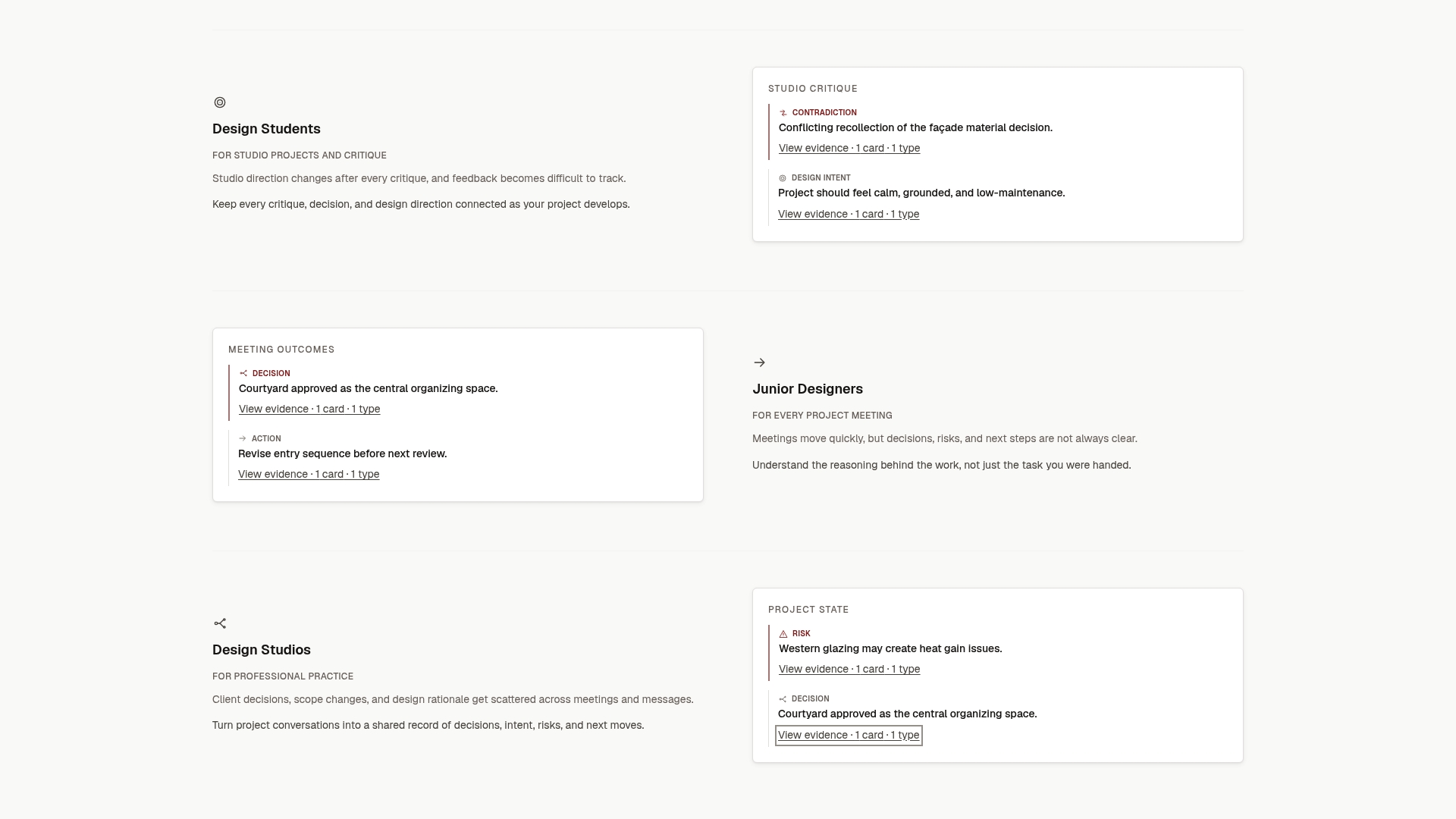
A practical way to test this: run a two-week pilot on one active project. Feed in your review recordings and critique notes, let the platform generate ILM Records, and compare what surfaces against what your team remembers documenting manually. For teams ready to start, the Working Set product line is a one-time $12 entry point, while the Working Memory subscription runs $29 a month for ongoing capture. Full plan and pricing details, including the Living Record and Shared Ledger tiers, are on the pricing page.
Sources
- Making sense of past design decisions in digital product teams (Aalto University thesis)
- The value of design rationale information (Simula/approved paper)
- Architectural decision records (AWS Prescriptive Guidance)
FAQ
Is a Decision Rights Matrix the Same as a RACI Chart?
No. A decision rights matrix in this sense is a record of individual decisions, their rationale, and their outcomes, not a chart assigning task responsibility across roles. It documents why a call was made and links it to the artifact it changed, rather than who is accountable for a category of task.
How Long Should a Single Decision Record Take to Write?
A well-scoped record using the six-field template takes about five minutes when captured immediately after the decision. Waiting even a day tends to double that time because someone has to reconstruct context from memory or chat logs.
Who Should Own Each Entry in the Matrix?
The person who made or approved the decision should be named as owner, with a rotating reviewer role to keep the log current. This distributes the capture workload and avoids the log falling to one exhausted lead every sprint.
What Does The Intent Ledger Cost for a Small Team?
The Working Memory plan runs $29 a month, and one-time ILM Record packs start at $12 for the Working Set product line. Full pricing, including higher tiers like Living Record and Shared Ledger, is listed on The Intent Ledger’s pricing page.
Do I Need to Record Every Design Decision?
No, and trying to will kill adoption within a month. Record decisions with real alternatives, cross-team impact, future re-evaluation risk, or audit value, and skip the small, reversible calls that don’t meet any of those thresholds.