Lock Decisions Same Day: Project Kickoff Notes for Project Managers
Lock Decisions Same Day: Project Kickoff Notes for Project Managers
Project kickoff notes exist to do one job: convert a room full of opinions into decisions with a name and a date attached. That means every set of notes needs four things, a decision, an owner, a due date, and a way to measure success, and they need to reach the team the same day or within 24 hours, while the reasoning behind each call is still fresh enough to defend. A tool like The Intent Ledger exists precisely because that reasoning is usually the first thing lost.
TL;DR:
- Effective kickoff notes must clearly record decisions with assigned owners, deadlines, and success criteria, not just general conversations or vague agreements.
- Pre-reads should be sent at least 48 hours in advance, including a project charter, draft timeline, and RACI chart, to ensure active participant engagement.
- During the meeting, capture only the decision, owner, and date initially, then add rationale and context within an hour afterward for full traceability.
- Speedy distribution of notes within 24 hours is crucial for maintaining their authority, along with a follow-up routine to confirm or correct key points.
- Use tools that link decisions back to source conversations, especially for complex projects with multiple stakeholders, to preserve reasoning and reduce scope creep.
Table of Contents
- What Makes a Timed Kickoff Agenda Actually Work?
- Kickoff Notes Template: What to Capture and How to Write It
- What Should You Send Before the Kickoff Meeting?
- How Do You Capture Decisions Reliably During the Meeting?
- How Fast Should You Distribute Kickoff Notes?
- How Do You Handle Sensitive Information in Kickoff Notes?
- What Makes Kickoff Notes Easy to Read and Act On?
- What Tools Work Best for Taking and Sharing Kickoff Notes?
- Author Perspective: Kickoffs Are Where Project Memory Either Starts or Never Forms
- How The Intent Ledger Turns Kickoff Talk Into a Traceable Record
- Sources
- FAQ
What Makes a Timed Kickoff Agenda Actually Work?
A one-hour kickoff only works if you prioritize key time slots and minimize less important ones. Many teams spend too much time on introductions and rush critical topics like scope and risk at the end. Flip that ratio.
Here’s a sequence built for a single-project, single-session kickoff, adapted from the structure used in PMI’s guidance on launch meetings, which separates “positioning” the project from “planning” it:
- Welcome and framing (5 minutes). State the meeting’s purpose out loud: this session ends with decisions, not just discussion.
- Sponsor vision (10 minutes). The sponsor states the business problem, the desired outcome, and why now. No slides needed, just a clear statement.
- Scope in and out (10 minutes). Name what’s included and, just as important, what’s explicitly excluded.
- Roles and decision rights (10 minutes). Walk through a draft RACI and get verbal confirmation from each person named.
- Milestones and timeline (10 minutes). React to a pre-drafted timeline rather than building one live.
- Risks, assumptions, and open questions (10 minutes). Surface what could derail the project before it starts.
- Decisions and next steps (5 minutes). Recap every decision made, confirm owners, and set the next check-in.
For anything beyond a single team or a few weeks of work, one hour won’t cut it. PMI’s own model recommends splitting complex launches into a positioning session and a separate planning session that breaks work into Level 2 or Level 3 WBS items, sometimes across two or three days entirely. If your project touches more than one department or a work breakdown structure deeper than two levels, don’t try to force it into 60 minutes. Run a sponsor-only session first to lock the vision, then a working session with the delivery team to plan.
Facilitators keep momentum by asking direct questions instead of open ones. “Who owns the data migration?” gets an answer. “Any thoughts on ownership?” gets silence.
Kickoff Notes Template: What to Capture and How to Write It
Kickoff meeting minutes fail for one reason more than any other: they record what was said instead of what was decided. A transcript is not a set of notes. Notes are a filter.
Structure your project initiation notes around these sections:
- Project overview. One or two sentences on the problem and the outcome, taken directly from the sponsor’s framing.
- Goals and success criteria. Written as testable statements, not aspirations.
- Scope: in and out. Two short lists, not paragraphs.
- RACI summary. Who is Responsible, Accountable, Consulted, and Informed for the major work streams.
- Milestones. Dates, not quarters, wherever possible.
- RAID log. Risks, Assumptions, Issues, Dependencies, each with an owner.
- Decisions. Every choice made in the room, with the reasoning behind it.
- Actions. Task, owner, due date, and expected output or link.
The decision and action rows are where most kickoff notes fall apart, usually because they’re written as vague summaries (“team agreed to move forward with vendor X”) instead of testable statements. GoTranscript’s minutes template guidance recommends locking in decisions with an owner, a due date, and a measurable success criterion attached, which is what separates a decision log from a transcript summary.
A cleaner way to write it: Decision = explicit choice + decision owner + condition or constraint + implication on scope or timeline. Compare these two entries:
Weak: “Discussed launch date, seems like March could work.”
Strong: “Decision: Launch date set for March 16, 2026, owned by Maria Chen, contingent on QA sign-off by March 9. Implication: content freeze moves up one week.”
Actions follow the same discipline. “Follow up on vendor contract” tells nobody anything. “Priya Nair to send signed vendor contract to legal by Friday, March 20, confirmation via email thread” tells everybody everything. Pro Tip: If an action item doesn’t have a date a human being can put in a calendar, it isn’t an action item yet, it’s a hope.
What Should You Send Before the Kickoff Meeting?
The meeting itself is the wrong place to build a timeline from scratch. Send pre-reads at least 48 hours ahead: a one-page project charter, a draft timeline, and a draft RACI chart. Rework’s kickoff guidance recommends asking every attendee to bring one question or concern, which turns a passive read into active engagement and pulls hidden risks out before they become surprises mid-project.
Invite list matters more than headcount. A few guidelines:
- Include anyone with decision authority over scope, budget, or timeline, not just delivery staff.
- Keep the working session under ten people; run a separate sponsor-only session for vision and budget conversations that don’t need the full team.
- For multi-phase launches, split attendees across the sessions described earlier, positioning with sponsors, planning with the delivery team.
The facilitator’s job before the meeting starts is arguably more important than during it. A short pre-kickoff checklist:
- Confirm the agenda is timeboxed and shared in advance, not built live.
- Flag every assumption baked into the draft timeline so it gets challenged out loud, not silently accepted.
- Assign a note-taker whose only job is capturing decisions and owners, not someone also trying to run the meeting.
How Do You Capture Decisions Reliably During the Meeting?
Real-time note taking during a fast kickoff conversation almost always loses the reasoning behind a decision, even when it captures the decision itself. A two-pass method fixes most of that.
Pass one: outcomes only. During the meeting, capture just the decision, the owner, and the date. Don’t try to write full sentences while someone is still talking.
Pass two: clarification. Within an hour of the meeting ending, go back through your rough notes and add the “why” behind each decision while it’s still in your head. This is also the moment to convert fuzzy statements into testable ones using the decision formula from the template section above.
If you’re recording the session, time-stamped transcripts make pass two far more reliable. Research on automated meeting summarization shows that linking action items back to the specific moment in a transcript where they were discussed improves traceability and cuts down on later disputes about what was actually agreed. That link back to source is the entire point, a decision without its rationale attached is just a rule nobody remembers agreeing to.
This is the specific gap The Intent Ledger is built around: it turns kickoff transcripts and notes into structured records that stay connected to the original conversation, so a project manager or a new team member six weeks later can trace a scope decision back to the actual moment it was made instead of relying on someone’s memory of the meeting. For teams building a system for tracking who owns what after the kickoff, that same source-linking approach carries into ongoing action item tracking once the project is running.
How Fast Should You Distribute Kickoff Notes?
Speed is the difference between notes that drive action and notes that get skimmed once and forgotten. Send them the same day when you can, within 24 hours at the absolute latest, with decisions and immediate actions at the very top of the document, not buried on page three.
A short follow-up routine keeps the notes honest:
- Ask attendees to confirm or correct the notes within 24 to 48 hours of receiving them.
- Chase down any action item that shipped without a clear owner before it becomes a gap nobody notices until it’s late.
- Load every action into your project tracker the same day, with the same owner and due date written in the notes, no retyping, no drift between the two documents.
- Put the first status check on the calendar before the kickoff meeting even ends.
Notes that sit in an inbox for a week lose their authority. By the time someone reads them, half the team has already moved on to a different understanding of what was agreed.
How Do You Handle Sensitive Information in Kickoff Notes?
Kickoff conversations often surface things that shouldn’t go into a document every stakeholder can read, budget ceilings, staffing concerns, client politics, or a client’s own confidential business information. Treat kickoff notes as a shared record, not a private diary, and write accordingly.
A few practical rules keep this manageable. First, separate the distributable notes from a private facilitator log. Budget discussions, personnel comments, or anything a client shared under a nondisclosure agreement belongs in the private version, not the version that goes to the full project channel. Second, redact rather than omit when something needs to stay traceable internally but not externally, a placeholder like “budget constraint discussed, see project lead for detail” preserves the fact that a constraint exists without exposing the number to everyone on the distribution list.
Third, check your storage and sharing tool’s permission model before you hit send. A note stored in a shared drive with open link access is not confidential no matter what the document says at the top. Fourth, if the project involves a client under contract, confirm what that contract says about information sharing before circulating notes that reference their internal decisions or numbers.
Finally, be explicit about who’s on the distribution list and why. Adding people “just in case” is how sensitive kickoff details end up in front of someone who never should have seen them.
What Makes Kickoff Notes Easy to Read and Act On?
Structure decides whether kickoff notes get read or get skimmed and ignored. A wall of paragraph text buries the two things people actually need: what was decided and what they’re on the hook for.
Lead with decisions and actions, not chronology. Nobody needs a play-by-play of who said what in what order, they need the outcome. Put a short summary block at the very top: key decisions, owners, and dates, before any of the supporting detail like scope or RAID items.
Keep the whole document to one or two pages. GoTranscript’s template guidance recommends capping kickoff minutes at roughly one to three pages, since anything longer stops getting read in full. Use consistent formatting for every action item, the same order of task, owner, date, and output every single time, so readers can scan without hunting for information in a different place each row.
Headings should match how people search their own inbox later (“Decisions,” “Actions,” “Risks”), not creative labels that need explaining. And write for accessibility from the start: plain language over jargon, short sentences, and enough white space that someone scanning on a phone between meetings can still find their action item in ten seconds.
What Tools Work Best for Taking and Sharing Kickoff Notes?
The right tool depends on how much of the “why” behind a decision you need to preserve, not just the decision itself. A shared document (Google Docs, Notion, Confluence) works fine for a straightforward, low-stakes kickoff where the notes just need to exist and get read once.
Templated tools built specifically for meeting structure add more discipline. Asana’s kickoff meeting template gives you a consistent checklist format so the same sections show up every time, which matters more than it sounds once you’re running kickoffs across multiple projects and need consistency between them.
For teams working on visually complex or spatially driven projects, planning tools built around layout and space, like Spaceplanner, can sit alongside your notes process to keep planning decisions grounded in the actual physical or spatial constraints of the work.
Where most tools fall short is traceability after the fact. A shared doc tells you what was decided; it rarely tells you why, or lets you jump back to the exact moment in a transcript where a client changed their mind about scope. If you’re already recording kickoff calls, pairing that recording with a record-of-decision structure that captures the specific fields worth preserving, decision, rationale, owner, source, closes that gap without adding a second meeting just to write things down properly.
Author Perspective: Kickoffs Are Where Project Memory Either Starts or Never Forms
Most kickoff failures don’t happen because nobody wrote notes. They happen because the notes captured what was said instead of what was meant, and six weeks later nobody can explain why a decision was made, only that it was. That gap is where scope creep and rework actually come from.
Teams that link decisions back to their original conversation onboard new members faster, because a new hire can trace the reasoning instead of asking around and getting three different answers.
— Rajas
How The Intent Ledger Turns Kickoff Talk Into a Traceable Record
This platform is built for the gap most kickoff note templates leave open: preserving why a decision was made, not just what got decided. It takes your kickoff transcripts, meeting notes, and client comments and turns them into structured ILM Records that stay linked to the original conversation, so a scope decision from week one can be traced back to the actual moment it happened, not reconstructed from memory during a dispute in week twelve.
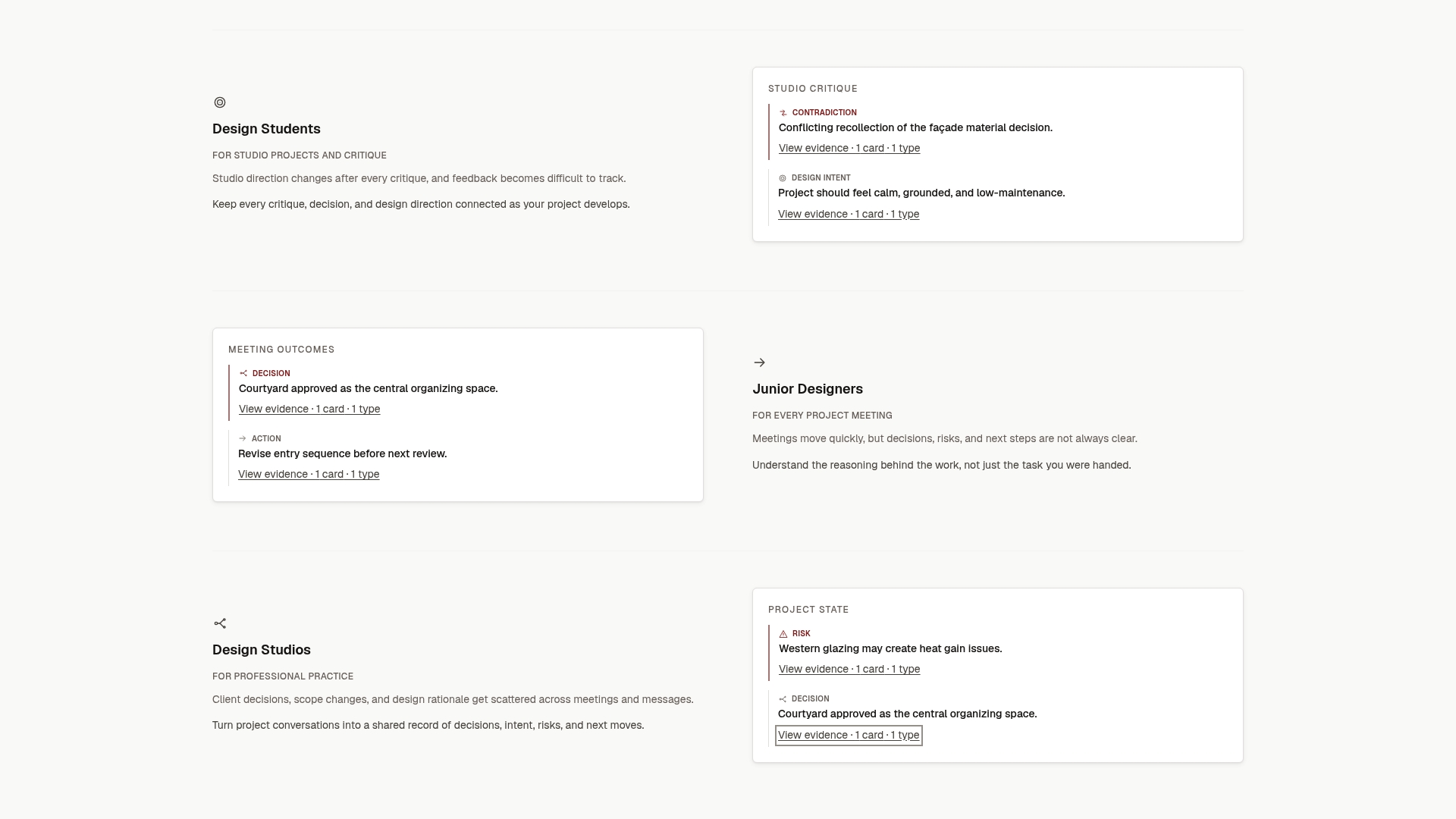
That traceability matters most for design teams and studios juggling multiple stakeholders, where “who decided this and why” gets asked constantly and answered inconsistently. Rather than a generic notes app that stores text, the platform connects the decision, the risk, and the commitment to its source conversation as a living record that grows with the project. If your kickoff notes routinely lose the reasoning behind a call, check the current plans and pricing and start turning your next kickoff into a record your team can actually trust six months from now.
Sources
For deeper reading beyond this guide: PMI’s launch meeting framework, Atlassian’s kickoff play, GoTranscript’s minutes template, and Rework’s kickoff checklist.
FAQ
What Should Be Included in a Project Kickoff?
A project kickoff should cover the sponsor’s vision, scope boundaries, roles and decision rights, a draft timeline, and known risks or open questions. It should end with documented decisions, owners, and due dates, not just a discussion summary.
What Are Three Key Components of a Project Kickoff Meeting?
The three components that matter most are scope definition (what’s in and out), role clarity (who decides what), and a decision log tied to owners and dates. Read.ai’s kickoff research frames this as problem framing, success metrics, and ownership clarity working together.
What Are the 5 P’s of a Meeting Agenda?
Definitions of the “5 P’s” vary by source, but a common version covers purpose, participants, plan, process, and payoff, essentially why you’re meeting, who’s in the room, what you’ll cover, how you’ll cover it, and what outcome you need. Not every kickoff agenda needs to follow this exact framework to be effective.
What Are Some Good Ideas for a Kickoff Meeting?
Send pre-reads with a draft timeline and RACI 48 hours ahead so the meeting reacts instead of presents. Use participatory techniques like quick breakout exercises to pressure-test the project vision, an approach Atlassian’s team playbook recommends for surfacing disagreement early rather than after the project is underway.
How Much Does The Intent Ledger Cost?
The Intent Ledger offers one-time product packs starting at $12 for Working Set, along with monthly plans starting at $29 for Working Memory. Full pricing details for every plan are available on the pricing page.