Architect Site Visit Notes: What to Capture and How
Architect Site Visit Notes: What to Capture and How
Good architect site visit notes record what you observed, who said what, what was decided and why, and who owes what by when, all dated and tied to the project documents. Notes that do this let anyone on the team reconstruct the visit months later. Most notes fail on the “why” and on the open questions, because those live in conversation and never reach the page. We built The Intent Ledger to turn those conversations into structured, source-backed records, so the reasoning behind a site decision stays attached to the conversation it came from.
TL;DR
- Prepare before you go: pick what to observe, check the latest contract documents, and review shop drawings and open RFIs.
- Record date, time, people present, areas visited, observations, deviations and follow-up actions, in a consistent format.
- Keep four things apart: what you saw, what someone told you, what was decided, and what is still unresolved.
- Number every action with an owner and a deadline, and carry open items into the next report.
- Store dated records where the whole team can retrieve them, and capture the reasoning behind decisions, not only the outcome.
Table of Contents
- Why site visit notes matter more than they seem
- Before the visit: what to prepare
- What to capture on site
- Keep observations, reports and decisions apart
- Recording decisions with their reasons
- Risks, actions, owners and deadlines
- A format that works for the team
- Confirming what clients and contractors told you
- Storing and revisiting the record
- Where The Intent Ledger fits
- Our perspective
- FAQ
- Sources
Why site visit notes matter more than they seem
A site visit produces a lot of fast decisions: a contractor asks about a detail, a client wanders over and changes their mind, a consultant flags a clash. Two weeks later, nobody remembers which of these was agreed and which was only discussed.
Professional guidance treats this record as project memory. The Royal Architectural Institute of Canada notes that structured documentation can help reconstruct project decisions years later, even after the people involved have left. The ACEC Massachusetts risk guidance adds that documentation should be factual, consistent and contemporaneous, meaning written at the time, not reconstructed from memory.
The AIA Trust, writing on claims defense, recommends numbered and dated site-observation reports for every visit, and keeping meeting notes, reports, clarification emails and site images.
For a junior designer, the same record answers a simpler question: where did this task come from, and why?
Before the visit: what to prepare
Preparation decides how useful the notes will be. The ASCE’s guidance on documenting field visits suggests you plan which parts of the project to observe, review the contract documents for the latest information, and review shop drawings and RFI queries.
In practice, that means:
- Confirm the purpose and your scope. A visit is usually to see whether the work is proceeding in line with the contract documents, not to carry out an exhaustive inspection. ASCE draws that same distinction between observing and inspecting. Your notes should describe what you observed, never imply you checked everything. If the limits of your role are unclear, read your agreement, and ask a construction lawyer before the visit when the wording is ambiguous. Contract review guidance from a construction law practice shows the kind of scope questions to settle early.
- Pull the current drawings and open items. Bring the latest set, the previous report and the list of open actions, so you can close or update them.
- Set a short list of things to verify. Marking drawings with the items you want to see keeps the visit focused.
- Prepare the template. Decide the headings before you arrive so every report looks the same.
- Pack the basics: notebook or tablet, camera, tape, and a way to record conversations if everyone present agrees.
What to capture on site
ASCE lists what a field record should contain: the date and time, observations, people met and spoken with, discussions about work, materials or equipment, and areas visited. ACEC Massachusetts adds the purpose of the visit.
RAIC goes further on content. Field reports should record observations, variances between construction documents and actual construction, and actions to be taken. It also suggests addressing each building system, even when the entry is a simple “Observed, no comment at this time.” A blank line is ambiguous; a stated “no comment” is a record.
Also identify the document itself. RAIC recommends dating documents and identifying project name and number so the chronology can be rebuilt later.
Keep observations, reports and decisions apart
The most common weakness in site notes is mixing categories. “Waterproofing looks wrong at the east parapet, contractor says it was approved, we will use the alternate detail” contains an observation, a claim and a decision in one line, and the source of each is lost.
Split them:
| Category | What it is | Example entry |
|---|---|---|
| Observation | What you saw directly | Flashing at east parapet not lapped as drawn, photo 14 |
| Reported | What someone told you, with attribution | Superintendent states the substitution was approved |
| Decision | What was agreed, by whom, and why | Alternate lap detail accepted by the owner’s rep to avoid delay |
| Open question | Not yet resolved | Confirm whether the substitution was approved in writing |
REC&I Resources recommends distinguishing what was directly observed from what someone reported, preserving attribution, linking entries to photographs or drawings, and keeping conflicting sources instead of averaging them. AIA’s G711 guidance says observations can include known deviations from the contract documents or the contractor’s latest schedule, defects, deficiencies and deliveries, and ties reporting to your actual contractual role.
Recording decisions with their reasons
A decision without a reason is hard to defend and hard to revisit. ASCE recommends a decision log that records who helped make the decision, the factors considered, the date it was finalized and the people informed, and that identifies the alternatives considered so the team can reopen the issue if stakeholders or information change.
For each decision from the visit, write down:
- The decision in one sentence.
- Who made it and who was told.
- The alternatives that were discussed.
- The reason this one won.
- The date, and where the conversation happened.
Our own pages on a decision log template and on the fields a record of decision needs go into each field in more detail.
Risks, actions, owners and deadlines
Actions are where site notes earn their keep. Deltek’s field report guide suggests giving each item a unique number and recording its status, photos or sketches, floor-plan location, assignee, deadline and the action needed, and updating active items in the next report.
A workable action line looks like this:
S-07, open. Level 3 corridor, gridline C: ceiling bulkhead conflicts with sprinkler main. Owner: mechanical subcontractor. Due: next coordination meeting. Photo 22, markup attached.
Three habits keep the list honest:
- Number once, never reuse. S-07 always means the same issue.
- Carry open items forward. Each new report starts with the open list from the last.
- Close items explicitly. Write who closed it and when.
A format that works for the team
AIA’s G711-2018 describes a concise record for periodic or daily visits covering project information, site conditions, progress, observations, deviations and follow-up actions. Its instructions add that attached sheets should be labeled and dated, and the person who made the visit should sign the report.
A simple structure that follows this:
- Project name, number, date, time, weather
- Attendees and who they represent
- Purpose of the visit and areas visited
- Progress against schedule
- Observations and deviations, by building system
- Decisions made, with reasons
- Open questions
- Actions, with owners and deadlines
- Photo index and attachments
- Signature and report number
Use it every time. A team that reads the same layout each week finds things faster.
Confirming what clients and contractors told you
Site conversations carry scope changes. RAIC recommends concise written summaries of voicemail, telephone and face-to-face conversations as soon as possible, and says to circulate or confirm them when they concern client directions contrary to your recommendations or scope changes.
So after the visit, send a short confirmation: “Per our conversation on site today, the owner asked us to…” If the other party doesn’t correct it, you have a dated record. The AIA Trust suggests issuing meeting reports within 24 hours and correcting reports created by others when necessary. A short guide to recording client conversations and confirming instructions from the landscape side shows how design workflows handle this step.
Storing and revisiting the record
RAIC says communications records should be kept accurate and comprehensive in a readily retrievable filing system. Dated, numbered reports in one place beat photos scattered across phones.
Version control matters too. ACEC Massachusetts warns that design iterations can create contradictory information and recommends controlling which document versions stay in the project file. When a later drawing contradicts an earlier decision, the reasoning behind the decision is what settles it.
For students, the same habit applies to critiques: record who said what, which suggestion you accepted, and why you rejected the others.
Where The Intent Ledger fits
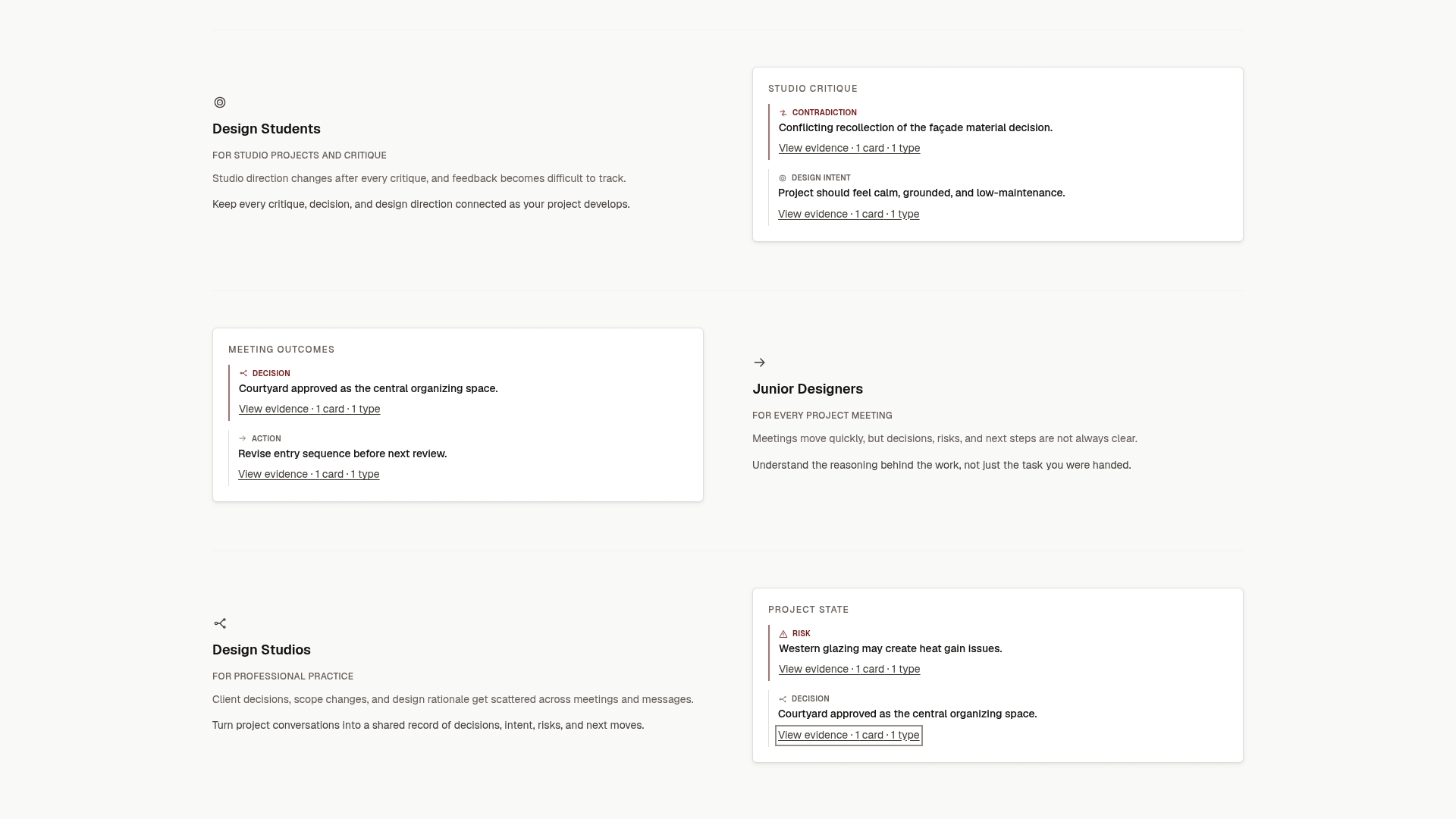
The hard part of site notes is not the template. It is turning an hour of talk, a stack of photos and a few emails into a record that separates decisions from chatter and keeps the source. The Intent Ledger turns project conversations, meeting notes, audio recordings, transcripts, critique feedback and client comments into ILM Records: structured, source-backed records of decisions, design intent, risks, actions, commitments and unresolved questions, each traceable to the conversation it came from.
Pricing is published on the pricing page. One-time ILM Record packs run from Working Set at $12 to Studio Ledger at $119, and monthly plans are Working Memory at $29 per month, Living Record at $79 per month and Shared Ledger at $149 per month.
You can also see how the platform fits architectural design documentation and client meeting notes on our blog.
Our perspective
Site notes usually record what happened. Teams need to know why. When a contractor asks six months later why a detail changed, “the architect approved it” is not an answer. The conversation is.
We built The Intent Ledger around that gap. Every ILM Record connects a decision, a risk or a commitment to the conversation it came from, so a junior designer can see where a task started and a studio owner can see how thinking evolved.
Generic meeting notes capture words. A project memory keeps the reasoning, the alternatives and the open questions, and keeps them findable. That is the record we want every design team to have.
Rajas
FAQ
What should be in architect site visit notes?
Record the date, time, purpose, people present, areas visited, observations, deviations from the documents, decisions with reasons, and numbered actions with owners and deadlines. Add project name and number, photos, and your signature.
Is a site visit the same as an inspection?
No. The purpose is generally to assess whether observed work is proceeding in line with the contract documents, not to perform an exhaustive inspection, as ASCE explains. Write notes that describe what you observed and your role’s scope.
How soon should I write up the visit?
As soon as possible. RAIC recommends prompt written summaries of conversations, and the AIA Trust suggests issuing meeting reports within 24 hours. Fresh notes are more accurate and more credible.
How do I keep track of open items across visits?
Number each item, record status, owner and deadline, and carry every open item into the next report until it is closed.
Sources
- ASCE: Why is it crucial to document decisions and field visits?
- RAIC: Chapter 5.3
- RAIC: Appendix A, Record Keeping
- ACEC Massachusetts: Risk Tip 5, Project Documentation
- AIA: G711-2018 Architect’s Field Report FAQs
- AIA: G711-2018 instructions
- AIA Trust: Claims Defense Documentation
- REC&I Resources: Write field notes that someone else can follow
- Deltek: How to Write a Field Report