Press & media
Everything you need to write about The Intent Ledger.
Official descriptions, product facts, terminology, screenshots and contact details, in one place.
Press enquiriesLast reviewed: October 2026
At a glance
The Intent Ledger at a glance
Product
The Intent Ledger
Category
Decision intelligence for design teams
Status
Early access
Audience
Design students, junior designers and design studios
Based
South Australia, Australia
Founder
Rajas Patwardhan
Website
Contact
Descriptions
Official descriptions
Use these as written. They are kept short and factual.
One-line description
22 words
The Intent Ledger is decision intelligence for design teams, turning project conversations into a living, source-backed record of decisions, intent and risks.
Short boilerplate
69 words
The Intent Ledger is decision intelligence for design teams. It turns project conversations into ILM Records: structured records of decisions, design intent, risks and actions. Every finding traces back to the source evidence it came from, and records accumulate into Project Memory, a living, dated record of why a project is the way it is. The Intent Ledger is currently in early access and operated from South Australia, Australia.
Full boilerplate
145 words
The Intent Ledger is decision intelligence for design teams. Design decisions are made in conversations — critiques, client calls, consultant check-ins — and the reasoning behind them is easily scattered across meetings, notes and project handoffs. The Intent Ledger turns recordings, transcripts and meeting notes into ILM Records: structured, source-backed records of decisions, design intent, risks, actions, commitments and unresolved questions. Every finding can be traced to the exact quote it came from, and open questions stay open rather than being tidied away. ILM stands for Intent-Led Memory, the model behind the product. As records accumulate across a project's conversations, they form Project Memory: a living, dated project record teams can return to. The Intent Ledger is built for design students, junior designers and design studios. It is currently in early access. Founded by Rajas Patwardhan and operated from South Australia, Australia, it is available at theintentledger.com.
Product
What it does
- Conversation
- ILM Record
- Project Memory
The Intent Ledger reads project conversations — recordings, transcripts and meeting notes — and structures them into ILM Records: decisions and why they were made, design intent, risks, actions, commitments and open questions. Every finding links to the quote it came from, so a record can be checked rather than taken on trust.
Records accumulate across a project into Project Memory, a living, dated record of how the project's direction was formed, not a single meeting's notes.
Where meeting-note software summarises a conversation, The Intent Ledger is designed to keep what a design team decided, why, and what is still unresolved.
Terminology
Terminology
The Intent Ledger
The public product name. In running text, write it with “The”.
ILM
Intent-Led Memory: the model behind the product.
ILM Record
A structured, source-backed record produced from an analysed project conversation or source.
Project Memory
The living project record that accumulates across ILM Records.
Category
Decision intelligence for design teams.
Tagline
Never lose the why behind the work.
Background
Background
Rajas Patwardhan is the founder of The Intent Ledger. His background in architecture and design shaped the product around a recurring problem in collaborative design work: decisions happen in conversations, while the reasoning behind them is easily scattered across meetings, notes and project handoffs.
The Intent Ledger is an independent software product operated from South Australia, Australia, and entered early access in 2026.
Screenshots
Product screenshots
Four views of the product, shown with a sample project. The project, its people and its conversations are fictional.
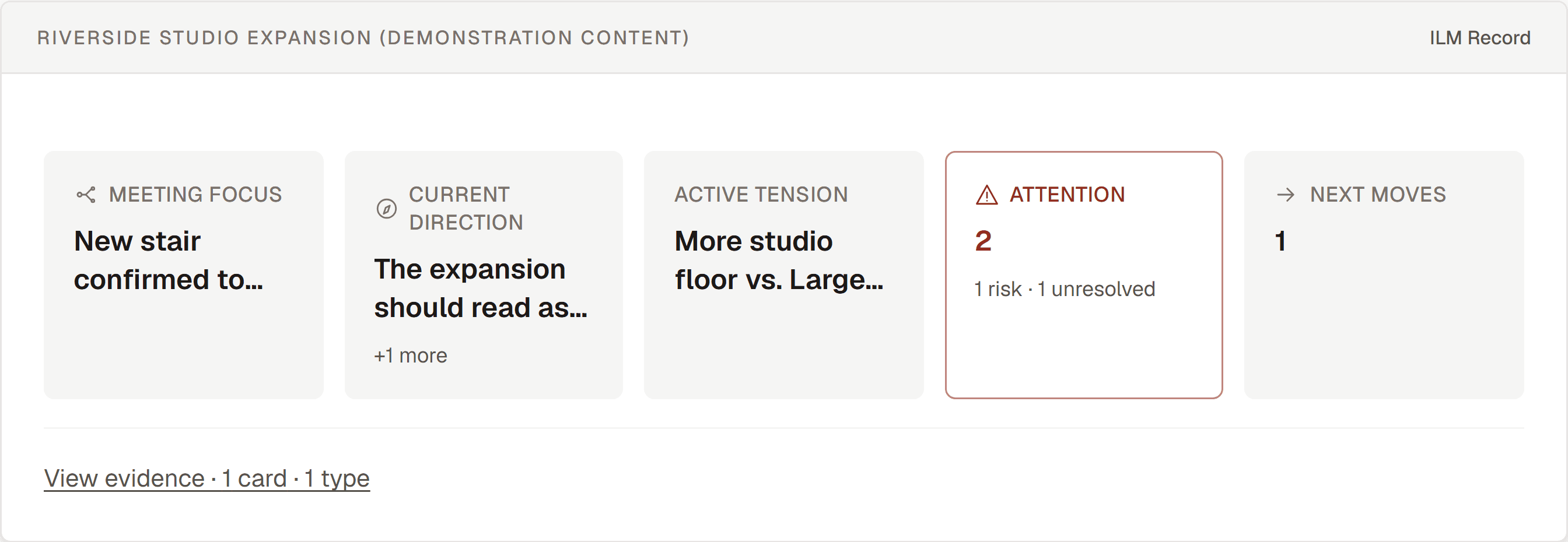
Executive summary
Download PNG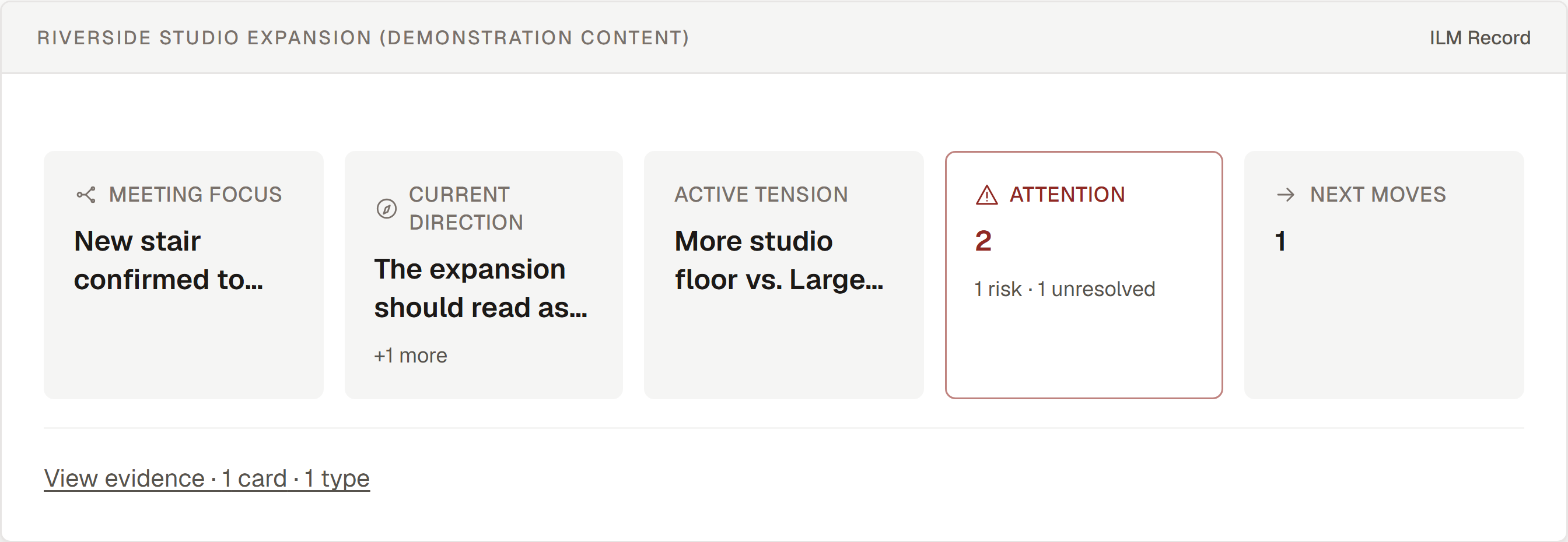
A session's summary at a glance: the meeting focus, current direction, active tension, items needing attention and next moves.
Illustrative sample project — fictional demonstration data.
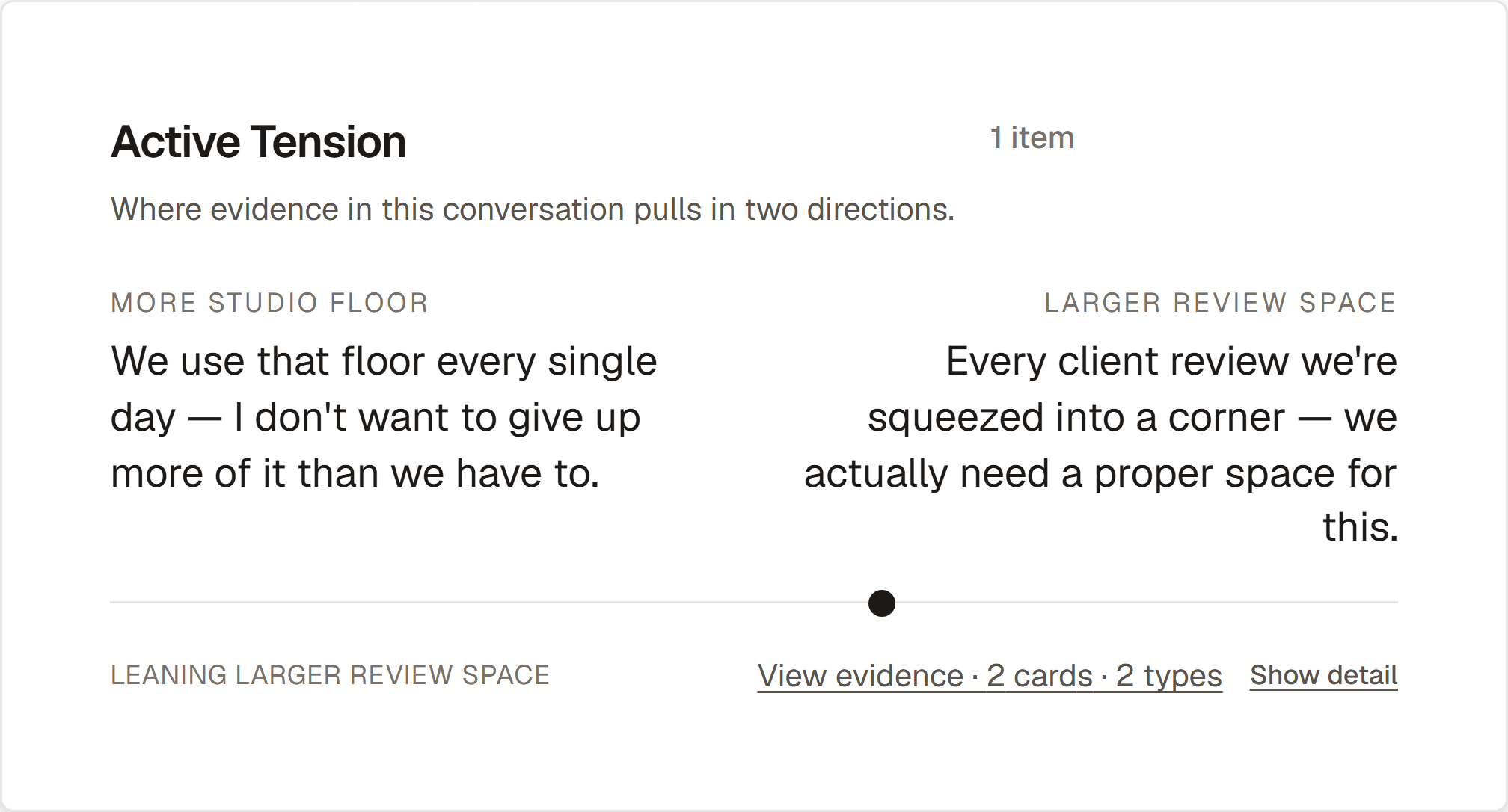
Active tensions
Download PNG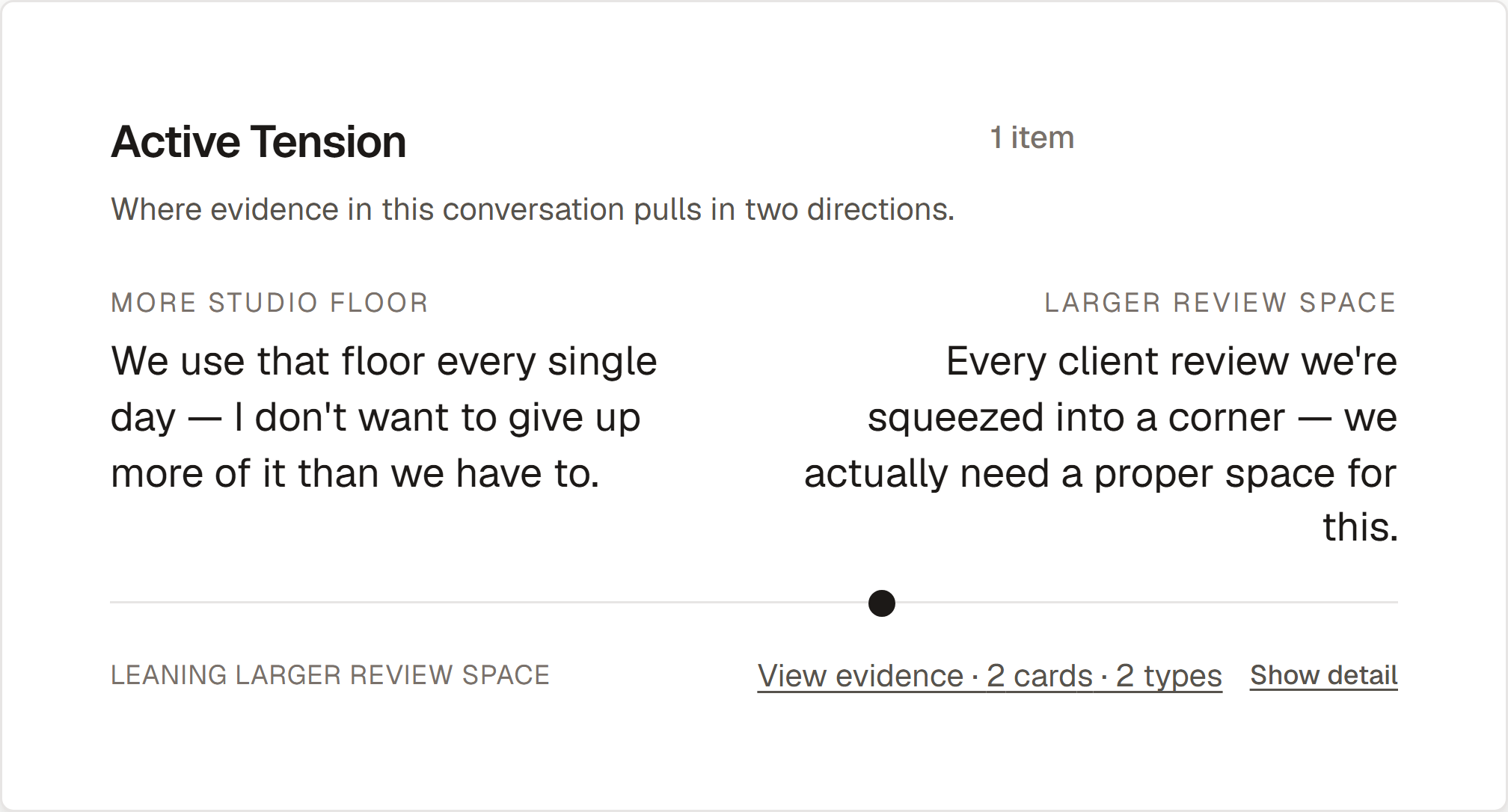
Where evidence in a conversation pulls in two directions, shown with the source quote on each side.
Illustrative sample project — fictional demonstration data.
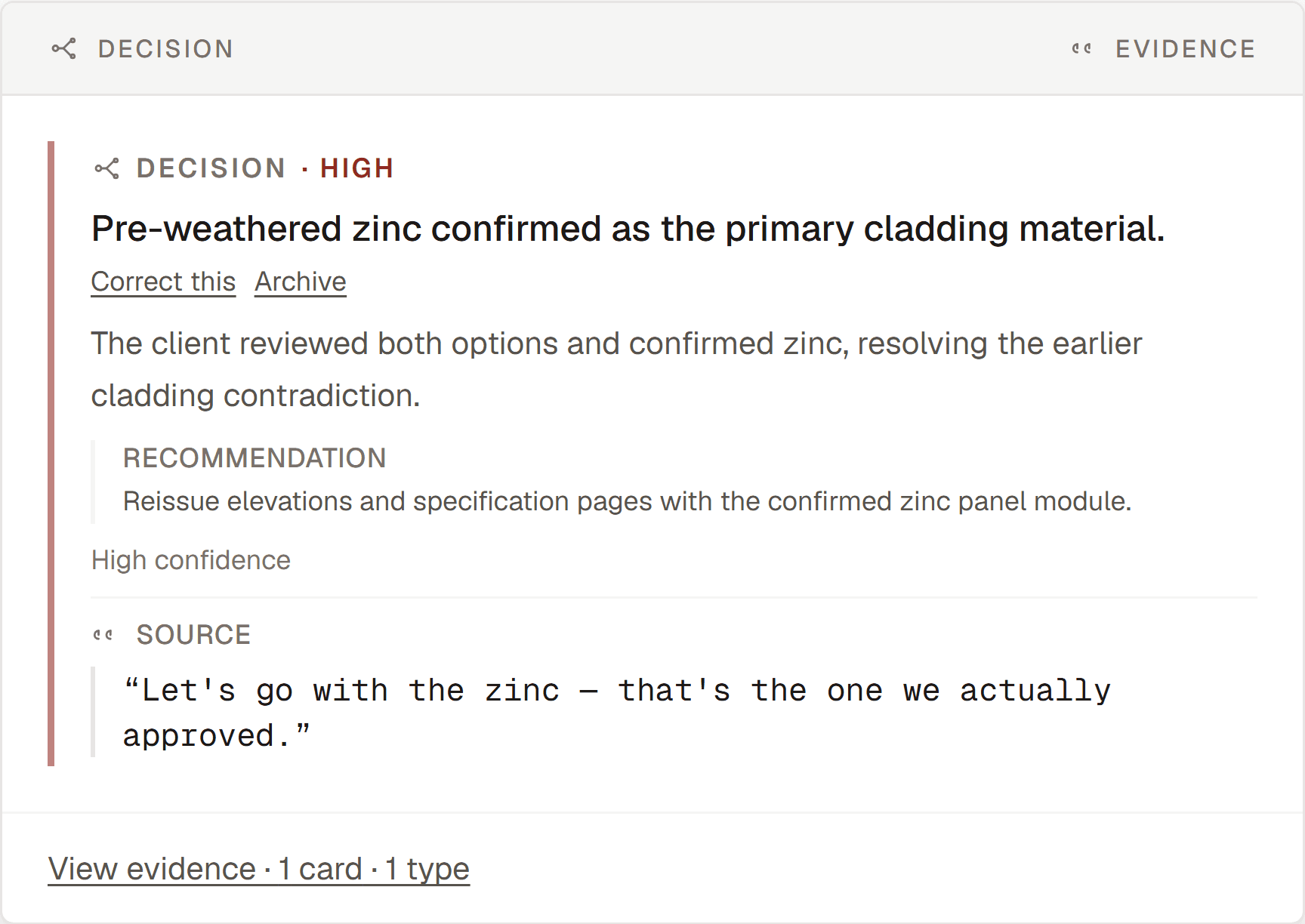
Source evidence
Download PNG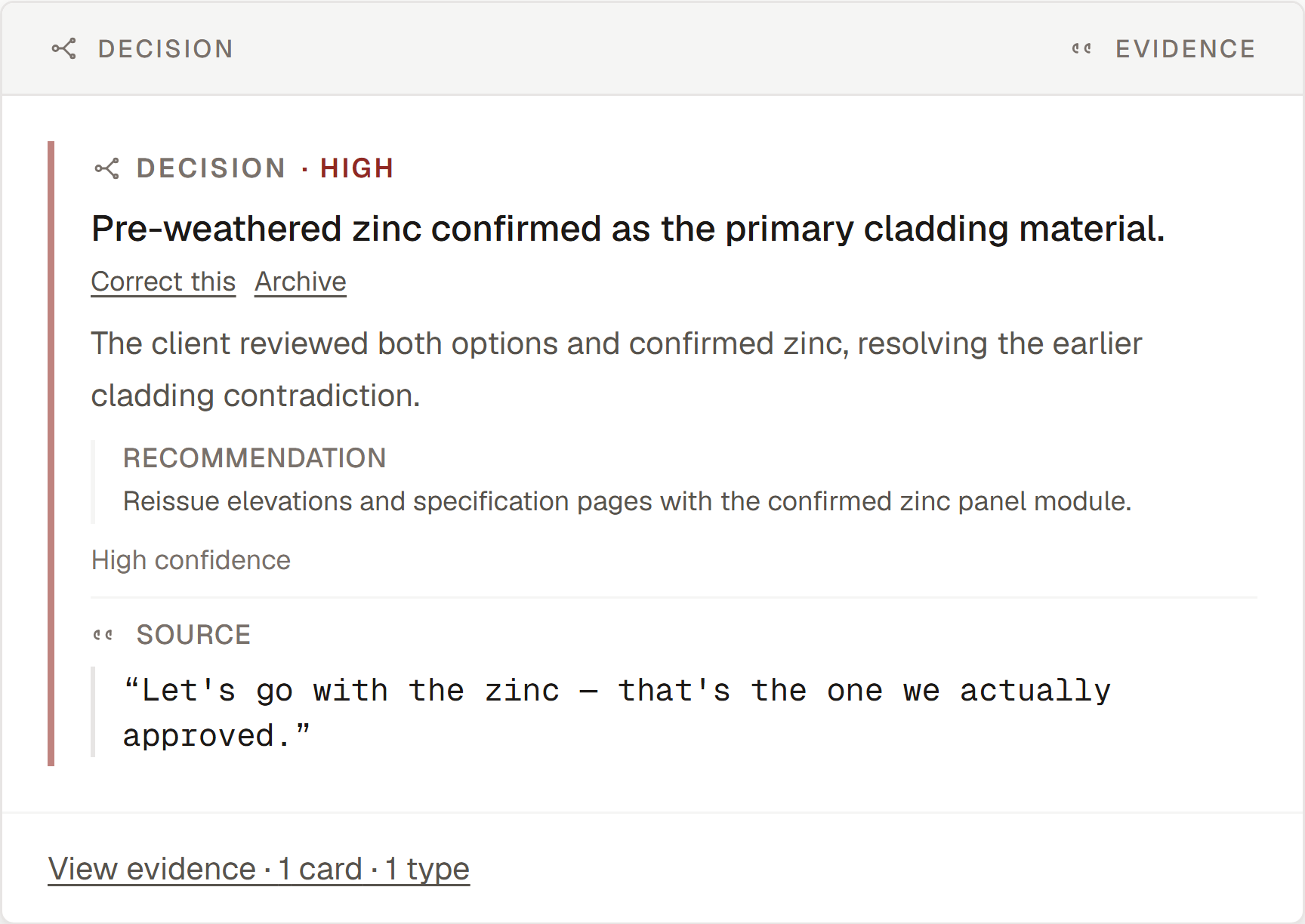
A decision record linked to the exact quote from the conversation it came from.
Illustrative sample project — fictional demonstration data.
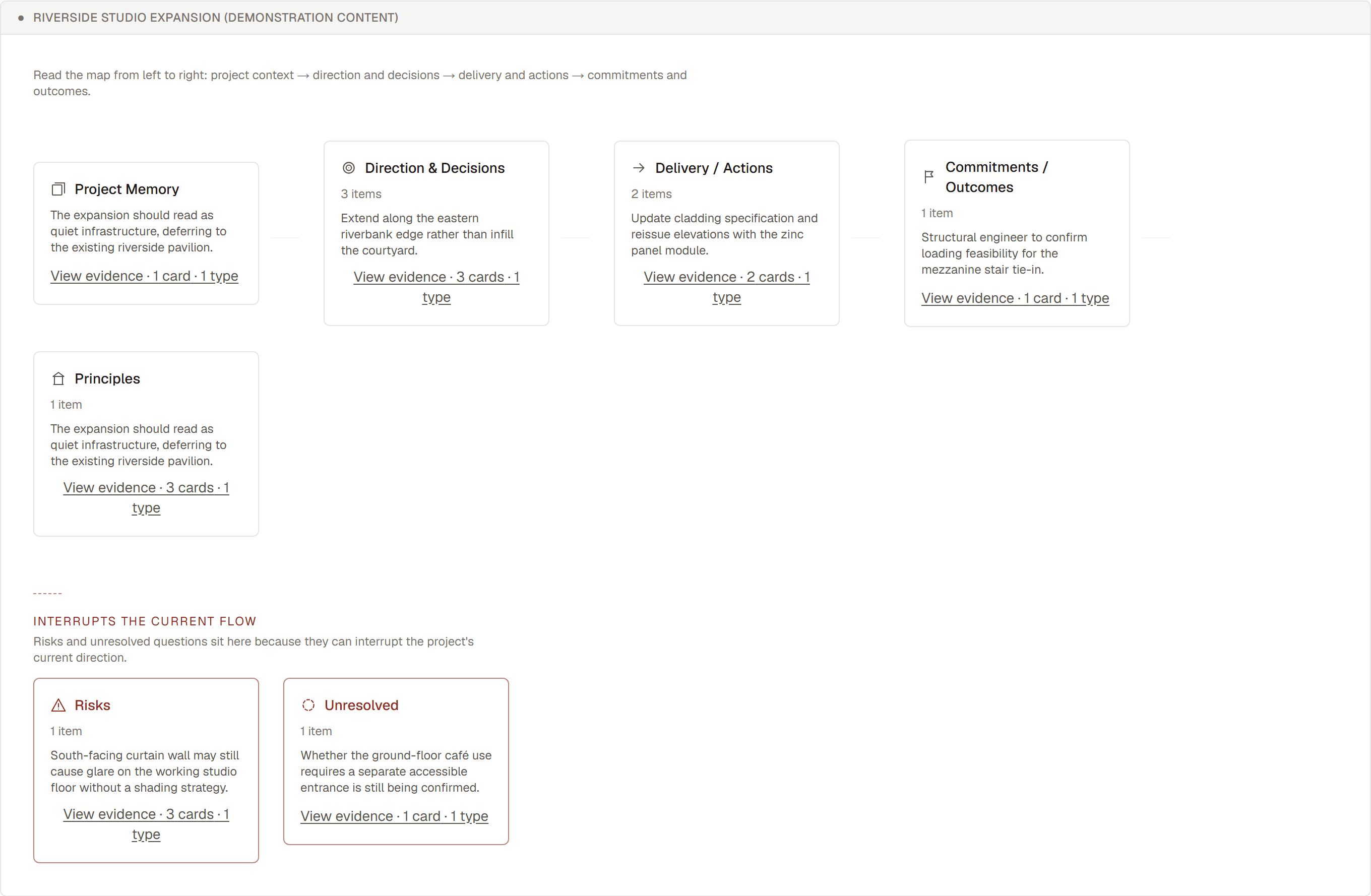
Project Memory
Download PNG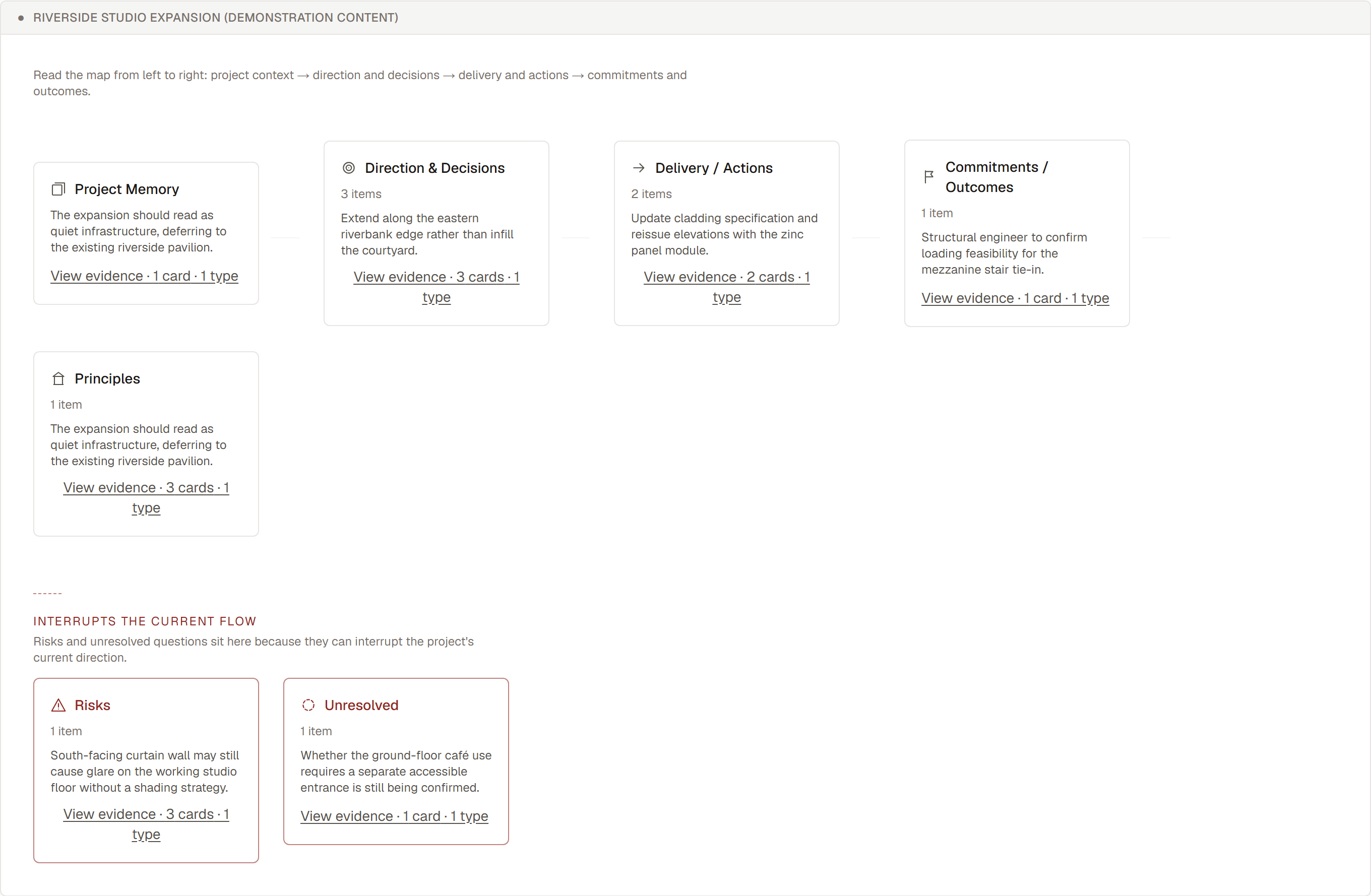
The project's memory map: direction and decisions, delivery and actions, commitments, principles, risks and unresolved questions across analysed sessions.
Illustrative sample project — fictional demonstration data.
Brand
Brand basics
The Intent Ledger is written as one wordmark in capitals, set in Geist Mono, medium weight and widely spaced, beside a small circular mark. Use both exactly as shown.
Wordmark and mark
ILM red #902923
Primary interface and editorial accent.
Ink #1C1917
Text and wordmark on light grounds.
Ground #FAFAF9
Page ground, and wordmark on dark grounds.
Mark red #DC2124
The red dot in the logo mark only. It is part of the mark, not an interface colour.
Geist for text; Geist Mono for labels and the wordmark.
- In running text, write “The Intent Ledger”, including “The”.
- Use the wordmark at 120px wide or larger on screen.
- Don’t recolour, stretch, outline or add effects to the mark or wordmark, and don’t set the name in another typeface.

Contact
Press contact
For press, media or interview enquiries, email support@theintentledger.com with “Press” in the subject.
Links
Useful links
- Homepage →What The Intent Ledger is and how it works.
- Trust →How project data, recordings and access are handled.
- Pricing →Current plans.
- Blog →Project memory and decision intelligence for design teams.
- Privacy →How information is collected, used and retained.
- Terms →The terms of use.
- Support →Help with an account or a technical issue.