Link Client Approvals to Contracts for Faster Architecture Signoffs
Link Client Approvals to Contracts for Faster Architecture Signoffs
A client approval is the formal confirmation that a design, submittal, or deliverable meets agreed standards and can move forward, and it closes a phase, triggers billing, and limits scope creep. The single most effective change a studio can make is switching to a structured binary approval workflow, approve or revise, with one named final approver, instead of open-ended feedback loops. Guidance from the RIBA and the AIA supports this shift. Project memory tools like The Intent Ledger help studios document why each decision was made.
TL;DR:
- Switching to a binary approval process with a designated final approver greatly reduces delays and disputes, especially when roles and response deadlines are clearly defined in advance.
- Incomplete paperwork, unclear authority, and scattered feedback are the top causes of stalled decisions, which can be mitigated with checklists, a single review portal, and explicit scope boundaries.
- Centralized software with full version histories and timestamped, linked comments enhances audit trails, making it easier to track approvals and avoid conflicts.
- Setting firm scope, revision limits, and response times upfront, along with recording all approvals with explicit rationale, streamlines project phases and limits scope creep.
- Formal approval points should trigger contractually defined billing and project milestones, with decision records linked to conversations and version numbers to support accountability and dispute resolution.
Table of Contents
- Building an approval workflow that fits every project phase
- Why approvals stall and how to unstick them
- Software and review habits that cut approval time
- A studio checklist for faster, lower-risk approvals
- How approvals connect to contracts, billing, and completion
- Turning approvals into a traceable project record
- What studios get wrong about enforcing approvals
- Keeping approval rationale intact with The Intent Ledger
- Sources
- FAQ
Building an approval workflow that fits every project phase
Every phase needs a defined “done” state before a client sign-off means anything. Concept design closes with an approved direction, design development closes with approved systems and materials, construction documents close with an approved permit set, and practical completion closes with a punch list and final acceptance.
Getting this right means being explicit about roles and mechanics at each gate.
- Assign one preparer and one approver per deliverable, and name the final approver in writing before work starts.
- Distinguish architect-led design approvals from contractor-led submittal reviews, since contractors prepare submittals and architects review them for conformance, not perfection, according to AIA submittal process guidance.
- Require binary decisions (approved, approved as noted, or revise and resubmit) instead of vague comments, and never treat silence or attendance at a meeting as approval.
- Version every submission so feedback attaches to a specific iteration, not a moving target.
- Set a firm response deadline and cap revision rounds in the contract, typically a limited number, before additional rounds trigger extra fees.
This structure turns approvals from a negotiation into a checklist, which is exactly what reduces disputes later.
Why approvals stall and how to unstick them
Most delays trace back to a handful of repeatable problems. Research on decision delays in construction projects found that unclear technical competence, incomplete paperwork, weak leadership, and poor coordination are common causes of stalled client decisions on large-scale projects.
A study using relative importance index analysis identified incomplete paperwork and coordination failures as critical drivers of decision delay on mega projects, according to research published in Sustainability. That finding lines up with what most studios experience day to day.
- Too many stakeholders with unclear authority: fix it with a written reviewer matrix naming who approves what.
- Incomplete drawings or missing technical information: fix it with submittal checklists and a published schedule.
- Feedback scattered across email, texts, and meetings: fix it with a single portal and threaded, timestamped comments.
- Subjective pushback on finishes or layout: fix it with clearer renders and a scope boundary that limits what is still open for debate.
Each fix targets a specific failure point rather than treating delay as a personality problem.
Software and review habits that cut approval time
The mechanics of a review matter as much as the workflow around it. A centralized portal that keeps every version, comment, and decision in one place removes the guesswork that comes from hunting through email threads. Practitioner guidance on audit trails recommends structured reviewer matrices and version-linked records specifically to avoid disputes over who approved what and when, a point backed by practitioner analysis published in Connect.
- A centralized approval portal with full version history and an audit trail of every decision.
- Binary approve or decline actions tied to timestamped, linked comments rather than free-form notes.
- Visual review aids such as 3D walkthroughs, annotated renders, and material toggles that reduce misreadings of 2D drawings.
- Direct links between an approval event and the project schedule or billing milestone it unlocks.
Pro Tip: Attach every approval request to a specific version number and a deadline, never to a general “let us know what you think.”
These habits do not require a specific platform. They require discipline about where feedback lives and how decisions get recorded.
A studio checklist for faster, lower-risk approvals
A short, repeatable checklist catches most of the mistakes that lead to disputes later.
- Define scope and cap revision rounds directly in the contract before design work begins.
- Name one final approver per project and specify a response window, such as five business days.
- Publish a submittal schedule and a reviewer matrix so everyone knows what is due and who signs off.
- Record every approval with a timestamp, the version it applies to, and a note on the rationale.
| Checklist item | What it prevents | Where it lives |
|---|---|---|
| Scope and revision limits | Endless redesign cycles | Contract |
| Named final approver | Approval by committee | Contract and reviewer matrix |
| Submittal schedule | Missed deadlines and rework | Project schedule |
| Timestamped approval record | Disputes over what was agreed | Decision log |
Studios that run this checklist on every phase spend less time reconstructing what happened and more time designing.
How approvals connect to contracts, billing, and completion
An approval is not just a design milestone, it is a contractual trigger. AIA guidance on owner-architect contracts describes formal approval as the point that closes a phase, releases the next billing installment, and limits later scope claims, and recommends coordinating professional services agreements with construction contracts so the two do not conflict, a point detailed in AIA contract guidance.
- Write approval language into the contract so sign-off explicitly triggers the next invoice.
- Coordinate the owner-architect agreement with the construction contract to avoid contradictory approval terms.
- Resist pressure to sign off on practical completion before punch list items are actually resolved.
- Use contract negotiation, not the final walkthrough, to set realistic time expectations and remedies for late client decisions.
Getting this alignment right at the contract stage removes most of the ambiguity that causes payment disputes at the end of a project.
Turning approvals into a traceable project record
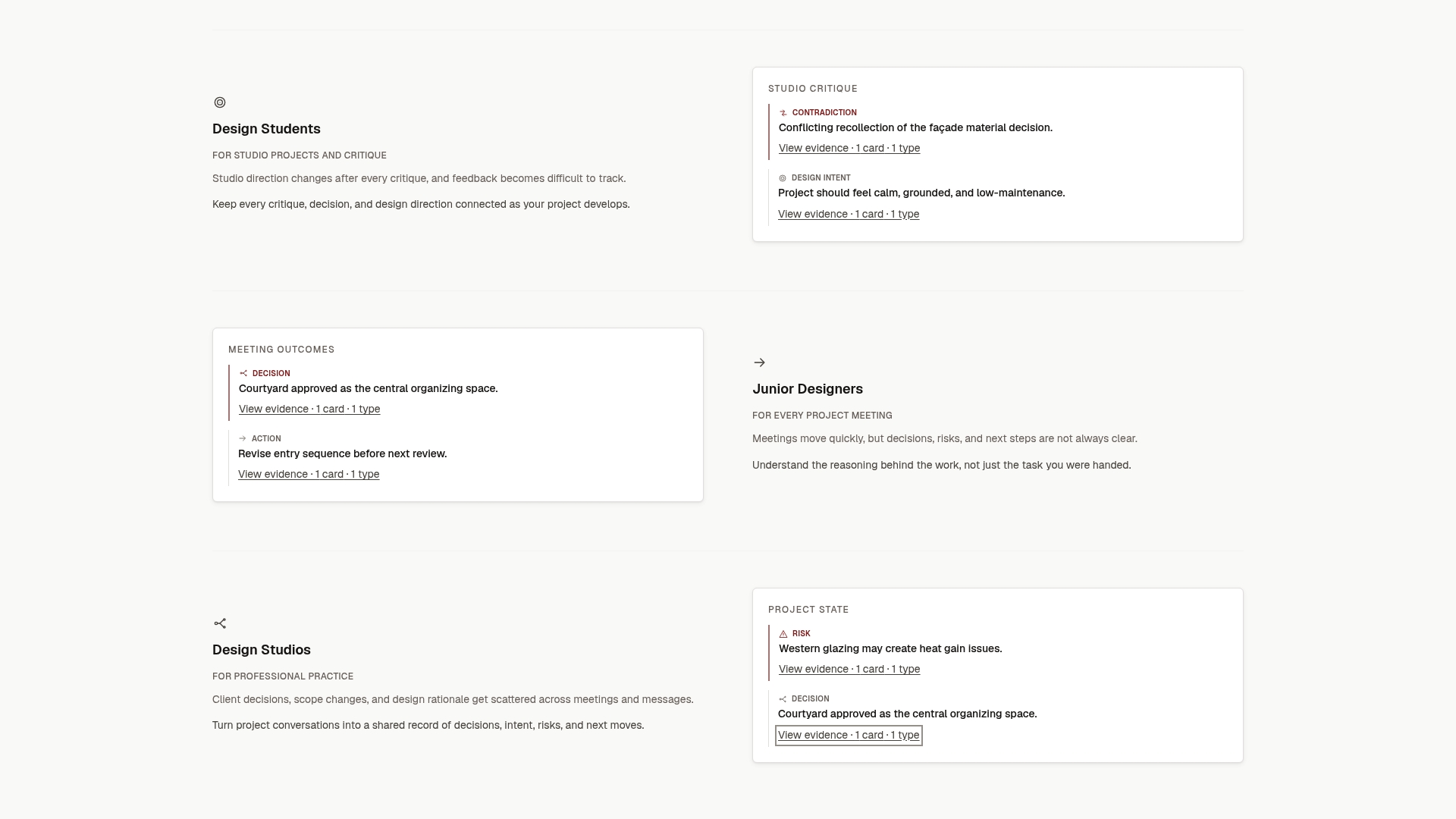
An approval only protects a studio if the reasoning behind it survives past the meeting where it happened. A usable decision record needs a handful of consistent fields.
- Decision maker, date, and the specific scope affected by the approval.
- The option chosen, the alternatives that were rejected, and the reasoning behind the choice.
- A link back to the source conversation, whether a transcript, email, or meeting note.
- Any action items and the person responsible for each one.
Traceable records like this cut down on repeated questions weeks later, since anyone on the team can trace a decision back to its origin instead of relying on memory. Lightweight automation that turns meeting transcripts directly into structured records, an approach described in The Intent Ledger’s guide to automating meeting notes, removes most of the manual effort involved in keeping this discipline going.
What studios get wrong about enforcing approvals
Most approval disputes trace back to conversations that should have happened at kickoff and didn’t. Studios that define a standard of completion, name a single approver, and put revision limits in writing before design starts spend far less time arguing later.
The recurring mistakes are predictable: vague scope language, approval by an unnamed group instead of one person, and feedback scattered across email, texts, and hallway conversations with no record. None of these require sophisticated fixes, just earlier and more explicit conversations. Clients respect clarity more than flexibility. A studio that sets firm terms early, then stays warm and responsive within them, keeps the relationship intact without giving up contractual protection.
— Rajas
Keeping approval rationale intact with The Intent Ledger
Most approval disputes come down to one problem: nobody can point to why a decision was made or which conversation it came from. Some project memory tools turn meeting notes, transcripts, and client comments into structured records that trace every approval back to its source conversation, so a studio never has to reconstruct reasoning from memory months later.
- Automatic capture of decisions, rejected alternatives, and rationale from meeting notes and transcripts.
- A built-in audit trail linking each approval to the conversation and version it came from.
- Structured records that hold up when a client questions a decision at practical completion.
Studios and freelance architects who want to pilot structured decision records can review plans on the pricing page for current details.
Sources
- Delay in Decision-Making Affecting Construction Projects: A Sustainable Decision-Making Model for Mega Projects (2023)
- AIA resource: Value of a comprehensive owner-architect contract
- According to Hoyle: The Submittal Process (AIA Community Hub, 2025)
- Connect journal practitioner article (2022) on audit trails and reviewer authority
FAQ
What does the 80/20 rule mean in architecture client approvals?
There is no established standard specific to client approvals, so definitions vary by studio. Some teams observe that most delays come from a small set of recurring causes, like unclear authority or incomplete paperwork, which aligns with the root causes documented in construction decision-delay research.
What are the different types of approvals in an architecture project?
Approvals generally fall into design approvals, where the client signs off on concepts, materials, or layouts, and submittal approvals, where the architect reviews contractor-prepared documents for conformance. The AIA submittal process guidance outlines explicit review actions like approved, approved as noted, or revise and resubmit for the latter.
What are the three C’s of architecture?
Definitions vary depending on the source and context, and no single authoritative version applies universally across the profession. In the context of client approvals, the practical equivalent that matters most is clarity of scope, a clear chain of communication, and a clearly named decision maker.
How do architects find clients for new projects?
Architects typically find clients through referrals, portfolio visibility, and relationships built during past projects, though this varies widely by market and firm size. Appointing a dedicated client adviser early, as described in RIBA client adviser guidance, can also improve how well early client needs are understood before a formal brief exists.