What Is an Architecture Knowledge Base for Studios?
What Is an Architecture Knowledge Base for Studios?

An architecture knowledge base is the living record of every decision your project makes: what was chosen, why, who chose it, and what it links back to. It is project memory, not a filing cabinet. The immediate payoff is traceability. When a contractor questions a detail eight months after the fact, or a new hire joins mid-schematic-design, the answer already exists instead of getting reconstructed from someone’s memory of a hallway conversation.
The single best move you can make this week: create your first decision record tied to your most recent client or coordination meeting. Not a summary. A record.
- Title/issue: what was being decided
- Decision: what was chosen
- Source: link to the transcript, meeting notes, or redline that produced it
Do that once, and the habit starts building itself.
Key Takeaways
A reliable architecture knowledge base works because it links every decision to its source conversation, captures rejected alternatives alongside accepted ones, and assigns clear ownership for updates.
| Point | Details |
|---|---|
| Start with one record | Create a decision record for your most recent meeting, linked directly to its transcript or notes. |
| Capture the rationale, not just the outcome | Record why an option won, not only which option won, using the decision, relationship, chronology, and stakeholder-involvement viewpoints. |
| Preserve rejected alternatives | Link every discarded option to the decision that replaced it so the reasoning survives past closeout. |
| Update before transmittal | Set a rule that no transmittal ships until its underlying decision record is current. |
| Use connected, link-first tooling | Theintentledger turns meeting transcripts and client comments into ILM Records linked to their original source, matching this playbook’s template directly. |
Table of Contents
- Building a Decision-Record Template That Actually Gets Used
- How to Make the Knowledge Base a Habit, Not a Chore
- What Should You Connect to the Knowledge Base?
- Where Most Firms Actually Lose the Thread
- How The Intent Ledger Puts This Playbook Into Practice
- Sources
Building a Decision-Record Template That Actually Gets Used
Most firms already write things down. The problem is that what gets written down is the decision, never the reasoning that got them there. Six months later nobody can explain why the curtain wall detail changed, only that it did. A documentation framework built on decision viewpoints fixes this by defining exactly what to capture and who will need it later, based on ISO/IEC/IEEE 42010 conventions for documenting architectural decisions.
A working decision record needs these fields, no more:
- Title/issue, the question being resolved, stated as a question
- Decision, the answer, in one sentence
- Options considered, the alternatives that were on the table
- Rationale, why this option won over the others
- Consequences/risks, what this decision commits you to downstream
- Linked sources, the meeting transcript, redline, or BIM element that generated it
- Owner, who is accountable for this decision holding
- Status/changelog, active, superseded, or under review, with dates
That eighth field, sources, is where most templates fail. A record that says “switched to a rainscreen system for thermal performance” without a link back to the engineer’s memo or the client call is a claim, not a record. Design-decision documentation tied to BIM elements through explanation tags shows how linking rationale directly to model geometry lets anyone query later why a wall assembly looks the way it does, rather than just what it looks like.
The four viewpoints worth building into every template are Decision Detail (what exactly was decided), Relationship (what other decisions this one depends on or conflicts with), Chronology (when it happened relative to other project milestones), and Stakeholder Involvement (who was in the room and who has authority to reverse it). Each viewpoint answers a different retrieval question, and together they keep a record from becoming an encyclopedia entry nobody rereads.
Rejected alternatives deserve their own line, not a footnote. A decision/memory model for non-selected design options found that rejected alternatives are the piece of project memory studios lose first, since CDEs and BIM platforms are built to preserve the winning model, not the paths not taken. Link every rejected option to the accepted decision that replaced it, with one line on why it lost.
Pro Tip: Write the rationale field before the decision field. If you can’t articulate why in a sentence, the decision probably needs another meeting, not a record.
How to Make the Knowledge Base a Habit, Not a Chore
A template is worthless if nobody updates it. The fix is assigning ownership and setting a rule simple enough that people actually follow it: no transmittal goes out until the decision record behind it is updated. That single rule catches more gaps than any policy document.
Studios that treat project memory as institutional infrastructure, not just project paperwork, tend to survive staff turnover better. Research on corporate memory in project-based engineering firms found that firms need to deliberately separate volatile project memory from perennial institutional memory, or the volatile kind evaporates the moment the project team disbands.
Practical habits that make this durable:
- Assign one record owner per major decision category such as structure or client approvals, instead of a single owner for the entire project.
- Capture the source at the moment of conversation. A transcript link added the same day is accurate; one added three weeks later is a guess dressed up as a record.
- Run a phase-handoff checklist at every milestone: SD to DD, DD to CD, CD to construction administration. Each handoff should force a review of open, unresolved, and superseded decisions before the next phase starts.
- Update record drawings progressively as redlines get approved, instead of batching the work at closeout.
That last point matters more than it sounds; see this beginner’s guide on how to read architectural drawings for insights on linking decision records to drawing elements. Guidance on the architectural documentation lifecycle describes progressive record drawings as the difference between a closeout process that takes days and one that takes months of archaeology through old email threads. Teams that update the model or the record register as approvals land almost never face the panicked reconstruction phase at project handover.
Schedule a short weekly or biweekly integration session where redlines, transcripts, and open decisions get reconciled against the register. Fifteen minutes here saves hours of “wait, why did we do it this way” later.
Pro Tip: Make the decision record the thing you update before you close a meeting, not after you review your notes the next day. Memory degrades fast, even for the person who made the call.
What Should You Connect to the Knowledge Base?
You don’t need more software. You need your existing tools to point at each other. A connected project memory beats a pile of disconnected apps every time, because fragmented information across email, drives, chat, and your CDE creates the illusion of organization without the substance of it.
Five categories worth connecting:
- Your CDE or BIM model, where the geometry and final decisions live
- The versioned drawing register, tracking what changed and when
- Meeting recordings and transcripts, the raw source of most decisions
- Chat threads and action-item trackers, where day-to-day commitments surface
- Redline and as-built logs, capturing what changed in the field versus on paper
The integration pattern that scales is link-first, not copy-first: store a pointer to the canonical source rather than duplicating its content into your knowledge base. Duplicated content drifts out of sync the moment the original updates. A record that links to the live transcript stays accurate; one that pastes a summary of it becomes stale the next revision.
Build toward an exportable handover package too. When a project transitions teams or closes out, that package, decisions, sources, and status, should travel as a unit, not get rebuilt from scratch by whoever inherits the file.
Where Most Firms Actually Lose the Thread
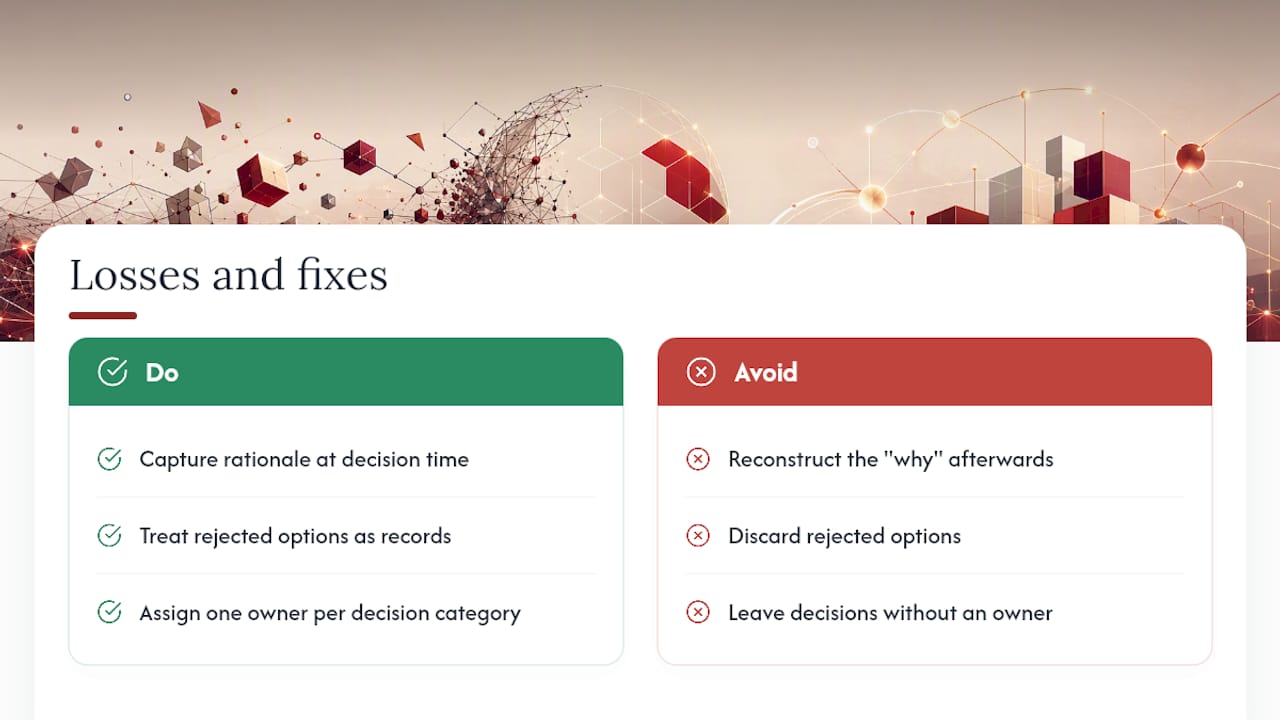
The failure pattern is consistent: firms try to reconstruct the “why” after the fact, usually during a dispute or a closeout deadline, and discover nobody wrote it down when it happened. By then the email is deleted, the meeting is a vague memory, and the rejected alternative that would explain the current design has vanished entirely. That invisible loss re-litigates settled decisions and stalls coordination exactly when speed matters most.
Three fixes outperform everything else: capture rationale at the moment of decision, not after; treat rejected options as first-class records, not discarded drafts; and make one person accountable per decision category so gaps have an owner.
, Rajas
How The Intent Ledger Puts This Playbook Into Practice
Everything above describes a discipline. Building it by hand, one template, one spreadsheet, one shared drive folder at a time, works until the studio grows past three active projects and the habit quietly dies under deadline pressure.
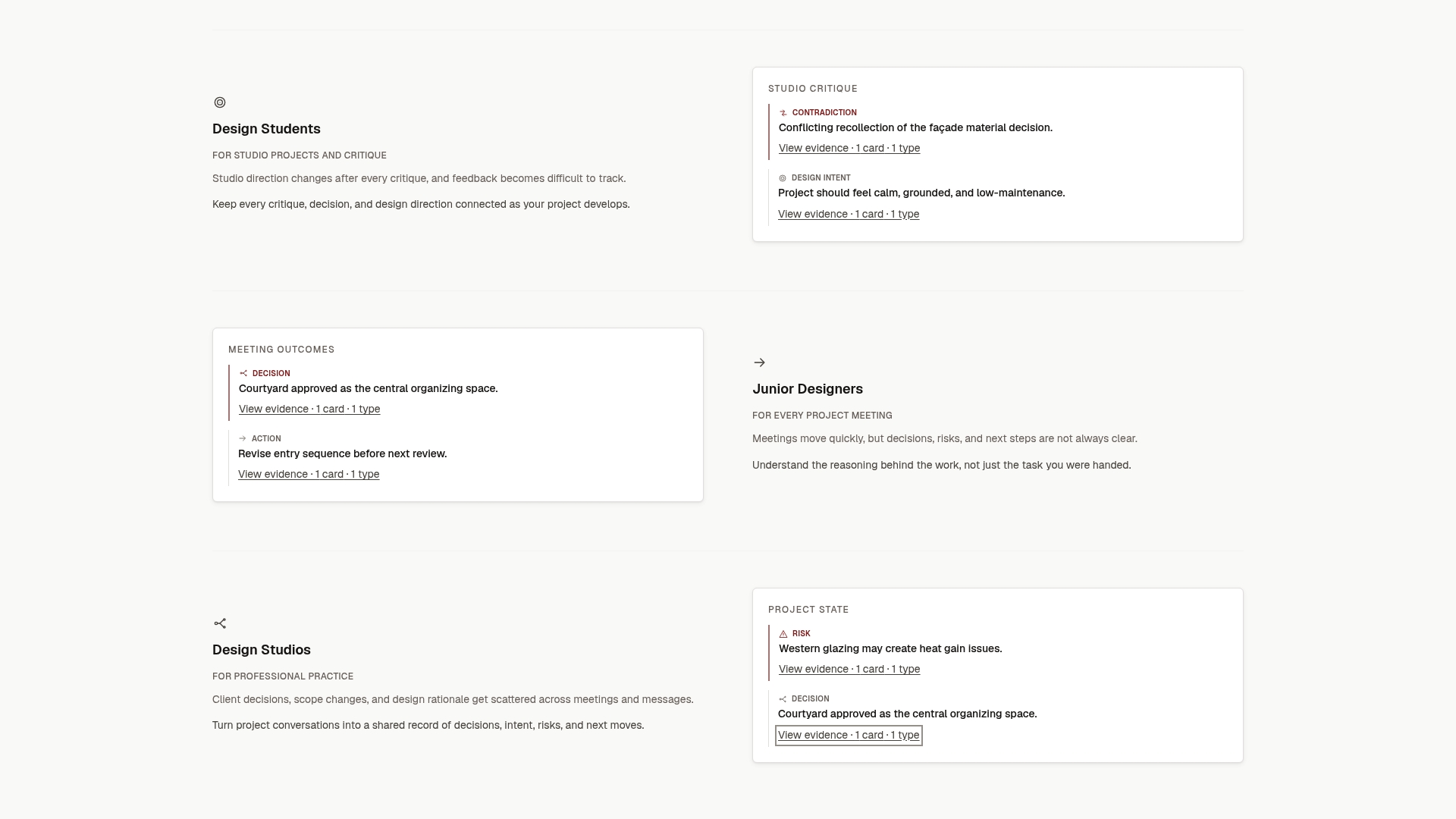
Theintentledger is built around exactly the record structure this article describes. ILM Records capture the title, decision, options considered, rationale, sources, and status fields directly from your meeting audio, transcripts, and client comments, so the record exists the moment the conversation happens instead of getting reconstructed from memory later. Every ILM Record links back to its original transcript, the way the decision-viewpoint framework recommends, which means a junior designer or a new PM can trace any design choice to the exact conversation that produced it. For studios juggling progressive record drawings, phase handoffs, and cross-project retrieval, that link-first structure is the part that usually breaks when teams try to build it manually.
If you’re ready to stop reconstructing decisions after the fact, start with The Intent Ledger and turn your next project meeting into a decision record instead of a memory you’ll need to recover in six months.
Sources
- Corporate memory dynamics in project-based organizations (PBOs): multiple case study in Brazilian engineering design firms and a framework proposal
- A documentation framework for architecture decisions (Decision viewpoints paper)
- Making Rejected and Non-Selected Architectural Design Decisions Traceable: A Decision/Memory Model