How to Archive Project Notes So the Why Survives
How to Archive Project Notes So the Why Survives
To archive project notes well, keep the reasoning, not just the pages. A folder of meeting notes tells you what was said on a Tuesday. A useful archive tells you what was decided, why, who agreed, what it was decided against and what is still open. That is the job of an ILM Record in The Intent Ledger: a structured, source-backed record of a decision, design intent, risk, action or unresolved question, traceable to the conversation it came from. The rest of this article shows the routine, whichever tools you use.
TL;DR
- Archive records of decisions and their reasons, not every scrap of text. Cull what has no continuing value.
- Give every note a project-specific title, a date, an author, the version it refers to and a link to its source.
- Freeze each review round, keep the original wording of every comment, and mark conflicts instead of picking a side.
- Never edit an accepted decision. Add a new one that supersedes it.
- Do the selecting and discarding while the project runs, not after it closes.
Table of Contents
- What archiving project notes actually means
- What each archived note should preserve
- A routine for archiving project notes
- Archiving critique and client feedback
- Who needs what
- Keeping the archive trustworthy
- Start your archive with ILM Records
- FAQ
- Sources
What archiving project notes actually means
Archiving is not storing. Engineers and Geoscientists BC defines a record as anything containing information that must be kept as evidence of a decision or action, whatever the medium. Its guide says that at the end of a project you should be clear what is and is not a record, cull files with no continuing value, group, label and log what remains, and confirm the records are trustworthy.
That guide is written for engineers in Canada, but the logic carries to a studio. A sketch-review chat, a client email, a recorded call and a transcript can all hold a decision. Each one is a record only if someone can later tell where it came from and what it settled.
The Italian architects’ association ANAI makes the same point from the design side. Its 2023 guidelines argue that keeping every document indiscriminately does not serve the archive, because redundant and superseded files create disorder and slow retrieval. They also name the reasons to keep documents: protection toward clients and authorities, reference for future projects and training, and shared memory of the practice.
What each archived note should preserve
The EGBC guide lists five qualities of a good record: authenticity (it shows its origin and who created or revised it), integrity (its meaning cannot change after it is accepted as final), accuracy, completeness and trustworthiness. It also recommends project-specific titles, because the project name alone often gives too little context.
For design decisions, a practical checklist follows from a decision-records guide published in October 2026. A decision record should hold:
- What was decided.
- The problem or condition that forced the decision.
- Who made or approved it, and with what authority.
- The date, and the drawing set, model or version it was made against.
- The scope: what it covers and what it does not.
- The evidence and constraints that mattered.
- Assumptions and uncertainty.
- Consequences and next actions.
- What would trigger a review.
The same guide says a record should not reproduce the whole conversation. It summarizes and points back to it. That pointer is the part most archives lack.
Keep what did not work
A working-journal guide from the software studio NelCapeTown adds a habit that suits design equally well: record unsuccessful attempts, so the next person does not rediscover the same constraint. It also says an unresolved item should say it is unresolved, and a check that could not be run should stay visible as a missing check. Keep passwords, access tokens and customer data out of notes you intend to share widely.
Which decisions earn a record
Not every remark deserves one. A practical rule from a systems-design guide says a decision earns a record if it is hard to reverse, expensive to change, would surprise a newcomer, constrains another team or was genuinely contested. For a studio, think of a structural grid change, a material swap, a client sign-off on a layout, or a code interpretation. The font size on a presentation slide can stay in the chat.
A routine for archiving project notes
Step 1: Capture while the conversation is fresh
Notes written a week later lose the reasons first. Capture the same day: meeting notes, the call transcript, the critique comments, the client’s email. This is where we built The Intent Ledger to help. You bring in conversations, notes, audio recordings or transcripts, and it turns them into ILM Records of decisions, design intent, risks, actions, commitments and unresolved questions, each traceable to its original conversation.
Step 2: Separate the why from the what
Keep the lasting reasoning apart from the current state of the design. One decision-record discipline guide traces the format to Michael Nygard’s 2011 architecture decision record and says the record is written in past tense, with its lasting value in the rationale and the problem that prompted it. The current drawings and specs live elsewhere. This keeps the archive from going stale every time the design moves.
Step 3: Label consistently
Pick one naming convention and one home. The UK government’s design team advises sharing design history with a standard naming convention and a chosen location, such as a wiki, shared folder or repository, so a future team does not start from scratch. The same guidance suggests ordering earlier work chronologically with dates and links to the artifacts, noting insights and gaps, and ending with assumptions phrased as questions for whoever comes next.
A workable title pattern: project code, topic, date, version. For example, “Harbor Street, stair core, 2026-11-12, v2.0”.
Step 4: Link every record to its source
A decision without its source is an assertion. Research on a prototype called DesignMemo, published in the ACM Digital Library in October 2025, linked design elements to the meeting transcripts that discussed them. In a 24-person user study, tracking that communication context made iterative design smoother and more efficient. The principle is the one behind ILM Records: from any decision, one click should lead back to the conversation. We cover this idea in more depth in our piece on decision provenance.
Step 5: Make accepted decisions immutable
The same systems-design guide argues that editing history destroys the one thing a record is for: knowing what the team believed at the time. So when a decision changes, write a new record, mark the old one as superseded by it, and leave the old text alone. Keep records short enough to read in a couple of minutes, and numbered or indexed so “why did we do this?” takes one lookup.
Step 6: Retire versions during the work
ANAI recommends version numbers with a “v” and two digits: v1.1 for minor changes, v2.0 for substantial revisions, and no “final” suffixes. After closure a studio may discard intermediate versions and keep only the last, but the guidelines say selection should happen during the work, not be postponed. Superseded decisions are different: keep them, marked as superseded, because they hold the reasoning.
Archiving critique and client feedback
Feedback is where context disappears fastest. A comment like “make it feel lighter” means nothing in a year unless you know which version it was about and who said it.
Two practitioner guides agree on the method. One on conflicting client feedback recommends freezing the version under review with an identifier, asking reviewers to cite the exact section, and keeping each comment’s original wording before you summarize it. Its register holds a stable ID, source location, reviewer, original comment, the objective affected, the proposed change, any conflict, an owner, a disposition and a reference to the decision. Withdrawn or superseded comments stay, with dates.
A guide to client feedback rounds adds the round structure: fix the version sent, the closing date and who may comment, then, when the round ends, archive the input log, the final brief, the approved decisions, the delivery link and the version notes together. It also notes that restoring an older file version does not remove later comments, so the log needs its own status and version notes. When two comments conflict, keep both with their sources, mark the conflict and ask the client to decide.
Teams that want to speed this up can see our client comment tracking fields and the 30-minute feedback capture routine. For the approval step that follows each round, a piece on streamlining approvals for faster decisions covers how to keep sign-offs moving.
Who needs what
| Reader | What to archive first | Why |
|---|---|---|
| Studio or team lead | Decisions with owner, date and version | Continuity when people leave or projects restart |
| Project manager | Commitments, actions and open questions from each meeting | Nothing falls between calls |
| Junior designer | The source conversation behind each task | Understand why, not just what |
| Freelance architect | Client comments with original wording and dates | Protection in a later dispute |
| Student | Critique comments and what you changed in response | Evidence of how the work developed |
Keeping the archive trustworthy
The EGBC guide ties trust to access control and to controls that stop content changing once it is final. A peer-reviewed article on archiving complex digital artworks (Barok and colleagues, 2019) adds that version control should preserve each file’s creation date, metadata and path from the moment of ingest. For a studio this means: limit who can edit archived records, keep dates and authors attached, and store backups in a second place.
Review the archive on a schedule. At each project milestone, cull duplicates, mark superseded decisions and check that open questions are either closed or still listed as open.
Our view
Most archives fail because they keep the minutes and lose the argument. Six months later nobody remembers why the stair moved or why the client rejected the oak, and the notes only say that it happened.
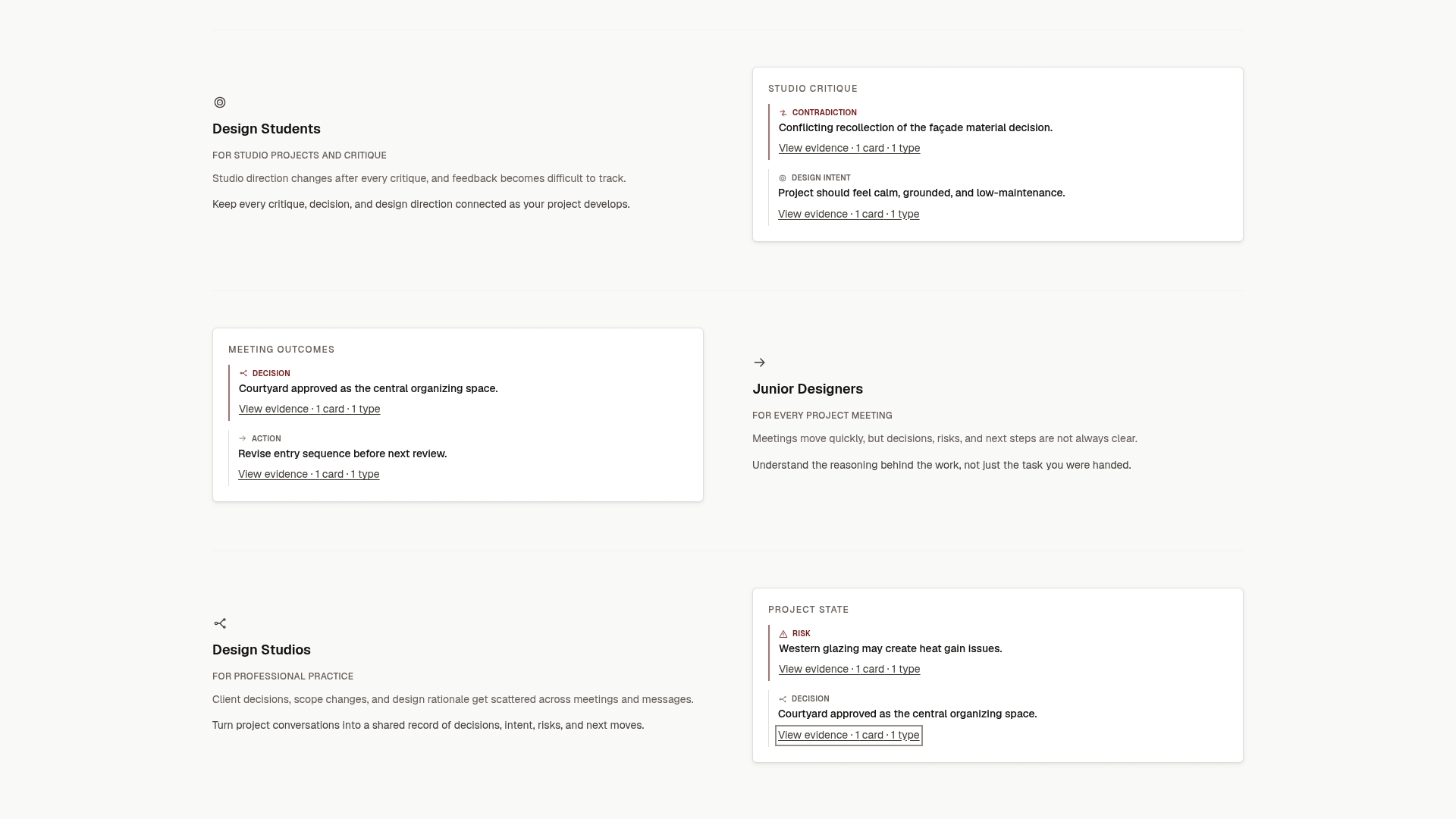
We built The Intent Ledger around that gap. An ILM Record keeps the decision, the intent behind it, the risks, the commitments and the unresolved questions together, and ties each to the conversation it came from. Over time the records become a living project memory that a new team member can read and trust.
A good archive is not a bigger pile of notes. It is a smaller set of records you can question.
Rajas
Start your archive with ILM Records
If you have a project’s worth of conversations and no record of the reasoning, start with the project’s decisions, risks and open questions. The Intent Ledger offers one-off record packs, from Working Set at $12 to Project Record at $29, Practice Memory at $59 and Studio Ledger at $119, as well as monthly plans: Working Memory at $29 per month, Living Record at $79 per month and Shared Ledger at $149 per month. See the options on the pricing page.
If you want a decision log structure to adapt first, our decision log template is a good place to begin.
FAQ
How do I archive project notes without keeping everything?
Keep records of decisions, risks, commitments and open questions, with their dates, authors and sources. Cull duplicates and files with no continuing value, as the EGBC guide advises. Do the culling during the project so it never becomes a cleanup chore at the end.
What is the best way to organize archived notes?
Use one naming convention, one shared home and chronological order with links to the artifacts. A project-specific title that includes topic, date and version makes a note findable years later.
Should I edit old decisions when the design changes?
No. Write a new record that supersedes the old one and mark the old one as superseded. This keeps the reasoning the team had at the time, which is the reason to archive at all.
How should a freelance architect preserve client comments?
Keep each comment in the client’s original wording, with the date, the version it concerned and the decision it led to. Keep withdrawn or conflicting comments too, marked as such. That gives you a clear trail if scope or approvals are questioned later.
Sources
- Guide to the Standard for Retention of Project Documentation, Engineers and Geoscientists BC
- ANAI guidelines on professional archives, 2023
- Decision Records: Preserving What Was Decided, Why, and More
- Why We Keep a Working Journal, NelCapeTown
- Design Documents and Architecture Decision Records
- Decision records, Claude Project Discipline
- Shaping your design history, Design in government
- DesignMemo, ACM Digital Library
- Conflicting Client Feedback: Build One Decision Record
- Using AI for Product Design: Client Feedback Rounds