Design Teams: Capture Meeting Decisions with 3 Fields and Hourly Recap
Design Teams: Capture Meeting Decisions with 3 Fields and Hourly Recap
The most reliable way to capture meeting decisions is to record three things for every call made in a meeting: the decision itself, a named owner, and a due date, confirmed aloud before anyone leaves the room. Add a timestamp or transcript link and a one-line rationale so the “why” survives past the meeting, per Berkeley’s BPM office. Publish the recap within an hour. Tools like The Intent Ledger build this discipline into a searchable record instead of a scattered doc.
TL;DR:
- Recording only the decision, owner, and due date aloud before leaving the meeting ensures clarity and accountability, especially when timestamps and rationales are included.
- Assigning roles and framing agenda items as decision questions, along with using shorthand tags, helps capture relevant outcomes without relying solely on a dedicated notetaker.
- Verifying decisions through a readback script and explicitly recording verbal acceptance improves follow-through and prevents overlooked closures.
- Linking decisions to structured notes and tasks within 24 to 48 hours maintains context and minimizes forgotten or ambiguous action points.
- Using project memory systems to connect decisions with the original conversation, rationale, and related files decreases rework and enhances transparency over time.
Table of Contents
- Quick checklist of methods to capture decisions without a dedicated notetaker
- Real-time capture tactics: scripts, readbacks, and moderator steps
- Decision log template: exact fields to record and why they matter
- Turning decisions into tracked tasks without losing the paper trail
- Which tools fit your team, and where automation falls short
- How project memory preserves the “why” behind a decision
- Handling dissent and multiple viewpoints in a single decision
- Three rules we use when documenting decisions
- A structured way to keep your project’s decision history
- Sources
- FAQ
Quick checklist of methods to capture decisions without a dedicated notetaker
Most teams lose decisions not because no one wrote anything down, but because no one wrote down the right things. Fix the roles and the framing first, and the notes take care of themselves.
Before the meeting starts, assign three roles and phrase every agenda item as a question to be answered, not a topic to discuss.
- Assign roles: a facilitator to run the agenda, a note-taker to log outcomes, and a timekeeper to enforce pace.
- Frame agenda items as decisions: “Should we approve the revised floor plan?” beats “Floor plan discussion.”
- Use shorthand tags: prefix lines with Decision, Action, or Risk, and attach an owner and due date inline as you type.
- No notetaker? Use a readback ritual: the facilitator states the decision aloud at the close of each item and someone confirms it before moving on.
- Choose recording over terse minutes when the topic is contentious or the group is distributed across time zones; choose fast minutes when the agenda is routine and low-stakes.
Real-time capture tactics: scripts, readbacks, and moderator steps
Closure is the part most meetings skip. A decision that never gets stated out loud rarely survives the walk back to someone’s desk.
- Time-box each agenda item and set a visible signal (a timer, a verbal warning) that forces a decision before moving on.
- Run a readback script at the close of each item: “So the decision is X, [name] owns it, due [date]. Confirmed?”
- Record verbal acceptance explicitly: the owner says “confirmed” or “I’ll own that,” not a nod that no one wrote down.
- Have the moderator arrive early, paraphrase discussion points, and summarize decisions at the end, a set of behaviors a CIPD evidence review ties closely to how effective attendees rate a meeting.
- Timestamp the decision the moment it’s made if you’re recording, and double-check speaker labels before you rely on them, since misattributed lines quietly break accountability later.
Pro Tip: Say the owner’s name out loud twice, once when you assign the task and once in the readback. It’s the cheapest accountability check you have.
Decision log template: exact fields to record and why they matter
A decision log only works if the fields force clarity. Loose notes let vague owners and fuzzy deadlines slide through; a structured log doesn’t.
When a decision requires a formal vote, add a “vote” row noting who voted for, against, and abstained, so a later dispute has a clear record instead of a memory contest. Store the log wherever your team already keeps project files, but link every entry back to the source conversation and related documents. The Cornell note-taking system offers a useful model for keeping the rationale line tight instead of letting it sprawl. A ready-made decision log template can save the setup work.
Turning decisions into tracked tasks without losing the paper trail
A decision that doesn’t become a task is just a well-documented plan to do nothing. The gap between meeting and execution is where most follow-through dies.
- Send a one-paragraph recap within an hour and create the corresponding tasks in your tracker at the same time, not the next day.
- Confirm scope and deadline with the owner within 24 to 48 hours; if they don’t respond, escalate to the facilitator rather than letting the task drift.
- Link every task back to the meeting note and the transcript excerpt that produced it, and keep the rationale in the task description, not just the outcome.
- Run a weekly or milestone audit of open decisions to catch anything stalled, unassigned, or quietly abandoned.
Connecting notes to tasks this way keeps the “why” attached to the “what,” which matters most when someone questions a decision three months later. A structured approach to linking notes and tasks makes this less manual.
Which tools fit your team, and where automation falls short
The right tool depends on team size and how distributed the work is, not on which app has the most features.
- Shared templates and docs work fine for small, co-located teams with low meeting volume and simple approval chains.
- Meeting assistants that record, transcribe, and timestamp suit distributed teams where no one can reliably attend every call live.
- Project memory systems that store decisions with sources and rationale fit complex or long-running projects where decisions get revisited months later.
Automated transcription has real limits. Speaker labels misfire often enough that you should verify who said what before treating a transcript as a citation, and any recording tool touching client conversations raises privacy questions worth clearing with your team first. Coverage of newer AI meeting assistants shows these tools can synthesize context and push time-stamped summaries, but treat that output as a draft, not a record, until a human checks it. A partner guide to automated note-taking walks through how these assistants generate summaries in practice. For guidance specific to design workflows, see automating meeting notes for design teams.
Pro Tip: Treat any AI-generated summary as a first draft. Read it against the recording once before you send it anywhere.
How project memory preserves the “why” behind a decision
A decision log tells you what was decided. It rarely tells you why, which is exactly what gets argued about when a client or reviewer pushes back weeks later. Project memory software turns meeting notes, transcripts, and critique feedback into structured entries that trace a decision back to the conversation that produced it, along with the rationale and related files.
For a design team, that might mean tracing a scope change back to the client call where budget constraints came up, with the transcript excerpt and the related spec document attached. Over time, that traceability shows up as fewer reopened decisions, faster onboarding for new team members, and less time spent reconstructing context that already existed somewhere.
Handling dissent and multiple viewpoints in a single decision
Most decision logs record only the outcome, which quietly erases the disagreement that led to it. That’s a problem when the dissenting view turns out to matter later, or when someone needs to understand why a decision was close rather than obvious.
Record dissent the same way you record the decision itself: as a line item, not a footnote. When a decision isn’t unanimous, note who disagreed and the core of their objection in a single sentence, right next to the decision statement. You don’t need a full transcript of the debate, just enough to reconstruct the logic if someone asks later.
For decisions made by vote, list how each person voted rather than just a tally, since a 4 to 3 split carries different weight than a unanimous call. For decisions made by consensus or a single decision-maker’s call, add a short “alternatives considered” line naming the option that was rejected and why. This matters most on design teams, where a rejected material, layout, or approach often resurfaces months later. Having the rationale on record, rather than relying on someone’s memory of a meeting from last spring, prevents the same debate from happening twice. Keep the tone factual rather than attributing blame. The goal is a record that a new team member could read and understand both the decision and the debate behind it, not a transcript of who pushed back hardest.
Three rules we use when documenting decisions
Capture minimal fields, force a readback and confirmation, and convert every decision into a task within the hour. Use informal minutes for routine calls; switch to a formal decision record when the outcome affects budget, scope, or anything auditable later. Ambiguous owners and fuzzy deadlines cause most re-litigated decisions, and these three rules close both gaps before they open.
— Rajas
A structured way to keep your project’s decision history
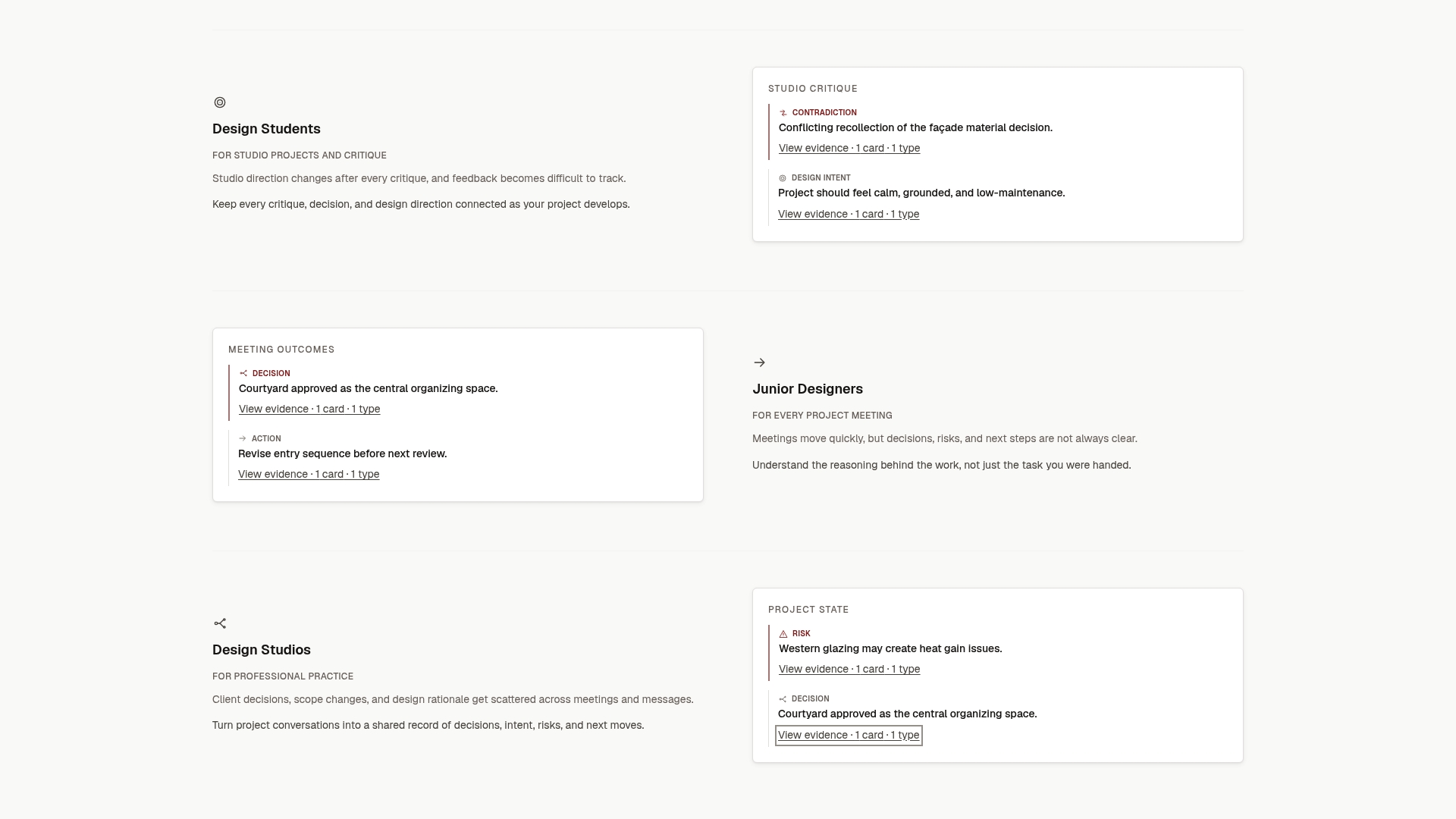
Everything in this guide points to the same problem: notes and task trackers capture what happened, but they rarely preserve why. Project memory systems build structured records specifically to hold that rationale, linking every decision back to the conversation, file, or critique comment it came from.
- Some project memory software offers monthly subscription plans with different features and pricing tiers.
- Pricing and plan details, including one-time product options, are on the vendor’s pricing page.
Pricing and plan details, including one-time product options, are on the pricing page. Visit The Intent Ledger to see how ILM Records work before committing to a plan.
Sources
- Productive meetings: An evidence review (Scientific Summary)
- Turn a Meeting Transcript into Decisions and Actions | Business Process Management Office
- Cornell note-taking system (LSC Cornell)
- Read AI launches an email-based digital twin (TechCrunch)
FAQ
What are the 5 P’s of meetings?
Definitions vary across sources, but a common version covers Purpose, Participants, Process, Preparation, and Products, a framework for planning a meeting before it starts. It’s a planning checklist rather than a formal standard, so teams often adapt the list to fit their own workflow.
What’s it called when you take notes during a meeting?
This is generally called minute-taking, and the resulting document is called meeting minutes or a meeting summary. When the focus is specifically on outcomes rather than a full discussion record, teams often call it a decision log instead.
What is the 40/20/40 rule for meetings?
This isn’t a standardized or widely documented framework, so there’s no single agreed definition to point to. If you’ve seen it referenced, it likely describes splitting effort between preparation, the meeting itself, and follow-up, but treat any specific ratio with caution.
What is the best way to capture meeting notes?
The most reliable method separates decisions, action items with owners and due dates, and open questions into distinct lists rather than one continuous narrative, an approach Berkeley’s BPM office recommends. Confirming each item aloud before the meeting ends and sharing the recap quickly makes the notes far more likely to get used.