Charrette Documentation: What to Record and How to Report
Charrette Documentation: What to Record and How to Report
Good charrette documentation does three jobs: it records what was decided, it keeps the reason behind each decision, and it ties every item to the conversation it came from. Capture decisions, risks, open questions and owners during the session, and send a short summary while the room is still fresh. Then follow with a fuller report. At The Intent Ledger, we build ILM Records for exactly this: structured, source-backed records of decisions, design intent, risks, actions and unresolved questions, traceable to the original conversation.
TL;DR
- Charrette documentation is the record of key activities and outcomes. Federal and municipal toolkits treat it as a required step, not an afterthought.
- Log each decision with an ID, a date, what was agreed and why, who agreed, and where the supporting material lives.
- Send a summary within about 24 hours, and a formal report within two weeks.
- Keep the source attached to every item: the sketch, the comment, the speaker. A decision without its reason is hard to defend six months later.
- A good report separates a short executive summary from a longer record with appendices.
Table of Contents
- What charrette documentation is and why it matters
- What to record during the session
- A simple capture template
- Capturing conversation, sketches and stakeholder input without losing the source
- Timing: when each document is due
- What a charrette report should include
- Recording actions, owners and follow-up
- Why charrette records lose their source
- How we handle this with ILM Records
- Getting started with ILM Records
- A checklist to run before you leave the room
- FAQ
- Sources
What charrette documentation is and why it matters
A charrette is an intensive, collaborative design session. Stakeholders, designers and sometimes the public work through a problem in hours or days instead of weeks. The pace is the strength, and it is also the risk: a great deal is said, sketched and settled in a short window, and most of it lives in people’s heads when they leave.
The DC Department of Energy and Environment’s charrette toolkit states that documenting the charrette is an important step because it provides a record of key activities and outcomes. The same toolkit says the facilitator should type up the notes and share them with all participants, with presentations optionally attached as an appendix to the report.
The record has an audience beyond the room. It serves participants who want to check what was agreed, team members who were not there, and later reviewers who need to understand why the design went one way and not another. The US Army Corps of Engineers’ 2024 charrette handbook adds a human reason: participants who do not feel their contributions are captured are likely to withdraw their buy-in. Documentation is part of how a charrette earns trust.
What to record during the session
The temptation is to write down everything. The better habit is to write down what someone will need later. Drawing on the USACE handbook and the planning toolkits above, a working list looks like this.
Decisions, with their reasons
The USACE handbook says a decision log should at minimum include a reference identifier, the date, a description of what was agreed to and why, who agreed to it, and where supporting documentation can be found. The 2013 SMART Planning charrette handbook gives the same five fields and describes the log as ongoing documentation of decisions throughout a study.
The “why” is the field teams skip. “Move the entry to the east facade” is a decision. “Move the entry to the east facade because the west approach crosses the loading dock, agreed by the client rep and the landscape lead” is a record someone can act on.
Risks, uncertainties and open questions
The same handbook recommends that a designated note taker keep a working copy of the decision log, a risk register and a list of due-outs, updated in real time. It also suggests a deliberate pause during the session to identify decisions, risks or uncertainties, and a briefing on these documents at the end of each day.
Open questions deserve the same discipline as decisions. Record what needs research, who needs to provide input, and what depends on the answer.
Direction changes and the thinking behind ideas
The handbook also lists the top improvements to carry forward, validated design decisions, questions needing research or stakeholder input, and major direction changes. It asks teams to capture the context behind ideas: the thinking, the scenario, the specific feedback and where the idea came from. A sketch with no note about what prompted it is a picture. A sketch with the comment that produced it is evidence.
What is set aside
Record what you decided not to pursue, with the reason. Humane Design’s charrette guide names not documenting in the room as a key failure mode and recommends recording both what is taken forward and what is set aside. Rejected options come back in review meetings. A line explaining why they were dropped saves the argument.
A simple capture template
Use one row per item, whatever tool you use:
| Field | What to write |
|---|---|
| ID | A short reference, such as D-014 for a decision or R-006 for a risk |
| Date and session | When and in which working session it arose |
| Item | The decision, risk, action or open question in one sentence |
| Rationale | Why it was agreed, or why the question matters |
| People | Who agreed, who owns the follow-up |
| Source | The sketch, comment, recording or note it came from |
| Status | Agreed, open, deferred or dropped |
The fields map directly to the minimum decision log above, with risks and actions added. If your team needs a ready-made format, our decision log template walks through one in detail.
Capturing conversation, sketches and stakeholder input without losing the source
Charrettes produce several kinds of material at once: spoken discussion, marked-up drawings, wall graphics, comment cards and, increasingly, online input. Each needs a plan before the session starts.
- Assign a note taker. The USACE handbook calls for a designated person. Do not ask the facilitator to do this while running the room.
- Decide the formats in advance. Typed notes for discussion, photos for sketches and boards, audio or video for activities you cannot transcribe live.
- Label as you go. Photograph each board with a visible session name and time. An unlabeled photo is hard to place two weeks later.
- Mark decisions in the moment. A short verbal confirmation (“we are agreeing X, because Y”) gives the note taker a clean line to log.
- Link every item to its origin. Note which sketch, speaker or comment produced it.
The Hollywood Burbank Airport Authority’s design charrette documentation report shows this at scale. It covers nine community workshops and five online workshops, with summaries, transcriptions and materials from each session. Comments from wall graphics, comment books and online surveys are summarized in one section and recorded in full in the appendices. The pattern is worth copying at any size: a readable summary up front, the complete record behind it.
Timing: when each document is due
Speed matters because detail decays. Humane Design recommends a summary document within 24 hours, since the energy and specificity of a charrette fade quickly. The USACE handbook sets a longer horizon for the formal record: within two weeks of wrap-up, complete a memorandum for record or report capturing attendees, notes, decisions, uncertainties, risks and follow-up actions.
A practical rhythm:
- End of each day: brief the decision log, risk register and due-outs to the room.
- Within 24 hours: circulate a one-page summary of decisions, open questions and next steps.
- Within two weeks: issue the full report.
- Within a month: the USACE handbook has the steering committee hold a debriefing, review evaluation feedback, and send participants the follow-up reports, especially the executive summary.
What a charrette report should include
The Whole Building Design Guide describes a two-tier report: a one-to-two-page executive summary with photos, and a longer report of roughly 25 to 35 pages covering action items, team members and visions. Not every charrette needs that length, but the two-tier idea holds for any size. Busy readers get the summary, and anyone who needs the detail finds it behind.
A solid structure:
- Executive summary. The goal, the main outcomes, the top priorities and the next steps.
- Context and participants. Who attended, what the brief was, what constraints applied.
- Process. The sessions held and the methods used.
- Decisions and rationale. The decision log, cleaned up, with reasons.
- Risks and open questions. What remains uncertain and who is resolving it.
- Actions and owners. Each with a person and a timeframe.
- Appendices. Raw notes, photographs, transcripts, presentations and comment records.
Carbon Design’s charrette write-up adds that the closing summary should include action items and next steps along with an evaluation of the day. If you run feedback forms, the Whole Building Design Guide suggests keeping them to one page, front and back, with room for open comments.
Recording actions, owners and follow-up
Actions are where charrette momentum usually dies. The report names a task, but nobody owns it, and by the next meeting it has changed shape. Write each action with an owner, a due date and the decision it implements. That last link is the one that keeps actions from drifting.
The DC toolkit recommends regular check-ins with the people responsible for tasks identified in the session. It also notes that a follow-up charrette meeting may be needed at the start of construction documents to revisit and realign goals. That second point is where good documentation pays off: the team can compare current work against the original decisions and see what has moved and why.
If your charrette surfaced significant risks, a structured follow-up helps. This guide to risk workshop follow-up covers how to turn workshop output into tracked actions.
Why charrette records lose their source
The usual failure is not missing notes. It is notes that have lost their origin. A typed summary says “the group preferred option B”. Months later, nobody knows whether that was the client’s view, a critic’s comment or a consensus, or what objection option A faced.
Three habits cause most of this:
- Summaries written from memory rather than from the recording or transcript.
- Decisions recorded without the reasoning, because the reasoning felt obvious in the room.
- Sketches filed in one folder and notes in another, with no link between them.
Teams that keep the rationale, the speaker and the source together can answer “why did we do this?” in minutes. Our post on a six-field decision audit trail for critique-driven work shows one way to structure that.
How we handle this with ILM Records
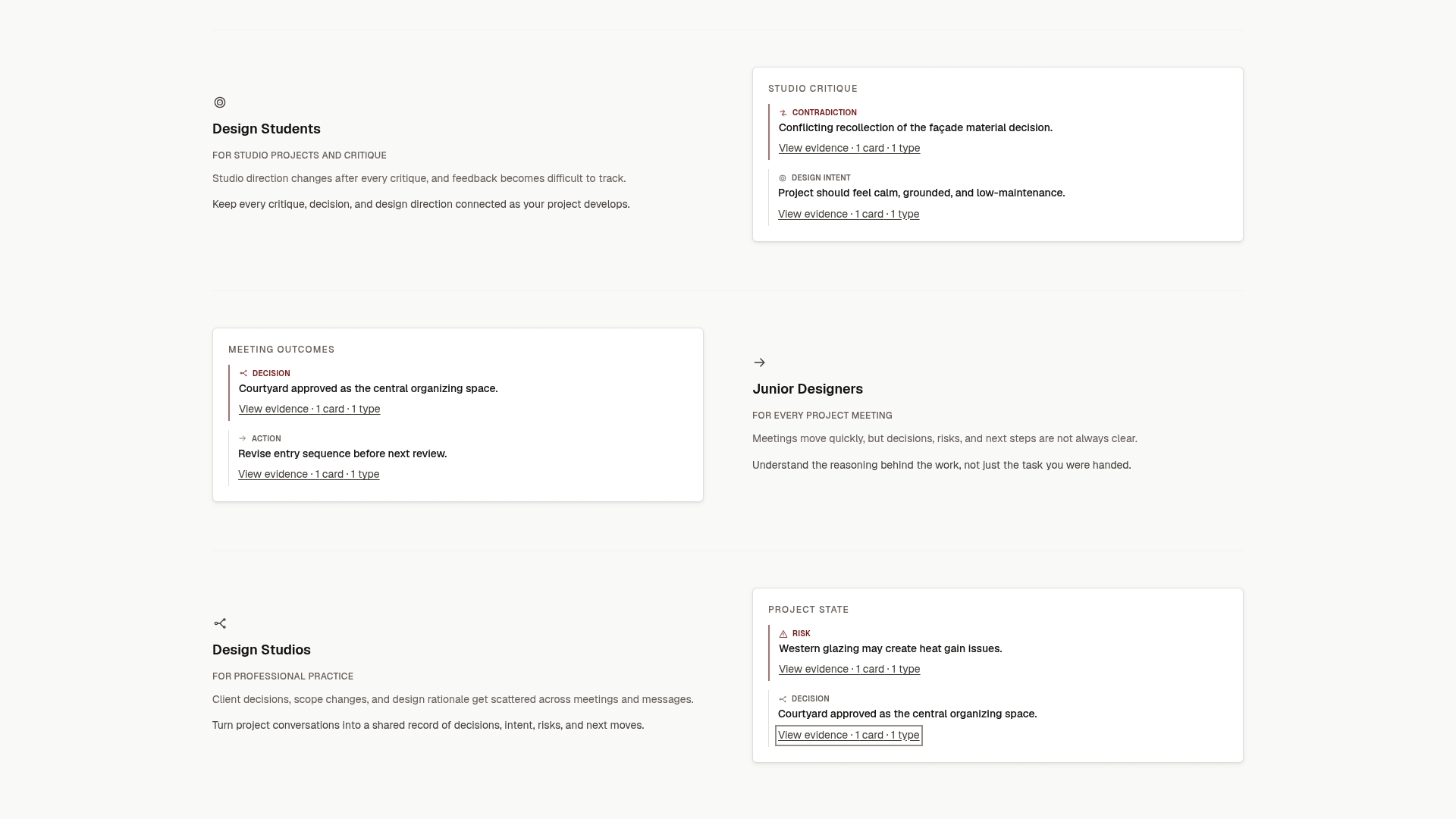
The Intent Ledger is project memory software for design teams. It takes project conversations, meeting notes, audio recordings, transcripts, critique feedback and client comments and turns them into ILM Records. Each record is a structured, source-backed entry for a decision, a piece of design intent, a risk, an action, a commitment or an unresolved question, and it traces back to the conversation it came from.
For charrette documentation, that maps onto the checklist above. The transcript or notes from a session become records with the rationale attached. The source stays one click from the item. The open questions and risks sit alongside the decisions rather than in a separate document nobody opens.
It is built for architecture studios, design teams, project managers, junior designers, design students and freelance architects, the people who run charrettes and critiques and need to explain them later.
Our view: the “why” is the deliverable
A charrette report is usually judged by what it lists: the concepts, the priorities, the action items. We think the more valuable output is the reasoning behind them. Concepts get redrawn and priorities get reordered. The reason a decision was made is what lets a team change course without starting the argument again.
That is why we built ILM Records around source-backed rationale rather than generic summaries. A decision that points back to the conversation it came from can be checked, challenged and carried forward by someone who was never in the room. A junior designer picking up a drawing set can see where a task came from. A project manager can show a client what was agreed and when.
Charrettes compress months of talk into days. The record should be just as dense and just as easy to trace, and we designed our records for that.
Rajas
Getting started with ILM Records
If you want charrette notes, transcripts and critique feedback turned into structured records, The Intent Ledger offers one-time record packs and monthly plans. As published on our pricing page, the packs are Working Set at $12, Project Record at $29, Practice Memory at $59 and Studio Ledger at $119, each a one-time purchase. Monthly plans are Working Memory at $29 per month, Living Record at $79 per month and Shared Ledger at $149 per month.
A single charrette fits naturally in a one-time pack. A studio that runs sessions and reviews all year suits a monthly plan. For more on structuring the records themselves, browse our articles on decision-making documentation.
A checklist to run before you leave the room
Before the session ends, check these items with the group:
- Every decision has an ID, a reason and the names of those who agreed.
- Every open question has an owner and a next step.
- Risks are listed, with what each one depends on.
- Every photo, recording and board has a session label.
- The top priorities are stated back to the group and confirmed.
- The date for the 24-hour summary and the two-week report is announced.
This takes ten minutes and prevents most of the rework that happens afterward. Reading reports from earlier charrettes also helps you set expectations, and the Whole Building Design Guide lists several examples, including the Boston National Historic Park and UNC-Asheville greening charrettes.
FAQ
What is the difference between charrette documentation and a charrette report?
Documentation is the whole body of records: notes, photos, recordings, the decision log, the risk register and comment records. The report is the finished, structured document built from them. The report usually has an executive summary on top, with the raw records in the appendices.
How soon after a charrette should the documentation go out?
Send a short summary within about 24 hours, while details are fresh. The USACE handbook sets two weeks from wrap-up for the formal memorandum or report. A debriefing and follow-up reports to participants should come within a month.
What should a decision log contain?
At minimum: a reference ID, the date, what was agreed and why, who agreed, and where the supporting documentation is. Adding a status field (agreed, open, deferred, dropped) makes it easier to scan in later meetings.
How long should a charrette report be?
It depends on the scale. The Whole Building Design Guide describes a one-to-two-page executive summary plus a longer report of about 25 to 35 pages. A small studio charrette may need only the summary and a clean decision log. The key is that readers can stop after the summary or go deeper.
Sources
- CHARRETTE TOOLKIT, DC Department of Energy and Environment
- Conducting a Risk Informed Planning Charrette: USACE Handbook, 2024
- SMART Planning Charette Handbook, Version 3.0
- Design charette, Humane Design
- Design Charrette Documentation, Burbank Airport
- Planning and Conducting Integrated Design (ID) Charrettes, Whole Building Design Guide
- How to implement a design charrette, Carbon Design