8 Fields That Make a Client Communication Log Work for Design Teams
8 Fields That Make a Client Communication Log Work for Design Teams
A client communication log, in the sense that matters for design work, is a source-backed record of every material decision, the reasoning behind it, and who owns what happens next — not a call diary. Start one now: pick a single Decision Log template and assign one person to capture it. Peer-reviewed design-documentation research and AIA guidance both treat rationale and ownership as non-negotiable fields, not optional extras.
TL;DR:
- Capturing decision rationale and source links at the moment of decision greatly improves future accessibility compared to relying on memory or unstructured notes.
- Assigning a dedicated owner or steward ensures the decision log remains accurate, updates reflect the current status, and the record is a trusted source.
- Reviewing entries within two days of key meetings and at major project milestones helps prevent drift and keeps decisions traceable during active phases.
- Recording only five essential fields—decision, rationale, source link, owner, and status—is recommended under time pressure, with others added later as needed.
- The Intent Ledger automates linking decisions to conversations, making it easier for teams managing multiple clients or projects to maintain reliable, source-backed records.
Table of Contents
- What to Capture for Every Material Client Decision
- How to Structure Records, Assign Ownership, and Set Rules
- From Conversation to Record: A Template and Workflow That Works
- When to Review the Log and What Should Trigger a Check
- Why Rationale, Not Just Decisions, Is What Saves Projects
- How The Intent Ledger Fits This Workflow
- Sources
- FAQ
What to Capture for Every Material Client Decision
A decision without its reasoning is just a fact floating with no anchor. Six months later, nobody remembers why the client rejected the cantilevered stair or why the facade material changed mid-schematic, and the team ends up re-litigating a choice that was already made. Peer-reviewed research on engineering project documentation found that a usable decision record needs the decision itself, its rationale, related constraints, affected design elements, dependencies, and participant identities to be reconstructed later without the original meeting.
Here’s the field set that actually holds up under scrutiny months into a project:
- Decision statement and status — what was decided, and whether it’s approved, proposed, or superseded by a later call.
- Rationale — the tradeoffs weighed, the constraints in play, and the criteria used to choose.
- Source evidence — which meeting, call, or transcript it came from, ideally with a link to the exact quote or timestamp.
- Affected design elements — the specific deliverables or model element references the decision touches.
- Dependencies — related decisions that this one relies on or unlocks.
- Participants, approvers, and owner — who was in the room, who signed off, and who’s accountable for follow-through.
- Downstream links — connections to actions, risks, assumptions, and open issues (a RAID structure, if your team already uses one).
- Metadata — project phase, impact level, priority, and any unresolved questions still hanging.
Pro Tip: If you can only capture five fields under deadline pressure, capture decision, rationale, source link, owner, and status. The rest can be backfilled; those five can’t.
A study of the Danish AEC industry found that design rationale is almost always left implicit in CAD files and meeting notes, which means it’s inaccessible the moment someone needs to revisit a decision after a model change. Capturing rationale at the moment it emerges, rather than reconstructing it later from memory, is the difference between a log that’s useful and one that’s decorative.
How to Structure Records, Assign Ownership, and Set Rules
A log without an owner turns into a shared drive full of contradictory notes. Someone needs to be responsible for the record existing, staying accurate, and reflecting the current state of a decision, not just its first draft.
- Name a record owner or steward. This can be a single person (a project manager or team lead) or a rotating role, but it should never be “whoever remembers.” AIA guidance recommends establishing a communication protocol that defines source types, ownership, and review cadence before the project gets moving, not after the first dispute.
- Pick one single source of truth. Naming conventions and links to model elements or deliverables matter more than the tool itself. A decision log scattered across three platforms is not a log; it’s a scavenger hunt.
- Decide when capture happens. In-meeting capture is faster but rougher; a same-day summary is cleaner but relies on memory. Most teams do best with a hybrid: rough notes live, polished within 24 hours, validated by someone who was in the room.
- Set edit and approval rules. Who can change a decision’s status from “proposed” to “approved”? How do you record that a decision was superseded rather than deleted? Overwriting history erases the exact context future teams will need.
- Wire it into your RAID or action tracker. Decision-tracker practice in project management treats decisions and actions as separate but linked records, which keeps the log from turning into a to-do list wearing a disguise.
Pro Tip: Assign a lightweight verification step: the recorder posts a summary within a day, and a named approver has a set window (say, two working days) to confirm it. Skip this and unverified notes start circulating as if they were official.
From Conversation to Record: A Template and Workflow That Works
A decision log doesn’t need forty fields to be useful. It needs the right eight or ten, filled in consistently.
- Decision
- Rationale
- Source link (meeting, call, or transcript timestamp)
- Affected items (deliverables or model elements)
- Owner
- Approver
- Actions triggered
- Dependencies
- Status
- Tags
Here’s what a populated entry looks like in practice:
| Field | Example Entry |
|---|---|
| Decision | Switch exterior cladding from zinc panel to fiber cement |
| Rationale | Budget constraint surfaced in cost review; zinc exceeded the target cost per square foot |
| Source link | Client review call, March 3, timestamp 22:40 |
| Affected items | West and south elevation drawings, material spec sheet |
| Owner | Project architect |
| Approver | Client principal |
| Actions | Update spec sheet, notify contractor of material change |
| Dependencies | Depends on structural review of substrate weight difference |
| Status | Approved |
| Tags | Budget, exterior, materials |
The workflow itself is short: capture the raw note or transcript, tag it against your fixed field set, link it to the relevant model elements or deliverables, spin off any actions it triggers, and have the approver verify. Research on BIM-linked documentation shows that attaching explanation tags directly to model elements makes decisions queryable later, so a future teammate can find out why a wall moved without hunting through six months of meeting notes.
Transcription tools can handle the raw capture, but they shouldn’t be trusted with judgment calls about what’s a real decision versus a passing comment. The Intent Ledger’s Decision Log template and its Record of Decision framework both lean on this same eight-field logic, built specifically so design teams don’t have to invent a schema from scratch.
When to Review the Log and What Should Trigger a Check
A decision log that only gets reviewed at project closeout is a lessons-learned document, not a working tool. AIA process guidance recommends reviews during active phases, not just at the end, because rationale is far more recoverable while the people who made the decision are still around.
A workable cadence looks like this:
- Immediate verification after any client meeting or critique, within a day or two.
- Weekly or biweekly syncs during active design phases to catch drift before it compounds.
- Phase-gate reviews at each major milestone, treating the log as a lessons-learned source rather than an afterthought.
Certain events should trigger an off-schedule check regardless of where you are in the cadence: a scope change, a client dispute over what was actually agreed, a new approver stepping into the project, or a regulatory submission that demands a clean paper trail. Logs built this way double as onboarding material. A new team member reading through decisions and their rationale gets weeks of context in an afternoon.
Why Rationale, Not Just Decisions, Is What Saves Projects
Most teams log outcomes. Almost none consistently log the reasoning, and that’s the gap that costs real time. When a senior designer leaves mid-project, it’s not the decisions that walk out the door with them, it’s the why. Rebuilding that context from scratch is where rework quietly eats a schedule.
This is the exact problem The Intent Ledger’s templates and blog are built around: treating rationale as a first-class field, not a nice-to-have note. Pick a template. Assign an owner. Do it this week, before the next client call happens and the reasoning behind it starts to fade.
— Rajas
How The Intent Ledger Fits This Workflow
Theintentledger is built for exactly the workflow described above: it turns meeting notes, transcripts, critique feedback, and client comments into ILM Records, structured entries that trace each decision straight back to the conversation that produced it. Instead of manually tagging source links and hunting for the moment a client approved a material change, the software does that linking for you.
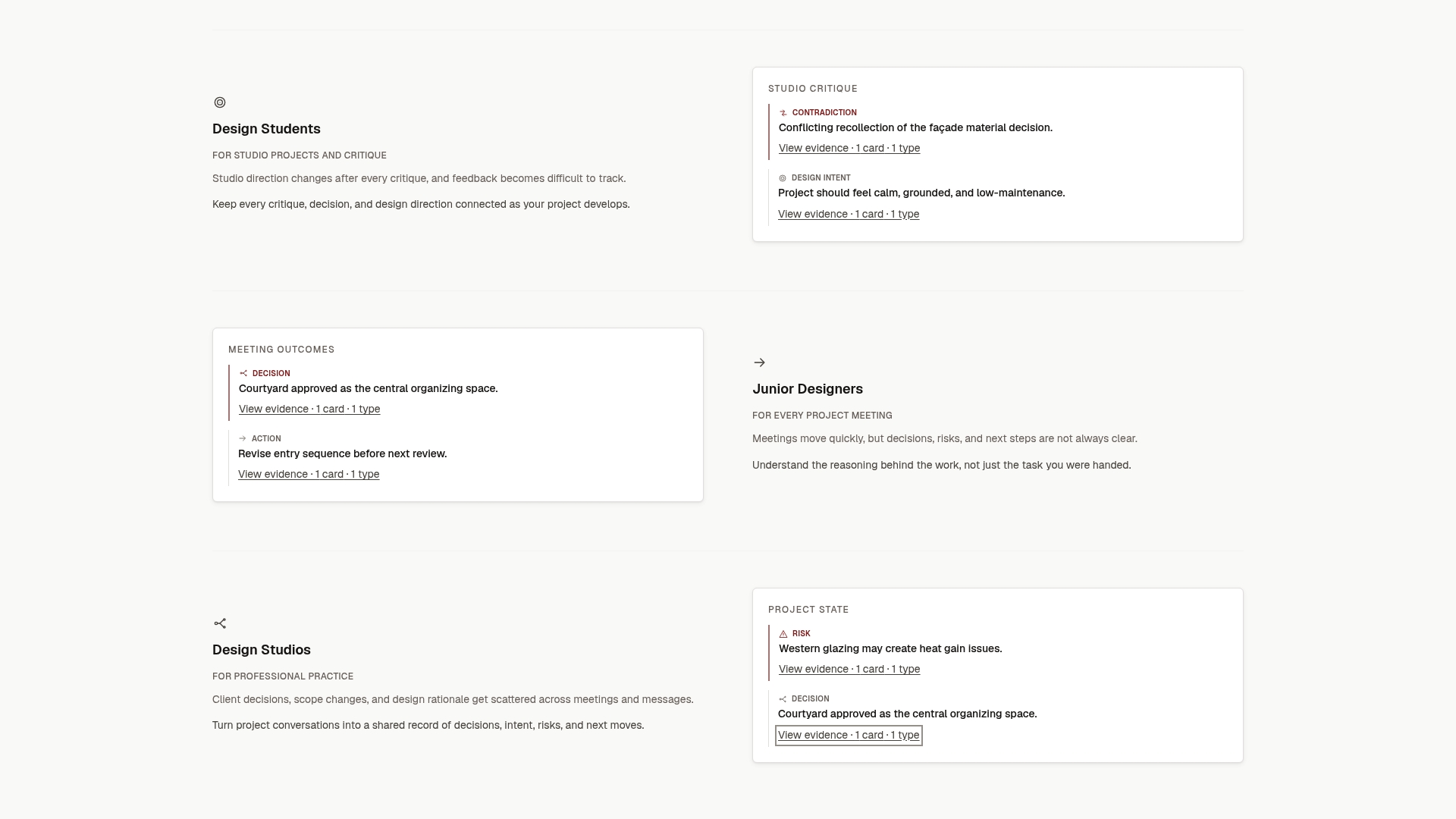
It fits design-team leads managing multiple client threads, project managers who need a defensible record when scope disputes come up, and freelance architects who don’t have a coordinator to chase down meeting notes after every call. A studio juggling five active client relationships, for instance, can use it to keep every decision traceable to its source without a dedicated documentation hire.
If you’re ready to stop reconstructing decisions from memory, view plans and pricing starting at $29 a month for the Working Memory plan, or explore what The Intent Ledger does before committing to anything.
Sources
- The documentation of design decisions in engineering projects: A study in infrastructure development
- Design rationale documentation and exchange in the Danish AEC industry
- AIA schematic design phase quality management / communications guidance
FAQ
What Is a Client Communication Log in Design Projects?
It’s a structured, source-backed record of each material decision made during a project, including the rationale, who was involved, and what it affects. It’s built to answer “why did we decide this” months after the conversation happened, not just “what did we decide.”
How Is This Different From Regular Meeting Notes?
Meeting notes capture what was said. A structured decision record captures what was decided, why, who approved it, and what it connects to, like affected deliverables or downstream actions. The Danish AEC research found that rationale left in raw notes is rarely accessible when it’s actually needed later.
How Often Should the Log Be Reviewed?
Verify entries within a day or two of the conversation, hold weekly or biweekly syncs during active design phases, and run a full review at each phase gate. Ad-hoc checks should happen after scope changes, disputes, or a new approver joining the project.
Who Should Own the Decision Log?
One person, or a clearly defined rotating role, needs to be accountable for accuracy and updates. Without a named owner, AIA process guidance notes that records tend to fragment across tools and stop reflecting the current state of decisions.
Does The Intent Ledger Handle This Automatically?
Theintentledger converts meeting notes, transcripts, and client feedback into structured ILM Records that trace back to their original source conversation. Pricing starts at $29 a month for the Working Memory plan, with full details on the pricing page.