Cut Rework: 8 Field ILM Client Meeting Documentation for Design Teams
Cut Rework: 8 Field ILM Client Meeting Documentation for Design Teams

Client meeting documentation means capturing an ILM Record for every significant decision: the context, the choice, the alternatives you rejected, and the trade-offs that made it a close call. The immediate action is simple. Stop taking generic minutes and start writing a short, source-linked decision record, tied back to the meeting where it happened, every time a design choice actually locks in.
TL;DR:
- Accurate decision records should include the decision ID, date, context, alternatives considered, trade-offs, actions, and links to source artifacts for full traceability.
- Recording soft decision factors like stakeholder preferences and beliefs improves buy-in and prevents subjective reasoning from disappearing over time.
- Capture decisions during meetings using shorthand tied to timestamps and convert them into detailed ILM Records within 48 hours after the meeting.
- Linking records directly to BIM elements, tickets, and other project artifacts ensures they remain accessible and meaningful in the design workflow.
- Keep sensitive information secure by controlling access based on roles, storing records in a central system, and stripping irrelevant details before external sharing.
Table of Contents
- Why Structured Meeting Records Matter for Design Projects
- The 8 Essential Fields Every ILM Record Should Contain
- How to Capture Decisions During and Right After Client Meetings
- Integrating ILM Records Into Design Workflows and Tools
- Practical Perspective From The Intent Ledger and Author Rajas
- Security and Confidentiality Considerations for Client Records
- Why “Just Take Better Notes” Misses the Point
- Turn Meeting Chaos Into a Traceable Decision Trail
- Sources
Why Structured Meeting Records Matter for Design Projects
Design teams lose more time to re-explaining old decisions than to making new ones. Research on design team interactions in construction projects finds that weak information flow and poor decision documentation directly increase rework and create project bottlenecks, dragging down both product quality and team efficiency. That’s not a communication problem you fix with more meetings. It’s a memory problem.
The Architecture Decision Record (ADR) model, originally built for software teams, offers a lightweight fix that design studios can borrow directly: every record states the context, the decision, the alternatives considered, and the trade-offs, so the reasoning survives staff turnover and client memory drift.
But architecture and design decisions carry something software decisions often don’t: subjective, relationship-driven factors. A client’s gut reaction to a facade material, a stakeholder’s unspoken preference for a certain layout. Design management research on capturing soft decision factors shows that recording team beliefs and stakeholder concerns explicitly raises buy-in and keeps the reasoning behind subjective calls from disappearing.
What a working record needs:
- A specific decision statement, not a vague summary
- The alternatives that were seriously considered and why they lost
- The trade-offs and risks accepted at the time
- A link back to the meeting or transcript where it happened
The rework connection is measurable, not theoretical: teams that lose track of why a decision was made tend to repeat the debate, second-guess the outcome, or rebuild work that was already settled weeks earlier.
The 8 Essential Fields Every ILM Record Should Contain
A traceable record doesn’t need to be long. It needs to be complete. The Intent Ledger’s 8-field template gives you the minimum structure required to make a decision defensible six months later, when nobody remembers the meeting but everybody has an opinion about the outcome.
- Decision ID, a short, unique tag so the record can be referenced from anywhere (a ticket, a BIM model, a follow-up email).
- Date and meeting source, the meeting name, date, and a link to the recording or transcript.
- Context and drivers, one or two sentences on what prompted the decision (budget pressure, code requirement, client preference).
- Decision statement, the actual call, written as a plain sentence, not a summary of discussion.
- Alternatives considered, the options that lost, briefly, so nobody reopens them without new information.
- Trade-offs and risks, what you gave up, and what could go wrong later.
- Actions and owners, who does what next, and by when.
- Links to source artefacts, the transcript timecode, the BIM element ID, the ticket number.
Each field earns its place because it answers a question someone will eventually ask. “Why did we pick this?” gets answered by fields three through six. “Who’s on the hook?” gets answered by field seven. “Can I verify this actually happened?” gets answered by field eight.
Give each record a status: proposed, accepted, or superseded. A proposed record is a decision still in play. Accepted means it’s locked until someone brings new information. Superseded means a later record replaced it. The link between the two should stay intact so the history reads like a chain, not a graveyard.
Pro Tip: Write the decision statement before the meeting ends. If you can’t state it in one sentence while everyone’s still in the room, the decision probably isn’t final yet.
How to Capture Decisions During and Right After Client Meetings
The best client meeting notes are written twice: once in shorthand during the meeting, once in full within 48 hours. Waiting longer than that is where detail actually disappears, since memory of a meeting fades fast and the people responsible for follow-up start filling gaps with guesses instead of facts.
Before the meeting, set a short list of decision prompts: what needs a final call today, who owns each topic, and how much time each item gets. A five-minute pre-meeting checklist prevents the common failure mode where a client casually approves something in the last three minutes and nobody captures it properly.
During the meeting, don’t try to write full sentences. Use shorthand tied to timestamps: a decision flagged with a timecode from the recording or transcript is far easier to convert later than a paragraph of paraphrased notes. If you’re recording audio, tag the moment a decision lands, not the moment the topic starts.
After the meeting, convert shorthand into full ILM Records within 24 to 48 hours. Assign owners immediately, and link each record to whatever task or ticket it spawns. This is the step teams skip under deadline pressure, and it’s exactly the step that determines whether the record is useful in three months.
A few micro-templates make this faster depending on the meeting type:
- Design review: decision statement, rejected alternative, and the one risk the team flagged before moving on.
- Client approval: decision statement, client’s stated reason, and the date it becomes binding.
- Critique session: decision statement, dissenting opinion (if any), and whether it changed the outcome.
Pro Tip: If a meeting produces no clear decision, don’t force one. Record it as “open,” note what’s blocking resolution, and set a date to revisit it. A false decision is worse than an honest gap.
Integrating ILM Records Into Design Workflows and Tools
A decision record that lives in a folder nobody opens is barely better than no record at all. The goal is to make the record findable from wherever someone would naturally look for it later: the BIM model, the ticket, the file itself.
Linking strategies that actually hold up:
- Attach explanation tags or design-episode references to BIM model elements, so a click on a wall assembly or a facade component surfaces the rationale behind it. BIM-based decision documentation research shows this kind of tagging improves how stakeholders understand and reuse design intent well after the original meeting is forgotten.
- Reference ticket IDs and task trackers directly inside the record, and vice versa, so a project manager checking a ticket sees the decision that justified it.
- Keep a central decision log for anything that affects multiple disciplines, but store narrowly scoped rationale (a single material choice, a single detail) next to the artefact it concerns.
Central logs work well for cross-team decisions. Artefact-local storage works better for anything a single discipline owns outright, where searching a central log adds friction without adding clarity.
Even with good habits, records go missing. That’s where unique IDs and persistent links matter most: automated recovery methods tested on real project histories reconstructed design decisions from commits and issue trackers with roughly 75% recall and 77% precision. That’s a strong signal that decisions leave a trail even when nobody wrote them down properly, but recovering them after the fact is slower and less reliable than capturing them right the first time.
Practical Perspective From The Intent Ledger and Author Rajas
The Intent Ledger builds ILM Records around one idea: the “why” matters more than the minutes. A record that only lists what was decided, without the alternatives or the trade-offs, is a decision with the evidence stripped out. That’s why every field in the template points back to a source, whether it’s a transcript timecode or a linked ticket.
Three experiments any studio can run this week: adopt the 8-field template for one recurring meeting type, require an owner on every action item, and link every new record to at least one artefact, whether that’s a BIM element or a task.
Two failure modes show up constantly. Over-documentation buries the useful records under noise nobody reads. Broken links quietly turn a record into an orphan the moment a file gets moved or a ticket gets closed. Fix both by keeping records short and checking links during your regular project review, not just at handover.
Security and Confidentiality Considerations for Client Records
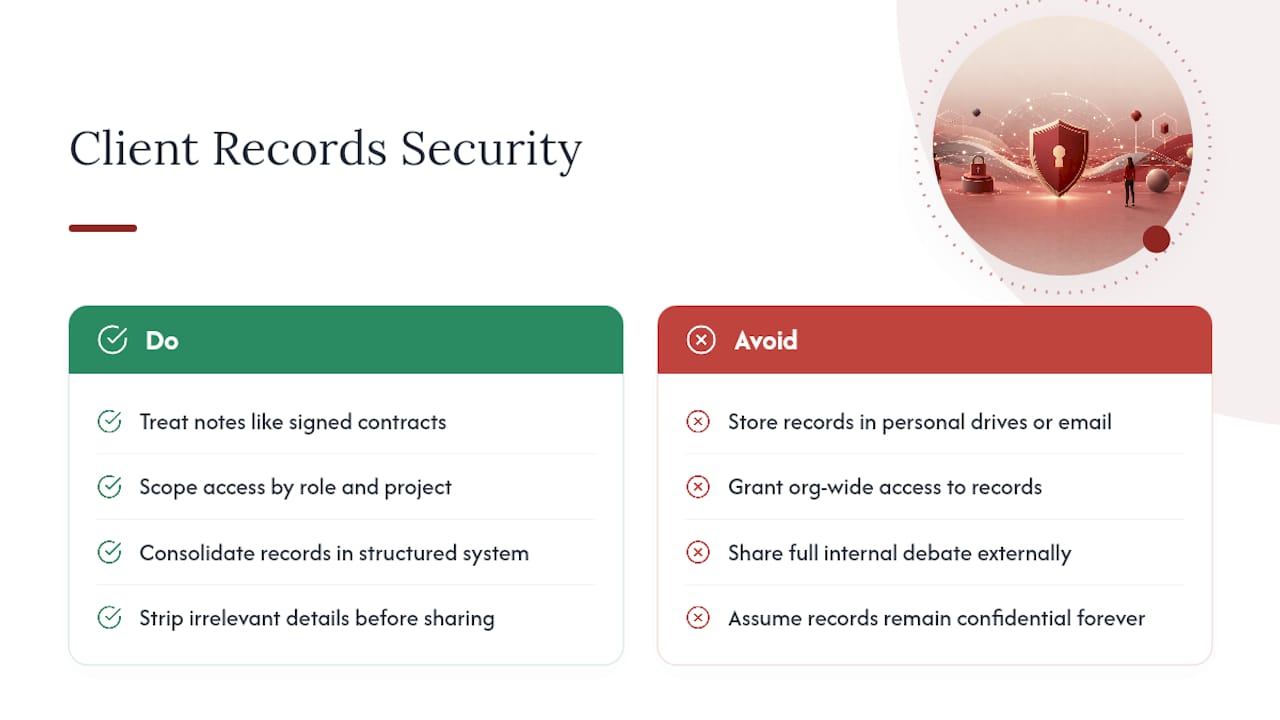
Client meeting documentation almost always contains information a client wouldn’t want floating around: budget ceilings, unresolved disputes, private feedback about a competing bid, or a candid reason a design got rejected. Treat that content with the same care you’d apply to a signed contract, because in a dispute, it functions like one.
Access should be scoped by role. A junior designer converting shorthand into a record doesn’t need visibility into every past client’s financial terms, and a subcontractor referencing a linked ticket doesn’t need the full meeting transcript behind it. Set permissions at the project level, not the organization level, so records stay visible only to people actually working on that account.
Storage location matters as much as access control. Records that live in scattered personal drives or email threads are both a security risk and a traceability risk. Consolidating them in a system built for structured records reduces the number of places sensitive rationale can leak from.
Before sharing any record externally, whether with a consultant, a contractor, or the client themselves, strip anything irrelevant to that recipient’s role. A record shared for handover purposes rarely needs the full internal debate that led to it, only the decision, the constraints, and the current status.
Retention policy deserves a plain answer, not an assumption. Decide upfront how long records stay active after project close, and whether superseded records get archived or deleted, so confidentiality obligations don’t quietly outlive the project itself.
Why “Just Take Better Notes” Misses the Point
The conventional advice on meeting documentation treats the problem as a discipline issue. Take more notes, write them faster, distribute them sooner. That advice is not wrong, but it’s aimed at the wrong target. The actual failure point isn’t effort. It’s structure. A team can write diligent, thorough minutes for a year and still lose every piece of rationale behind a major decision, because minutes capture what was said, not what was decided and why.
What the research on rework and information flow actually supports is narrower and more useful: capture the decision, the rejected alternatives, and the trade-offs, every time, in a format small enough that nobody skips it under deadline pressure. That’s the whole argument for the 8-field structure over free-form notes.
If you take one thing from this guide, prioritize the source link over everything else. A decision statement without a traceable link back to its meeting is a claim, not a record. Teams that get this one field right tend to fix the rest of their documentation habits on their own, because a broken link is obvious the moment someone goes looking for it.
, Rajas
Turn Meeting Chaos Into a Traceable Decision Trail
Writing eight fields by hand after every client call is exactly the kind of discipline that erodes under deadline pressure, which is the gap The Intent Ledger closes. It converts meeting transcripts, audio, and critique feedback directly into structured records, source-linked back to the original conversation, without anyone retyping a decision statement from memory two days later.
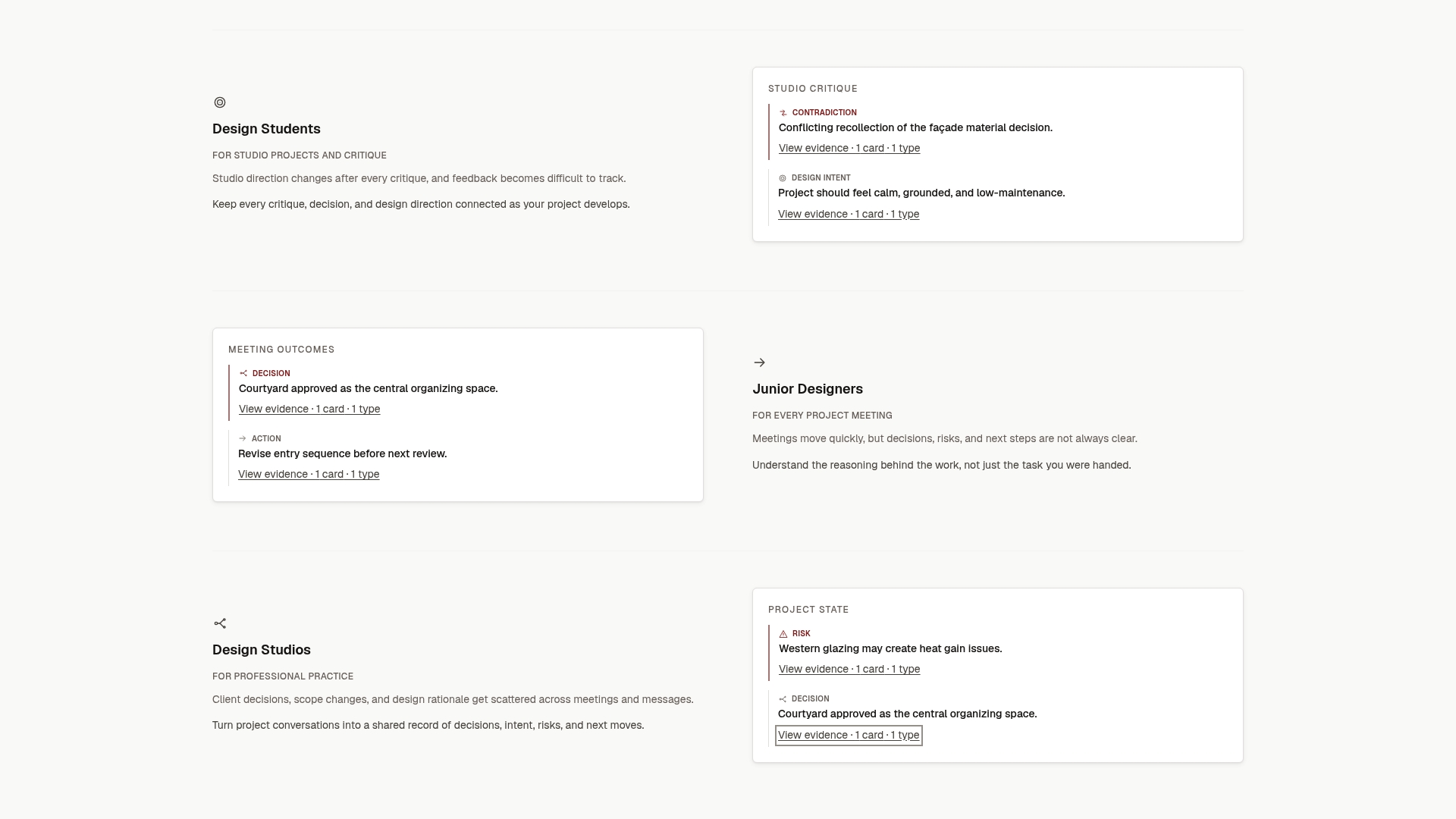
The payoff shows up fastest for teams onboarding a new project manager or junior designer: instead of re-litigating why a material got rejected six months ago, they open the record and see the alternatives, the trade-offs, and the transcript link in one place. That’s less rework, faster ramp-up on inherited projects, and an audit trail you can actually hand to a client without editing it first.
Start by trying the design documentation template on your next client meeting, and check pricing to see which plan fits a studio your size.
Sources
- Problems and Challenges in the Interactions of Design Teams of Construction Projects: A Bibliometric Study
- Recovering architectural design decisions from project artifacts (RecovAr)