Design Teams: Triad + Log to Start Collaborative Design Decisions
Design Teams: Triad + Log to Start Collaborative Design Decisions

Collaborative design decisions happen when the people accountable for a choice, usually a product manager, a designer, and an engineer, decide together using a written agreement and a repeatable ritual, rather than defaulting to consensus or the loudest voice in the room. The single most effective first move is drafting a one-page working agreement and running one recurring ritual, like a design jam, on a fixed schedule. Everything else in this guide builds on that foundation, and the implementation checklist near the end turns it into a plan you can start this week.
TL;DR:
- Clear decision ownership and written agreements reduce ambiguity and ensure accountability across product, design, and engineering teams.
- Using structured models like the Research Tree or expert scoring prevents anchoring on first ideas and promotes objective evaluation.
- Maintaining a lightweight, linked decision record with source references enables future traceability and verification of past decisions.
- Running scheduled rituals like design jams with defined roles and facilitation rules fosters faster, more informed trade-offs and higher team buy-in.
- Scaling these practices requires standardized templates and asynchronous documentation to support distributed and time-zone-separated teams.
Table of Contents
- What Collaborative Design Decisions Actually Mean
- The Real Benefits and the Pitfalls Nobody Warns You About
- Frameworks That Turn Debate Into a Decision
- Running Rituals That Actually Change What Happens Next
- What Belongs in a Decision Record (and What Doesn’t)
- Picking Tools That Reduce Friction Instead of Adding It
- Your Next Sprint: A Checklist You Can Run This Week
- What the Research Actually Shows (and Where It’s Thin)
- How to Resolve Conflict Without Killing Momentum
- Checking Whether a Decision Actually Held Up
- Scaling the Triad Across Bigger, Distributed Teams
- An Honest Note on Adoption
- How The Intent Ledger Turns Rituals Into Records
- Sources
- FAQ
What Collaborative Design Decisions Actually Mean
Collaborative decision-making in design is not consensus, and it’s not a manager announcing a call after a meeting. Consensus asks everyone to agree, which usually means the group settles on whatever offends the fewest people rather than what actually works. Autocratic decisions move fast but lose the technical and business context that only cross-functional partners hold. Collaborative design decisions sit between the two: a small, named group owns the call, gathers input from a wider circle, and someone breaks the tie when opinions split.
Participation typically works in two layers. The core is a triad, usually product management, design, and engineering, each owning a lens on the problem. Around that sits an extended group: researchers, content strategists, stakeholders, or clients who contribute input but don’t hold a vote.
Teams that run this well tend to see three measurable shifts:
- Better trade-offs. Decisions account for feasibility and business constraints before they hit engineering, not after.
- Faster cycles. A named decision owner and a tie-break rule cut the number of meetings needed to close a debate.
- Higher buy-in. People who helped shape a decision defend it later, instead of relitigating it in a retro.
The Real Benefits and the Pitfalls Nobody Warns You About
Group design collaboration pays off in ways that are easy to state and harder to sustain. Teams surface trade-offs a single designer would miss, because engineering flags feasibility risk before a concept ships to build, and product catches business misalignment before launch. Rework drops because the room that made the call also owns the fallout. Accountability spreads, so no one person absorbs the blame when a bet doesn’t land.
The pitfalls show up fast if the process is sloppy:
- Unwritten assumptions. Two people leave a meeting with different memories of what was decided, and neither one is wrong on paper because nothing was written down.
- The HiPPO problem. The highest-paid person’s opinion wins by default, not because the reasoning was better.
- Meeting theatre. A workshop looks collaborative but the outcome was already decided beforehand; participants sense it and stop engaging honestly.
- Broken handoffs. A decision made in a design review never reaches the engineer who has to build it, so the same debate happens again two weeks later.
Each of these traces back to the same root cause: no written record, no named owner, no ritual anyone can rely on twice.
Frameworks That Turn Debate Into a Decision
Structured team-based design choices need a model, not just good intentions. Three approaches cover most situations design teams face.
- The Research Tree. This model separates exploration from evaluation across four phases: induction (surface every plausible option), abduction (predict likely outcomes per option), deduction (filter against Must criteria), and expert ranking (independent scoring, then aggregation). The Research Tree model exists specifically because teams that skip straight to opinions tend to anchor on the first idea presented and never seriously test alternatives. A minimum-viable version fits in a two-hour block: thirty minutes each for induction, abduction, deduction, and expert weighting.
- Expert-weighted scoring. Each triad member scores options independently against agreed criteria before any group discussion, then the scores get compared out loud. Independent scoring first, discussion second, prevents the first opinion spoken from dragging the whole room toward it.
- Deep Democracy and other inclusive methods. These work best when a decision touches people who won’t be in the room, or when early signals suggest quiet disagreement. Facilitation techniques like pro-con-fix lists and structured climate reports surface hidden resistance that a quick show-of-hands vote would bury.
Whichever model you pick, decide the tie-break rule before the meeting starts, not during it. Naming the tie-breaker in advance is what keeps a framework from collapsing into the same HiPPO problem it was meant to fix.
Running Rituals That Actually Change What Happens Next
Facilitation is where most of these frameworks either take root or quietly die. A framework on a slide changes nothing; a ritual the team actually shows up for does.
- Draft the one-page triad working agreement. Name what each seat owns, typically value for product, usability for design, feasibility for engineering, and write down exactly where those lenses overlap. State who breaks ties when the triad splits, and set a fixed meeting cadence. A written triad working agreement functions as the actual seating chart for who decides what, replacing the informal assumption that proximity equals collaboration.
- Structure a 90-minute design jam. Spend the first 15 minutes framing the problem and constraints. Give 30 minutes to individual or paired sketching. Spend 20 minutes on a silent pin-up where everyone reviews work without commentary. Close with 25 minutes of structured critique and a decision, not just discussion.
- Enforce four facilitation rules every session. Timebox every phase visibly. Require at least two alternatives before anyone commits to a direction. Define Must criteria before evaluation starts, not during it. Rotate who facilitates so the ritual doesn’t depend on one person’s energy.
Pro Tip: Run paired exploration before the jam even starts: assign two people to sketch the same problem independently for 20 minutes. You’ll get more genuine variation than a full-group brainstorm ever produces, and it kills the anchoring effect of the first idea spoken aloud.
What Belongs in a Decision Record (and What Doesn’t)
A decision log only earns its place if someone can find the right entry six months later and understand why the team chose what it chose. Eight fields cover nearly every situation a design team runs into:
- Who made the decision (names, not just role titles)
- The reasoning behind the choice
- Alternatives that were seriously considered and rejected
- The Must criteria the winning option satisfied
- The evidence or research that informed the call
- The date the decision was finalized
- Follow-up actions and who owns them
- A link back to the source conversation, transcript, or artifact
That last field is the one most teams skip, and it’s the one that matters most. A decision log without a source link is a claim you can’t verify.
The gap between “we decided X” and “here’s the conversation where we decided X, and here’s why” is the entire difference between a useful record and a sticky note nobody trusts six months later.
Keep the record of decision lightweight rather than exhaustive. A single source of truth, linked to meeting transcripts and design artifacts, beats a perfectly formatted document that lives in someone’s personal folder. ThoughtWorks’ guidance on making design work visible through story walls backs this up directly: teams that keep decisions visible and compact retain more context than teams that document everything and read none of it.
Picking Tools That Reduce Friction Instead of Adding It
Different decision types call for different workshop formats. A diverge/converge session fits early-stage exploration, when the team genuinely doesn’t know the answer yet. A spike works for narrow technical unknowns that block a broader decision. A pin-up session works for reviewing finished concepts before a go/no-go call.
Tooling should map to those formats rather than replace facilitation:
- Shared boards for sketching and pin-ups, kept accessible to remote and in-person participants alike.
- Meeting intelligence tools that convert spoken discussion into searchable text, closing the gap between what was said and what got written down. Platforms built for AI meeting intelligence exist specifically to solve this handoff problem.
- Decision logs, kept separate from general meeting notes so decisions don’t get buried in status updates.
- Prototyping tools that let the triad test feasibility fast enough to inform the decision instead of validating it after the fact.
Pick tools on three criteria: traceability back to source conversations, searchability months later, and low enough friction that people actually use them under deadline pressure.
Your Next Sprint: A Checklist You Can Run This Week
Adopting collaborative decision-making doesn’t require a process overhaul. It requires seven concrete steps, run in order, starting now.
- Draft the one-page triad working agreement and get all three seats to sign off on it.
- Schedule the first ritual, a 90-minute design jam or sketching session, on the calendar before the week ends.
- Assign roles for the first run: one person prepares the problem framing, one facilitates, one records the decision.
- Name the tie-break rule out loud before the first real disagreement happens, not during it.
- Add one entry to a decision log using the eight fields, linked to the source conversation.
- Connect the resulting decision to concrete follow-up actions so it doesn’t dissolve into a note nobody revisits, using a practice like connecting notes to tasks.
- Review after two sprints: count how many decisions got revisited versus how many held.
Watch two metrics over that window: the number of decisions that got reopened, and how long it took new team members to understand why a past choice was made. Both should trend down.
What the Research Actually Shows (and Where It’s Thin)
The evidence behind these practices is more practitioner-grounded than experimentally proven, and it’s worth being honest about that gap.
- A game-theoretic experimental platform for team-based design decisions found that how information gets shared among team members shapes their decision strategies, and that higher exploration costs reduce how often teams try new approaches. The pilot sample was small enough that the differences weren’t statistically strong.
- Practitioner guidance on the triad working agreement reports that naming ownership and overlap in writing reduces ambiguity in practice, based on case examples rather than controlled trials.
- ThoughtWorks recommends story walls and lightweight decision logs based on field experience across design teams, not a formal study.
Treat this evidence as a set of tested-in-practice signals, not proof with statistical backing. Use it to inform how you run your own rituals, then adjust based on what actually reduces rework on your team.
How to Resolve Conflict Without Killing Momentum
Disagreement inside a triad is normal, and treating it as a problem to eliminate usually backfires. The goal is resolving it fast enough that the decision still ships on schedule.
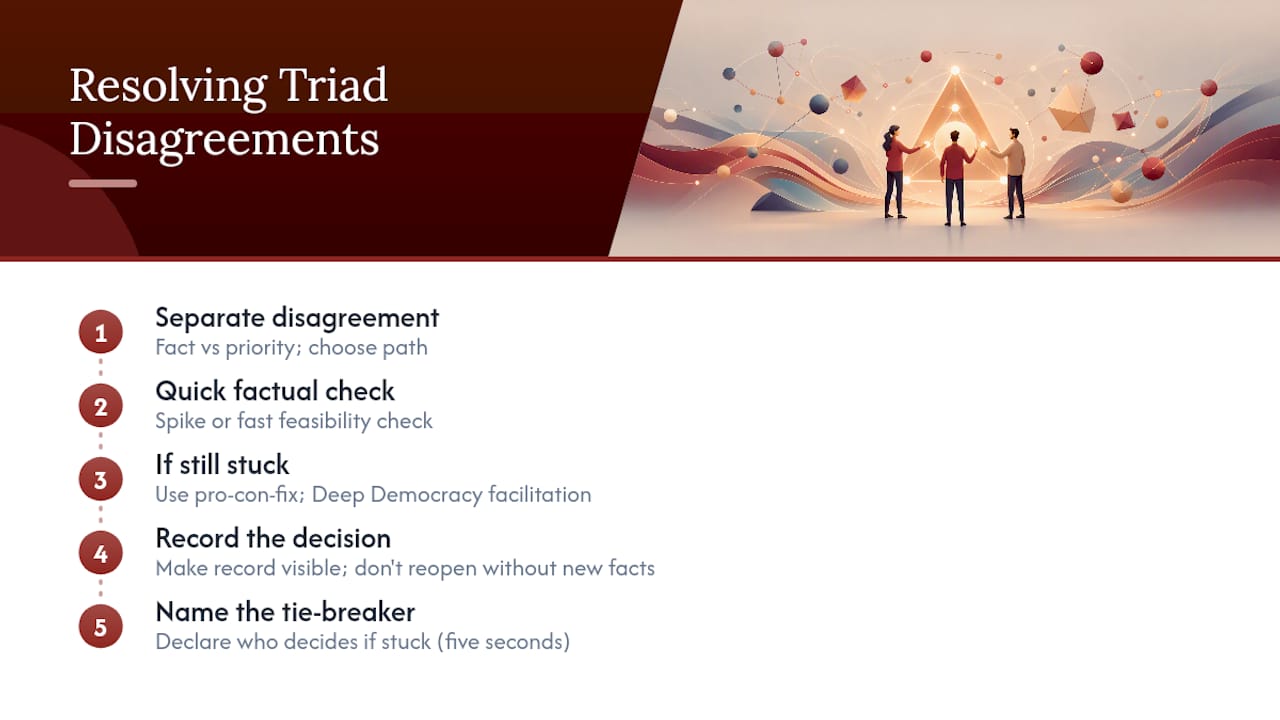
Start by separating disagreements about facts from disagreements about priorities. A dispute over whether a technical constraint is real gets settled with a spike or a quick feasibility check, not more discussion. A dispute over which trade-off matters more, speed versus polish, for instance, needs the tie-breaker named in the working agreement to actually make the call.
When a disagreement resists a quick answer, techniques like pro-con-fix lists force each side to state the downside of their own position out loud, which tends to soften entrenched stances faster than open debate does. Facilitation methods like Deep Democracy work well specifically because they give the quietest person in the room, often the one with the most legitimate concern, a structured way to be heard before a vote happens.
Avoid re-litigating a decision in a later meeting just because someone who was absent disagrees after the fact. The fix isn’t reopening the decision every time; it’s making sure the decision record was visible enough that absence isn’t an excuse. If a genuinely new fact emerges, that’s grounds to revisit. A recycled objection with no new information is not.
One rule prevents most conflict escalation before it starts: no decision closes without the tie-breaker being named ahead of time. Teams that skip this step end up relitigating splits that a five-second “who decides if we’re stuck” agreement would have resolved on the spot.
Checking Whether a Decision Actually Held Up
A decision that looked solid in the room can still fail two sprints later, and the only way to know is to check deliberately rather than assume silence means agreement.
Build a short review into the cadence you already have, ideally the same ritual that produced the decision in the first place. Ask three questions: did the decision ship as agreed, did any of the Must criteria turn out to be wrong once real usage data came in, and did anyone quietly work around the decision instead of following it? That third question catches more failures than the first two combined, because a workaround is a decision reversal nobody announced.
When a decision doesn’t hold, resist the urge to blame the framework. Usually the record shows the evidence at the time was thin, not that the process was broken. Update the decision log with the outcome rather than deleting the original entry. A record that shows “we decided X, and it didn’t hold because Y” is more valuable to the next team than a clean log that hides every mistake.
Iteration works best when it’s scheduled, not triggered only by visible failure. A quarterly pass through recent decision logs, checking which held and which didn’t, surfaces patterns individual retros miss, like a specific type of feasibility estimate that keeps being wrong, or a stakeholder group that consistently gets left out of the extended input circle. That pattern is worth fixing at the process level, not the decision level.
Scaling the Triad Across Bigger, Distributed Teams
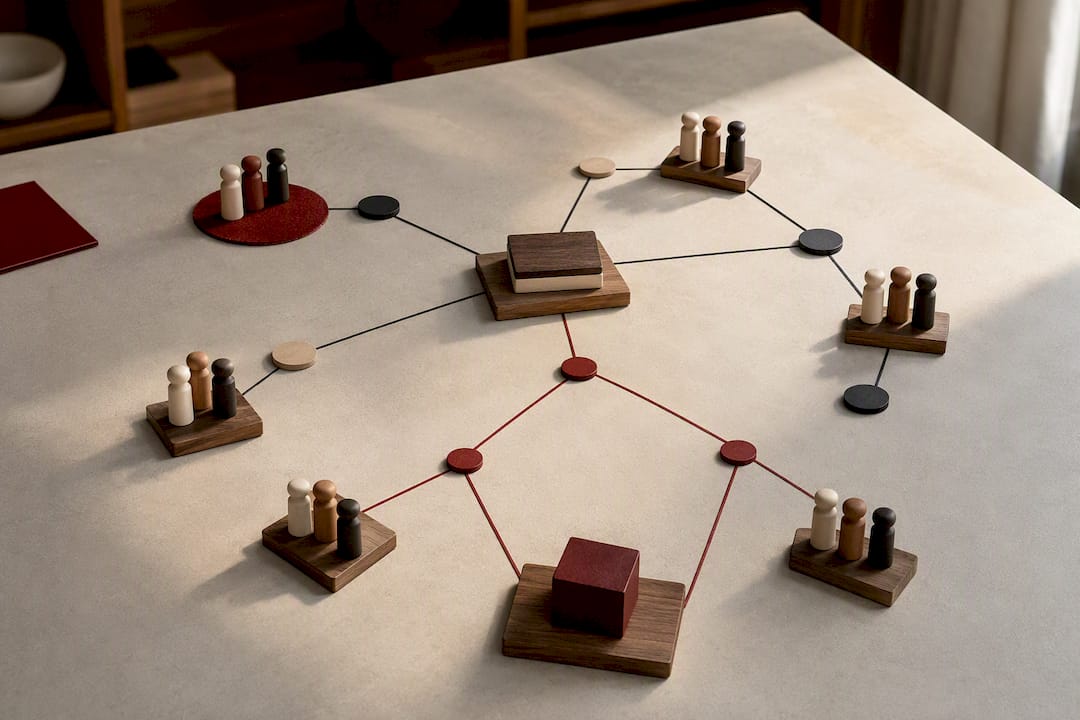
The triad model breaks cleanly at scale unless you’re deliberate about how you replicate it. A single triad works for one product surface. Ten product surfaces need ten triads, and without a shared template, each one reinvents its own working agreement, tie-break rule, and ritual cadence from scratch.
The fix is a shared skeleton, not a shared decision-maker. Every triad across the organization should use the same eight-field decision record and the same working-agreement template, even though the people, priorities, and criteria differ team to team. That consistency is what lets someone move between teams, or a leader review decisions across five squads, without relearning a new system each time.
Distributed teams add a second problem: time zones make live rituals harder to run with full attendance. Asynchronous documentation stops being a nice-to-have and becomes the only way context survives. A design jam that happens live in one time zone needs its outcome, not just its final decision, written up well enough that someone twelve hours away can review the reasoning without waiting for a recap meeting. This is where a searchable, linked decision log stops being bureaucracy and starts being the actual connective tissue between teams that never overlap in real time.
Escalation paths need the same clarity as tie-break rules. Define explicitly what happens when a decision affects more than one triad, who arbitrates, and how fast that arbitration needs to happen. Without that, cross-team decisions default to whichever leader is loudest in a shared Slack channel, which is the HiPPO problem again, just at a larger scale.
An Honest Note on Adoption
The friction nobody warns you about isn’t the framework. It’s that most teams adopt a ritual for two weeks, skip it during a crunch, and never restart it. Start with one triad, one ritual, one decision log. Measure whether decisions actually get revisited less often. If they don’t, adjust before you scale it to a second team.
— Rajas
How The Intent Ledger Turns Rituals Into Records
Running a good triad ritual solves half the problem. Keeping the reasoning behind it findable six months later solves the other half, and that’s usually where teams fall down. The Intent Ledger is built for exactly that gap: it takes your meeting conversations, transcripts, critique feedback, and client comments and turns them into structured ILM Records, each one linked back to the exact conversation it came from.
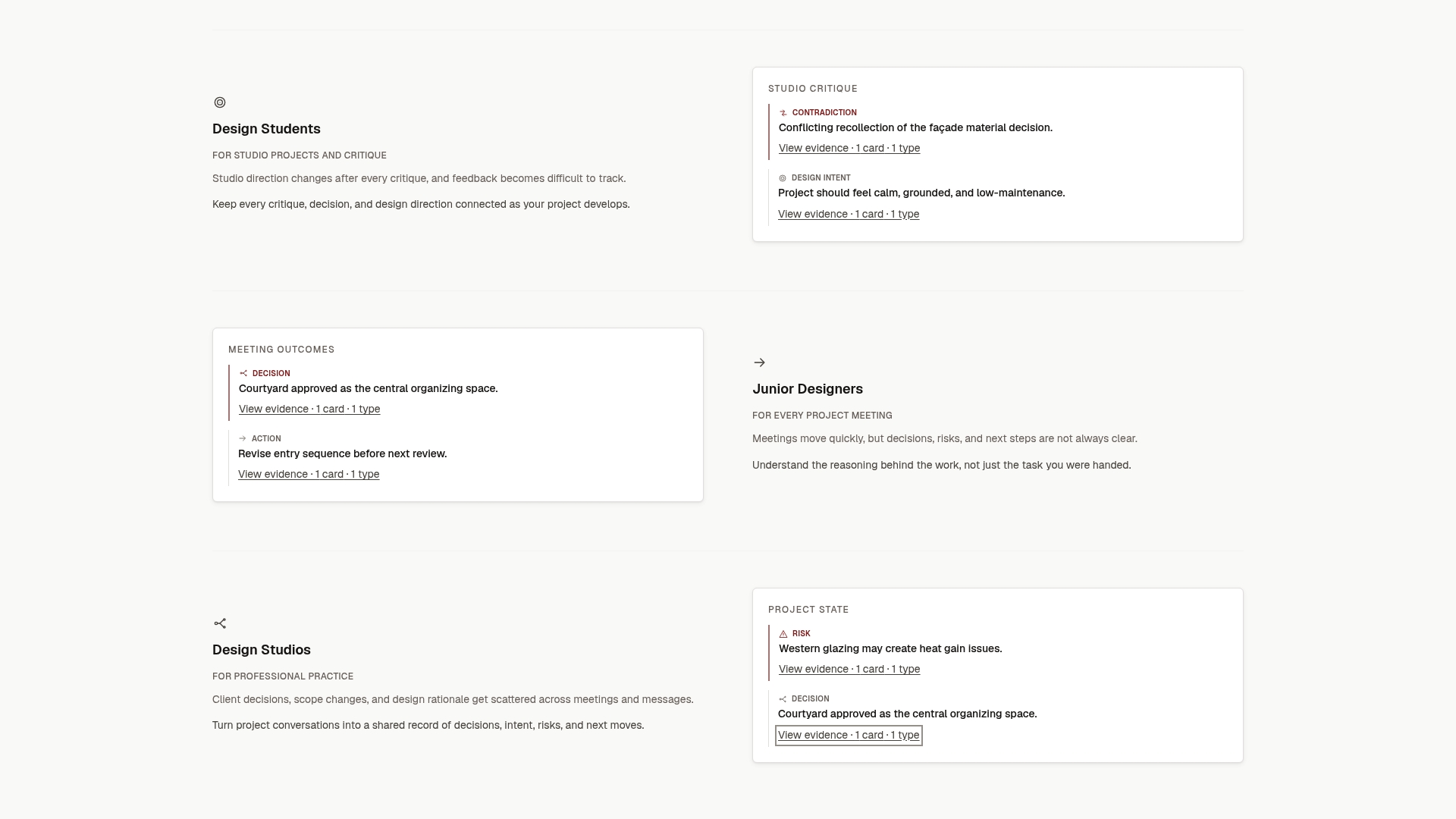
Instead of a decision log that someone updates when they remember to, teams get a record that captures who decided, why, what alternatives got rejected, and what’s still unresolved, without anyone manually filling out a template after the fact. New team members onboard faster because they can trace a decision back to its source conversation instead of asking around and hoping someone remembers correctly. If your next design jam produces a decision worth keeping, see how The Intent Ledger works or check the pricing plans to start capturing records this week.
Sources
- A game-theoretic research platform for team-based design decisions under competition
- The Triad Is Not a Seating Chart: Make PM, Design, and Engineering Actually Decide Together · Radar
- Design as a team (ThoughtWorks guidebook)
- Every Team Has a Design Debate. Most of Them Are a Mess.
- Facilitating collaborative design decisions @ Technovate’24 - Speaker Deck
FAQ
What does collaborative design mean?
Collaborative design means the people accountable for a design outcome, typically product, design, and engineering, make choices together using a shared process rather than one person deciding alone or the whole group needing to agree unanimously.
What are the 5 rules of effective collaboration?
Definitions vary, but the practices that show up consistently across design teams are: name a decision owner, write a working agreement, timebox discussion, require at least two alternatives before committing, and record the decision with its reasoning.
What is collaborative decision-making?
Collaborative decision-making is a structured process where a defined group, often a triad plus extended stakeholders, gathers input, weighs alternatives against agreed criteria, and reaches a decision with a clear tie-breaker rather than defaulting to hierarchy or unanimous agreement.
Can you give me some examples of collaborative projects?
A design jam where product, design, and engineering sketch and score competing solutions together is one common example, and a triad running a fixed weekly ritual with a shared decision log, the kind The Intent Ledger is built to support, is another.