Critique Questions That Produce Decisions, Not Just Opinions
Critique Questions That Produce Decisions, Not Just Opinions
The best critique questions do three jobs: they clarify what the work is trying to do, they ask for specific observations tied to that goal, and they end in a recorded decision. This guide gives you question sets for each stage, for design and architecture critiques, plus a way to write down the answers so the reasoning is still there months later.
Most pages on this topic are about critiquing writing or art classroom activities. If you run design reviews, studio crits or client feedback sessions, you need something different: questions that move a project forward.
TL;DR
- Start with intent. Ask what the design is meant to achieve before anyone says whether it works.
- Replace “do you like it?” with questions that tie a choice to a goal, and ask for one concrete change.
- Use dedicated questions for assumptions, risks and what nobody has decided yet.
- For architecture, add questions about the brief, users, site, context and constraints.
- Close every critique by naming the decision, the actions, the owners and the source of each, then write it down.
Table of Contents
- Why the question matters more than the critic
- Questions that clarify goals and intent
- Questions that turn opinions into specific feedback
- Questions that surface assumptions, risks and open issues
- Architecture critique questions: brief, users, site and context
- Questions that end in a decision
- How to run the session
- Perspective: the answer is only half the record
- Recording critique so the context survives
- Where The Intent Ledger fits
- A starter set you can paste into your next review
- FAQ
- Sources
Why the question matters more than the critic
A critique usually fails in the first two minutes. Someone shows the work, and the room reacts with taste: “I’d make it bolder,” “the entrance feels off.” Nobody has said what the work is for, so every comment is equally valid and equally impossible to act on.
Professional guidance points the same way. IDSA’s Anatomy of a Critique says reviewers should first ask questions that clarify the concept’s goals or objectives, and investigate intent before judging how well the solution fulfils it. Nielsen Norman Group adds that a critique needs a stated scope and goals, shared in advance with the work, so participants know what the conversation should and should not cover.
So the order below is deliberate: intent, then evidence, then risk, then context, then decision. Skip a stage and the next one gets noisy.
Questions that clarify goals and intent
Ask these before any judgment. They work for a junior designer presenting to a lead, a student at a pin-up, or a studio talking to a client.
- What is the objective of this design?
- Which elements relate most directly to that objective?
- Are those elements effective in achieving it? Why, or why not?
- What other objectives should we have considered?
- What new problems or opportunities might these choices create?
The first four come almost straight from a framework for discussing design as an objective-and-evidence exercise: name the intended outcome, connect choices to it, and explain whether the choices support it.
The Queensland Government’s design-critique playbook suggests the agenda also clarify who the users are, what problem is being solved, what value the work creates, why it is a priority and what stage the project is in. Those become a useful opening round:
- Who is this for, and what are they trying to do?
- What problem are we solving, and why now?
- What stage are we in: early ideas, a developed option, or a near-final detail?
The stage question matters more than it looks. Feedback on a sketch and feedback on a construction detail are different activities, and mixing them wastes the meeting.
Questions that turn opinions into specific feedback
“I don’t like it” is information about the reviewer. The goal of these questions is to convert it into information about the work.
Tie the comment to the goal
NN/g recommends asking how a design choice supports the goal, for example how a layout helps users accomplish a task quickly and efficiently, and reformulating opinionated or directive comments around the design goals. In practice:
| Vague or directive comment | Question that fixes it |
|---|---|
| “Make the lobby bigger.” | What do you see happening in the lobby that the current size doesn’t support? |
| “The palette feels cold.” | Which goal does the palette work against: welcome, calm, wayfinding? |
| “I’d move the stair.” | What problem would moving it solve, and what would it cost elsewhere? |
| “This is confusing.” | Where exactly did you hesitate, and what did you expect to find? |
Ask where feedback comes from and where it is going
Harvard’s Program on Negotiation advises asking where feedback comes from, meaning what was specifically observed, and where it is going, meaning what specifically should change, and narrowing the request to one concrete improvement. Two questions cover it:
- What did you observe that led to that comment?
- If we could change only one thing, what should it be?
Name the kind of feedback you want
The Queensland playbook recommends stating whether you want ideas, detailed feedback or quick specific feedback, so reviewers comment at the level the team needs. A one-line request at the top of the session does it: “We want ideas on the circulation concept, not comments on finishes.”
Separate what you saw from what you conclude
Academic writing guidance transfers well to design reviews. The University of Oklahoma Writing Center advises separating summary from analysis: first represent the work objectively, then evaluate it. A review version:
- Can someone restate what the design is doing, without judging it?
- What is the evidence for that judgment: something in the drawing, the site, the user research, or a precedent?
- Is this a fact, an assumption, or a preference?
That last question is the single most useful one in a heated review. It lets people keep a preference without letting it pose as a requirement.
Questions that surface assumptions, risks and open issues
The quiet risks are the ones that cost money later. Build a deliberate round for them.
Assumptions. The Oklahoma guidance suggests asking what assumptions underlie the piece, whether they are explained or implied, and whether they affect validity. For a design:
- What are we assuming about the users, the budget, the program or the schedule?
- Which of those have we confirmed, and which are we hoping are true?
- What evidence or ideas have we not considered?
Failure and exclusion. A design-review guide from the HIF project proposes red-team prompts such as misunderstanding, missing content, exclusion, interruption and failure, and which claim would change the decision if it were false. Adapted:
- Who might misread or be excluded by this?
- What happens when something goes wrong or is interrupted?
- Which single assumption, if false, would change our decision?
Where it breaks first. A critique framework by Zangwei Zheng suggests checking cognitive, execution, external, structural, second-order and long-term risks, then simulating likely failure paths. Keep it light: “If this fails, where does it show up first?”
What is still open. Flowtrace’s follow-up guidance says teams should record what was not decided, identify missing evidence or authority, and avoid treating silence as agreement. Before you close, ask:
- What did we not decide today?
- Who has the authority to decide it, and what do they need?
- Did anyone stay quiet on something that matters?
Architecture critique questions: brief, users, site and context
Architecture adds a layer that interface design rarely has: the building answers to a place. The Government Architect NSW’s Evaluating Good Design guidance says evaluation should consider immediate and wider context, landscape, urban form, site conditions, public realm, neighbouring sites, heritage, local identity and community needs. That is Australian guidance, and the specific policy tests will differ by jurisdiction, but the questions travel well.
The brief
- What did the client ask for, and what do they actually need? Where do those differ?
- Which parts of the brief are fixed and which are negotiable?
- Has the brief changed since the concept was set, and is that change recorded?
Users
- Who uses this building daily, and who only passes it?
- Which user group did we design for most deliberately, and which did we design for least?
Site and context
- What does the project do to its neighbors: light, views, access, scale?
- How does the building meet the street or public realm?
- What on this site (slope, orientation, existing structures, heritage) shaped the form most?
Constraints
- Which constraints are regulatory, which are budgetary, and which are self-imposed?
- What would we do differently if the biggest constraint were lifted, and does that tell us something?
Intent versus outcome
- Which of the concept’s original ideas is still visible in the current plan?
- Which one got traded away, and who agreed to it?
That last pair is where student crits and studio reviews usually leave value on the floor. Design intent erodes through a series of small, reasonable trades, and without a record nobody remembers that the trade happened.
Questions that end in a decision
A critique that produces only a pleasant discussion has not finished. The HIF guide suggests asking what decision is being made and recording whether the outcome is approve, approve with actions, iterate, test, escalate, reject or exception, along with the rationale, actions, owners, due conditions and how each will be verified.
Flowtrace recommends testing each proposed action with a few blunt questions: does it support a real decision, is its underlying assumption still true, are ownership and authority clear, and would it still matter if the next meeting were cancelled. Combined into a closing round:
- What decision did we make today, and which outcome is it: approve, iterate, test, escalate?
- Why did we decide it? What reasoning would a new team member need?
- Which actions follow, and who owns each?
- Does each action still matter if the assumption behind it is wrong?
- How will we know it is done?
- What is still unresolved, and who will resolve it?
Question 2 is the one most teams skip, and it is the one that matters in six months.
How to run the session
Questions only work if the room lets them. NN/g describes facilitation as the conscious, balanced management of conversation toward a conclusion, and says rotating facilitators, time-boxing and reformulating opinionated comments keep one voice from dominating. A workable structure for a 45-minute review:
| Block | Minutes | Purpose |
|---|---|---|
| Context and goals | 5 | Stage, objective, kind of feedback wanted |
| Silent look and notes | 5 | Everyone writes observations first |
| Goal-tied feedback | 15 | Questions from the intent and evidence sets |
| Risks and assumptions | 10 | The red-team round |
| Decision and actions | 10 | The closing round, recorded live |
The silent round is a small trick with a large payoff: it stops the first confident speaker from setting everyone’s opinion.
Perspective: the answer is only half the record
We built The Intent Ledger because we kept seeing the same pattern. A good critique happens, people leave energized, and three weeks later someone asks, “Why did we drop the courtyard?” Nobody can answer with confidence. The notes say “courtyard removed.” They do not say who raised the concern, what it was tied to, or whether the question was ever really settled.
Good critique questions get the reasoning out into the open. They do not keep it. Our view is that the why is the most perishable thing a design team produces, more than drawings or files, and that it should be stored with its source: the exact conversation, comment or critique it came from. A decision you cannot trace back to a conversation is a decision you will eventually re-argue.
That is why we think of the closing questions above as the most valuable part of any review. “What did we decide, why, who owns it, and what is still open?” is a complete record in four lines, if someone writes it down while the room still remembers.
, Rajas
Recording critique so the context survives
Recording is where good intentions go to die, so keep it boring and structural.
- Take notes in public. NN/g says critique notes should be taken publicly in a collaborative tool, with participants adding observations and clarifications in real time, and that follow-up should include the notes and action items.
- Keep a comments-and-responses table. One utility’s design-document requirements specify that review output should be a maintained table of reviewer comments and the design firm’s responses, with significant design decisions and further research needs documented. It is a good model even if you are not submitting to a utility.
- Capture lessons at close-out. The AIA’s Design for Discovery framework recommends engaging the project team in close-out review, recording lessons learned including details and materials to repeat, and sharing outcomes with staff.
A minimal record for each decision has these fields: the decision, the reason, the source conversation, who raised it, the actions and owners, the risks named, and the questions left open. If you want ready-made layouts, our posts on design review note templates, what to capture in a record of decision and a three-phase design review checklist go field by field. For a longer trail across a project, see the six-field decision audit trail.
Where The Intent Ledger fits
The Intent Ledger takes the raw material of a critique, whether that is meeting notes, a transcript, an audio recording, or client comments, and turns it into ILM Records: structured, source-backed entries for decisions, design intent, risks, actions, commitments and unresolved questions, each traceable to the conversation it came from.
You can start small. Pricing is published on the pricing page: one-off packs run from Working Set at $12 to Studio Ledger at $119, and monthly plans run from Working Memory at $29 per month to Shared Ledger at $149 per month. A single student or freelance architect usually needs far less capacity than a studio sharing a ledger across projects, so pick the size that matches how many critiques you run.
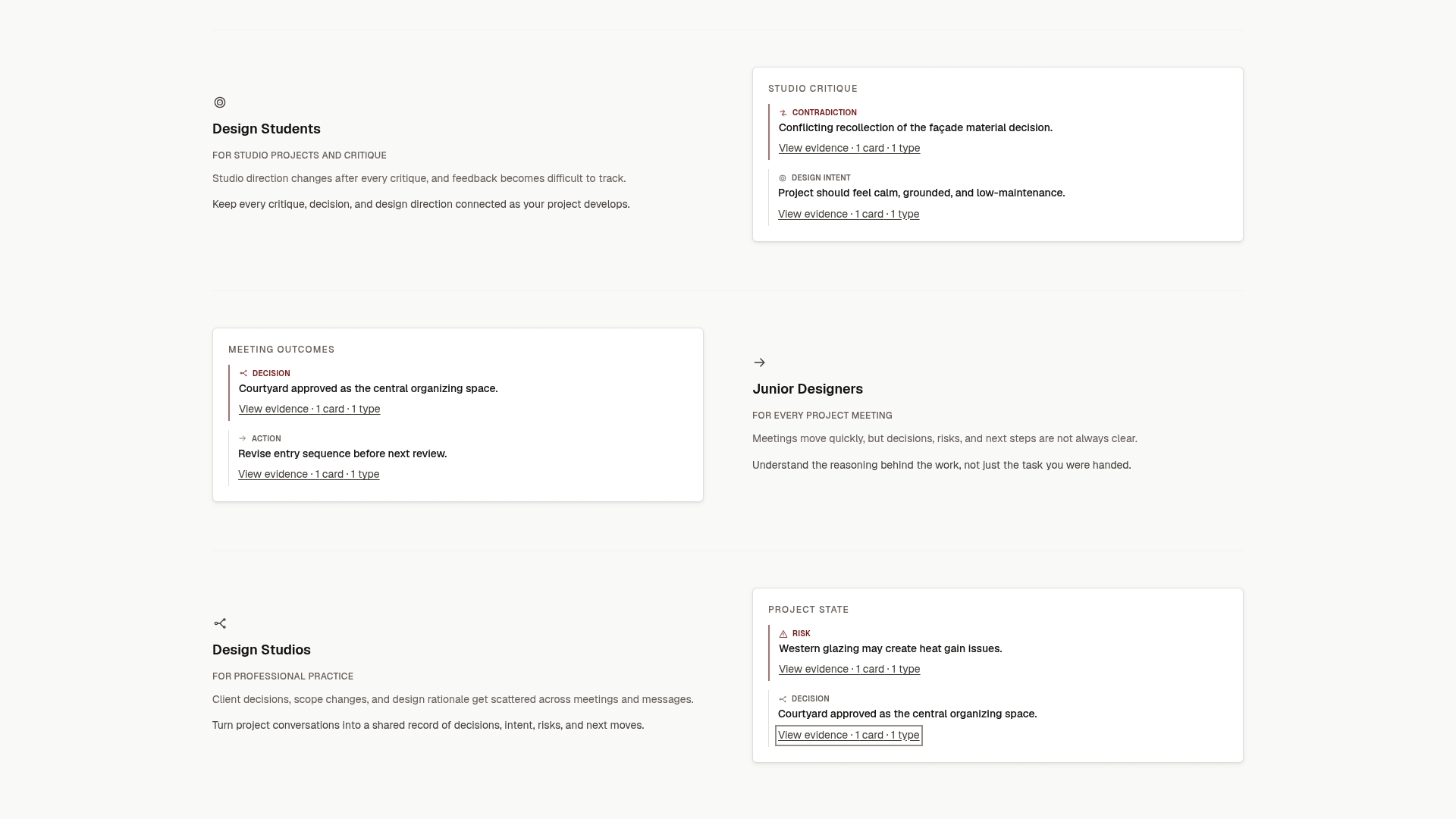
If you want to see how the structure works before you commit, the Intent Ledger homepage walks through it.
A starter set you can paste into your next review
If you take nothing else, use this short list. It covers every stage above in ten questions.
- What is this design trying to achieve, and for whom?
- What stage is it at, and what kind of feedback do we want?
- Which choices support that goal most, and which least?
- What did you observe that led to your comment?
- Is that a fact, an assumption or a preference?
- What are we assuming that we have not confirmed?
- If this fails, where will it show up first?
- What are the brief, site and context telling us that we have not yet answered?
- What are we deciding today, why, and who owns each action?
- What is still unresolved, and who will resolve it?
Print it, put it on the first slide, or paste it into the shared notes. A student can use it at a pin-up, a junior designer can use it to ask a lead where a task came from, and a freelancer can use it to turn a client call into something both sides can point to later.
FAQ
What are good questions to ask in a design critique?
Start with the goal: what is the design meant to achieve, and for whom? Then ask how specific choices support that goal, what the reviewer observed, and what single change would help most. Finish with what was decided and what remains open.
What should I ask in an architecture critique?
Add questions about the brief, the users, the site, the surrounding context and the constraints to the general design set. Government Architect NSW guidance, for instance, points to context, public realm, heritage and community needs. Also ask which original design ideas survived and which were traded away.
How do I get specific feedback instead of “I like it”?
Tell reviewers what kind of feedback you want and tie your questions to the design goal. Ask what they observed and what one thing they would change. Harvard’s Program on Negotiation recommends exactly that narrowing of the request.
How do I respond to criticism politely?
Ask a clarifying question before defending: what did you notice, and what would you change? Treat the comment as information about how the work reads, then decide afterward what to act on. Writing the comment and your decision down keeps the exchange calm and checkable.
How should I document the results of a critique?
Record the decision, the reason, the actions with owners, the risks raised and the questions left open, each linked to where it came from. Take notes in a shared place during the session rather than reconstructing them later.
Sources
- Anatomy of a Critique: Observations (IDSA)
- Design Critiques: Encourage a Positive Culture (Nielsen Norman Group)
- Discussing Design
- Design critique (Queensland Government)
- Learning from Feedback Without Losing Your Mind (Harvard PON)
- Writing a Critique (University of Oklahoma Writing Center)
- Design review and critique (HIF)
- Universal Critique, Evaluation and Risk Analysis (Zangwei Zheng)
- Meeting Follow-up Best Practices (Flowtrace)
- Evaluating Good Design (Government Architect NSW)
- Design Document Submission Requirements (SRP)
- Design for Discovery (AIA)