Critique Summary: How to Write One That Keeps the Why
Critique Summary: How to Write One That Keeps the Why
A critique summary is a short written record of a design critique. It states what was reviewed, what feedback came up, what the group actually decided, who owns each next step, and what is still open. A good one takes ten minutes to write and saves hours of “wait, why did we do it that way?” later. Below you will find the structure, the rules that keep it honest, and a filled-in example.
The phrase also means something else in academic writing, where a critique summary condenses a book or article and then evaluates it. This guide covers the design version: studio reviews, client feedback sessions, and student crits.
TL;DR
- A critique summary separates five things: feedback, decisions, actions, risks, and open questions. Mixing them is the most common failure.
- A decision is what the group agreed to, not what it discussed. Write it in one active sentence with the reason attached.
- Every action needs a task, an owner, and a date. Flag missing ones instead of guessing.
- Keep a pointer to the source (recording, transcript, board) so anyone can trace a line back to the conversation.
- Write it the same day, in under a page, and store it with the project history.
Table of Contents
- What a critique summary is for
- What to include
- How to tell feedback, decisions, actions and open questions apart
- How to write the feedback itself
- A filled-in critique summary example
- A short process that works
- Making critique summaries useful across a project
- Common mistakes
- Turn critique conversations into ILM Records
- FAQ
- Sources
What a critique summary is for
The Nielsen Norman Group describes a design critique as analyzing a design and giving feedback on whether it meets its objectives. The summary is what remains once the room empties. Without it, a critique lives only in people’s memories, and memories disagree.
Researchers at the Singapore University of Technology and Design make the same point about design education: critique often happens episodically and disappears after verbal discussion, which is why they argue for structured, exportable records. The problem is not limited to classrooms. Studios lose context the same way when a client comment is mentioned in a hallway and never written down.
A design review standard published by HIF says a review’s purposes include recording decisions, dissent, exceptions, and residual risk, and that the record should sit with the product’s decision history. That is a useful test for your own summary: if someone joins the project in three months, can they see what was decided, who disagreed, and what risk was accepted?
What to include
You do not need a long document. A one-page summary with the sections below covers nearly every critique. The Berkeley i213 course asks students for a short executive summary under one page that outlines the major problems and possible solutions, prioritized by severity and fixability. The same discipline applies in practice: lead with what matters most.
| Section | What goes in it | Test for a good entry |
|---|---|---|
| Context | Date, attendees, what was reviewed, which version | Someone can find the exact artifact |
| Summary | Two or three sentences on the outcome | Readable without the rest |
| Feedback | Observations and suggestions, grouped by theme | Specific and tied to the work |
| Decisions | What the group agreed to, with the reason | Written as a completed choice |
| Actions | Task, owner, due date | No action without all three or a flag |
| Risks | What could go wrong if feedback is ignored or a choice is wrong | Names the consequence |
| Open questions | Raised but unresolved | Has someone assigned to answer it |
A public meeting-recap template from the OpenDesignOps project uses a similar skeleton: a 2 to 3 sentence summary, key decisions, discussion highlights, an action table with owner and due date, and a parking lot for open questions. Adapt it to your team rather than treating it as a standard.
How to tell feedback, decisions, actions and open questions apart
This is where most summaries go wrong. Everything said in a critique feels equally important, so it all lands in one bulleted list. Sort it instead.
Feedback is not a decision
Feedback is an observation or suggestion: “The entry sequence feels cramped.” A decision is a commitment: “We will widen the entry by 600 mm.” One public meeting-notes guide puts it bluntly: decisions record what the group agreed to, not what was discussed. “The team discussed deployment timelines” is not a decision. “The team decided to delay deployment” is.
A second guide on turning transcripts into records suggests a separate bucket for items that were mentioned but not decided, so half-agreements do not leak into the decisions list. It also asks for an evidence phrase: the line from the conversation showing the matter was settled. That habit is the single best defense against a summary that overstates agreement.
Actions need an owner and a date
The OpenDesignOps guidelines say an action item needs what, who, and when. If the owner or date is missing, mark it “[Owner TBD]” or “[Date TBD]” and write in active voice: “Taylor will revise the section” rather than “it was discussed that Taylor might.” The meeting-notes guide above agrees: an unowned action is marked unassigned, never given an invented name.
The transcript guide goes one step further and gives each action a status of confirmed, implied, or needs review. That prevents two errors at once: dropping commitments made casually, and inventing crisp assignments nobody made.
If you want to track those actions after the meeting, action item tracking for students and young professionals shows one way to keep accountability visible once the summary is written.
Open questions stay visible
An open question is something raised and not resolved. Put it in the summary with a name beside it. The same guide recommends keeping every section in the template even when empty, writing “[None recorded]” so readers know nothing was skipped.
Decision outcomes can be more than yes or no
The HIF standard lists seven outcomes a review can record: approve, approve with actions, iterate, test, escalate, reject, and exception. Exceptions carry metadata such as owner, evidence, mitigation, expiry, and review date. You probably will not use all seven, but naming “approve with actions” or “iterate” is far clearer than a vague “mostly good.”
How to write the feedback itself
The wording of feedback in the summary should preserve its usefulness. The Northwestern User-Centered Design Workbook lists four principles: descriptive before evaluative, user-centered, specific and actionable, and solution-focused. It also advises framing suggestions as opportunities (“What if…” or “Consider…”) instead of directives.
Two practical effects follow:
- Describe before you judge. “The stair is 1.1 m wide and sits at the center of the plan” comes before “the stair dominates the plan.”
- Critique the work, not the person. HIF states that critique evaluates the work, not the worth or talent of its author. A summary that names who was “wrong” becomes a document nobody wants to write honestly.
The same workbook warns reviewers to watch for five biases: aesthetic, expertise, confirmation, anchoring, and solution bias. Solution bias matters most for summaries. If a reviewer proposed a fix, record the underlying problem first and the proposed fix second, so the team can find a better answer later.
A filled-in critique summary example
The example below is an illustration written for this guide, not a real project. It shows the level of detail that works. Copy the shape, not the content.
Project: Riverside community library, schematic design, Option B Date: Tuesday studio review. Attendees: Maya (lead), Dev (junior designer), Ana (PM), client rep Chris Reviewed: Plan and section set, version 4
Summary: The group endorsed the daylight strategy and the central reading room. The main concern is the entry sequence, which feels cramped at peak hours. Option B proceeds with a wider entry; the budget impact is unresolved.
Feedback
- Reading room: north-facing clerestory praised for even light (Chris, Maya).
- Entry: the vestibule feels tight compared with expected visitor volumes (Chris). Suggestion: consider merging vestibule and lobby.
- Circulation: stair location pulls visitors away from the help desk (Dev).
Decisions
- Keep the clerestory daylight strategy. Reason: it meets the client’s goal of low daytime lighting load. Source: recording, 14:20.
- Widen the entry sequence in the next version. Reason: peak-hour congestion raised by the client. Source: recording, 31:05.
Actions
Action Owner Due Status Draft two entry options with widened vestibule Dev Next review Confirmed Get a rough cost impact on the wider entry [Owner TBD] [Date TBD] Needs review Send revised plans to client Ana After options are drawn Implied Risks: A wider entry may reduce reading room area. If the cost check slips, the next review may lack the information to choose.
Open questions: Does the client want the help desk relocated? (Chris to confirm.) Is merging vestibule and lobby compatible with fire egress? (Maya to check.)
Notice what the example does. Decisions carry a reason and a pointer to the moment in the recording. The unowned cost action is flagged rather than quietly assigned. The entry suggestion stays in feedback because nobody committed to merging spaces.
A short process that works
- Capture the raw material. Record the session if everyone agrees, or assign one person to take notes. Photograph boards.
- Write within a day. Memory of tone and nuance fades quickly.
- Sort, don’t transcribe. Move each item into feedback, decision, action, risk, or open question.
- Attach the reason and the source. One clause for why, one pointer for where.
- Flag gaps. Missing owners, dates, or unconfirmed commitments get marked, not smoothed over.
- Circulate and correct. Ask attendees to reply with corrections within a day or two, then treat it as the record.
- File it with the project. A summary nobody can find is the same as no summary.
For more templates, our posts on design review notes and a three-phase design review checklist go deeper on the formats. If you need to show how a decision evolved, the six-field decision audit trail covers that.
Making critique summaries useful across a project
A single summary helps. A series of them becomes project memory. The Nielsen Norman Group notes that a healthy critique culture keeps everyone up to date, enables earlier buy-in, and builds team consensus, and that critiquing work in progress allows changes before the design is final without hurting cost or timeline. Summaries are how those benefits outlast the meeting.
For different readers, the emphasis shifts:
- Students need to track which critique points they acted on, which they rejected, and why. That reasoning is what instructors and portfolio reviewers want to see.
- Junior designers benefit when the summary shows where a task came from, so they can ask the right person instead of guessing.
- Project managers use the actions and open-questions tables as a running list for the next meeting.
- Freelancers protect themselves and their clients with a dated record of what feedback was given and what was agreed.
Teams that run recurring reviews also benefit from a lightweight look-back. A piece on turning project retrospectives into a billable step for consultants shows how to fold review learnings back into the way you work.
Common mistakes
- Writing a transcript, not a summary. If it takes longer to read than the meeting took, nobody will.
- Recording what, not why. “Changed the facade” is useless in six months. “Changed the facade to reduce afternoon glare, per client” is not.
- Inventing consensus. If one person objected, record the dissent. The HIF standard explicitly lists dissent among what a review should record.
- Losing the source. Without a pointer, no one can check a disputed line.
- Waiting a week. By then the details have blurred.
Our perspective
We built The Intent Ledger around one belief: the hardest thing to recover from a design project is not what was decided but why. A summary that lists outcomes tells a new team member what the drawings show anyway. The reasoning, the alternative that was rejected, the client comment that triggered the change, is what disappears.
That is why we treat a critique summary as a record, not a recap. Each ILM Record is designed to hold the decision, the design intent behind it, the risks, the actions, and the unresolved questions, and to stay traceable to the conversation it came from. When someone asks “where did this come from?”, the answer should be a click, not a debate.
Whether you use our software or a well-kept template, hold yourself to the same standard: every decision gets a reason, every action gets an owner, and every line points back to its source. Studios that do this stop relitigating old choices and start building on them.
Rajas
Turn critique conversations into ILM Records
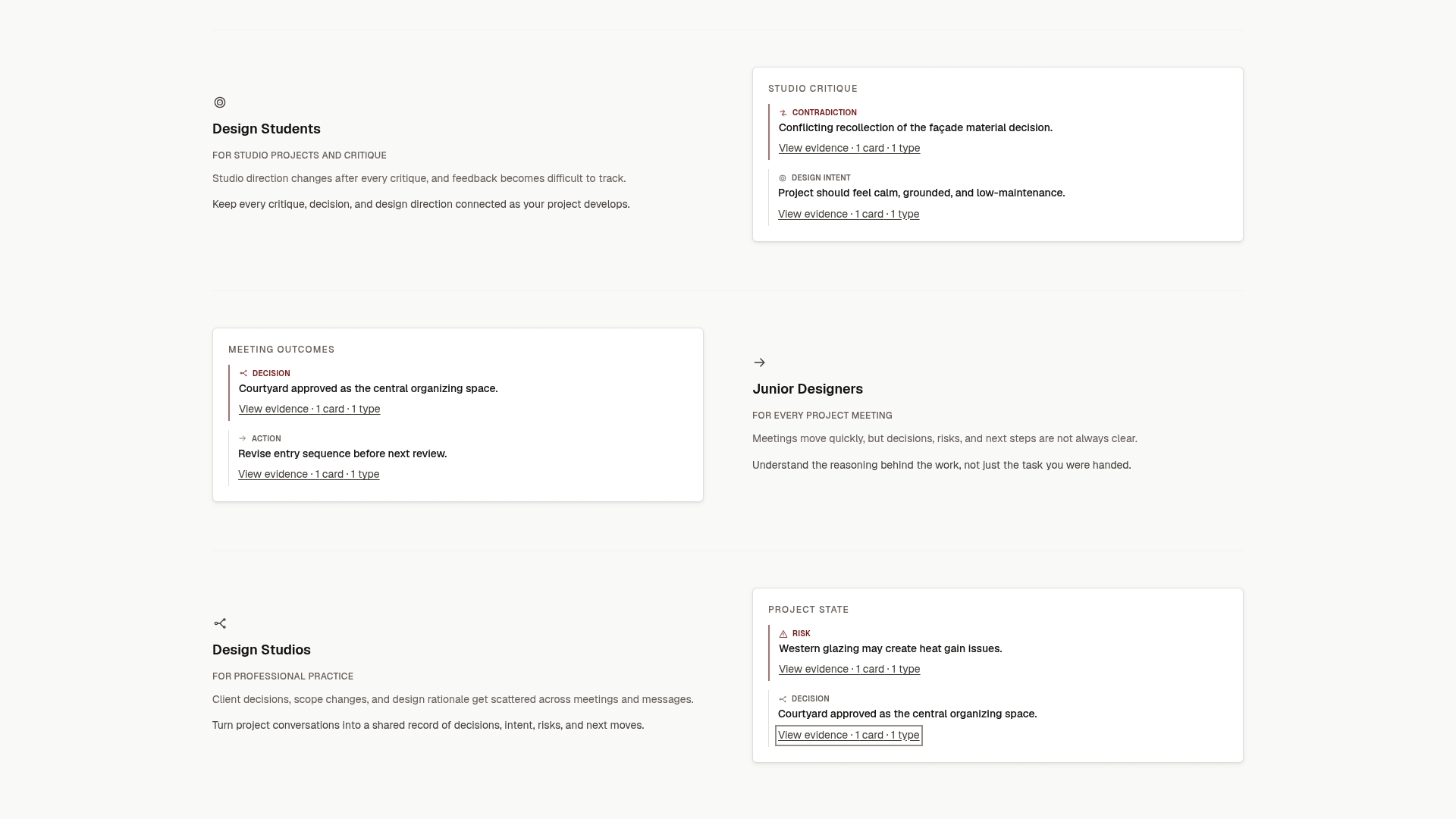
If writing summaries by hand is the step that keeps slipping, The Intent Ledger is built for it. It turns meeting notes, transcripts, critique feedback, and client comments into structured, source-backed ILM Records of decisions, design intent, risks, actions, commitments, and unresolved questions.
You can start small with a one-off pack: Working Set is $12 and Project Record is $29. For ongoing work, the Working Memory plan is $29 per month. Compare every option on the pricing page, or see how the product works on The Intent Ledger home page.
FAQ
How long should a critique summary be?
Aim for one page. The Berkeley course guidance asks for a short executive summary of under a page, with the highest-priority problems first. Put the outcome in two or three sentences at the top, then use tables for actions and open questions so readers can scan.
What is the difference between critique notes and a critique summary?
Notes capture what was said as it happened. A summary sorts it afterward into feedback, decisions, actions, risks, and open questions, and drops the rest. Notes are raw material; the summary is what you share and file.
Who should write the summary?
One named person, ideally someone other than the presenter, so the presenter can listen. Rotating the role spreads the habit. Attendees then review it and correct anything misstated before it is final.
Should a critique summary include who said what?
Attribute feedback to a role or name when it matters, such as a client requirement or an expert concern. Keep the focus on the work rather than the person, in line with the principle that critique evaluates the work, not its author.
Does the academic kind of critique summary follow the same format?
No. An academic critique summary condenses a book or article and then assesses it, usually in prose. The design version is a working record of decisions and next steps, closer to meeting minutes with the reasoning kept in.
Sources
- Design Critiques: Encourage a Positive Culture to Improve Products, Nielsen Norman Group
- Design review and critique, HIF
- Formative evaluation assignment, Berkeley i213
- Meeting recap template, OpenDesignOps
- Project management meeting notes specialist, agency-agents
- Sample Design Critique Framework, Northwestern User-Centered Design Workbook
- Turn a Meeting Transcript Into Decisions and Actions, NewPrompt
- Critsly: An Artefact Aware AI Critique Teammate for Design Education
- Action Item Tracking: Unlocking Student Success
- Project Retrospectives for Consultants