Decision Accountability Matrix: How to Build One for Design Work
Decision Accountability Matrix: How to Build One for Design Work
A decision accountability matrix is a grid that shows, for every decision on a project, who does the work, who owns the final call, who gives input and who is told afterward. Most teams build it as a RACI chart: decisions down the left, people or roles across the top, and one of four letters in each cell. It answers “who decides?” The question it leaves open is “why did they decide that?”, and on design projects that second answer is the one people lose first.
This guide covers both halves: how to build a matrix that works for a design team or studio, and how to keep the reasoning behind each decision attached to the name in the grid.
TL;DR
- A decision accountability matrix maps each decision to four roles: Responsible, Accountable, Consulted, Informed (RACI).
- Every decision gets exactly one Accountable person. Two names mean an argument later, and none means a dropped ball.
- Build it from decisions first, roles second, and review it for gaps (no A, no R) and overlaps (two As) before anyone relies on it.
- The matrix records who owns a call. A decision record keeps the why, traced to the conversation it came from.
- Revisit it at each project phase, because roles and clients shift.
Table of Contents
- What a decision accountability matrix is
- Why design teams need one
- How to build the matrix, step by step
- A worked example: a small architecture studio
- One decision, one accountable owner
- Keep consultation lean
- Keeping the matrix honest on a live project
- The gap a matrix cannot fill: the reasoning
- Variants and alternatives
- Where The Intent Ledger fits
- Our perspective
- FAQ
- Sources
What a decision accountability matrix is
The tool most people mean by this phrase is the RACI matrix. It was first introduced in the 1950s, originally called the Decision Rights Matrix and also known as Responsibility Charting. The name stuck to the four letters instead, but the purpose is the same: make decision rights visible so nobody has to guess.
The four letters:
- Responsible ®: the role that does the work. More than one person can be Responsible for a task. In NN/g’s example, a user researcher runs a usability test while a product manager and an engineer share note-taking.
- Accountable (A): the person who gives final review and determines whether and when the task is complete. There is only one per task, and the Accountable person can also be Responsible.
- Consulted ©: people whose input is sought before the decision is made. Communication runs both ways.
- Informed (I): people told about the outcome once it is made. Communication runs one way.
For a design team, translate these into studio terms. The principal might be Accountable for approving a schematic design. The project architect is Responsible for preparing it. The structural engineer and the client are Consulted. The junior designer and the contractor are Informed.
Why design teams need one
Design work produces decisions constantly, and most of them happen in conversation: a desk critique, a client call, a coordination meeting. Someone says “let’s go with the timber screen,” everyone nods, and three weeks later two people remember different outcomes and a third was never told.
A matrix helps because it settles ownership before the conversation happens. NHS Scotland’s guidance says a RACI matrix is especially useful when several people or teams contribute to the same project, which describes nearly every studio project with consultants and a client attached.
It helps different readers in different ways:
- Project managers get a reference when a decision stalls: who is supposed to make it?
- Junior designers can see why they were asked to redraw something, and who to ask.
- Students can assign roles inside a group project and a critique, so feedback has an owner.
- Freelance architects can show clients which calls are theirs and by when, which keeps approvals from drifting.
How to build the matrix, step by step
The steps below combine the Institute of Project Management’s six-step guide with the gap checks used in ITIL’s service-design process.
Step 1: List decisions, not tasks
Start with the decisions and deliverables that need an owner. Be specific: “approve facade material” is useful, “design the building” is not. Faster Than Normal’s guide suggests aiming for 10 to 25 rows on a typical project and treats more than 30 as a sign the list is too granular. For a design project, rows usually follow phases: brief sign-off, concept direction, schematic approval, material selection, consultant coordination, change requests, handover.
Where it goes wrong: listing everything. A matrix with 80 rows is never read, so it never governs anything.
Step 2: Identify roles, not names
The IPM guide recommends using roles rather than names, since people change but roles persist. In a studio: principal, project architect, designer, project manager, client representative, structural engineer, contractor. If one person holds two roles on a small project, write both roles in the column header.
Step 3: Build the grid
Put decisions in rows and roles in columns. As NN/g describes it, each cell specifies involvement with one of the four letters. Blank cells are fine. A blank means “not involved,” and that is intentional.
Step 4: Assign letters row by row
Assign the A first, because it is the hard one. Then the R. Then add Cs and Is only where input or notification really changes the outcome. Faster Than Normal puts the cost bluntly: every C you add is a meeting you are creating, and every I you convert to a C is a veto you are implicitly granting.
Step 5: Check for gaps and overlaps
ITIL’s gap analysis gives a useful checklist, as set out in its service-design chapter:
- More than one A: only one role can be accountable.
- No A: at least one must be assigned.
- No R: nobody is doing the work.
- Many Rs: too many responsible roles often means no one takes responsibility.
- Many Cs: is the consultation time justified?
- No Cs or Is: are communication channels open?
Step 6: Review with the people named in it
Share the draft with everyone in it, get their objections in the open, and fix the grid before the project depends on it. A matrix the principal wrote alone will be ignored by everyone else.
A worked example: a small architecture studio
Here is a trimmed matrix for a mid-sized residential project. P = Principal, PA = Project Architect, D = Designer, C = Client, E = Structural Engineer.
| Decision | P | PA | D | C | E |
|---|---|---|---|---|---|
| Approve schematic design | A | R | C | C | I |
| Select facade material | C | A/R | R | C | I |
| Approve structural grid change | I | A | I | I | R |
| Accept client layout feedback | C | A | R | R | |
| Sign off change order | A | R | C | C |
Read the second row. The project architect is both Accountable and Responsible for the facade material, which is fine for one decision. The IPM guide warns against the same person being both R and A on every task, since that signals workload has not been distributed. In this grid the principal owns the two highest-stakes calls, and the others are spread out.
Notice also that the client holds an R in the layout-feedback row. They are responsible for giving feedback, and the project architect is accountable for deciding what to do with it. That separation is what keeps client comments from becoming silent instructions.
One decision, one accountable owner
The most common question is whether two people can be accountable. The standard answer is no. PMI’s stakeholder-management guidance says responsibility can be shared but a single name owns the outcome. Two names in the Accountable column set up your next argument, and none sets up your next dropped ball.
The IPM guide explains the mechanism: when two people share the A, neither feels fully responsible, decisions slow down, blame spreads out and escalation paths become unclear. If a decision truly needs two senior people, split it into two rows, such as “approve design intent” and “approve construction cost,” and give each its own owner.
NN/g’s Anna Kaley makes a similar point about cross-disciplinary work: even when design collaborates with product and engineering, primary accountability should fall on one discipline. The same logic applies when an architect, an interior designer and a landscape designer all touch the same courtyard.
Keep consultation lean
Over-consulting is the quiet failure of matrices. IPM advises that more than two or three Consulted roles on a task creates a committee, not a consultation. NHS Scotland’s guidance likewise says to avoid large numbers of consulted stakeholders because they create delays.
Practical rules for a studio:
- Consult only people whose input could change the decision.
- Give Cs a deadline. The HHS Office of Population Affairs describes an approach where the accountable lead incorporates input by a set deadline and decides if input does not arrive.
- Move people to I when they only need to know the outcome.
The same HHS document notes that decisions often have to be made quickly and with limited information, so the Accountable person needs to understand each stakeholder’s concerns and the project’s quality targets. In design terms: the owner of a call must know what the client cares about and what the design cannot give up.
Keeping the matrix honest on a live project
Drawing the grid is the easy part. PMI frames the real difficulty as keeping roles honest on a live project, where priorities shift and people feel blindsided when they are cut out of a decision they cared about.
Three habits help:
- Review at phase gates. IPM recommends revisiting the matrix at key lifecycle gates. For a design project that means the end of concept, schematic, design development and construction documents.
- Announce the outcome to the Informed list. Communication in team engagement depends on people hearing decisions that affect them, not discovering them in a drawing revision.
- Treat consultation and updates as part of governance. Sound project governance for professional firms pairs clear ownership with efficient stakeholder updates.
For how to run the meeting where owners are confirmed, see our piece on stakeholder alignment meetings and one-owner decision records.
The gap a matrix cannot fill: the reasoning
A matrix tells you that the project architect owned the facade decision. It does not tell you that the client rejected brick because of a maintenance concern raised in the call on a Tuesday, that the engineer flagged a load limit, or that the team agreed to revisit the choice if the budget moved.
That reasoning matters on design projects because decisions are revisited. A client asks “why aren’t we using brick?” and the honest answer lives in someone’s memory, a meeting transcript nobody reopens, or a comment thread. A junior designer asks why a task exists and finds only the task.
The fix is to pair the grid with a record of each significant decision: what was decided, by whom, the reasons, the risks raised, the actions assigned and the open questions, with a pointer back to the original conversation. A decision log does this at its simplest. Our blog collects articles on the decision log template and the project decision record, and our design review checklist shows where in a three-phase review the decisions should be captured.
Variants and alternatives
RACI is the default, but you will meet others:
- RASCI adds a Support role for people who assist without formal responsibility. Cornell IT’s definitions page notes that one R plus S for helpers is cleaner than several Rs.
- DACI replaces Responsible with Driver and Approver, and suits product and engineering decisions. Our comparison of DACI vs RACI helps you choose.
- RAPID comes from Bain & Company, published in a 2006 Harvard Business Review article by Paul Rogers and Marcia Blenko, and is suited to high-stakes, multi-stakeholder calls.
- Decision charters are one-page documents stating the decision, who owns the final call, who must be consulted and by when, who is informed afterward and what success looks like. Vestd describes them as suited to one-off calls or situations where roles have not stabilized.
A practical rule for small studios: use a RACI for the project’s recurring decision types, and a short charter for the occasional big call such as a major scope change. In both cases, the Accountable person should be the one who writes down the outcome.
Common mistakes to avoid, drawn from the sources above: over-consultation that causes paralysis, roles that change monthly in fluid teams, confusion between Responsible and Accountable, and a matrix that takes more upkeep than it saves. Keep the grid short, review it at phase gates and it stays useful.
Where The Intent Ledger fits
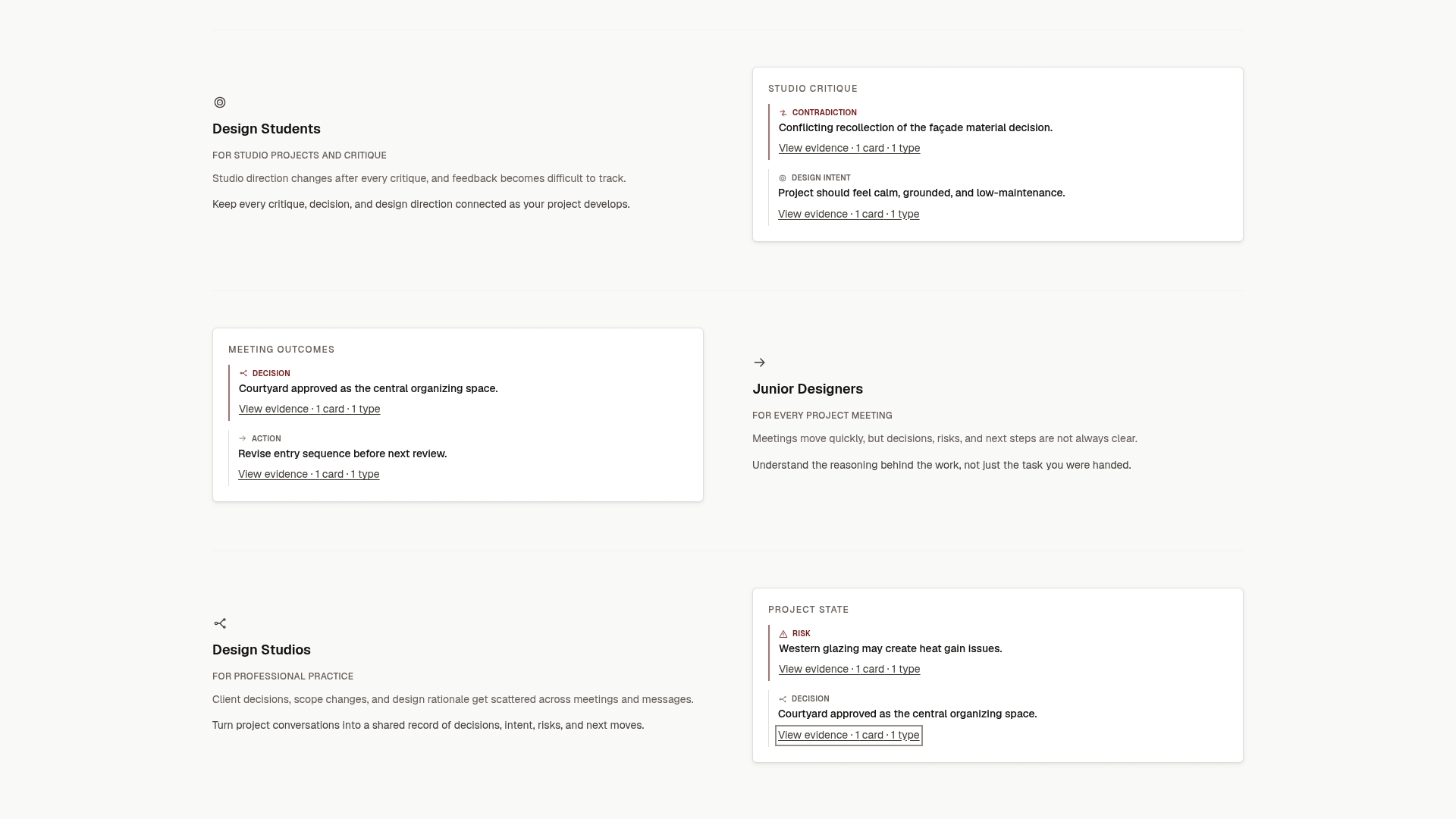
The matrix assigns the owner. The Intent Ledger keeps the reasoning. It turns project conversations, meeting notes, transcripts, critique feedback and client comments into ILM Records: structured, source-backed records of decisions, design intent, risks, actions, commitments and unresolved questions, each traceable to the conversation it came from.
For a studio, that means the name in the Accountable column can be matched to a record of what they decided and why. For a junior designer, it means a task can be traced back to where it started. For a freelance architect, it means client feedback is preserved in a form you can point to.
One-off packs start at $12 for Working Set, with Project Record at $29, Practice Memory at $59 and Studio Ledger at $119. Monthly plans are Working Memory at $29, Living Record at $79 and Shared Ledger at $149. See the pricing page to choose, or start from The Intent Ledger.
Our perspective
We built The Intent Ledger around one observation: teams are better at recording who decided than why they decided.
A decision accountability matrix is a good discipline. We would put one on every project. But the grid is a snapshot of ownership, and design projects live on reasoning: the constraint that ruled out an option, the critique that changed direction, the client comment that was agreed to and then half forgotten.
That is why we focus on the why behind the work. When each decision is tied to the conversation it came from, the Accountable person is not just a name. They are an owner with a traceable rationale, and the team can revisit the call without reconstructing it from memory.
Use the matrix to decide who owns the call. Use an ILM Record to keep what the owner knew when they made it.
Rajas
FAQ
What does RACI stand for?
RACI stands for Responsible, Accountable, Consulted and Informed. Responsible roles do the work, the Accountable role owns the outcome and gives final approval, Consulted roles give input beforehand, and Informed roles are told afterward.
Can more than one person be accountable for a decision?
No. Every decision should have exactly one Accountable person, while responsibility can be shared. If two senior people each need authority, split the decision into two separate rows, each with its own owner.
How many rows should a matrix have?
Faster Than Normal suggests 10 to 25 rows for a typical project, and treats more than 30 as too granular. For a design project, build rows around the decisions that need a named owner, not around every drawing or task.
Is RACI outdated?
It dates back to the 1950s, but it remains in wide use, and variants such as RASCI and DACI adapt it. Teams with fast-changing roles often add a one-page decision charter for single big calls and keep the RACI for routine decisions.
Sources
- Setting UX Roles and Responsibilities in Product Development, NN/g
- RACI Matrix Template and Expert Guide 2026, Institute of Project Management
- RACI Matrix Decision Framework, Faster Than Normal
- ITIL Version 3, Service Design chapter
- Stakeholder Management and RACI, PMI
- RACI matrix, NHS Scotland Turas Learn
- Lessons Learned: The RACI Diagram Tool, HHS Office of Population Affairs
- RACI and RASCI Definitions, IT@Cornell
- What is RACI? An Introduction, RACI Solutions
- Decision Rights, Accountability, and Separation of Duties, COMPEL Framework
- Beyond RACI: smarter ways to clarify ownership, Vestd
- The Role of Communication in Team Engagement
- Governance, Not Tools: Capture 70% of AI Value in Professional Firms