Decision Governance Framework for Design Teams
Decision Governance Framework for Design Teams
A decision governance framework is an agreement about who makes which decisions, how each decision is recorded, and what happens when people disagree or the facts change. For a design team, the part that matters most is the record: a decision that cannot be traced to the conversation and reasoning behind it gets reopened, misread or quietly reversed. This guide shows how to set up the framework in five parts, with a template and a worked example. It also shows why the record should be built from the original conversation, which is what ILM Records at The Intent Ledger are designed to do.
TL;DR
- A decision governance framework answers three questions: who decides, what is written down, and how a decision changes later.
- Define decision levels, named roles, a fixed record template, an escalation path and a review trigger. Five parts are enough for a small studio.
- Record the why (context, options, consequences), not only the what. Records that explain the reason are harder to overrule by accident.
- Never edit an accepted record. Write a new one that supersedes it and link the two.
- Link every record to the meeting, critique or client message it came from, so anyone can check what was actually said.
Table of Contents
- What a decision governance framework means for a design team
- The five parts of a working framework
- A worked example: one decision, start to finish
- Running meetings so decisions come out of them
- Where project context gets lost
- Doing it by hand, and doing it in the flow of work
- Start with the offer that fits your project
- Our perspective
- FAQ
- Sources
What a decision governance framework means for a design team
The search results for this phrase are mostly about AI and data governance. The idea underneath is the same for a studio. The UK Government Service Design community describes design governance as a framework and agreement about who gets to make design decisions, which aspects they can decide on, and who is accountable. It covers approving, rejecting or amending designs, expert review of hard choices, and discussing differing views.
That is not bureaucracy for its own sake. In a six-person studio, the governance question looks like this:
- A client says in a call that the lobby can lose the skylight. Who confirms it, and where is it written?
- A junior designer finds a task on the board with no explanation. Who can say where it came from?
- A crit ends with ten opinions. Which ones became decisions?
A framework gives each of those a standard answer. You do not need a committee. You need the same five parts applied every time.
The five parts of a working framework
1. Decision levels
Not every decision deserves the same process. The UK Government’s Architectural Decision Record Framework, published on 4 November 2025, starts by having teams determine the decision’s scope and level, and it sets escalation criteria from team-level up to strategic, cross-government decisions. Scale that down for a studio:
- Level 1, within a task: the designer decides and notes it in the project record.
- Level 2, within a project: the project lead decides after consulting the people affected.
- Level 3, project-defining or contractual: the studio principal and the client both confirm, and the decision is logged with the client’s own words attached.
Bain & Company’s guidance on decision systems suggests matching rigor and pace to a decision’s value, risk and reversibility. A door handle is reversible. A structural grid is not. Treat them differently.
2. Named roles
The most common failure is a decision that everyone thinks someone else made. Several published frameworks fix this by naming roles:
- The HIF design review standard defines six roles: owner, facilitator, presenter, reviewers, recorder and decision authority.
- Bain’s RAPID framework uses Recommend, Agree, Perform, Input and Decide, and advises ideally one decider with primary accountability for the outcome.
- Government Architect NSW’s design governance advice says the protocol should describe the roles of the project sponsor or design champion, the lead designer and the operator representative, and should cover handover and replacement of key people so project intent survives staff changes.
For a small team, collapse these to four: a decider (one person), a recommender (usually the designer), input (people consulted, including the client where relevant) and a recorder (whoever captures the outcome). On a solo freelance project you hold all four hats, but the client is still the decider on anything in their brief. Write that down.
3. A fixed record template
The record is the heart of the framework. The UK ADR framework requires a title, date, status, context, decision, consequences, stakeholders consulted and links to supporting documents. AWS guidance adds that the structure should focus on the reason for the decision rather than how it was implemented, which helps others adopt it and keeps people who were not involved from overruling it later.
These records come from software and government architecture, but the logic carries over to buildings, interiors and products. A design version is below.
| Field | What to write | Why it matters |
|---|---|---|
| Title | The decision in a short phrase | Searchable later |
| Date and status | Proposed, accepted or superseded | Shows what is current |
| Context | The brief, constraint or problem | Explains the why |
| Options considered | What was rejected and why | Stops old ideas returning |
| Decision | One sentence | Removes ambiguity |
| Consequences and risks | What this changes or puts at risk | Surfaces trouble early |
| People | Decider, consulted, owner of follow-up | Gives accountability |
| Source | The meeting, critique or message it came from | Lets anyone verify |
Our own guide to the eight fields a design record of decision should capture goes deeper on each one.
4. An escalation path
Disagreement is normal. Governance means it has somewhere to go. Consult Australia’s design principles say a framework needs unambiguous decision-making authority and that the impact of delayed decisions should be managed through agreed escalation and resolution protocols, including an independent design review or issues resolution panel where needed.
In a studio, that can be as simple as:
- The recommender and decider talk it through and record both positions.
- If it stays unresolved after an agreed time, say two working days, it goes to the principal.
- If the client’s sign-off is the blocker, the open question is logged with an owner and a date, and work continues on everything it does not touch.
Escalation is a path to a named person, not a second vote. Silence is also not consent: if a mandatory reviewer has not replied, the record says “awaiting response”, not “agreed”.
5. A review trigger
Decisions age. A material choice should carry a short, owned sentence stating what would reopen it, for example “if the façade supplier cannot meet the lead time, revisit the cladding choice.” That idea comes from decision record practice in software, and it applies directly to design: a threshold nobody owns is only a reminder.
A worked example: one decision, start to finish
A four-person architecture studio is redesigning a clinic waiting room. During a client call, the clinic manager says patients feel exposed in the current layout and asks to move the reception desk to the side wall.
Level: Level 2. It affects circulation and accessibility but not the structure.
Record created that day:
- Title: Reception desk moves to the east wall.
- Context: Client reports patients feel exposed at arrival; the call is the source.
- Options considered: keep the desk central with a screen; move it to the east wall; build a curved desk.
- Decision: Move to the east wall, subject to a sightline check to the entrance.
- Consequences and risks: Queue now runs along the window; staff lose view of the corridor.
- People: Decider, project lead. Consulted, clinic manager. Follow-up owner, junior designer, due Friday.
- Review trigger: If the sightline study shows staff cannot see the entrance, reopen.
- Status: Accepted.
Three weeks later the sightline study fails. The team does not edit the record. They write a new one, “Reception desk returns to a central position with a low screen”, mark the first as superseded and link them. Anyone joining the project can see when the direction changed and why. That is exactly the append-only approach Microsoft’s Azure Well-Architected guidance recommends: never edit accepted records, supersede them and link the two.
Running meetings so decisions come out of them
A framework fails at the meeting, not on the page. Three habits make the record almost write itself.
Set the review question first. The HIF standard asks the decision authority to record exactly one outcome from seven options: approve, approve with actions, iterate, test, escalate, reject or exception. It also states that “looks good” is not an approval record. A usable outcome vocabulary stops vague nods from being treated as sign-off.
Record dissent and open questions. The same standard’s review record includes dissent, unresolved uncertainty, actions with owners and a review trigger. A record that hides disagreement looks tidy and misleads whoever reads it next.
Close with owners. Every action needs a name and a date before people leave the room. The Get It Right Initiative recommends defined gateways and milestones on larger projects so that assumptions are resolved and there are no gaps before design proceeds. Students running a critique can borrow the same idea on a smaller scale: end every crit by listing what changes, what stays open and who owns each item.
Our three-phase design review checklist lays out what to capture before, during and after a review, and the articles on the design review process cover the surrounding practice.
Where project context gets lost
Most lost decisions were never missing. They were made in a call, a critique or a comment thread and never written down in a form anyone could find. The usual symptoms:
- A junior designer receives a task and cannot tell whether it came from the client, the principal or a crit.
- A client says “I never agreed to that”, and nobody can find the message.
- A rejected option returns because the reason for rejecting it was never recorded.
- Two people use different words for the same element, so one record cannot be matched to another. A consistent vocabulary, which is the idea behind terminology consistency, keeps records searchable.
The cure is traceability. A good record carries a link back to the source: the transcript, the notes, the email. When a decision is challenged, you do not argue from memory, you open the conversation. This is also why the client-facing end of the framework matters. Your client approval process is only as strong as the record of what the client actually approved.
Doing it by hand, and doing it in the flow of work
You can run this framework with a template document and discipline. The cost is the writing: turning a 40-minute call into a structured record while the next task is already waiting. That is where most teams slip, and slipped records are worse than none, because people assume the log is complete.
The Intent Ledger exists for that step. It turns conversations, meeting notes, transcripts, critique feedback and client comments into ILM Records: structured, source-backed records of decisions, design intent, risks, actions, commitments and unresolved questions, each traceable to the conversation it came from. The fields line up with the template above, so the framework you design is the one the records follow.
Start with the offer that fits your project
If you are setting up governance for one project, a one-off ILM Record pack is the simplest start: Working Set is $12 and Project Record is $29, both one-off. If records are created every week, the Working Memory plan is $29 per month. Studios that want a shared ledger across a team can compare the Practice Memory pack at $59 one-off, the Studio Ledger pack at $119 one-off and the other plans on the pricing page.
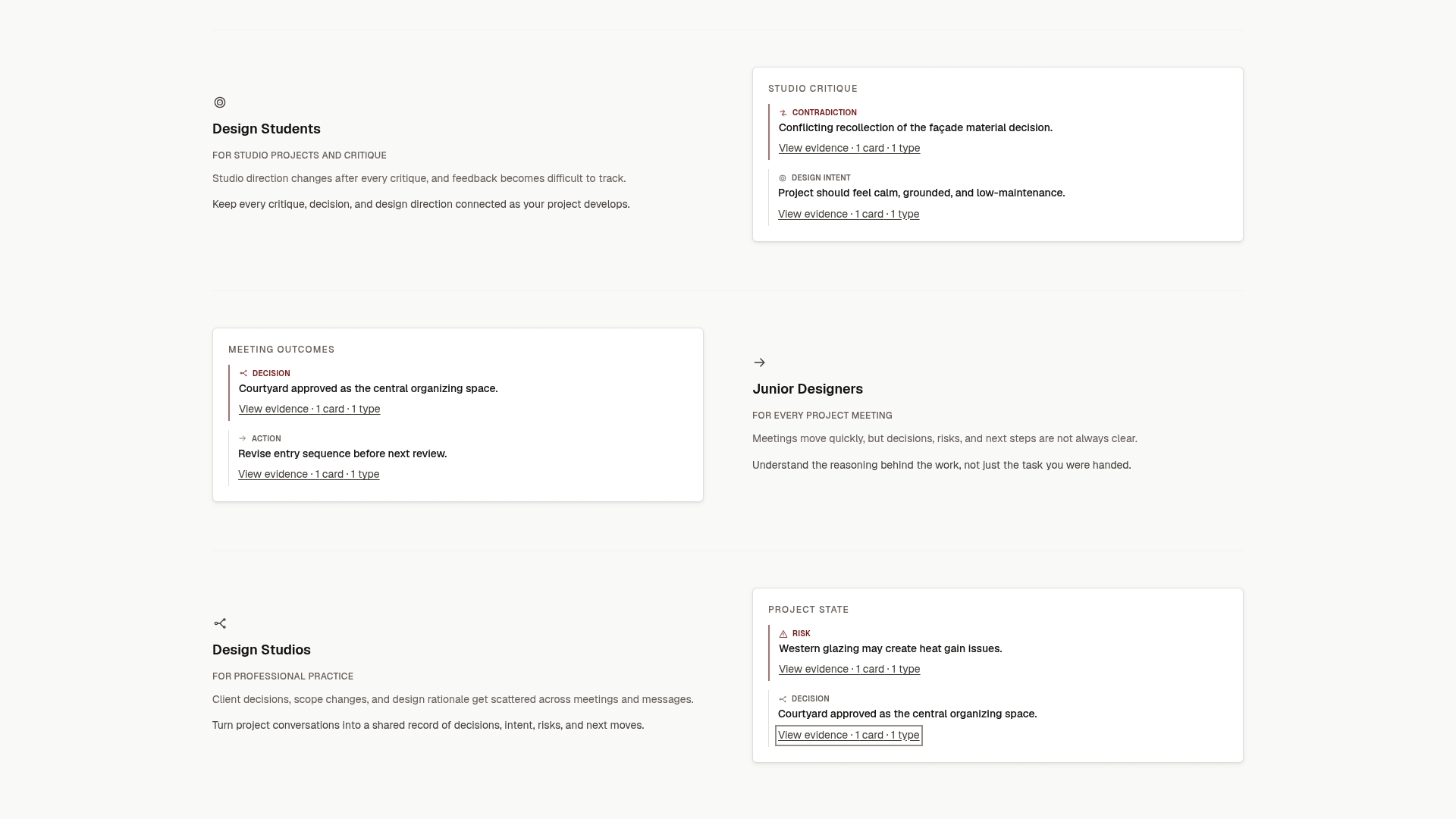
You can see the product itself on The Intent Ledger home page.
Our perspective
Most studios do not have a decision problem. They have a memory problem. The decision was made, usually by sensible people, and then the reason evaporated. Six weeks later someone reopens it because nothing told them why it was closed.
We built The Intent Ledger around that gap. A governance framework tells you who decides and what a record contains. What it cannot do on its own is make writing the record cheap enough that people do it every time. We think the record should start from the conversation itself, so the why is captured while it is still being said, and so every record can be traced back to its source.
That is why an ILM Record holds decisions, design intent, risks, actions, commitments and unresolved questions together. The decision is one line. The intent behind it is the part a junior designer, a new project manager or a student reviewing a crit needs most.
Our advice: keep the framework small, agree it once, and let every conversation feed the same record.
Rajas
FAQ
What is a good governance framework for documenting project decisions?
A good one is small and consistent: decision levels, named roles, a fixed template, an escalation path and a review trigger. The UK Government’s six-step ADR model (scope the decision, engage stakeholders, record, approve, share, review) is a solid reference to adapt for a design team.
Who should be the decision maker on a design project?
One named person per decision. Bain’s RAPID guidance recommends ideally a single decider who is accountable for the outcome and who communicates the decision and its rationale. Others give input, but they do not each hold a vote.
Can I change a decision record after it is accepted?
Not the original. Write a new record that supersedes it and link the two, so the history of when and why direction shifted stays visible. Microsoft’s guidance describes this as an append-only log, with statuses such as Proposed, Accepted and Superseded.
How do I keep client feedback from getting lost?
Log each client decision with its source attached, whether a call transcript, email or comment, and mark its status. If a request is still open, record it as an open question with an owner and a date rather than leaving it in a thread. For freelancers, this record is also your reference when scope is questioned.
Sources
- Playbook for setting up a design governance body, UK Government Service Design
- Architectural Decision Record Framework, GOV.UK
- Design Quality Framework advisory note, Government Architect NSW
- Architectural decision record process, AWS Prescriptive Guidance
- Design review and critique, HIF
- Guiding the design team, Get It Right Initiative
- Project design: best practice principles, Consult Australia
- RAPID Decision Making Framework, Bain & Company
- Building a Repeatable System for Effective Decisions, Bain & Company
- Maintain an architecture decision record, Microsoft Learn
- Architecture Decision Records: Template and Examples
- Terminology consistency explained