Decision Meeting Cadence: How Often Design Teams Should Meet
Decision Meeting Cadence: How Often Design Teams Should Meet
A decision meeting cadence is a recurring rhythm built around questions that need an answer, not around status updates. Set the frequency by how fast each class of decision has to land, keep the room small, send status in writing beforehand, and end every item with a decision, a dated deferral, or a named delegate. Then write the decision down with its reasons, or you will be making it again in three weeks.
This guide shows how to pick the rhythm, build the agenda, choose who attends, adjust as a project moves through its stages, and tell whether the cadence is working.
TL;DR
- Match frequency to decision speed: if a blocked person can wait a few days without harm, weekly is enough; if waiting costs a deliverable, you need a faster loop or lower decision rights.
- Send status in writing before the meeting and use a decision queue as the agenda.
- Keep the group to the author, the people who commented, and the decision-maker. Five to eight people is a sound ceiling.
- Every item ends in a decision, a deferral with a date and reason, or delegation. Record alternatives and rationale, and keep open questions visibly open.
- Review the cadence monthly and retire any meeting that no longer produces decisions.
Table of Contents
- What a decision cadence is, and what it is not
- How to decide how often to meet
- What goes on the agenda
- Who should attend
- Changing the cadence as the project moves
- Recording decisions so they stay decided
- Telling whether the cadence is helping
- Our perspective: the cadence is only as good as the memory behind it
- Put the record behind your cadence
- Related reading on decisions and reviews
- FAQ
- Sources
What a decision cadence is, and what it is not
A general meeting cadence answers “when do we get together?” A decision cadence answers “when do we resolve what is stuck?” The difference shows up in the agenda. One decision-first approach puts written status before the meeting, uses a decision queue as the agenda, and requires each item to close as a decision, an explicit deferral with a date and a reason, or delegation. Its argument is that a meeting should be judged by the decisions it produces, not the time it consumes.
Another way to say the same thing: an operating cadence can be treated as a decision pipeline rather than a calendar of recurring entries, with each frequency designed for a specific class of decision.
It also helps to separate two kinds of meeting. One writer on meeting design distinguishes process-oriented meetings, which exchange information on a regular basis, from mission-oriented meetings, which solve a specific problem and often produce a decision. Studio life needs both. The mistake is letting the first kind pose as the second: a Monday “design sync” where everyone reports and nobody commits is a process meeting wearing a decision meeting’s name.
The practical test is simple. Look at your last four sessions of a recurring meeting and count the decisions each one produced. If the answer is zero or one, the meeting is carrying information that could have been written, and the decision work is happening somewhere else, often in hallway chats and direct messages nobody can find later.
How to decide how often to meet
There is no universal number. The useful question is how long a decision can wait before something breaks. Work through four inputs.
- Cost of delay. If a drawing set, a client deadline or a purchase order waits on the answer, the cost of delay is high and the loop must be short. If the answer feeds a milestone three weeks away, a weekly slot is plenty.
- Decision class. Sort your recurring decisions into types: day-to-day production choices, design direction choices, scope and budget choices, and go/no-go choices. Each type has its own natural rhythm.
- Who holds the decision. A frequent meeting is sometimes a workaround for decision rights that sit too high. If a project lead has to wait for a Thursday meeting to approve a door schedule revision, move that call down to the lead and keep the meeting for the choices that really need several voices.
- Project stage. Early concept work throws off many open questions. Late documentation throws off fewer but costlier ones. The rhythm should change with them.
A starting grid for a small design studio or project team might look like this. Treat it as a draft to test, not a standard.
| Decision class | Typical rhythm | Format | Who decides |
|---|---|---|---|
| Blockers on current tasks | Daily, 10 to 15 minutes, or asynchronous | Short written check-in | Task owner or project lead |
| Design direction and trade-offs | Weekly, 45 to 60 minutes | Decision queue meeting | Design lead with key reviewers |
| Client-facing choices (scope, finishes, budget) | Every two weeks, aligned to client contact | Prepared options with a recommendation | Project manager and principal |
| Phase approvals | At each phase gate | Gate review | Principal or sponsor |
| Review of the cadence itself | Monthly | 20-minute retrospective | Whoever owns the calendar |
The weekly design-direction meeting is the anchor. Most of what a team decides lands there. The others exist to stop things from piling up in it.
A published example of a rhythm
A project roadmap template linked to PMI practice shows one way to layer rhythms: daily issue triage during the first week, weekly working sessions, biweekly sponsor decision sessions, and a monthly value review. The pattern to borrow is the layering, not the exact numbers. Fast loops handle small questions, a slower loop handles the ones with budget or scope consequences, and a monthly review keeps the whole structure honest.
What goes on the agenda
A decision meeting runs on a queue. Before the meeting, each item on the queue needs a written question, the options on the table, a recommendation if there is one, and the deadline that makes it urgent. Anything without those fields is not ready to be decided and belongs in the pre-read thread, not the room.
One published agenda example for a recurring decision meeting includes prior decisions and their status, exceptions from the dashboard, the decision queue, and a read-back of owners and deadlines. It allots 5 minutes to records, 10 to dashboard exceptions, 40 to the decision queue and 5 to close. Notice how much of the clock goes to the queue.
For design reviews specifically, one engineering-leadership guide recommends a 60-minute maximum split like this:
| Minutes | Segment |
|---|---|
| 5 | Context |
| 10 | Clarifying questions |
| 30 | Discussion of contentious topics |
| 10 | Decisions and actions |
| 5 | Drafting the decision record |
The same guide suggests an asynchronous pre-review two to three days before the session: the author shares the document, reviewers comment, and the facilitator picks out the contentious topics for the live meeting. That one habit changes the meeting’s character. Questions of fact get answered in writing, and the room is left for real disagreement.
Adapted for a studio, the structure could be:
- Read-back of last week’s decisions (5 minutes). What was decided, who owns the follow-up, what is overdue.
- Exceptions (5 to 10 minutes). Only what is off track. Anything on track stays in the written status.
- Decision queue (30 to 40 minutes). Each item gets the question, the options, the discussion and a closing outcome.
- Close-out read-back (5 minutes). Say every owner and every date aloud so nobody leaves with a different version.
If you need a ready template for the agenda itself, our articles on meeting agenda templates and on the design team agenda go deeper on layouts.
The three allowed outcomes
Every queue item ends one of three ways:
- Decided. State the decision, the owner and the date it takes effect.
- Deferred. State what information is missing, who will bring it, and the date the item returns. A deferral with no date is a decision to forget.
- Delegated. Name the person who will decide, the deadline, and the criteria they should use.
Nothing else gets to leave the room. “We’ll circle back” is the failure this rule exists to prevent.
Who should attend
The attendee list is a decision in itself. One guide to architecture decision records names the proposal’s author, the key stakeholders who commented, and the decision-maker as core attendees. It recommends keeping the group to 5 to 8 people and warns that larger meetings tend to turn into status updates rather than decision forums.
In a design setting, that usually means:
- the person bringing the question (often a junior designer or a project architect),
- the lead who owns the design direction,
- the project manager who tracks scope, schedule and commitments,
- one or two reviewers who have commented in writing, such as a consultant coordinator or a technical specialist,
- the person with authority to say yes, if different from the lead.
Everyone else gets the written outcome. This is not exclusion, it is protecting the room. Junior team members who are not in the meeting still need to know why a decision was made, which is the point of keeping a record they can search.
Changing the cadence as the project moves
A rhythm that suits schematic design will choke documentation. Plan for the change instead of letting the calendar drift.
One cadence plan template records meeting purposes, frequencies, attendees, owners and decision rights, and recommends a monthly review. It also notes that communication needs can shift from daily syncs during discovery to weekly during steady delivery and back to daily during testing. Design projects follow a similar curve: intense at the start of each phase, quieter in the middle, intense again before issue dates.
A rolling-wave planning guide gives the planning logic behind that: keep long-range work coarse, detail the near-term, align planning cadence with product cycles and team rhythms, and revise as delivery feedback and conditions change. For a studio, that means you do not need to schedule twelve weeks of decision meetings now. Fix the next four, then re-plan.
Stage gates as a model for big calls
For the largest decisions, a gate structure helps. The Stage-Gate model places decision gates before discovery, scoping, business case, development, testing and launch. At each gate the outcome is Go, Kill, Hold or Recycle, the next stage’s plan and resources are approved, and the next gate date is set.
The design equivalent is straightforward. Before moving from concept to schematic design, or schematic to design development, hold a gate review with the principal and the client contact. Decide go, hold or rework, approve the next phase’s plan, and set the date of the next gate. Between gates, the weekly decision meeting handles what falls inside the phase.
Recording decisions so they stay decided
A cadence without a record is a treadmill. Two habits matter most.
Keep the alternatives and the reasons. A decision log template for product managers points out that recording only the chosen outcome causes the same debate to reopen, while recording the alternatives and the rationale closes it. In design work, this is the difference between “we chose the oak veneer” and “we chose the oak veneer over the laminate because the client wanted warmth in the reception and the budget held; the stone option was dropped on cost.” When the client asks in week twelve why the laminate was rejected, you have the answer.
Do not turn open questions into agreement. A recent guide to AI meeting notes says unresolved questions should stay visibly unresolved. It separates proposals, confirmed decisions, conditional decisions and unresolved items, and says missing owners or dates should not be invented. Apply that rule to human notes too. If nobody said who owns the follow-up, the record says “owner: not assigned,” and that blank becomes the first item next week.
A minimal record for each decision needs:
- the question and the date,
- the decision and its status (confirmed, conditional, deferred),
- the alternatives considered and why they were set aside,
- the reasons and the design intent behind the choice,
- the owner, the next action and the date,
- a pointer to the source conversation.
Our decision log template for project teams lays out these fields, and our pages on project decision records and why decision records matter cover the habit in more depth.
Telling whether the cadence is helping
Check the cadence monthly, using evidence rather than impressions. Pull the last four to eight weeks of meetings and ask these questions:
- How many decisions did each recurring meeting produce? A meeting that regularly yields none is a reporting ritual. Convert it to a written update or cancel it.
- How many items were deferred, and how many were deferred twice? A repeat deferral means the item is missing information, an owner or authority.
- How many decisions were reopened? Reopened decisions point to missing rationale or to people who were not in the room and were not told why.
- How long do blocked people wait? If the answer is longer than the work can bear, shorten the loop or move the decision down.
- Does the attendee list match the queue? If half the room has nothing to say on most items, trim it.
- Are decisions happening elsewhere? If the real calls get made in side threads, the meeting is not trusted. Bring those items into the queue.
If the answers are bad, change one thing at a time. Shorten the meeting, cut the attendee list, add a written pre-read, or move the slot. Then recheck in a month. Calendars that never get reviewed accumulate recurring invites that outlive their reason, so give the review a standing place and an owner.
A short worked example
Imagine a six-person studio running a mid-size renovation. Their original rhythm is a one-hour Monday sync plus a Thursday client call. After eight weeks, the review finds the Monday sync averages one decision, with most time spent on status. Three decisions a week are being made in chat threads, and the client has twice reopened a finishes choice.
They change three things. Status moves to a written update posted Friday. Monday becomes a 45-minute decision queue with the project lead, the project architect, the project manager and whichever reviewer commented. Every decision is logged with its alternatives and reasons, and the Thursday client call opens by reading back the decisions affecting the client. Four weeks later, the review shows more decisions per meeting, no repeat deferrals, and no reopened finishes choice. The numbers are illustrative, but the sequence is the pattern: measure, strip status out, shrink the room, and write the reasons down.
Our perspective: the cadence is only as good as the memory behind it
Most advice on decision cadence stops at the calendar. We think the calendar is the easy part. The hard part is what happens in the twenty minutes after the meeting ends, when the reasons for a choice are fresh and the person who understood them best is about to move on to the next task.
In design work, the “why” carries the project. A junior designer who inherits a drawing needs to know why the stair moved, not just that it moved. A client who asks about a rejected option deserves an answer that does not depend on who remembers. That is why we built The Intent Ledger around preserving the reasoning behind decisions, and connecting each one to the conversation it came from.
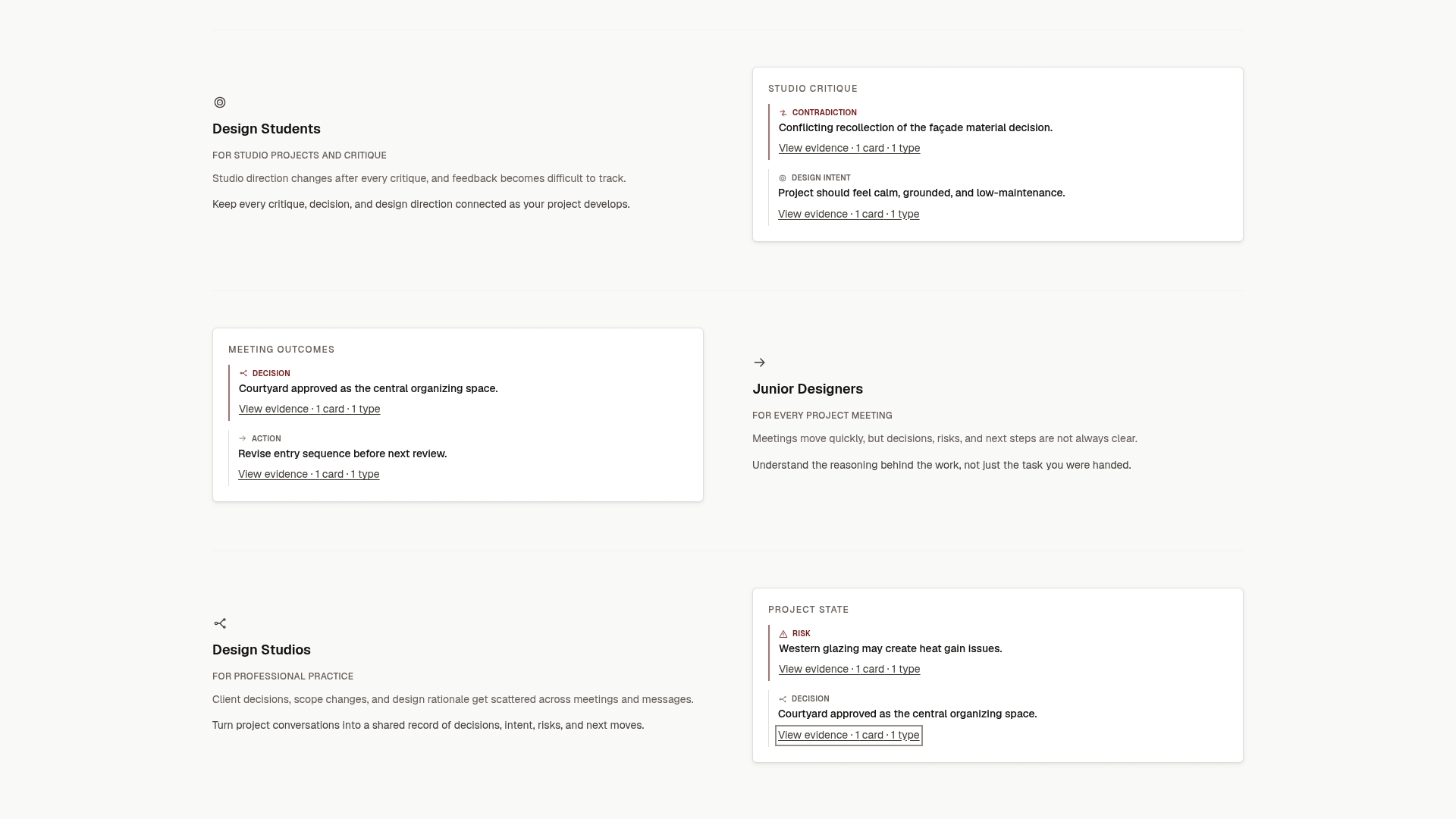
Our approach is to turn meeting notes, transcripts, critique feedback and client comments into ILM Records: structured, source-backed records of decisions, design intent, risks, actions, commitments and unresolved questions. A cadence tells you when to decide. A record tells you what was decided, why, and where to look when someone asks. Together they let a team meet less often about the same things and more often about new ones.
We designed the system so that unresolved questions stay visible as unresolved, and so that every record points back to its source. Teams that pair a disciplined rhythm with that kind of project memory spend less time re-litigating and more time designing.
Rajas
Put the record behind your cadence
If your decision meeting already runs well, the next gain is in what you keep from it. The Intent Ledger turns your meeting notes, transcripts and client comments into ILM Records that trace each decision back to the conversation it came from.
You can start with a one-off pack: Working Set at $12, Project Record at $29, Practice Memory at $59 or Studio Ledger at $119. For continued record creation, the monthly plans are Working Memory at $29 per month, Living Record at $79 per month and Shared Ledger at $149 per month. See the details on the pricing page, or read more about The Intent Ledger first.
Related reading on decisions and reviews
To build the habits around the meeting, our pages on decision making documentation, meeting notes best practices, the design review process and the design change log cover the recording side. Pair a monthly cadence review with a quick look at your last month of decision records, and you will see quickly which meetings earn their slot.
FAQ
How often should a design team hold a decision meeting?
For most teams, weekly is the anchor, with a short daily check-in or asynchronous thread for blockers and a longer slot at phase gates. Let cost of delay set the rhythm: the longer a decision can wait without harm, the less often you need to meet. Review the rhythm monthly and change it as the project stage changes.
What is the difference between a decision cadence and a meeting cadence?
A meeting cadence is the schedule of recurring meetings. A decision cadence ties each meeting to a class of decision, uses a queue as the agenda, and requires each item to end in a decision, a dated deferral or a delegation. The first organizes the calendar, the second organizes the outcomes.
How long should a decision meeting be?
Sixty minutes is a common ceiling, and one published design-review format uses exactly that, with most of the time on contentious topics and 10 minutes for decisions and actions. If your queue regularly overruns, move more of the factual discussion into a written pre-read instead of lengthening the meeting.
Who needs to be in the room?
The person raising the question, the people who commented in writing, and the person with authority to decide. Guidance on decision records suggests keeping the group to roughly 5 to 8, because larger groups drift toward status updates. Everyone else receives the recorded outcome and its reasons.
How do I stop the same decision from being reopened?
Record the alternatives you rejected and the reasons, along with the owner and the date. When the question returns, point to the record instead of restarting the debate. Keep open questions marked as open so nobody mistakes silence for agreement.
Sources
- Decision Cadence: Replace Status Meetings With Decisions
- Operating Cadence: Structuring Meetings and Decisions
- On Meetings
- PMI Roadmap Template: Phases Owners Cadence
- Design Reviews That End with Decisions
- Architecture Decision Records
- Sample Project Communication Plan Template
- Rolling Wave Planning
- Discovery-To-Launch Process, Stage-Gate International
- Free Decision Log Template for Product Managers
- AI Meeting Notes: Keep Decisions Separate From Ideas