Design Approval Matrix: How to Build One That Holds
Design Approval Matrix: How to Build One That Holds
A design approval matrix is a single table that says who may approve which design decision, at which stage, against which version, and where the proof of that approval lives. Build it with decisions down the side, roles across the top, and a named approver, a condition and an evidence link in every cell that matters. The table is the easy part. Keeping it true after the third round of client feedback is where most studios lose it.
This guide gives you the columns to use, a worked example for an architecture or interior design project, ways to adapt it for critiques and client comments, and a routine that keeps it current.
TL;DR
- A design approval matrix maps decisions and deliverables to the people who can approve them, with the version and evidence attached.
- Organize rows by project stage (schematic design, design development, construction documents), then by decision type inside each stage.
- Name one accountable approver per decision, record sign-off against an exact version, and treat conditional approval as open until the conditions close.
- Assign a matrix owner who updates it after every material decision, or it will drift out of date within weeks.
- Store the reason and the source conversation next to each approval, so nobody has to reconstruct the why later.
Table of Contents
- What a design approval matrix is (and what it is not)
- What the matrix should cover at each design stage
- The columns every row needs
- A worked example: a small mixed-use project
- Building it in six steps
- Adapting the matrix for critiques, clients and freelancers
- Approval is not the end of responsibility
- Keeping the matrix current
- Capturing the why behind each approval
- Common problems and how to fix them
- How the approval workflow moves
- Our perspective
- Turning conversations into approval evidence
- FAQ
- Sources
What a design approval matrix is (and what it is not)
An approval matrix maps key project activities, such as functions, tasks, documents or phases, to the people responsible for approving them, as a generic required-approvals form describes it. In design work, the rows are decisions and deliverables: the massing, the material palette, the revised floor plan, the door hardware schedule. The columns are the people or groups who review, advise or sign.
It is not a decision matrix in the scoring sense, where options are rated against weighted criteria. That tool helps you choose between options. An approval matrix records who has the authority to say yes once the choice is made. It is also not a task list. A task list says who does the work. The matrix says who may close the question.
The confusion matters because teams often paste a finance-style approval table into a design project. Finance matrices route transactions by dollar threshold. Design decisions rarely work that way. A change of ceiling height costs little and can alter every section drawing, so authority has to follow design consequence, not only money.
What the matrix should cover at each design stage
The cleanest way to organize rows is by phase. The APPA design document deliverable list, a facilities-sector checklist, breaks the work into schematic design, design development and construction documents, with objectives and deliverables for each. Use those three stages as your skeleton and add a feasibility or brief stage in front if your practice sells one.
A practical matrix connects each approval gate to key deliverables and a decision authority: feasibility to strategic and economic alignment, schematic design to site plan, massing and preliminary budget, design development to systems selection, material specifications and models, and construction documents to the final permit set and definitive cost estimate.
Schematic design rows
The APPA list shows what schematic design needs to settle before the conceptual direction can be approved: the project brief and scope, functional relationships and circulation, area allocations, site and building orientation, massing, principal interior and exterior materials, structural and MEP system concepts, alternatives considered, and enough cost information to support the approval. Each of those is a candidate row. You do not need all of them on a small project, but you should decide deliberately which to drop.
Design development and construction document rows
At design development the rows get more granular: system selections, material specifications, finish schedules, coordinated models. At construction documents they turn into release decisions: the permit set, the issued-for-tender set, the final cost estimate. Fewer people should hold authority as you go later, because a late change has a longer tail of redrawn sheets.
The columns every row needs
A matrix that only shows initials in a grid tells you who was involved, not who decided. One construction-focused guide on stakeholder sign-off matrices recommends recording the approval group, a named approver, their authority or role, the approval responsibility, required decisions or conditions, review materials, due dates and the location of the evidence. Translated into columns:
| Column | What goes in it | Why it earns its place |
|---|---|---|
| Decision or deliverable | “Ground-floor plan, rev C” or “Façade material: zinc vs. fiber cement” | Rows must be specific enough to close |
| Stage | Schematic, design development, construction documents | Authority changes by stage |
| Approver (named) | A person, not a department | Ambiguity dies here |
| Authority basis | Client principal, lead architect, structural engineer, code reviewer | Shows why this person may decide |
| Contributors and reviewers | Who must be consulted first | Keeps the loop small but complete |
| Conditions | “Subject to cost check under budget cap” | Conditional approval stays visible |
| Version approved | File name, revision, date | Stops approval from drifting to a newer drawing |
| Evidence | Link to the email, markup, meeting record or signed form | Proof without searching |
| Status | Pending, approved, approved with conditions, rejected, superseded | One glance tells you where you stand |
Two discipline points sit behind this table. First, assign one accountable owner per decision, and define authority boundaries and escalation paths so each participant knows what they contribute. Second, define completion criteria for each entry and limit participants to those who materially affect the outcome. A matrix with eleven reviewers per row is a mailing list, not a governance tool.
A worked example: a small mixed-use project
Here is a trimmed matrix for a four-story mixed-use building. The names are illustrative roles, not real people.
| Decision | Stage | Approver | Consulted | Version | Condition | Status |
|---|---|---|---|---|---|---|
| Massing option B | Schematic | Client principal | Lead architect, cost consultant | Massing deck v3 | Within preliminary budget | Approved with conditions |
| Ground-floor retail depth | Schematic | Lead architect | Client, leasing agent | Plan rev C | None | Approved |
| Structural grid | Design development | Structural engineer | Lead architect | Grid sketch v2 | Coordinate with parking layout | Pending |
| Façade cladding | Design development | Client principal | Lead architect, cost consultant | Spec sheet v1 | Sample approved on site | Pending |
| Permit set release | Construction documents | Project lead | Code consultant | Set issue 04 | Final checklist closed | Pending |
Three things to notice. The approver is a role holder with authority, not whoever replied first. The version column pins the approval to a specific document. And the façade row carries a condition, which means it is not closed even if the client said “looks good” in a meeting.
That last point is where matrices earn their keep. A reliable client approval workflow should define decision states and record sign-off with evidence, and conditional approval remains open until its conditions are closed. If your status column cannot express “approved with conditions”, people will round it up to “approved”.
Building it in six steps
- List the decision points, not every task. Walk the project from brief to permit set and mark the moments where someone could say “yes, proceed” or “no, rework”. Aim for 15 to 40 rows on a studio-sized job.
- Name the roles before the people. Client principal, client project lead, lead architect, discipline engineers, cost consultant, code reviewer. Then attach real names.
- Decide the authority for each row. Ask who can be held to the decision. If the answer is “the group”, pick a chair.
- Set the evidence rule. Decide what counts as sign-off: a signed form, a reply from a named address, a recorded meeting decision. Do not let tone or attendance stand in. The guidance is blunt: do not infer approval from seniority, meeting attendance or email tone; record it against the exact version, scope and decision authority.
- Agree it with the client before design starts. The Scottish Futures Trust says a design responsibility matrix should define responsibilities across project stages, address design coordination, identify specialist expertise and be understood before tender documentation or appointments. Even on a small private job, the principle holds: the client should see the matrix in the first meeting.
- Name a matrix owner. One person updates it after each material decision. More on that below.
Adapting the matrix for critiques, clients and freelancers
Client feedback rounds
The most common failure is feedback from five people arriving as five emails. The fix is a client owner who consolidates. Teams can adapt a client approval template by naming a client owner to consolidate feedback, resolving contradictions before revision starts, and recording sign-off against the exact version and scope. A school-design handbook gives the same advice from the client side: the project lead should consolidate stakeholder feedback before submitting it, because concise lists avoid disjointed revisions that can harm design decisions or affect scope.
In practice, add a “feedback round” column to the matrix. Round 1 comments are consolidated by the client owner, contradictions get flagged as separate rows, and the revision does not start until each flagged row has a decision and an approver.
Critique-driven work
Studio critiques differ from client sign-off: the reviewers advise, and the student or designer decides. Still, the same structure helps. Put each critique point in a row, mark the reviewer as consulted, mark the designer as the decider, and record what changed and why. That turns a pile of pinned-up comments into a trail you can defend at final review.
Freelancers and solo practitioners
A freelancer has no internal approvers, which makes the client side of the matrix the whole matrix. A professional body’s job approval form tracks approvals of project components, phases and revision rounds, and for freelancers it can serve at the end of the project or before handing off files. Borrow that rhythm: one approval per phase, one before file handoff, each against a named version.
Approval is not the end of responsibility
A matrix records who signed. It does not move liability. Standard owner-architect agreements say as much: in one university-hosted copy of the AIA B101 form, owner approval of design documents does not relieve the architect or its consultants of their responsibilities under the agreement. So treat the matrix as a record of decisions and authority, not a shield. If a contract question arises, such as who bears the cost of a late change, your attorney and the signed agreement govern, not the spreadsheet.
Keeping the matrix current
Static matrices decay. Someone approves a revised plan by phone, a consultant changes, and the grid still shows last month’s picture. Three habits slow that down.
Appoint an owner and a trigger. Appoint a matrix owner to update it after every material decision, record its version, and keep approval evidence in one controlled project location. Define “material”: anything that changes a drawing, a spec, the budget or the schedule.
Validate against intent, not only against paperwork. The Scottish Futures Trust’s view is that responsibility should be agreed early and then validated continuously against the project’s intended outcomes rather than handled as a one-time administrative exercise. At each stage gate, ask whether the approvals still serve the original brief.
Keep entries short and modular. One practitioner’s observation on architecture decision records is that short, modular documents are easier to read and more likely to be updated. The same applies here: a row plus a linked one-page decision note beats a 30-column monster.
Capturing the why behind each approval
The matrix tells you who approved. It rarely tells you why the team chose the option, what was rejected, or which conversation produced the decision. That gap is what causes the “why did we do it this way?” question six months later.
Software teams solved a version of this with the architecture decision record, a short format proposed by Michael Nygard and widely adopted since. The UK government’s framework says a record should hold a title, date, status, context, decision, consequences, stakeholders consulted and links to supporting documents. Design teams can lift that shape almost directly. For each row in your matrix, link a note with:
- The decision and its status
- The context: what problem or brief item it answered
- The options considered and why they lost
- Who was consulted, and who approved
- The source: the meeting, critique or client message where it was settled
- Consequences: actions, risks and open questions that follow
We go deeper on this in our guides to the fields a record of decision needs, a decision log template for project teams, and linking drawings to decisions. If your problem is critique feedback getting lost, the six-field audit trail for critique-driven work is the closest fit.
Common problems and how to fix them
| Problem | What it looks like | Fix |
|---|---|---|
| Scattered comments read as approval | “Looks good” in a hallway or a thread | Define what counts as sign-off; log it against a version |
| Conflicting feedback | Two stakeholders want opposite changes | Client owner resolves before revision |
| Unclear reviewer authority | Anyone may weigh in, nobody may decide | One accountable approver per row |
| Version drift | Approval given to rev B, rev D is built | Version column; superseded status |
| Stale matrix | Grid shows last month | Matrix owner, update after each material decision |
| Lost reasoning | Nobody recalls why option B won | Linked decision note with source conversation |
These are the failure modes one client-approval guide lists: scattered comments mistaken for approval, conflicting feedback, unclear reviewer authority and different versions, with the remedy being a named client owner, resolved contradictions and sign-off recorded against exact version and authority.
How the approval workflow moves
A workable flow for each row has five steps:
- Submit. The designer issues a named version with a short cover note stating what needs a decision.
- Consolidate. The client owner or internal lead gathers comments into one list and resolves conflicts.
- Decide. The named approver chooses approved, approved with conditions, or rejected, and gives a reason.
- Record. The matrix owner updates status, version and evidence, and files the reason.
- Follow up. Conditions and actions get owners and dates. The row stays open until they close.
The step teams skip is the last one. Conditional approvals that nobody tracks turn into silent assumptions.
Regulatory approvals sit outside this loop and vary by place. In Ontario, for example, architect licensing coursework covers pre-application meetings and design-compliance dispute resolution in the building-permit process. Add your local permit authority as an external approver row, and check its current rules directly.
Our perspective
We build project memory software for design teams, so we see the same pattern in studio after studio: the approval grid is rarely wrong on day one. It goes wrong because the conversation that justified each cell lives somewhere else, in a transcript nobody reopens, a critique nobody wrote down, a client call summarized as “agreed”.
Our view is that an approval matrix answers who and when, but a project also needs the why. When a client revisits a decision, or a junior designer inherits a drawing, the useful question is not only “who signed this?” but “what were we trying to achieve, and what did we give up?” That is why we structure conversations into records of decisions, design intent, risks, actions, commitments and open questions, each traceable to the conversation it came from. Pair a lean matrix with source-backed records and the grid stays short, because the reasoning is not crammed into it.
, Rajas
Turning conversations into approval evidence
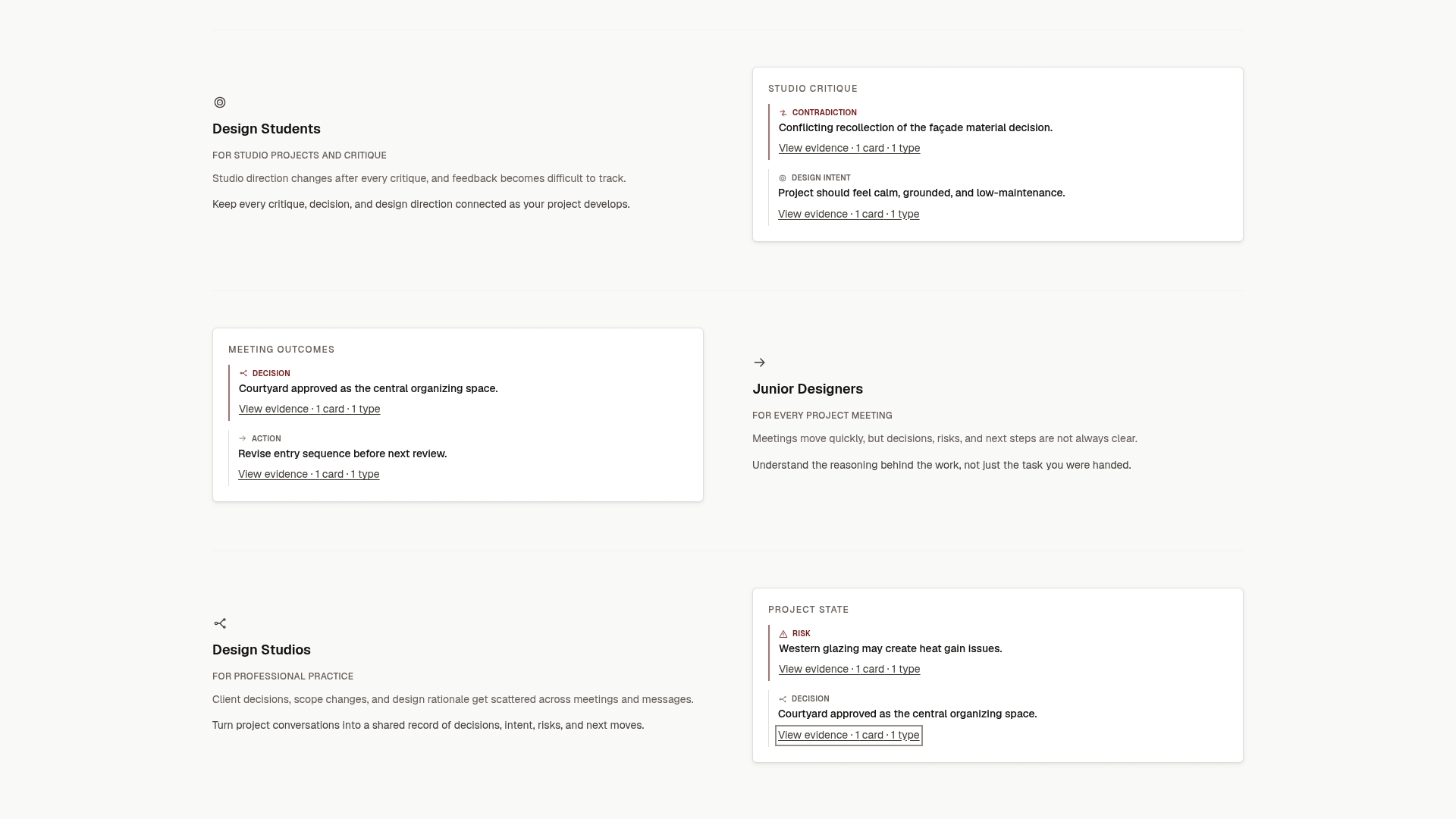
If your matrix already exists but its evidence column is thin, the quickest upgrade is to capture decisions at the moment they are made. The Intent Ledger turns meeting notes, transcripts, critique feedback and client comments into ILM Records that link each decision, risk and action back to its source conversation, so your matrix’s evidence column points to something real.
You can start small with a one-off pack: Working Set at $12, Project Record at $29, Practice Memory at $59 or Studio Ledger at $119. For ongoing capture, monthly plans run $29 (Working Memory), $79 (Living Record) and $149 (Shared Ledger). See the details on the pricing page, or look at The Intent Ledger overall.
If you want a template to pair with your matrix, our design documentation template captures decisions, not just tasks.
FAQ
What is the difference between an approval matrix and a RACI chart?
A RACI chart shows who is responsible, accountable, consulted and informed for work. An approval matrix goes further on one thing: who may approve each decision, against which version, under which conditions, with which evidence. Many teams use a RACI to draft the roles, then convert the accountable column into named approvers.
How many rows should a design approval matrix have?
Only as many as there are real decision points. For a studio-sized project, 15 to 40 rows is typical. If rows multiply, group minor items under a parent decision and keep detailed notes in linked records.
Who should own the matrix?
One person, usually the project lead or a project manager, updates it after each material decision and records its version. Shared editing without an owner is how matrices go stale. Everyone else flags changes to the owner.
Can a freelancer use an approval matrix?
Yes, and it is often more valuable for a freelancer because there is no internal team to remember what the client said. Keep it to one approval per phase and one before file handoff, each tied to a named version and a client owner who consolidates feedback.
Does client approval remove the architect’s responsibility?
Not by itself. Standard owner-architect agreements, such as the AIA B101 form, state that owner approval of design documents does not release the architect from its obligations under the agreement. For a specific contract, ask your attorney.
Sources
- APPA design document deliverable list
- Required approvals matrix form
- Construction project stakeholder sign-off matrix
- What a project decision rights matrix should include
- Scottish Futures Trust stage-based validation, concept design
- Client approval workflow template
- Design management for construction owners
- RGD job approval work form
- Custom design handbook, 2021
- Architecture decision records, GDS Way
- Architectural decision record framework, GOV.UK
- Architecture decision record notes
- OAA building permit application process syllabus
- AIA B101 standard form, university-hosted copy