Studio Ready Design Intent Documentation: Templates and Governance
Studio Ready Design Intent Documentation: Templates and Governance

Design intent documentation is the written and modeled record of what a project must achieve and why, built to standards like buildingSMART’s Information Delivery Manual and referenced against RIBA’s stage guidance, so anyone downstream from a substitution reviewer to a contractor can trace a decision back to its reasoning. The Intent Ledger treats this record as living memory rather than a one-time brief. Its primary value is simple: it stops good reasoning from evaporating the moment the person who had it leaves the room.
TL;DR:
- Recording decision rationale, including rejected options and supporting evidence, prevents future misunderstandings and reduces unnecessary review meetings.
- Every intent record should contain a clear outcome statement, decision evidence, linked artifacts, ownership roles, and versioning rules to remain useful through project stages.
- Documenting intent during meetings and immediately after decisions ensures accuracy and helps prevent loss of critical reasoning over time.
- Assigning explicit roles for authorship, verification, and updates keeps the intent documentation alive and credible throughout construction and handover.
- Using structured ILM Records that link decisions directly to source conversations creates a traceable, living memory that is less likely to be overlooked or overwritten.
Table of Contents
- What Design Intent Documentation Actually Covers
- Why Capturing Intent Changes Project Outcomes
- The Checklist: What Every Useful Intent Record Needs
- A Template and Worked Example You Can Use Today
- Keeping Intent Alive Through Construction and Handover
- How The Intent Ledger Turns Intent Into Living Memory
- Where Studios Actually Fail, and the Fix
- A Simpler Way to Keep Project Memory Without the Manual Work
- Authoritative Next Reads
- Sources
- FAQ
What Design Intent Documentation Actually Covers
Architecture and CAD use “design intent” to mean related but distinct things. In architecture, design intent documentation records functional goals, client priorities, aesthetic principles, performance requirements, constraints, and the reasoning behind decisions. In parametric modeling, design intent means embedding relationships and dimensioning schemes into a model so it behaves predictably when a variable changes: move a wall, and the windows, structure, and finishes should adjust in ways that still reflect the original logic.
Most studios end up keeping three categories of documentation, whether they name them this way or not:
- Design-development documents: sketches, massing studies, material boards, and narrative statements that explain direction before it hardens into drawings.
- Technical or construction documents: the drawings, specifications, and schedules that translate intent into buildable instructions.
- Decision or design-rationale records: the log of what was chosen, rejected, and why, tied to a date, an owner, and supporting evidence.
The third category is the one most teams skip, and it’s the one that saves the most time later.
Why Capturing Intent Changes Project Outcomes
Skip the rationale record and you inherit a predictable problem: a contractor proposes a substitution, nobody remembers why the original material was chosen, and the team either rejects a perfectly good swap out of caution or approves one that quietly breaks a performance goal nobody wrote down.
RIBA’s guidance addresses this directly, recommending that a project begin with an intent statement at concept approval and expand it through schematic design, design development, technical design, construction, and handover. Each stage checkpoint is a chance to confirm the intent still holds or to record why it changed.
A finding worth internalizing: a longitudinal study of professional design teams found that rationale develops in stages, starting as loosely organized reasoning, sharpening as teams focus on specific aspects of the problem, and finalizing once one aspect is prioritized. The same research found that preserving intermediate arguments and rejected alternatives, not just the final call, is what helps later teams actually understand the decision.
That single insight explains most of what a good intent record does:
- It shows what was tried and discarded, not just what was chosen.
- It gives future reviewers a test to check compliance against, not just a description to admire.
- It reduces the number of “why did we do it this way” meetings by giving people a document to read instead.
The Checklist: What Every Useful Intent Record Needs
A design intent statement without an operational test is just a mood board with better grammar. Pair every principle with something a person can actually check. buildingSMART’s IDS exists precisely because unstructured wish lists don’t scale. Write intent at two levels: a short principle a client or reviewer can read in ten seconds, and a testable condition a designer or contractor can verify.
A complete record should include:
- The intent statement — the outcome, the priorities in order, and the constraints that bound the solution.
- The decision rationale — alternatives considered, the evidence behind the final choice, who owns the decision, who approved it, the date, and its current status.
- Linked artifacts — the drawings, models, and specs the decision touches, along with LOD/LOI notes describing how detailed those artifacts need to be at this stage.
- Ownership and QA checkpoints — who verifies the decision still holds at each stage gate.
- Versioning rules — how a superseded decision is marked and why it changed.
The pattern separates what must remain true from how it gets delivered, which is exactly what lets a contractor propose a substitution without triggering a full redesign review. Methods for specifying information requirements in digital construction projects make the same case: intent and delivery method are not the same thing, and conflating them is what causes most value-engineering fights.
Pro Tip: Don’t wait for a formal design review to log a decision. Capture it the day it’s made, in one sentence, with the name of the person who made the call. A decision written a week later is a decision half-remembered.
A Template and Worked Example You Can Use Today
Here’s a structure that works whether you’re documenting a lobby finish or a structural strategy:
- Header: project name, stage, date, author.
- Intent statement: outcome, priorities, constraints.
- Decision log: alternatives, evidence, owner, approval, date, status.
- Evidence links: meeting notes, calculations, client emails, code references.
- Approval checkpoint: who signs off and when the next review happens.
A worked example, adapted from RIBA’s design statement guidance: “Create a calm, legible arrival sequence that gives visitors an immediate sense of welcome and orientation. Prioritize daylight, visual continuity, and durable low-maintenance materials, while keeping circulation accessible and construction details within the approved budget.”
That single paragraph gives you two or three operational tests for free: does the entry sequence read clearly from the street, does the material palette survive the maintenance budget, and does the accessible route add cost the client already flagged as tight? Those questions are what a reviewer checks at the next stage gate, not the paragraph’s prose quality.
When you’re annotating a model or drawing, note the intent directly on the sheet where a substitution is most likely, not buried in a separate binder nobody opens. During meetings, write the decision down before the conversation moves on. A decision log template built for this exact habit removes the excuse that there wasn’t time.
Keeping Intent Alive Through Construction and Handover
Intent documentation dies the moment nobody owns updating it. Assign four roles explicitly: the author who writes the original statement, the translator who turns it into drawings, the approver who signs off, and the verifier who checks it still holds at each gate. Typical checkpoints land at schematic design, design development, technical design, and just before handover.

Baseline every decision. When intent changes, mark the old version superseded rather than deleting it, and record the reason for the change along with whatever evidence justified it. This is what separates a living record from a file that just gets overwritten every time someone changes their mind.
At handover, the package should let a facilities team verify, not just read, the intent behind a decision:
- The current intent statement, distinct from anything superseded.
- Linked evidence for the decisions that still matter operationally (material specs, performance targets).
- A short list of what to test if a future substitution comes up.
Pro Tip: Run a five-minute “what would confuse a stranger” pass on the handover package before it ships. If a maintenance team couldn’t figure out why a material was chosen from the record alone, the record isn’t done.
How The Intent Ledger Turns Intent Into Living Memory
The Intent Ledger built ILM Records specifically to solve the ownership problem above. Each record links a decision, a design intent, a risk, or an open question back to the meeting transcript, note, or client comment it came from, so the rationale isn’t a summary someone wrote from memory later. It’s traceable to the source conversation.
Two templates on the blog are worth adapting even if you never touch the software: the Design Documentation Template for capturing decisions instead of just tasks, and the Record of Decision format for the eight fields worth logging every time.
| Piloting step | What it checks |
|---|---|
| Pick one active project | Avoids retrofitting old work |
| Log every material decision for two weeks | Tests habit formation, not tooling |
| Review the log at the next design meeting | Confirms the record is actually useful |
| Count coordination questions before and after | Measures whether the habit paid off |
Where Studios Actually Fail, and the Fix
Most studios don’t fail because nobody understood the value of writing intent down. They fail because the habit had no owner and no deadline, so it quietly died after the third busy week. Start smaller than feels responsible: one project, one decision log, one named owner who reviews it every Friday.
Measure success by counting coordination questions, not by counting pages written. If your team is asking “why did we pick this again” less often three months in, the pilot worked. If the log sits untouched, the problem was never the template.
— Rajas
A Simpler Way to Keep Project Memory Without the Manual Work
Templates and decision logs work, but someone still has to remember to fill them out after every meeting, and that’s where most good intentions quietly die. The Intent Ledger turns meeting recordings, transcripts, and client comments directly into ILM Records, structured entries that trace each decision, risk, or open question straight back to the conversation it came from, without anyone typing a summary by hand.
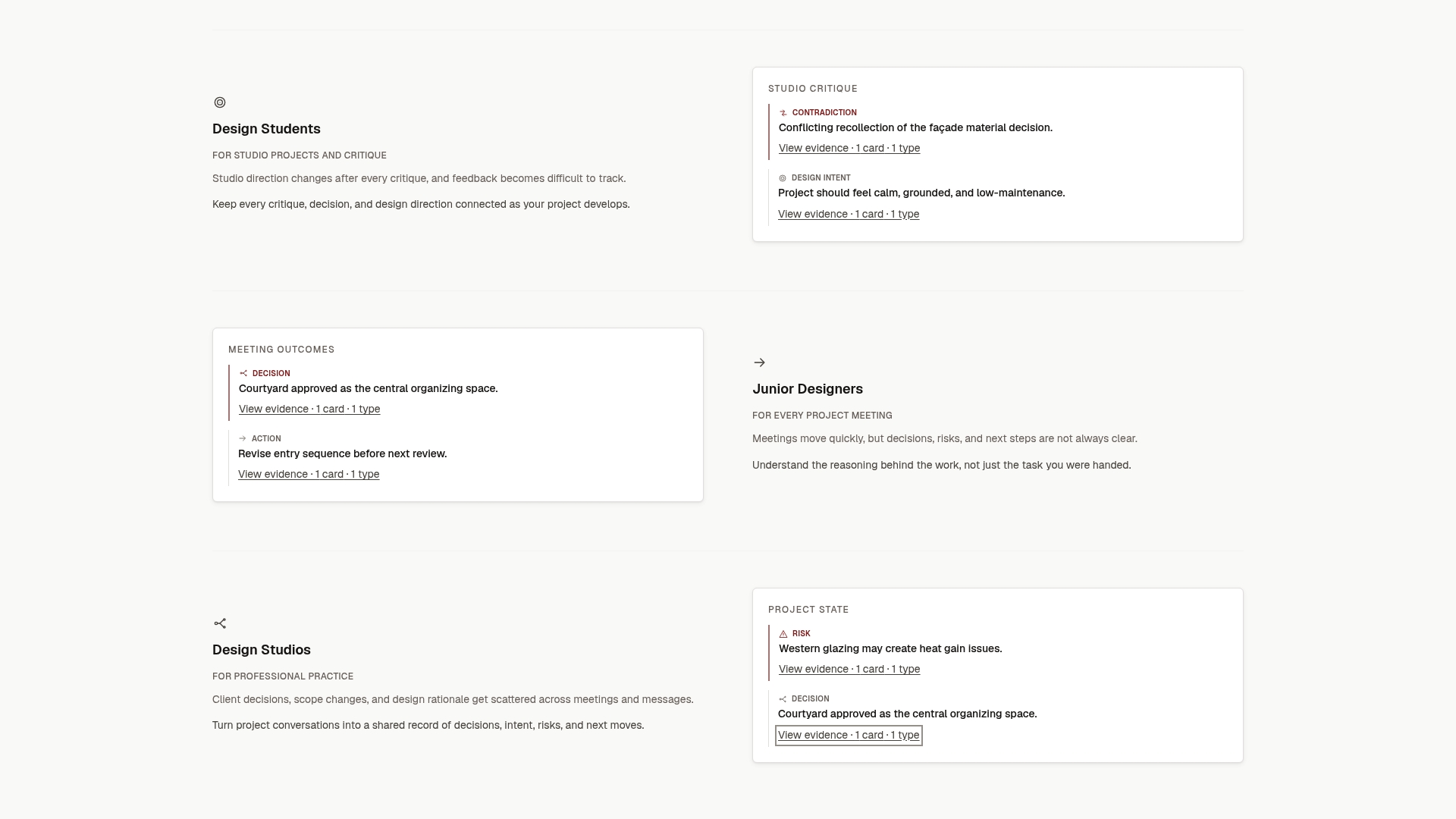
A one-page design statement is genuinely enough for a small renovation with one client and one architect. Once you’ve got multiple disciplines, a longer construction timeline, or a team that turns over mid-project, a manual log starts losing decisions between the cracks that a structured record wouldn’t. If that’s where your studio is, look at the pricing page for the Working Memory and Living Record plans, or start with a one-off Project Record pack if you just want to test the format on a single job. Either way, the product overview walks through how ILM Records connect to your existing meeting workflow, and you can be logging your first decision within the hour.
Authoritative Next Reads
- buildingSMART’s Information Delivery Manual: the standard for specifying who needs what information and when.
- RIBA’s design statements guidance: practical wording for briefs and planning submissions.
- The longitudinal design rationale study: the research behind preserving rejected alternatives.
- Design and architecture transfer students weighing studio culture against documentation habits can check this transfer admissions guide for context on what programs expect.
Sources
- Information Delivery Manual - buildingSMART International
- Design rationale in conceptual design: a longitudinal study
FAQ
What Is Design Intent?
Design intent is the recorded explanation of what a design must achieve and why, including the priorities, constraints, and evidence behind the decisions that shaped it. In parametric modeling, it also refers to embedding relationships into a model so it updates predictably when something changes.
What Are the Two Main Types of Design Documentation?
Design documentation generally splits into design-development documents, the sketches and narratives that establish direction, and technical or construction documents, the drawings and specifications that make a project buildable. A third category, decision or design-rationale records, is increasingly treated as essential rather than optional.
Can You Give an Example of a Design Statement?
A concise example from RIBA’s guidance reads: “Create a calm, legible arrival sequence that gives visitors an immediate sense of welcome and orientation; prioritize daylight, visual continuity, and durable low-maintenance materials, while keeping circulation accessible and construction details within the approved budget.” It states an outcome, ranks priorities, and sets a constraint all in one paragraph.
What Is Another Word for “Design Intent”?
Common alternatives include “design rationale,” “design brief,” and “intent statement,” though each carries a slightly different emphasis. “Design rationale” leans toward the reasoning behind a choice, while “intent statement” leans toward the forward-looking goal a decision is meant to serve.
How Does The Intent Ledger Support Design Intent Documentation?
The Intent Ledger converts meeting transcripts, notes, and client comments into ILM Records that trace each decision back to its original source conversation. Pricing starts with a Project Record pack or the Working Memory subscription, depending on whether a team wants one-off documentation or ongoing capacity.