A Design Meeting Agenda That Actually Produces Decisions
A Design Meeting Agenda That Actually Produces Decisions

A good design meeting agenda ties every item to a decision or a learning outcome, not just a topic to “discuss.” If an agenda item doesn’t end in a choice, an owner, or a documented answer, cut it from the invite. Here’s a compact template you can paste into a calendar right now:
- Meeting title & purpose: One sentence naming the problem this meeting solves.
- Attendees & roles: Presenter, facilitator, timekeeper, decision owner.
- Pre-work: Links to prototypes, research, or specs, shared in advance.
- Timeboxed items: Each with a stated desired outcome (decide, gather options, surface risks).
- Decisions & owners: What got decided, who owns the follow-up.
- Next steps: Concrete actions with due dates.
This structure works for a design review or a critique. A quick sync or a brainstorming session needs a lighter version, but the same rule applies: no item survives the agenda unless it points toward a decision, a specific piece of feedback, or a resolved question.
Key Takeaways
A design meeting agenda only works when every item is tied to a decision, an owner, and a timebox, not just a topic.
| Point | Details |
|---|---|
| Tie items to outcomes | Every agenda line needs a verb: decide, gather options, or surface risks. |
| Pre-share 24 hours ahead | Distribute prototypes, a one-sentence problem statement, and two or three specific questions. |
| Separate critique phases | Finish clarification before critique, and critique before suggestions, to avoid bikeshedding. |
| Assign explicit roles | Name a presenter, facilitator, timekeeper, and decision owner on the invite. |
| Record decisions with context | Log the decision, the reasoning, and the owner, ideally in a tool like The Intent Ledger that links back to the source conversation. |
Table of Contents
- Five Design Meeting Agenda Templates You Can Use Today
- How Do You Structure a Design Critique Without Bikeshedding?
- What Belongs in Every Design Meeting Agenda?
- Preparation Checklist: What to Share 24 Hours Before
- Facilitation Tactics That Keep Reviews on Track
- Frequently Asked Questions
- Sources
Five Design Meeting Agenda Templates You Can Use Today
Different meetings need different shapes. Trying to run a brainstorm and a critique off the same template is why half your meetings feel off. Here are five templates built around what design teams actually run, adapted from planning frameworks like the four P’s checklist: Purpose, Participants, Preparation, Process.
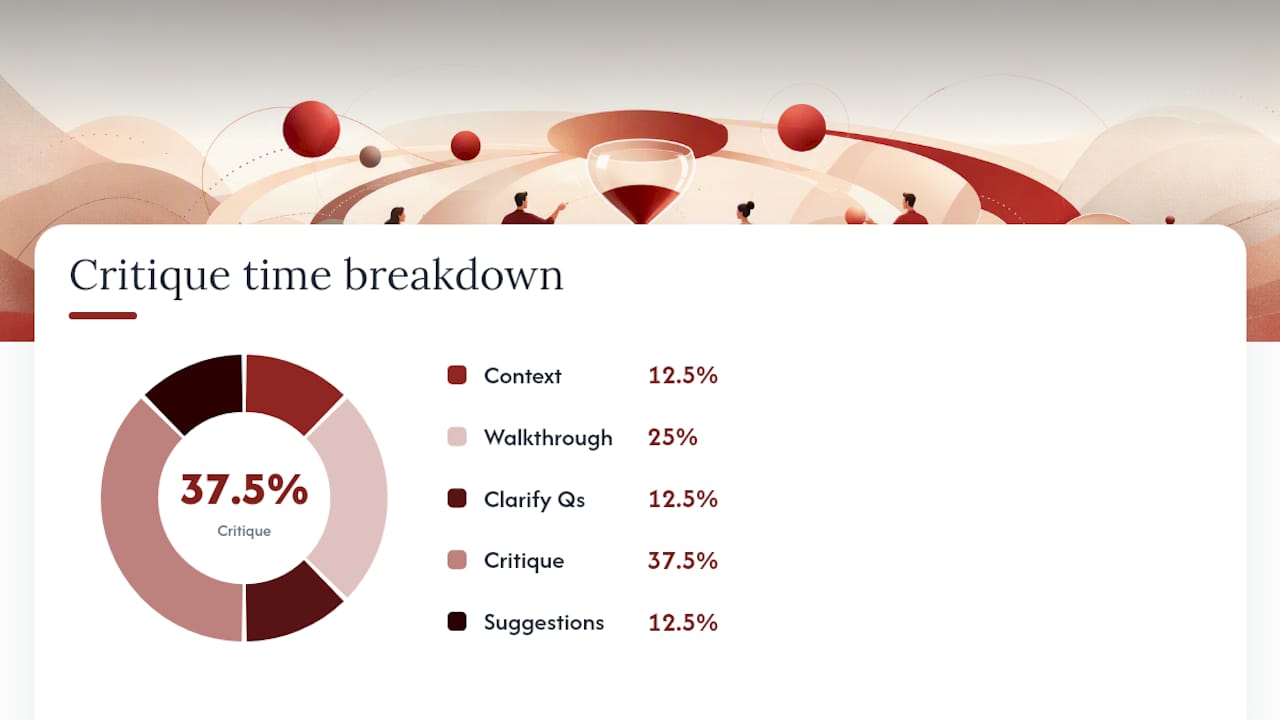
- Design critique / review. Context (5 min), walkthrough (10 min), clarifying questions (5 min), critique by level (15 min), suggestions and next steps (5 min). Pre-share the prototype and problem statement at least a day out.
- Weekly design sync. Round-robin status (10 min), blockers (10 min), quick feedback on in-progress work (15 to 20 min). Keep this one tight. It’s a pulse check, not a review.
- Project kickoff / discovery. Problem statement (10 min), target users and constraints (15 min), known risks (10 min), early ideas or open questions (15 min). This is where scope gets defined, so give it room.
- Brainstorming / ideation session. State the constraint (5 min), diverge individually or in pairs (15 to 20 min), share and cluster ideas (15 min), align on which directions to pursue (10 min).
- Handoff / engineering sync. Acceptance criteria (10 min), known risks and edge cases (10 min), asset and spec walkthrough (15 min), open questions for engineering (10 min).
A few things apply across all five:
- Every template needs a named decision owner, even for a sync.
- Timeboxes should be visible on the agenda itself, not just in the facilitator’s head.
- If a session runs long every week, the agenda has too many items, not too little time.
Pick the template closest to your meeting type and cut what doesn’t apply. A five-person startup team doesn’t need a formal handoff agenda; a 40-person studio running client reviews probably does.
How Do You Structure a Design Critique Without Bikeshedding?
Bikeshedding happens when a group spends 20 minutes debating a button color and five minutes on whether the flow even solves the user’s problem. The fix isn’t more discipline. It’s phase separation. Clarification, critique, and suggestions each get their own window, and none of them overlap.
A practical five-phase structure looks like this:
- Set context (5 min): The presenter states the problem, the users, and any constraints.
- Walkthrough (10 min): Silent or narrated review of the work, no interruptions.
- Clarifying questions only (5 min): Reviewers ask what they don’t understand. No opinions yet.
- Critique by level (15 min): Feedback moves top-down, fundamentals to interaction to surface.
- Suggestions and next steps (5 min): Concrete recommendations, not more critique.
The order matters as much as the phases themselves. Design critique workflows that enforce clarification before critique, and suggestions after critique, produce measurably more actionable feedback because reviewers aren’t reacting to half-formed impressions. Sequencing critique itself top-down, fundamentals then interaction then surface, keeps a group from settling on font weight before anyone’s confirmed the flow solves the actual problem.
For a 15-minute review slot, compress rather than skip. Cut the walkthrough to a silent five-minute read and combine clarifying questions with context-setting. For multi-presenter sessions, rotate the full five phases per presenter rather than batching all walkthroughs first. Batching tends to bleed critique into the next person’s context-setting.
Pro Tip: Post the five phases on a shared screen during the meeting. When someone jumps ahead to suggestions during the critique phase, point at the screen instead of arguing. It’s a lot less awkward than calling someone out directly.
What Belongs in Every Design Meeting Agenda?
Most agendas fail for the same reason: someone lists topics instead of outcomes. Here’s what a working agenda actually needs, field by field.
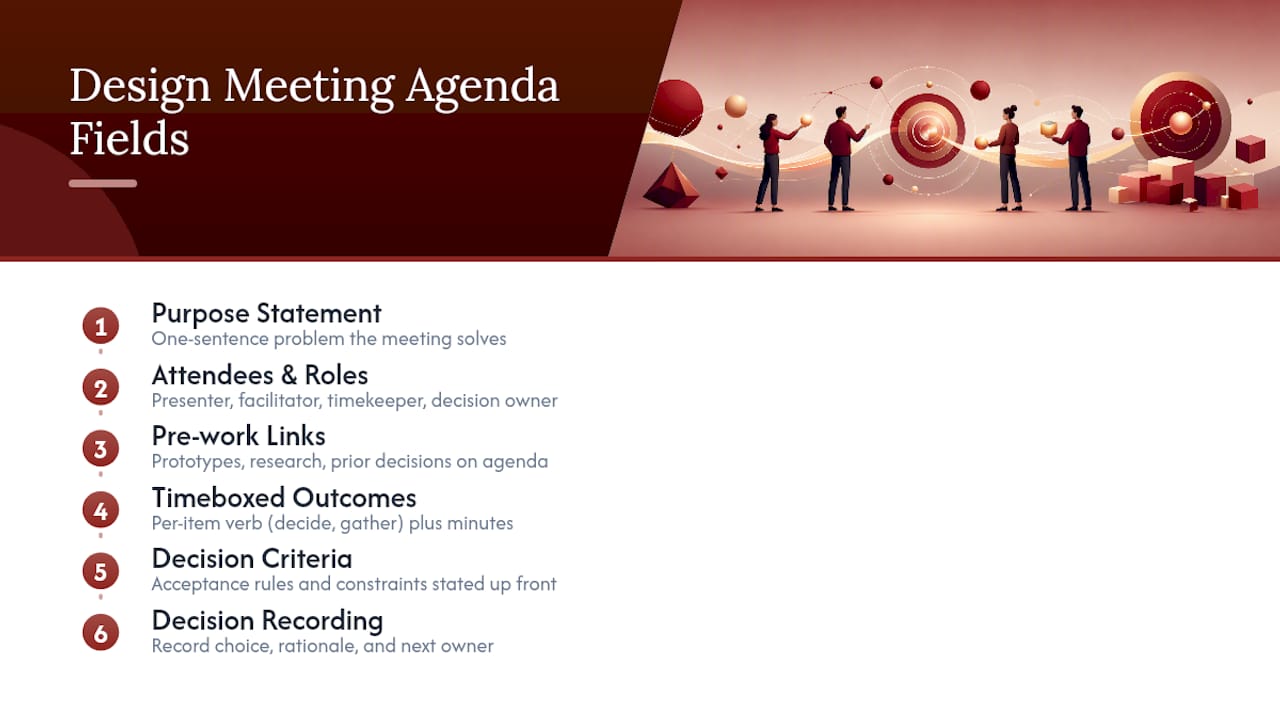
Meeting title and purpose. One sentence stating the problem the meeting exists to solve. “Review checkout flow v3” is a topic. “Decide whether checkout v3 reduces cart abandonment enough to ship” is a purpose.
Attendees and roles. Name the presenter, facilitator, timekeeper, and decision owner explicitly on the invite. A meeting planning checklist with clear roles and objectives consistently produces more effective sessions than an open invite with no assigned responsibilities.
Pre-work links. Prototypes, research summaries, and prior decisions the group needs before walking in. Don’t bury these in a chat thread. Put them directly on the agenda.
Per-item desired outcome and timebox. Every agenda line gets a verb: decide, gather options, surface risks. Attach a number of minutes next to it.
Decision criteria and constraints. State what makes an answer acceptable before the discussion starts, including accessibility and technical constraints that might otherwise surface too late to act on cheaply.
How to record the decision. Note the choice, the reasoning, and who owns the next step, written down before the meeting ends, not reconstructed from memory the next day.
Preparation Checklist: What to Share 24 Hours Before
The single highest-leverage habit in this whole guide is sharing materials a full day ahead. Reviewers who walk in cold spend the first ten minutes reading instead of thinking, and that’s ten minutes you don’t get back.
- Share the artifact. A working prototype or annotated screenshots, not a Figma link with no context.
- State the problem in one sentence. Who is this for, and what are they trying to do?
- List constraints. Technical limits, brand guidelines, deadline pressure, anything shaping the solution space.
- Ask two or three specific questions. “Does this flow reduce steps for returning users?” beats “thoughts?” every time.
Design review preparation practices that include distributing assets and research at least 24 hours in advance consistently shift meeting time from information consumption toward actual evaluation. Format the pre-share as a one-page brief with highlighted flows or a short test script. Reviewers should be able to skim it in five minutes and know exactly what you’re asking them to weigh in on.
Facilitation Tactics That Keep Reviews on Track
The facilitator’s job isn’t to run the clock. It’s to keep the conversation evidence-based when it starts drifting into personal taste. That drift from objective review to subjective opinion is the single biggest way design meetings go sideways, and it’s almost always the facilitator’s job to catch it early.
A working facilitator checklist:
- Open by restating the meeting’s purpose and the decision at stake.
- Enforce phase discipline. Redirect suggestions back to the critique phase if they show up early.
- Require feedback tied to the stated user or constraint, not “I don’t like it.”
- Close by naming the next step out loud before anyone leaves.
Roles matter here too. The presenter owns the walkthrough and answers clarifying questions. The facilitator enforces phases and time. The timekeeper flags when a phase is running over. The decision owner makes the final call when the group can’t converge.
Pro Tip: When someone says “I feel like this should be blue,” ask “what user problem does that solve?” It reframes a preference as a testable hypothesis, or reveals there isn’t one.
How Long Should Design Meetings Run, and How Often?
Duration should match the stakes, not the calendar default. A design review or critique typically needs 60 to 90 minutes to cover two or three items properly. A weekly sync runs fine at 30 to 60 minutes covering status and blockers only.
- Discovery phases benefit from more frequent, shorter kickoff-style sessions as scope is still moving.
- Iterative development settles into a steady weekly or biweekly review cadence.
- Polish phases often need tighter, more frequent syncs since changes are smaller but decisions still need tracking.
Split a session when you’re covering unrelated projects. Combine sessions when splitting would force the same people to re-explain context twice in one week.
Capturing Decisions So Design Intent Doesn’t Get Lost
The decision itself is only half the record. Without the reasoning attached, someone reopens the same debate three months later. A minimal note format that works:
- Decision: What was decided, in one sentence.
- Why: The evidence or constraint that drove it.
- Owner: Who’s accountable for the follow-through.
- Due date and artifact link: Where the work lives and when it’s due.
Tying each decision back to the conversation or artifact it came from matters more than it seems. Capturing decision context, including the research and alternatives considered, cuts down on repeated “why did we decide that” conversations that eat into future meetings. Most teams try to do this in a shared doc or a chat thread, which works until the thread gets buried. That’s the exact gap purpose-built project memory tools like The Intent Ledger are built to close.
What Usually Breaks Design Meetings
The failures repeat across teams: no pre-share, critique and suggestions tangled together, decisions made verbally and never written down. Three habits fix most of it. Share materials a day ahead. Enforce phase separation. Write the decision and the why, not just the outcome.
Teams that adopt even one of these habits report fewer repeated debates and faster handoffs, because nobody’s reconstructing context from memory two sprints later.
The Intent Ledger Turns Meeting Talk Into a Record You Can Trust Later
Theintentledger is the alternative to letting decisions live in someone’s memory or a scattered chat thread. It takes your meeting notes, transcripts, and critique feedback and turns them into ILM Records: structured entries that capture the decision, the reasoning behind it, the owner, and links back to the original conversation.
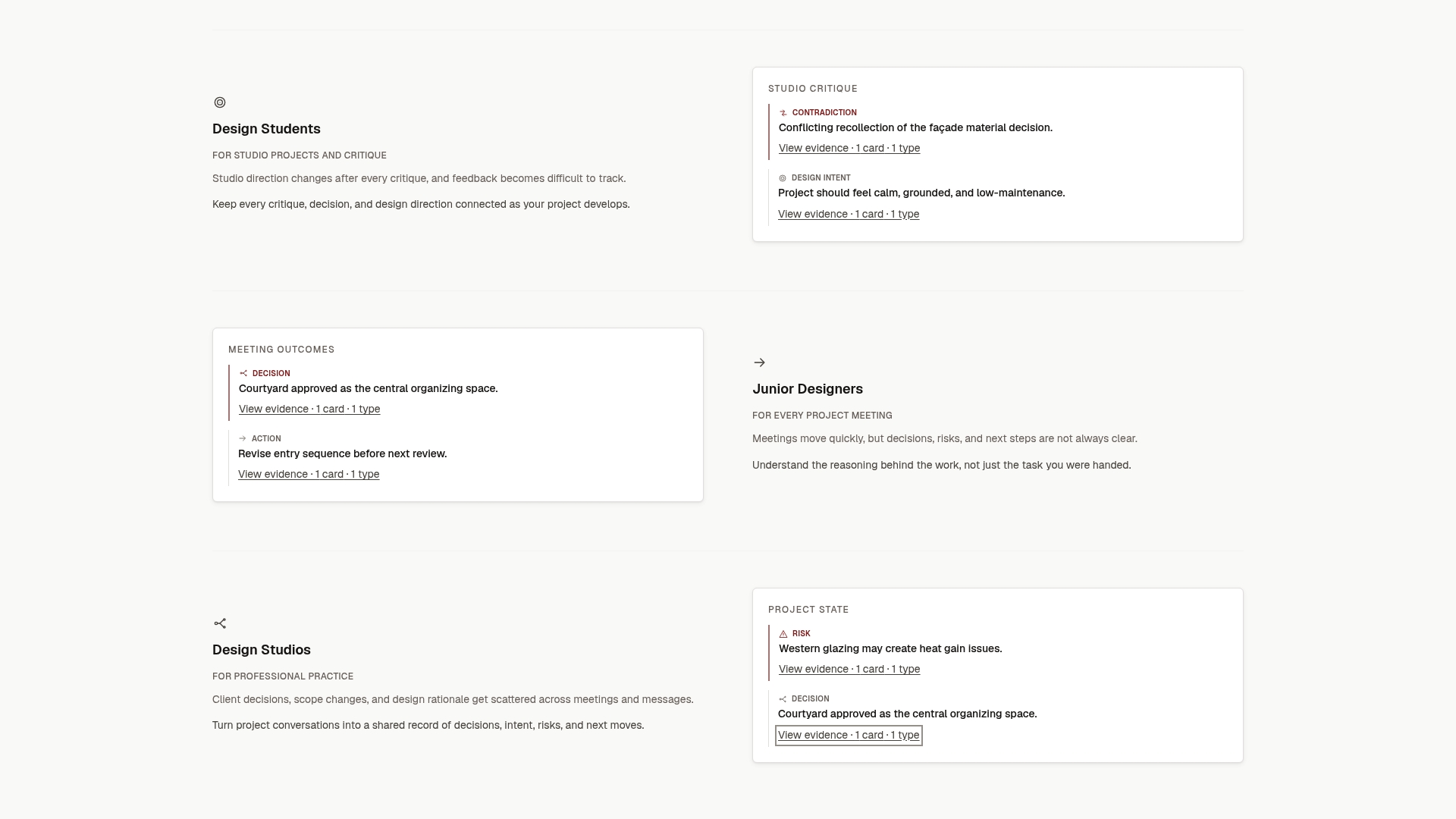
Picture a design review where the group decides to simplify a checkout flow after weighing two prototypes. Instead of that reasoning living in someone’s notes app, it becomes an ILM Record anyone on the team can search later, complete with the linked artifacts and the “why” behind the call. New team members onboard faster because they’re reading the actual decision trail instead of asking around. If your team is tired of re-litigating decisions nobody wrote down, start with The Intent Ledger and turn your next design review into a record that outlasts the meeting.
Frequently Asked Questions
What should a design meeting agenda always include? A purpose statement, attendee roles, pre-work links, timeboxed items with a desired outcome, and a place to record decisions and owners.
What are the four P’s of a meeting agenda? Purpose, Participants, Preparation, and Process, a checklist that keeps a meeting intentional rather than reactive.
How long before a design review should I share the prototype? At least 24 hours ahead, along with a one-sentence problem statement and a couple of specific questions for reviewers.
How do I stop design critiques from turning into arguments about color? Separate clarification, critique, and suggestions into distinct phases, and critique top-down, from fundamentals to interaction to surface details, before anyone touches visual polish.
Who should own decisions made in a design meeting? A named decision owner assigned before the meeting starts, distinct from the facilitator and the presenter, so someone is accountable when the group can’t reach consensus.
Sources
- The Brief: a definitive guide to running design reviews, DesignBetter
- Effective meetings, Toastmasters (Magazine, Jan 2024)
- Design critiques solved, VMware Design (Medium)
- A checklist for planning your next big meeting, Harvard Business Review