46% Less Documentation, Traceable Design Meeting Notes for Design Teams
46% Less Documentation, Traceable Design Meeting Notes for Design Teams
Design meeting notes, done right, are not minutes. They are structured, source-backed ILM Records that capture what was decided, why it was decided, what risks came with it, and what still needs answering, each one traceable back to the conversation that produced it. Done this way, notes stop being a formality and start preventing the slow leak of context that kills projects months later.
TL;DR:
- Record decisions only when they significantly impact the project’s structure, direction, or when future team members are likely to ask why they were made.
- Limit each decision record to three pieces of supporting evidence to prevent overloading and ensure clarity, unless it warrants a dedicated follow-up meeting.
- Capture the decision live during meetings and expand it with source links and evidence within 24 to 48 hours for better traceability.
- Attach timestamped transcripts or artifact links to each record promptly, as well as assign owners and due dates to ensure accountability for next steps.
- Use structured roles for note-taking, verification, and action ownership to maintain accuracy and track unresolved questions effectively.
Table of Contents
- 1. What to capture: apply the FSE framework to design notes
- 2. When to record a decision: a short capture rule tied to milestones
- 3. A concrete template: copy-ready fields and a micro-example
- 4. Meeting practices that make notes reliable
- 5. Tools and workflow: turning notes into living project memory
- 6. Why most documentation efforts quietly fail
- How The Intent Ledger implements this approach
- Sources
- FAQ
1. What to capture: apply the FSE framework to design notes
Most teams either write too little (a single line: “Went with option B”) or too much (a transcript nobody rereads). The FSE framework solves this by organizing rationale around three compact elements: the Feature being decided, the Specification chosen for it, and the Evidence that supports the choice. An analysis of 846 pages of student design reports and 218 pages of industry reports found this feature-based structure outperformed more elaborate rationale models for practical use, largely because it asks for just enough detail to be useful later.
Mapped onto an ILM Record, FSE becomes a short set of fields:
- Decision title and context: what was being decided and why it came up.
- Decision and specification: the choice made, stated as a concrete spec.
- Evidence: the test result, transcript snippet, or comparison that justified it.
- Stakeholders, impact, and dependencies: who was involved and what the decision touches.
- Owner, actions, and unresolved questions: who runs with it and what is still open.
- Source link: the meeting, transcript, or artifact the record traces back to.
Keep the evidence tight. The same research suggests limiting each feature to its top one to three specs or pieces of evidence rather than logging every option discussed.
Pro Tip: If a decision needs more than three pieces of evidence to justify it, the decision probably deserves its own follow-up meeting, not a longer note.
2. When to record a decision: a short capture rule tied to milestones
Not every choice in a meeting needs a record. Microsoft’s architecture decision record guidance offers a workable test: record a decision when it significantly affects the project’s structure, direction, or outcome, or when a future team member would reasonably ask why that choice was made. Anything smaller can stay in the general meeting notes.
Timing matters as much as the rule itself. Exchange information requirements guidance describes structuring information exchanges around delivery milestones and key decision points, so that documentation lines up with the moments a client, contractor, or reviewer actually needs it. In practice, that means:
- Record immediately when a mid-sprint change alters scope, structure, or a prior commitment.
- Record before and after formal approvals, so the “before” rationale and the “after” outcome both exist.
- Record at information delivery milestones, even for decisions that only confirm an earlier direction.
Skip the record for reversible, low-stakes calls, like a placeholder color or a temporary label, unless someone is likely to ask about it in six months.
3. A concrete template: copy-ready fields and a micro-example
A usable template needs to be short enough to fill out in minutes and complete enough to answer questions later. Each field below carries a target length so the record stays scannable:
- Title (one line): the decision in plain language.
- Context (one to two sentences): the problem or question that triggered the decision.
- Decision (one sentence): the specific choice made.
- Alternatives considered (one line each, optional): what was rejected and why, briefly.
- Rationale and evidence (two to three sentences): the reasoning, plus a linked transcript snippet or test result.
- Impact and dependencies (one to two lines): what this touches, blocks, or depends on.
- Owner and actions (names and dates): who is accountable and what happens next.
- Source link, date, and status: the meeting or transcript it came from, when it was recorded, and whether it is open, confirmed, or superseded.
A micro-example: “Feature: sidebar navigation width. Decision: fixed at 280px on desktop. Evidence: usability walkthrough (transcript, 14:22) showed 240px truncated three of five menu labels; client feedback confirmed 280px matched the brand grid. Owner: Priya, due before next milestone review. Source: design review, March 3, 2026, linked to Figma file v12.”
For traceability, attach an ID to each record and store it against the ticket number or model version it relates to, inside a shared container rather than scattered documents. The survey of tool support for design decisions found that linking rationale directly to artifacts and visualizing relationships between decisions improves both traceability and reuse, compared with rationale kept separate from the work it explains.
Value-based documentation captures roughly 46% of full documentation on average while preserving its usefulness, according to a Simula study on design rationale. That is the practical target: less than half the volume, most of the value.
4. Meeting practices that make notes reliable
A good template fails without meeting habits to back it up. Assign three roles at the start of a project: a scribe who owns the note during the meeting, a decision verifier who confirms the record matches what was actually agreed, and an action owner for each open item. Splitting this prevents the common failure where the scribe writes down what they thought they heard.
- Capture the minimal decision live, then expand it into a full record within 24 to 48 hours with source links and evidence attached.
- Review open records at each project milestone, not just when someone remembers to.
- Timestamp quotes pulled from recordings or transcripts, and mark where each piece of evidence came from.
- Treat missing owners, vague outcomes, or records with no source link as red flags to fix before the meeting is considered closed.
Pro Tip: A record with no linked source is a note about a decision, not a record of one. Treat the link as a required field, not an optional extra.
For teams running frequent coordination meetings, particularly MEP-heavy architecture projects, a structured weekly BIM coordination workflow offers a useful model for pairing meeting cadence with documentation discipline.
5. Tools and workflow: turning notes into living project memory
The workflow that makes ILM Records stick is straightforward: capture the decision during the meeting, draft the full record afterward, link it to its transcript or artifact, tag and assign any resulting actions, then surface the decision history at the next relevant milestone. Each step is small, but skipping one is usually why records go stale.
Automation helps with the mechanical parts. Transcript linkage and candidate-extraction tools can flag likely decisions from a recording, but a human still needs to verify the wording and confirm the owner, since automated extraction can misread context.
- Capture the raw decision the moment it happens, even as a single sentence.
- Link the record to its source transcript, model version, or ticket before the meeting ends if possible.
- Assign an owner and due date so actions do not sit unclaimed.
- Revisit the record at the next milestone to confirm it still holds.
This is the gap The Intent Ledger is built to close: it turns meeting conversations, transcripts, and critique feedback into structured ILM Records automatically linked back to their source, so teams do not have to rebuild that trail by hand. For a deeper look at fields and automation, see the design documentation template and guidance on automating meeting notes. A small team on a short project can manage with a shared document; once decisions span multiple milestones or contributors, a dedicated tool earns its keep.
6. Why most documentation efforts quietly fail
The biggest barrier to good design meeting notes is not a missing template, it is the cost of writing one. Teams that ask for exhaustive documentation get exhausted producers who quietly stop bothering, which is exactly the failure pattern research on architecture decision documentation describes as producer resistance to onerous recording. The fix is not less rigor, it is less volume per record.
A value-based approach, capturing the few things a future teammate would actually ask about, keeps the habit alive long enough to matter. Start with the template above, skip the fields that do not fit your project, and adjust after a few weeks rather than trying to get it perfect on day one.
— Rajas
How The Intent Ledger implements this approach
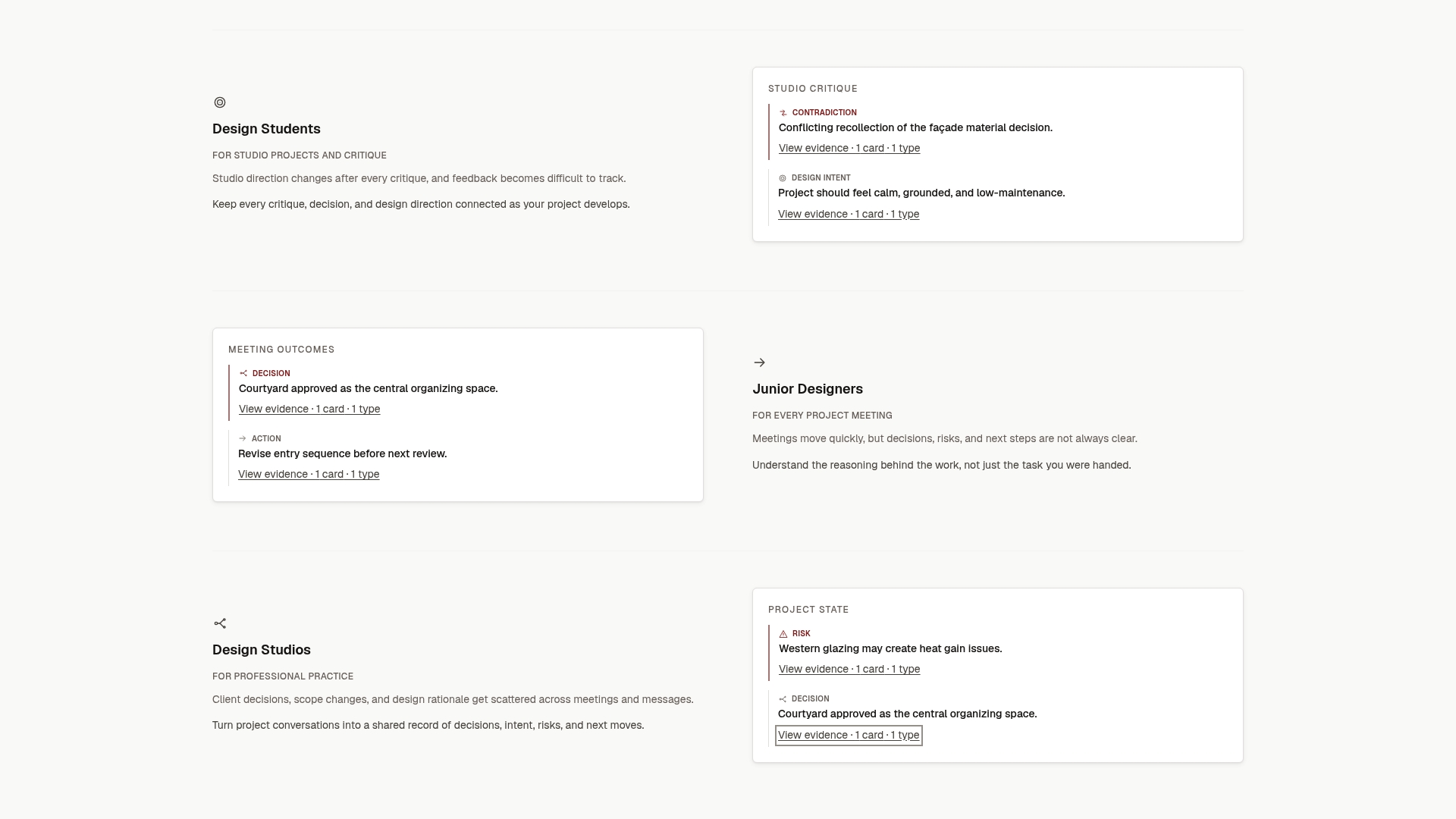
The Intent Ledger turns meeting conversations, transcripts, and critique feedback into structured, source-backed ILM Records automatically linked to the artifacts they came from, so the “why” behind a decision stays attached to it instead of drifting into someone’s memory.
Plans range from the Working Memory subscription at $29 per month to one-time ILM Record packs like Project Record at $29, depending on whether your team wants ongoing capture or a fixed set of records. For field-by-field guidance, the record of decision breakdown and the decision log template are good next reads, and the pricing page has full details on every plan.
Sources
- Architecture decision record guidance (Microsoft)
- Survey of tool support for working with design decisions (Tlatoza et al.)
- The value of design rationale information (Simula study)
- Exchange information requirements (EIR) guidance (UK CDBB)
FAQ
What are design meeting notes in this context?
They are structured, source-backed ILM Records that capture a decision, its rationale, risks, and open questions, each traceable back to the meeting or transcript it came from. This differs from generic minutes, which log what was discussed without preserving why a choice was made.
How detailed should a design decision record be?
Keep it short: a title, one to two sentences of context, the decision itself, and one to three pieces of supporting evidence, following the FSE framework. Value-based documentation captures roughly 46% of full documentation on average, according to Simula’s research, and preserves most of the practical value while staying quick to write.
When should a decision get its own record instead of a line in the notes?
Record it when the choice affects the project’s structure, direction, or outcome, or when a future teammate would reasonably ask why it was made, per Microsoft’s ADR guidance. Smaller, reversible choices can stay in general meeting notes without a dedicated record.
How do you keep meeting notes linked to their source material?
Attach a timestamped transcript snippet, recording link, or model version to each record at the time it is drafted, ideally within 24 to 48 hours of the meeting. Tools built for this, including The Intent Ledger, automate part of the linkage, though the wording and owner still need human confirmation.
Who should own design meeting notes on a project?
Assign a scribe to capture the record during the meeting, a decision verifier to confirm accuracy, and an action owner for each resulting task. Splitting these roles keeps records accurate and prevents open items from going unclaimed.