Make a Design Project Postmortem Stick: Turn Findings into Traceable Records
Make a Design Project Postmortem Stick: Turn Findings into Traceable Records

A design project postmortem is a structured, blameless review held after a project ends to document what happened, why it happened, and what system changes will prevent the same failure twice. Run one after any major launch, missed deadline, or unexpected win, and after any project where leadership needs root-cause clarity instead of guesses. You’ll leave with a written record and a set of action items, each tied to a specific owner and a deadline.
TL;DR:
- Schedule postmortems within two weeks for non-metric projects to ensure details are fresh, but wait until data is representative for metric-driven projects.
- Include only essential participants, define success criteria upfront, and focus root-cause analysis on two to three key issues for trustworthy findings.
- Link each action item to a specific decision with an owner and deadline, and regularly verify if fixes address the root causes effectively.
- Store postmortem records in a searchable, centralized system that links decisions, evidence, and conversations to build organizational memory.
- Foster a blameless culture by framing discussions around process improvements and aggregating findings across projects to identify systemic issues.
Table of Contents
- What Makes a Postmortem Different From a Retrospective?
- When Should You Actually Run the Meeting?
- Who Should Be in the Room, and What Should They Bring?
- How Do You Actually Run the Meeting?
- What Belongs in the Template, and Where Should It Live?
- How Do You Make Sure the Findings Actually Change Anything?
- How Do You Build a Culture Where This Actually Sticks?
- What I’ve Learned Running These Sessions Wrong Before Getting Them Right
- How Theintentledger Turns Postmortem Findings Into Lasting Project Memory
- Where to Go Next for Deeper Postmortem Practice
- Sources
What Makes a Postmortem Different From a Retrospective?
A postmortem analyzes a specific event, usually a project’s end, a launch, or a failure, to trace outcomes back to their root causes and change the systems that produced them. A retrospective, by contrast, is a recurring check-in on team process, typically run at the close of a sprint, meant to tune how the team works together over time. Lessons learned is neither a meeting nor a method. It’s the document you produce, the artifact that survives after both types of meetings end.
The confusion between these terms costs teams real time, because picking the wrong format wastes the meeting.
- Retrospective: recurring, process-focused, asks “how did we work together this cycle?”
- Postmortem: one-time, event-focused, asks “why did this specific outcome happen?”
- Lessons learned document: the written output either meeting can produce, meant to outlive the discussion
Pick a retrospective when you want to tune a repeating cadence, like a two-week sprint rhythm. Pick a project retrospective analysis of the postmortem variety when something notable happened, whether a launch beat every metric or a redesign quietly tanked conversion, and you need to understand the specific mechanism behind it. Design teams that blur the two often end up running vague “how do we feel” sessions when what they actually needed was a focused post-project review of one event.
When Should You Actually Run the Meeting?
Timing determines whether a postmortem produces real insight or a room full of fuzzy memories. For non-metric design work, such as design system overhauls, research sprints, or exploratory phases, it is recommended to hold a postmortem soon after completion while the details are still fresh.
Metric-driven projects run on a different clock. NN/g’s guidance on UX postmortems recommends waiting until representative performance data actually exists, but not so long that the team loses the thread on what they were trying to achieve.
That single rule solves most scheduling debates:
- Design systems, research sprints, exploratory work: schedule within two weeks of completion, while conversations and decisions are still fresh
- A/B tests, staggered feature launches, funnel redesigns: wait for a full, representative data cycle, typically once traffic patterns stabilize past any launch anomaly
- Anything with strong seasonality: hold off past the seasonal spike so you’re not confusing a holiday bump with a genuine design win
Pro Tip: If a launch straddles a holiday or a known traffic spike, run a short “initial reactions” session within the two-week window anyway, then follow with the full data-driven postmortem once the numbers settle. You’ll capture the human context before it fades and still get a clean read on performance.
The mistake most teams make isn’t scheduling too late. It’s convening the metric-driven postmortem before the data has had a chance to say anything real, which turns the meeting into a guessing exercise dressed up as analysis.
Who Should Be in the Room, and What Should They Bring?
A postmortem lives or dies on who shows up and what they’re asked to prove. Every strong session covers six components, and skipping any one of them tends to produce a document nobody trusts six months later.
- The right participants. Bring the lead designer, the project manager, a researcher if one was involved, one client-side or business stakeholder, and a neutral facilitator who wasn’t emotionally invested in the outcome. Five to seven people is the sweet spot. More than that, and half the room stays silent.
- Defined success criteria. Before anyone opens their mouth about what went wrong, the group needs to agree on what “right” would have looked like. Without that baseline, every disagreement about the outcome becomes a disagreement about the goalposts.
- Blameless framing. Facilitators should model causal language over accusatory language from the first sentence, shifting the question from “who missed this” to “what in our process let this slip through.” That single framing choice, as NN/g notes, determines whether people share honestly or spend the meeting protecting themselves.
- Root-cause analysis. Build a timeline of what actually happened, then run a five whys pass or a causal map on the two or three moments that mattered most. Don’t stop at the first plausible cause. The real failure is usually one or two layers deeper.
- Owned, dated action items. Every fix gets a named owner and a real deadline before anyone leaves the room. A postmortem’s real output is a set of system-level changes, not a vague sense that “we’ll be more careful next time.”
- A written record. Capture what was said, link to the primary sources, transcripts, analytics dashboards, prototype files, and store it somewhere the next team can actually find it.
Design assessment work in the D-LAD framework reinforces a point most postmortems miss: evaluate process alongside output. A launch can hit every metric while the decision-making behind it was chaotic, and a launch can miss its numbers while the team’s reasoning was sound given what they knew at the time. Capture both, or you’ll only ever learn half the story.
How Do You Actually Run the Meeting?
Good facilitation starts before anyone sits down. Send a request for the project timeline, links to relevant data, and a short anonymous pre-meeting survey a few days ahead. That survey does real work. According to Parabol’s comparison of postmortems and retrospectives, quieter participants share more honestly in writing, and common themes surface before the room even convenes, which speeds up the live discussion considerably.
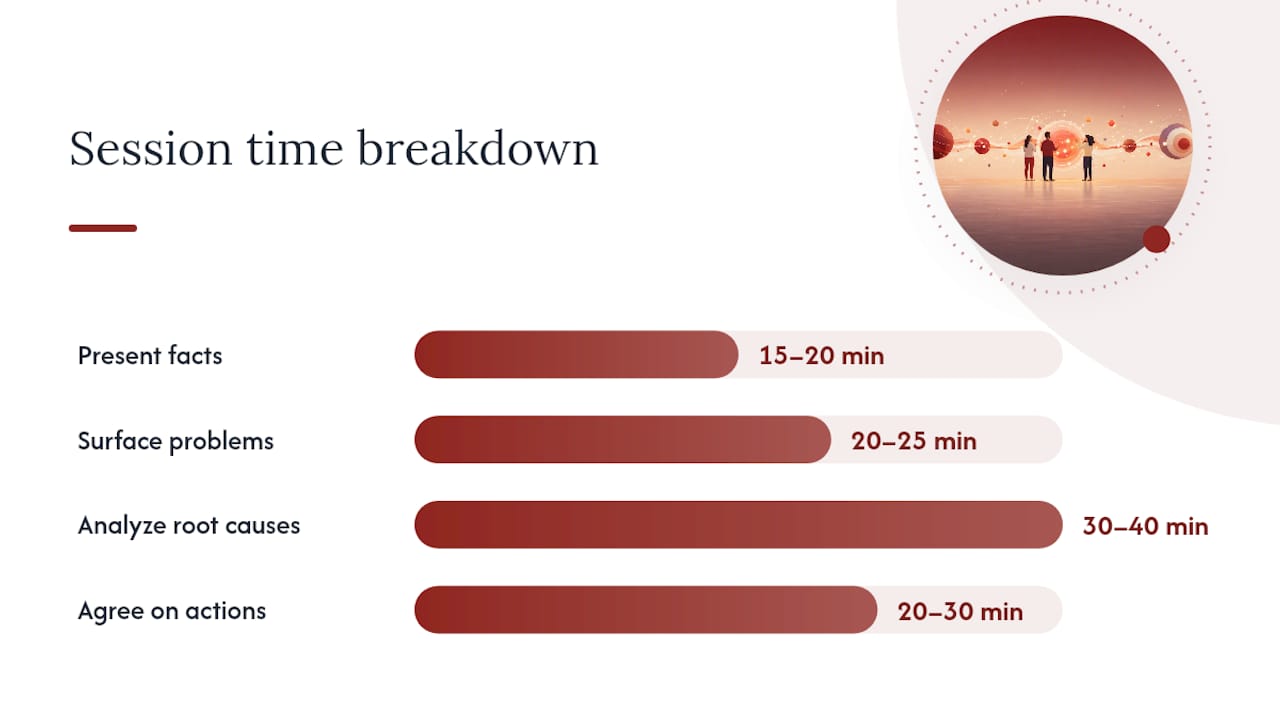
A 90 to 120 minute session, timeboxed, tends to cover the ground without exhausting anyone:
- Present the facts (15 to 20 minutes). Walk through the timeline and the data. No debate yet, just the shared record.
- Surface the problems (20 to 25 minutes). Pull recurring themes from the pre-survey and open the floor for anything missed.
- Analyze root causes (30 to 40 minutes). Run the five whys or a causal map on the top two or three issues. Resist the urge to solve everything.
- Agree on actions (20 to 30 minutes). Convert the discussion into a short, prioritized list, each item with a name and a date attached.
A few facilitation habits keep the room evidence-focused instead of defensive:
- Restate accusatory comments in causal terms out loud, on the spot, so the norm is visible to everyone.
- Ask “what would have made this decision obvious in hindsight” instead of “why didn’t you catch this.”
- Cap root-cause discussion at three issues; a longer list dilutes focus and rarely gets acted on.
- Close by reading the action items aloud with owners named, not just written on a shared screen.
That last habit matters more than it sounds. An action item nobody hears out loud is an action item people forget they agreed to.
What Belongs in the Template, and Where Should It Live?
A consistent template turns a design feedback session into something you can actually compare across projects a year later. Atlassian’s project postmortem template settles on a field list that holds up well for design work specifically:
- Summary: two or three sentences on what happened and the outcome
- Timeline: key decisions and events in order, with dates
- Evidence links: transcripts, analytics, prototypes, client feedback threads
- Root causes: the two or three that surfaced from the five whys or causal map
- Action items: each with an owner, a deadline, and a verification step
- Process notes: how decisions actually got made, not just what got decided
That last field is the one most templates skip, and it’s the one the D-LAD framework argues matters most for design teams specifically, since process quality often predicts future outcomes better than any single project’s results.
Pro Tip: Tag every postmortem by project type, client, and root-cause category when you file it. Six months from now, you’ll want to search “handoff failures” or “scope creep,” not scroll through a folder of loosely named documents.
Storing these records matters as much as writing them well. A postmortem buried in a shared drive with forty other files functions as an archive nobody opens twice, which defeats the entire point of a project learnings document. A centralized, searchable system, one that links each decision back to the conversation or transcript it came from, is what makes lessons retrievable when the next project hits a familiar wall. That’s the exact gap a system like The Intent Ledger is built to close, keeping the “why” behind a decision attached to the decision itself.
How Do You Make Sure the Findings Actually Change Anything?
A postmortem without follow-through is just an expensive meeting. Every action item needs an owner and a deadline before the group disperses, full stop. Teams that skip this step almost always find the same root cause showing up again in the next postmortem.
Set a follow-up rhythm and stick to it:
- Weekly: a two-minute async check on items due that week, just a status ping.
- Monthly: a short progress review across all open action items from recent postmortems.
- At the deadline: verify against the criteria set in the original meeting, not a vague sense that things feel better.
Verification criteria matter more than they get credit for. If the root cause was “designers didn’t get final copy until two days before launch,” the fix isn’t “communicate better.” The fix is a specific handoff checkpoint with a date, and the verification is whether that checkpoint actually happened on the next three projects. If it didn’t, reopen the action item rather than quietly letting it drop. A fix that fails its own verification test is a signal the root-cause analysis missed something, not a reason to give up on the process.
How Do You Build a Culture Where This Actually Sticks?
One good postmortem changes one project. A blameless culture changes every project after it. That shift starts with language: swap “who caused this” for “what allowed this,” consistently, in every session, until it’s the default and not a facilitator’s script.

The bigger payoff comes from aggregating findings across projects. A single postmortem might flag a missed handoff. Ten postmortems flagging the same handoff pattern is an organizational signal that no individual review would catch alone. Leadership’s real job here is governance: protecting time on the calendar for these sessions, reading the aggregated patterns quarterly, and resisting the urge to quietly skip the meeting when a project went badly and everyone would rather move on.
What I’ve Learned Running These Sessions Wrong Before Getting Them Right
The most common postmortem failure isn’t a bad root-cause analysis. It’s a great one that gets written down beautifully and then never looked at again, because the document lived in someone’s personal notes instead of a place the next project team would think to check. The fix that actually worked was almost embarrassingly simple: link every action item to the original decision it came from, and store both somewhere searchable by project type, not just by date.
Try the template on the next project you close, even a small one. The habit matters more than the first result.
, Rajas
How Theintentledger Turns Postmortem Findings Into Lasting Project Memory
Most of what gets decided in a postmortem, or in the client call and critique session that preceded it, evaporates the moment the meeting ends unless someone deliberately captures the reasoning behind it. Theintentledger is built for exactly that gap: it turns project conversations, transcripts, and critique feedback into ILM Records, structured entries that preserve decisions, design intent, risks, commitments, and open questions, each one traceable back to the exact conversation it came from.
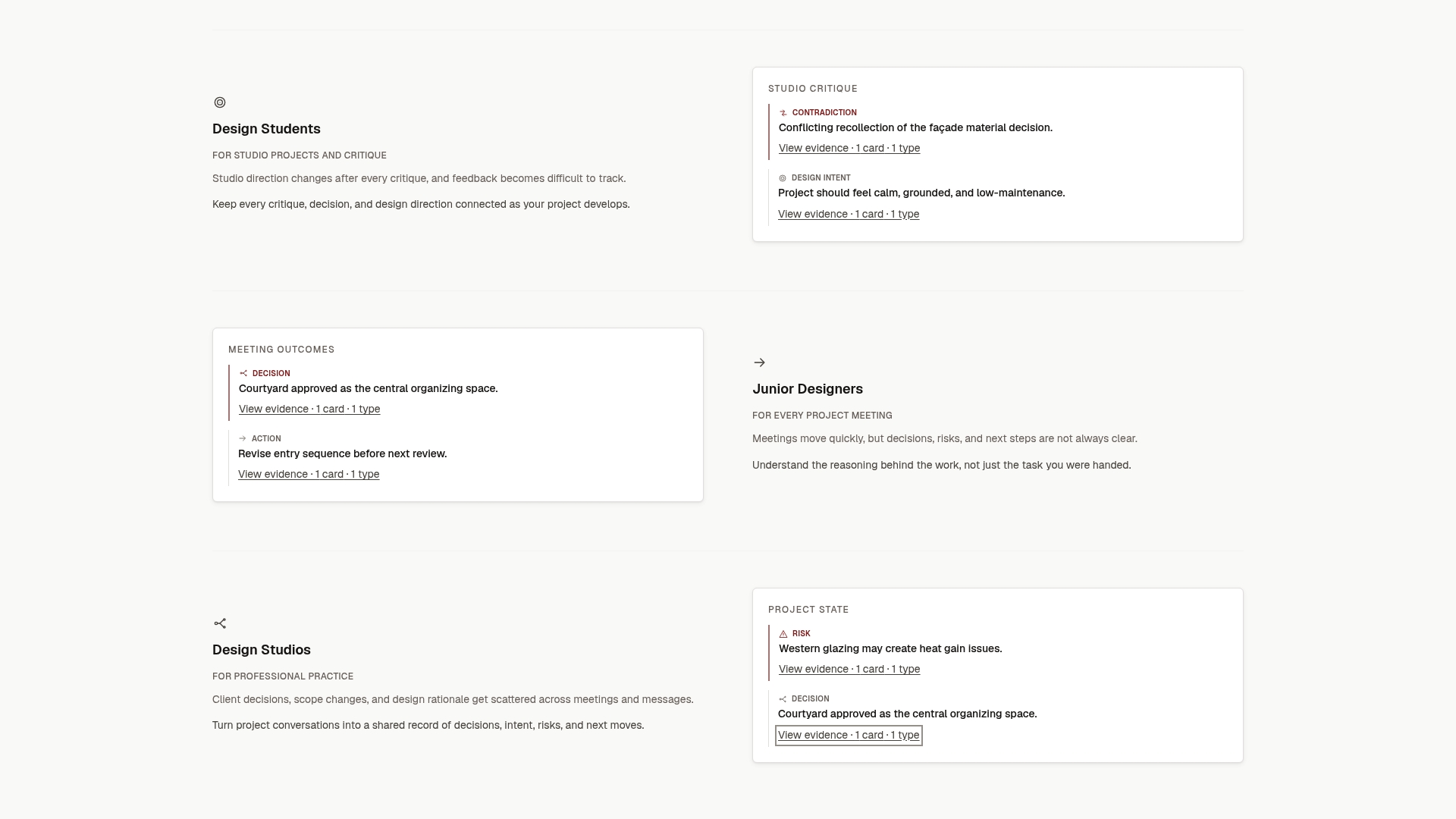
That traceability is what separates a real project learnings document from a folder of scattered notes. When a root cause surfaces in your next postmortem, you can trace it straight back to the meeting where the original tradeoff got made, instead of relying on someone’s memory of “I think we discussed that in March.” For design teams running frequent design outcomes evaluations across multiple clients, that searchable history compounds fast. Start a trial on the Theintentledger product page and run your next postmortem findings straight into a searchable, source-backed record instead of another static document.
Where to Go Next for Deeper Postmortem Practice
For the evidence and theory behind UX-specific postmortems, read NN/g’s full postmortem guide. For a ready-made structure you can copy today, grab Atlassian’s project postmortem template. Studios managing client-facing design work more broadly may also find Forefront Industries’ guide to architect and interior design websites useful context for how workflow and documentation habits shape client trust over time.