Traceable, Copy Ready Design Review Documentation for Design Teams
Traceable, Copy Ready Design Review Documentation for Design Teams
Design review documentation is the written record of what a review found, what got decided, and who owns the fix. It should be a short report paired with a decision log, both tied to the meeting or conversation where the call was made. The one action to take today: draft a one-page report and open a decision log before your next review cycle ends, then circulate both within your team’s usual turnaround window.
TL;DR:
- A comprehensive design review documentation should include a review report, decision log, action register, and annotated deliverables, all linked by decision, owner, rationale, source, and due date.
- Using stage-specific checklists ensures decisions are binary and justified, with formal review reports issued within two weeks to maintain relevance and accessibility.
- A structured decision log, stored in familiar tools and capturing rationale, owners, and links to discussions, prevents loss of context across project phases.
- Profiles of review artifacts emphasize clear roles, timely updates, and staged review frequency, typically two to three formal sessions with interim asynchronous checks.
- Automated tools like the Intent Ledger can transform meeting recordings into traceable, structured decision records, reducing manual reconstruction and improving team consistency.
Table of Contents
- What Design Review Documentation Should Include
- Design Review Report Template You Can Copy
- How Do You Build a Stage-Based Design Evaluation Checklist?
- Turning Review Notes into a Decision Log with Traceability
- How Long Should a Design Review Report Take to Issue?
- Copy-Ready Snippets for Your Next Review
- How The Intent Ledger Supports Stronger Review Documentation
- Adopting Review Documentation Without Adding Overhead
- A Lighter Way to Keep Review Records Straight
- Templates and Manuals Worth Bookmarking
- Sources
- FAQ
What Design Review Documentation Should Include
Not every stage needs the same paperwork. A concept review calls for a light report and an open-issues list; a construction document review needs a full action register and sign-offs, because the cost of a missed detail is higher once drawings go out for pricing.
Four artifacts cover almost every project:
- Review report — the narrative summary: what was reviewed, what the panel decided, what’s still open.
- Decision log — a running record of every decision with its rationale and source.
- Action register — assigned tasks with owners and due dates.
- Annotated deliverables — the marked-up drawings, models, or mockups the review was actually about.
Whatever the artifact, five fields make it traceable later: decision, owner, rationale, source, and due date. Skip any one of them and someone reopens a settled argument in three months because nobody can remember why the team chose option B.
Design Review Report Template You Can Copy
A design review report doesn’t need to be long to be useful. It needs a consistent structure so anyone on the team, or a new hire six months later, can find the same information in the same place every time.
Start with a header block: project name, review type (concept, design development, or final/CD), session chair, attendees, and the specific decision or approval the session was trying to reach. Follow that with a short summary verdict, two or three sentences stating the panel’s overall recommendation in plain language. Something like: “The panel approved the massing and circulation concept. Facade materials remain open pending cost input. No structural concerns raised.”
After the verdict, list issues in priority order, each with the rationale behind the call and a link back to its source, whether that’s a meeting recording, a transcript, or a comment thread. Then the action register:
| Field | What Goes There |
|---|---|
| Item | The specific task or open issue |
| Owner | One named person, never a team |
| Due date | A real date, not “next sprint” |
| Status | Open, in progress, blocked, or closed |
| Source link | The meeting note, recording, or thread it came from |
Close with an appendix for annotated drawings and any referenced codes or standards. That’s the whole template. It fits on two pages for most concept reviews.
How Do You Build a Stage-Based Design Evaluation Checklist?
Checklists work better than open-ended discussion because they force a yes-or-no answer instead of a vague “looks fine.” The format that engineering agencies rely on, including INDOT’s highway design review checklists, marks each item Yes, No, or N/A, and any item marked No or Deficient requires a written explanation before the review closes. That single rule stops teams from checking a box just to move on.
Concept-stage items usually cover:
- Does the design satisfy the stated program or brief?
- Are site constraints (access, easements, zoning) accounted for?
- Has the client’s budget range been validated against the concept?
- Are there unresolved code or accessibility conflicts?
- Has the design been checked against comparable precedent projects?
Design development and CD-stage checklists shift toward coordination and buildability: structural and MEP clash checks, detail resolution at critical junctions, specification completeness, and confirmation that prior review comments were actually closed out.
Pro Tip: Run the checklist asynchronously first, and save the live panel session for items marked No. That turns a two-hour meeting into a 30-minute conversation about the three things that actually need a room full of people.
Turning Review Notes into a Decision Log with Traceability
A checklist tells you something was checked. It doesn’t tell you why a decision was made or who is supposed to act on it. That’s the job of a decision log, and it’s the piece most teams skip until a client asks “why did we choose this?” six months later and nobody has an answer.
Store the log wherever your team already lives, whether that’s Confluence, a repo alongside the drawings, or a dedicated project memory tool. The tradeoff is searchability versus friction: a wiki page is easy to start but hard to query later; a structured tool makes retrieval faster at the cost of one more login.
The schema itself should stay simple; using tools like Minuted meeting notes that write themselves can help capture review discussions and assign corrective actions efficiently.
- ID — a stable reference number
- Decision statement — what was decided, in one sentence
- Rationale — why, in the reviewers’ own words
- Source — the meeting, recording, or comment it came from
- Owner, due date, status, and related tickets
A Virginia Tech study of structural engineering firms found that firms without a formal review process consistently lose context between phases, forcing new team members to reconstruct rationale from memory or scattered emails. The fix is a lifecycle: capture the decision when it’s made, assign an owner, verify the fix, close it, and archive the record linked to the final deliverable it affected.
How Long Should a Design Review Report Take to Issue?
Delay kills the usefulness of a review report. If findings sit for a month, the team has already moved past the point where a comment is cheap to act on.
- Issue interim or final review reports within 7 to 14 calendar days of the session, per the Local Government Design Review Manual’s turnaround guideline, adjusting toward 14 only for genuinely complex projects.
- Favor async checklist review for routine or low-risk items, and reserve a synchronous panel for concept-stage decisions or anything flagged Deficient.
- Public design review manuals typically recommend two to three review sessions across a project, concentrated early when changes are still cheap.
Copy-Ready Snippets for Your Next Review
Templates only help if someone actually pastes them in. Here’s a compact skeleton and a sample checklist row you can lift directly.
Report skeleton:
- Header: Project X, Concept Review, Chair: [name], Attendees: [list]
- Verdict: “The panel approved the site strategy. Facade approach remains open. No structural issues raised.”
- Open issue: “Facade material undecided pending cost estimate, owner: [name], due: [date]”
Concept checklist excerpt:
Action-item example: “Resolve facade material selection, owner: Priya, due: March 20, 2026, source: Concept Review recording, 14:32 mark.”
How The Intent Ledger Supports Stronger Review Documentation
The Intent Ledger turns meeting recordings, transcripts, and critique comments into structured records that link every decision back to the conversation where it happened. That maps directly onto the fields covered above: decision, owner, rationale, source, and due date all get captured automatically instead of retyped by hand after the meeting ends.
For teams building out a decision log from scratch, The Intent Ledger’s guide on decision record fields walks through the same eight fields discussed here in more depth, and the design documentation template post maps closely to the report structure above. Neither replaces judgment. Both remove the busywork of reconstructing “who said what” from scratch.
Adopting Review Documentation Without Adding Overhead
Formal reports make sense for client-facing milestones. Internal weekly check-ins don’t need one. Match the paperwork to the stakes, not the calendar.
Most documentation efforts fail for one of two reasons: nobody owns the action item, or the artifact goes stale the moment the meeting ends. Fix both by requiring an owner field on every entry and treating the log as a living document, per Design Council’s guidance, not a file you write once and forget. The minimum any team should accept: a decision, a name, and a date, tied to where it came from.
— Rajas
A Lighter Way to Keep Review Records Straight
The Intent Ledger is the alternative to retyping meeting notes into a spreadsheet after every review. Instead of a project manager reconstructing the decision log from memory the next morning, the platform turns the recording, transcript, or written feedback directly into structured records, each one traceable back to the exact conversation it came from.
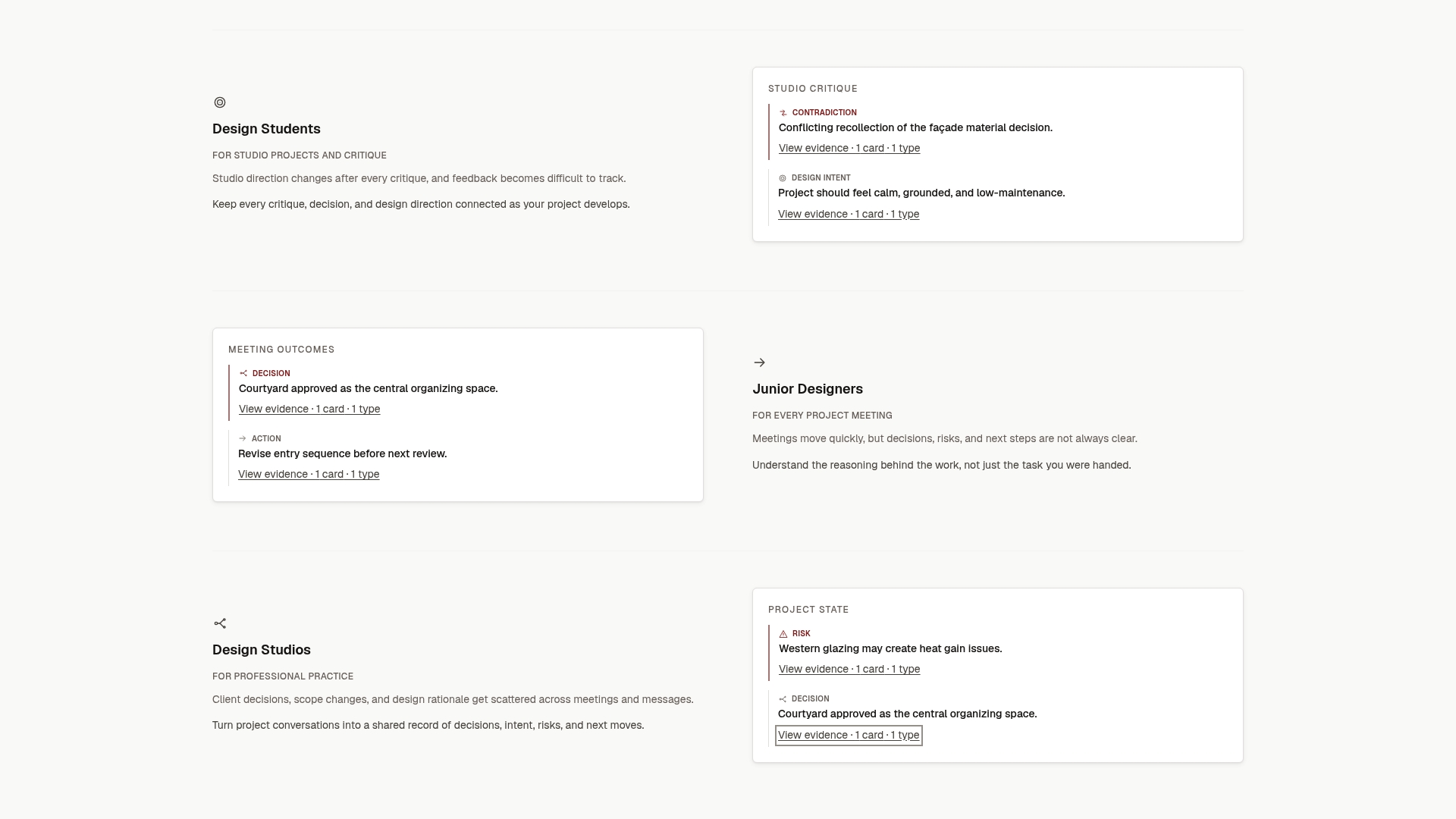
That matters most for teams running multiple concurrent reviews, where the person who remembers why a decision was made isn’t always the person writing the report. A freelance architect or a small studio can start with a one-time purchase like Project Record at $29, while a studio running continuous reviews across projects fits better on an ongoing plan like Living Record. Either way, this is an optional layer on top of the templates above, not a replacement for the habit of reviewing well. Check the full pricing breakdown and see which tier matches how often your team actually reviews.
Templates and Manuals Worth Bookmarking
- ISO 9001 design and development process guidance
- Local Government Design Review Manual (Western Australia)
- INDOT Highway Design Review Checklists
- Local government design review panel manual (NSW)
Sources
- Internal design review study — Virginia Tech (structural engineering)
- Local Government Design Review Manual (Western Australia)
- INDOT Highway Design Review Checklists
- Local government design review panel manual (NSW)
FAQ
What Is the Difference Between a PDR and a CDR?
A Preliminary Design Review (PDR) checks whether the overall concept and approach are sound before detailed design starts, while a Critical Design Review (CDR) checks whether the fully detailed design is ready to move into construction or production. PDR happens early when changes are cheap; CDR happens late and focuses on buildability and completeness.
How Do You Write Design Documentation?
Start with a short header (project, review type, attendees, objective), add a plain-language verdict summarizing the outcome, then list issues with rationale and a source link for each. Close with an action register naming an owner and due date for every open item, following a structure like the report template above.
What Is a Design Review Checklist?
A design review checklist is a stage-specific list of items reviewers mark Yes, No, or N/A, with a required written explanation for anything marked No. INDOT’s checklists use this exact format to keep reviews consistent across projects and reviewers.
What Should Be Included in Design Documentation?
At minimum, design documentation needs a review report, a decision log, an action register, and the annotated deliverables the review was based on. Each entry should capture the decision, the rationale, its source, the owner, and a due date so the record stays useful months later.
How Often Should Design Reviews Happen?
Most projects benefit from two to three formal review sessions, concentrated at the concept stage where changes cost the least, according to NSW’s local government design review panel manual. Lighter async checklist reviews can fill the gaps between formal sessions without adding meeting overhead.