Save Days: Designer Onboarding Documentation Built on Decision Records
Save Days: Designer Onboarding Documentation Built on Decision Records
Designer onboarding documentation is a small set of structured decision records plus a central decision log that gets new designers up to speed on why decisions were made, not just what was decided. It replaces scattered meeting notes with short, searchable records linked to the conversations that produced them, cutting the time a new team member spends guessing and asking around.
TL;DR:
- Document decisions immediately during focused 30 to 45 minute meetings to ensure rationale is captured accurately and consistently.
- Maintain a clear, minimal template including context, decision, alternatives, consequences, and source links to support quick scanning and understanding.
- Link new records to previous decisions and change their status instead of deleting, preserving the decision history and evolution over time.
- Tag decision records by discipline or feature area to allow designers to filter relevant decisions for their roles, such as UX, UI, or interaction design.
- Measure onboarding success by reducing time-to-productive contribution and tracking whether new team members rely more on records than scattered notes.
Table of Contents
- Why preserving decision rationale matters for designer onboarding
- Essential components: the fields every ILM/ADR must include
- Capture workflow: time-boxed meetings and the step-by-step process for creating records at decision time
- Governance and lifecycle: ownership, status changes, changelogs, and review cadence
- Practical template and 48-hour onboarding checklist for new designers
- Structuring documentation for UX, UI, interaction, and visual designers
- Integrating decision records with design tools and workflows
- Measuring whether your onboarding documentation actually works
- What teams get wrong about decision documentation
- How The Intent Ledger turns this practice into a working system
- FAQ
- Sources
Why preserving decision rationale matters for designer onboarding
When a new designer joins a project, the hardest part is not learning the tools. It is reconstructing why the layout changed twice, why a component library got dropped, or why a client rejected an earlier direction. Architecture teams have faced the same problem for years, and the fix that emerged, architecture decision records, focuses on capturing rationale at the moment a decision happens rather than reconstructing it later.
Much of what a design team knows lives as tacit knowledge: unwritten assumptions one person carries in their head. When that person leaves a meeting and the reasoning stays verbal, the next person inherits only the outcome, not the thinking behind it. Project handover research backs this up directly: handover works best as a phased, incremental process, and documentation that is meaningful to the people receiving it beats a single end-of-project data dump every time. Capturing decisions as they happen, continuously, is what keeps a project record trustworthy.
Essential components: the fields every ILM/ADR must include
A usable decision record does not need to be long. It needs the same fields every time, so anyone scanning the log knows exactly where to look. At minimum, an ADR-style record should define context, the decision itself, and the consequences, with rationale given more weight than implementation detail.
For design work, that minimal structure expands into a short, repeatable template:
- Title and date: a short, searchable name and when the decision was made.
- Owner: who made the call and who can answer follow-up questions.
- Status: proposed, accepted, superseded, or deprecated.
- Context: the problem or constraint that triggered the decision.
- Decision: stated as an action, not a description.
- Alternatives considered: what else was on the table and why it lost out.
- Consequences and trade-offs: what the team is accepting in exchange.
- Links to source conversation: the meeting, thread, or critique it came from.
- Open questions or follow-up actions: anything still unresolved.
Keep the “why” separate from the “how.” The decision record should explain rationale; implementation detail belongs in specs, Figma files, or build documentation, with a link connecting the two. A field-level breakdown of what to capture is useful when a team is building its first template.
Pro Tip: Write the decision line in imperative language, such as “We use an 8-point grid,” rather than “An 8-point grid was discussed.” It reads faster and leaves no doubt about what was actually decided.
Capture workflow: time-boxed meetings and the step-by-step process for creating records at decision time
Decisions get documented reliably only when the team has a repeatable rhythm for capturing them. AWS guidance on decision records recommends keeping decision meetings between 30 and 45 minutes, with readout reviews lasting 10 to 15 minutes to keep discussion focused and prevent meetings from sprawling into unrelated topics.
A step-by-step capture process:
- Prepare the template before the meeting so the owner only needs to fill in blanks, not invent structure on the spot.
- Run the decision meeting within the 30 to 45 minute window, keeping discussion on one decision at a time.
- Draft the record immediately afterward while context is fresh, including links to the source conversation.
- Circulate for readout review, a short 10 to 15 minute session where others comment or flag gaps.
- Accept or reject the draft and update its status accordingly.
- Store it centrally with links intact, so it is discoverable by title, date, or project area.
The Intent Ledger reports that ADRs can save days during onboarding by giving new team members the background on why decisions were made, according to a practical overview of architecture decision records, which found that the records help onboard new team members quickly compared with reconstructing history from scattered notes.
Storage matters as much as the writing. A wiki works if it is searchable and tagged by project. A code repository works if designers already live there. Purpose-built project memory software works best when the team wants records automatically linked back to the conversations, transcripts, or critique notes they came from.
Governance and lifecycle: ownership, status changes, changelogs, and review cadence
A decision log only stays useful if old decisions do not quietly vanish when new ones replace them. The practical fix is an append-only model: a record’s status changes over time, but the record itself is never deleted. A practical overview of ADRs recommends a clear status lifecycle, moving from proposed to accepted to superseded or deprecated, which keeps history intact and makes the log something the team can trust.
When one decision replaces another, link the two records instead of overwriting history. Guidance on maintaining decision lineage recommends that teams link the new record to the old one and preserve the old record with a status change rather than deleting it, so anyone reading the log later can trace how thinking evolved.
Good governance in practice looks like this:
- Assign a visible owner to every record, not just a team or role.
- Log a changelog entry with date, responsible person, and a short reason whenever status changes.
- Schedule a review cadence, such as monthly, to catch stale or missing records.
- Distribute ownership across the team rather than funneling all documentation through one person.
Practical template and 48-hour onboarding checklist for new designers
A new designer does not need the full project history on day one. They need a one-page snapshot and a short checklist that points them to the right records.
Project snapshot (paste-ready):
- Top 5 decisions that shaped the current direction, each linked to its record.
- Active risks or open questions the team is tracking.
- Key contacts by decision area.
- Where the full decision log lives and how to search it.
48-hour checklist:
- Read every decision headline in the log before touching any files.
- Open the full ILM Record for any feature currently in active work.
- Meet each decision owner for five minutes, not a full briefing.
- Note any open questions you cannot answer yet and raise them in the next readout.
A ready-made version of this snapshot, including field examples, is covered in a template built for capturing decisions rather than tasks.
Pro Tip: Hand the new designer the snapshot before their first meeting, not after. They will ask sharper questions in that first conversation if they already know the top five decisions.
Structuring documentation for UX, UI, interaction, and visual designers
Not every designer on a project needs the same slice of the record. A UX designer cares most about decisions tied to user flows, research findings, and the problem framing that shaped the product direction. A UI designer needs the decisions behind layout systems, component choices, and spacing rules, the records most likely to connect directly to a design system.
Interaction designers need the rationale behind state changes, animation timing, and edge-case handling, decisions that often get lost because they live in a prototype rather than a document. Visual designers need the decisions behind color, typography, and brand application, which tend to be revisited most often as a project matures.
The fix is not separate documentation systems for each role. It is tagging. A single decision log, tagged by discipline or feature area, lets each designer filter to the records that matter to their work without wading through everything. A UI designer joining mid-project can filter to “component” and “layout” tags and ignore interaction-timing decisions that do not affect their task. The record structure itself, context, decision, alternatives, consequences, stays identical across roles. Only the tags and the filtering change, which keeps the system simple enough that a small team will actually maintain it.
Integrating decision records with design tools and workflows
A decision log that lives apart from where designers actually work gets ignored within a few weeks. The more reliable pattern is linking, not duplicating: a Figma file links out to the decision record that explains why a component was built a certain way, and the record links back to the specific frame or version it describes.
For design systems specifically, this linking matters even more. A component library changes constantly, and without a record of why a button variant was deprecated or why a spacing token changed, teams end up relitigating settled decisions every few months. Attaching a short decision record to each meaningful design system change turns the library itself into a navigable history, not just a current snapshot.
Tools like Sketch, Figma, and shared component libraries are where designers spend their day, so the decision log should feel like an extension of that environment rather than a separate chore. Automating the capture of meeting notes and critique feedback into structured records, rather than relying on someone to write them up after the fact, is one practical way to keep the log current without adding another task to a designer’s plate. A breakdown of automation patterns for capturing meeting notes covers this in more detail.
Measuring whether your onboarding documentation actually works
The simplest signal is time-to-productive-contribution: how long it takes a new designer to make their first unsupervised decision that does not get reversed for lack of context. If that number is not dropping as the decision log grows, something about the records themselves, not the practice, needs fixing.
Feedback loops matter more than any single metric. After onboarding, ask the new designer directly: which records helped, which were missing, and which decisions took a meeting to explain that should have been written down. That feedback should feed back into the template itself, not just into a list of complaints.
A second signal worth tracking is repeated questions. If the same “why did we do it this way” question comes up in critique more than once, that decision was either never recorded or recorded poorly. Research on project knowledge transfer found that success depends on a configuration of relationship, tools, and facilitators working together, which means a good template alone will not fix a team culture where nobody reads the log. Track adoption, not just existence: records written versus records actually opened by new team members.
What teams get wrong about decision documentation
Most teams that try this fail for a predictable reason: they try to document everything at once, retroactively, instead of starting with one decision type and building the habit. Pilot the practice on decisions that are hard to reverse, like a core layout system or a client-facing design direction, where the cost of losing context is highest. Measure whether the next onboarding takes less time than the last one. That single comparison does more to convince a skeptical team than any policy memo.
The real blocker is rarely disagreement about whether documentation matters. It is time and habit. Keep meetings short, keep templates minimal, and show the first win publicly: the first time a new hire answers their own question by reading a record instead of interrupting someone’s afternoon. That is the moment the practice sells itself.
— Rajas
How The Intent Ledger turns this practice into a working system
Building this discipline by hand works, but it depends entirely on someone remembering to write things down — a challenge addressed in detail in Administrative Record: A Practical Guide for Project Sponsors. Some project memory software turns project conversations, meeting notes, transcripts, and critique feedback directly into structured entries with the same context, decision, alternatives, and consequences fields this guide recommends, linked back to the conversation they came from.
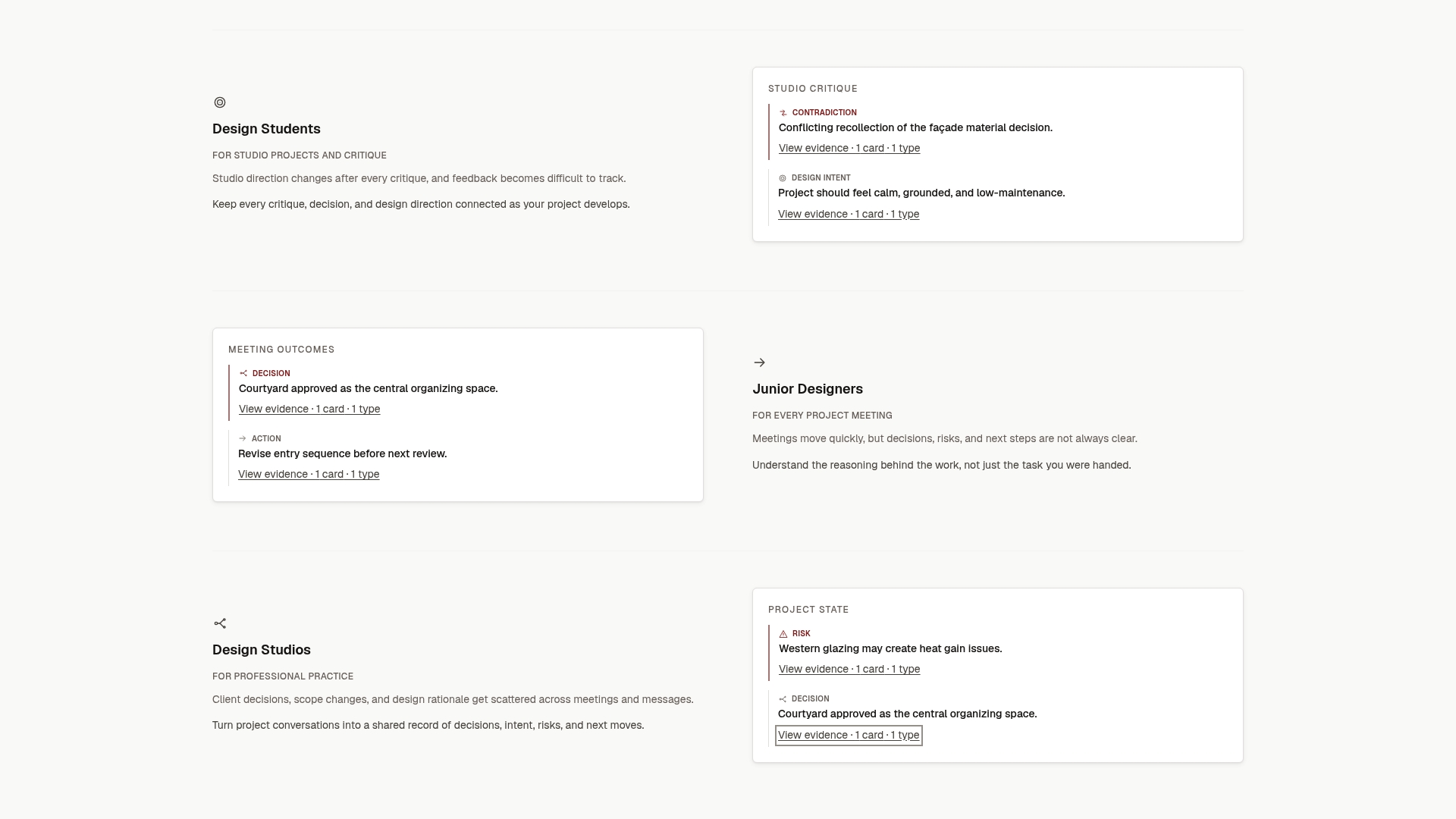
If you want to try the practice before committing to a workflow change, start with a single decision log template and run one time-boxed meeting this week. When you are ready for something that captures the records automatically, see pricing and plans or visit The Intent Ledger to see how it fits your team.
FAQ
What should go in designer onboarding documentation?
It should contain a small set of decision records, each with context, the decision, alternatives considered, consequences, and a link to the source conversation. A central decision log ties them together so a new designer can scan headlines before diving into detail.
How long should decision meetings be?
AWS guidance on architecture decision records recommends keeping decision meetings to 30 to 45 minutes, with a separate 10 to 15 minute readout review. Shorter, focused sessions keep the record accurate and prevent scope creep into unrelated decisions.
When should a decision record be created?
Capture it at the moment the decision is made, not weeks later. Reconstructing rationale after the fact loses nuance and tends to introduce rationalization bias, so the record ends up explaining the decision the team wishes it had made rather than the one it actually made.
What happens when a decision gets superseded?
Change its status rather than deleting it, and link the new record back to the old one. Guidance on maintaining decision lineage recommends preserving the original record so the history of how thinking evolved stays intact.
Does The Intent Ledger replace a manual decision log?
The Intent Ledger automates the capture step by turning meeting notes, transcripts, and critique feedback into structured ILM Records linked to their source conversations. It follows the same context, decision, and consequences structure this guide recommends, without requiring someone to write every record by hand.
Sources
- Master architecture decision records (ADRs): Best practices for effective decision-making | AWS Architecture Blog
- AWS Prescriptive Guidance - Architectural decision records
- How can we hand over projects better? | APM Research
- A practical overview on Architecture Decision Records (ADR)
- ADR README — Source docs