Documentation Debt in Design: What It Costs and How to Pay It Down
Documentation Debt in Design: What It Costs and How to Pay It Down
Documentation debt in design is the gap between the decisions your team has made and the reasoning anyone can still find. It grows quietly, because everyone in the room understands the “why” on the day, and it comes due months later, when someone asks why the stair moved, why the client rejected option B, or why a component was built that way. The fix is not more documentation. It is capturing the right few things, close to the conversation they came from, with a link back to the source. That is what ILM Records from The Intent Ledger are built to do: turn conversations, notes, transcripts, and critique feedback into structured records that trace back to where the decision was made.
TL;DR
- Documentation debt is missing, incomplete, or inadequate documentation. In design, the costliest missing piece is the rationale behind a decision, not the decision itself.
- Research on engineering and architecture projects links undocumented rationale to repeated discussions, rework, and lost context at handovers.
- Record only decisions that had real alternatives, affect other work, or will be questioned later. Write the record right after the conversation.
- Give each record a source: the meeting, thread, critique, or client comment it came from.
- Review records at the start of each project phase, and replace old records rather than deleting them.
Table of Contents
- What documentation debt means in design
- Where the debt piles up
- What undocumented decisions cost
- What to record, and what to skip
- A practical process to reduce the debt
- Students, junior designers, and freelancers
- From manual logs to project memory
- Start paying down the debt
- Our perspective
- FAQ
- Sources
What documentation debt means in design
Technical debt is the familiar idea that a shortcut now creates extra work later. Documentation debt applies the same logic to written knowledge. One academic definition, summarized by Peter Morlion, covers documentation that is missing, inadequate, or incomplete. Missing means nothing was written. Incomplete means it was started but not kept up to date. Inadequate means it exists but is hard to read or scattered across several places.
IBM describes the same thing in software terms: when teams don’t promptly create or update documentation, it becomes harder to improve systems without the context behind earlier decisions, and new team members take longer to get up to speed.
Design teams use “design debt” for a related but different problem. In UX, design debt shows up as inconsistent components, navigation, and terminology after teams shortchange research or testing. That is debt in the work itself. Documentation debt is debt in the memory of the work: nobody can say why it looks or behaves the way it does. The two feed each other. A team that cannot recall why a pattern exists will either keep it blindly or break it and repeat an old mistake.
This matters well beyond software. Architects, interior designers, landscape designers, and students all make hundreds of small choices in meetings, critiques, site visits, and client calls. Most of the reasoning stays in people’s heads.
Where the debt piles up
Research on real projects is consistent about where reasoning goes missing.
A study from the University of Twente and the engineering consultancy Witteveen+Bos examined four projects. It found that rationale and the links between decisions were documented far less completely than theory recommends, and that teams applied neither immediate documentation nor periodic monitoring.
Interviews in the Danish architecture, engineering, and construction industry, reported by Aalborg University, found that design rationale is usually captured only implicitly, in CAD or BIM models, emails, documents, handwritten notes, or meeting minutes. Most of it is never documented at all.
NASA researchers studying design rationale made a sharper point: even on small projects, rationale ends up scattered across paper, notebooks, and designers’ memory, so design knowledge often leaves with the employee.
The same pattern appears in everyday tools. UX writer Jess Eddy describes design reasoning buried in Slack threads and Figma comments, where critical context disappears and has to be reconstructed when someone asks for an explanation. Even a careful landscape design workflow from brief to planting palette, like the one described in this landscape design workflow, produces reasoning that ends up in emails and meeting notes unless someone deliberately keeps it.
For a small studio, the usual hiding places are:
- Meeting recordings nobody rewatches
- Email threads where the client’s real reason sits in message nine
- Margin notes on printed drawings
- Critique comments in a chat channel
- The memory of the one person who was at the site visit
What undocumented decisions cost
The Twente study lists the consequences in plain terms. At phase transitions, documentation is often incomplete or missing, so no clear baseline exists. Teams that depend on that work either stall or make assumptions that turn out wrong. Tracing information across different formats is tedious and error-prone. And discussions repeat because nothing exists on which to close them.
The Danish interviews add a design-specific cost: functional solutions get reworked, and model changes get discarded because the argument for them can no longer be found.
For different members of a team, that looks like this:
- Project managers reopen a scope question the client already settled, because no one can show when or why.
- Junior designers receive a task like “change the entry sequence” with no idea who asked or what problem it solves, so they guess.
- Studio owners lose context when a senior person leaves or moves to another project.
- Students forget which critique comment led to which revision, and cannot explain their process at the final review.
- Freelancers face a dispute over what the client approved, with only a scatter of emails to prove it.
A useful way to see the cost: Morlion frames documentation debt as a timing problem. At the moment of the work, everything is clear to the people doing it, but months later it is not clear even to them. The interest on this debt is the time spent rediscovering what you already knew.
What to record, and what to skip
Trying to document everything is the fastest way to abandon documenting anything. The research gives a workable scope.
The Twente framework recommends recording four things: the decision itself, its rationale (the justification and the process that led to it), dependencies and interrelations between decisions, and the context, meaning which parts of the design the decision affects.
UIGuides suggests a similar minimum for each significant design decision: the decision, the alternatives considered and why they were discarded, the rationale, and the date. The date matters because a decision made under a constraint that has since disappeared may deserve a second look.
The same guide is just as clear about what not to record. Prioritize decisions that had real alternatives, affect several screens or features, are likely to be questioned by stakeholders or newcomers, or will shape future work. Skip taste-based choices, decisions obvious from the design itself, and temporary ones (or mark those clearly as temporary). In its words, ten well-documented decisions beat a hundred nobody reads.
Translated to a design studio, a good decision record answers:
- What was decided? One sentence.
- Why? The reason, in the words of the person who gave it.
- What else was considered? And why it lost.
- What does it affect? Drawings, components, budget, other decisions.
- Who said it, when, and where? The source conversation.
- What is still open? Questions, risks, and actions that came out of the same discussion.
- When should it be revisited? The assumption it depends on.
Our own guides go deeper on these fields: see the eight fields a record of decision should capture and the difference between rationale and justification. If you want a starting layout, the decision log template is a good place to begin.
A practical process to reduce the debt
The Twente study’s recommendations are the backbone of a sound routine, and they are simple.
1. Document immediately
The study recommends documenting decisions right after they are made. Memory fades within days, and so does the nuance of why. If the record cannot be written during the meeting, write it the same day while the conversation is still in the notes or recording.
2. Give someone responsibility
The same study suggests assigning a specific person to document and monitor. On a small team, that can rotate by project. What matters is that “everyone” does not become “no one.”
3. Keep records short
A record that takes twenty minutes will not get written. Aim for half a page: context, decision, rationale, consequences, and status. This is the shape used in architecture decision records, a format software teams popularized and designers have adapted. Design-systems writers who use it suggest one decision per record, never editing an accepted record, and replacing it with a new one when the decision changes. That keeps the chain of reasoning intact.
4. Log the decisions that set direction
Product leader Matt Woods recommends logging high-leverage, principle-setting decisions rather than every small choice, and treating the log as a library, not a workshop. Review upcoming key decisions weekly so research and conversations are aimed at what actually needs deciding.
5. Link each record to its source
A rationale with no source is an assertion. A rationale that points to the meeting, the transcript, or the client email is evidence. This is the step most manual systems skip, because linking takes effort. It is also what lets a new teammate, or you in a year, trust the record.
6. Review at phase boundaries
The Twente study recommends reviewing documentation periodically and at the start of each new project phase, since that is when gaps surface and dependent teams need a baseline. A concept-to-schematic handover is the natural checkpoint: list the open questions and the decisions the next phase relies on.
When you revisit an old decision, compare its original context with what you know now. The reasoning may still hold, or the constraint behind it may be gone.
Students, junior designers, and freelancers
The same discipline scales down well.
Design and architecture students can treat every critique as a source of decisions. After each review, write down each comment, whether you accept or decline it, why, and what you will change. At the final review, you can show the evolution of your thinking, not just the end result. Keep the date and the reviewer’s name next to each item.
Junior designers often receive tasks stripped of their origin. Ask for the source when a task arrives: who requested it, in which conversation, and what problem it solves. Record the answer next to the task. A task you understand is one you can do well, and one you can push back on intelligently.
Freelance architects carry the highest stakes per conversation, because they are often the whole team. Summarize each client call in writing the same day, with the decisions and open questions, and keep the original message or recording the summary came from. When a client later says “I never approved that,” you can point to the date and the conversation.
From manual logs to project memory
A spreadsheet or document log works for a while. It tends to break in the same two places: nobody writes the entry right after the meeting, and entries lose the link to what was actually said. Both are timing and effort problems, and both are what turn good intentions into debt.
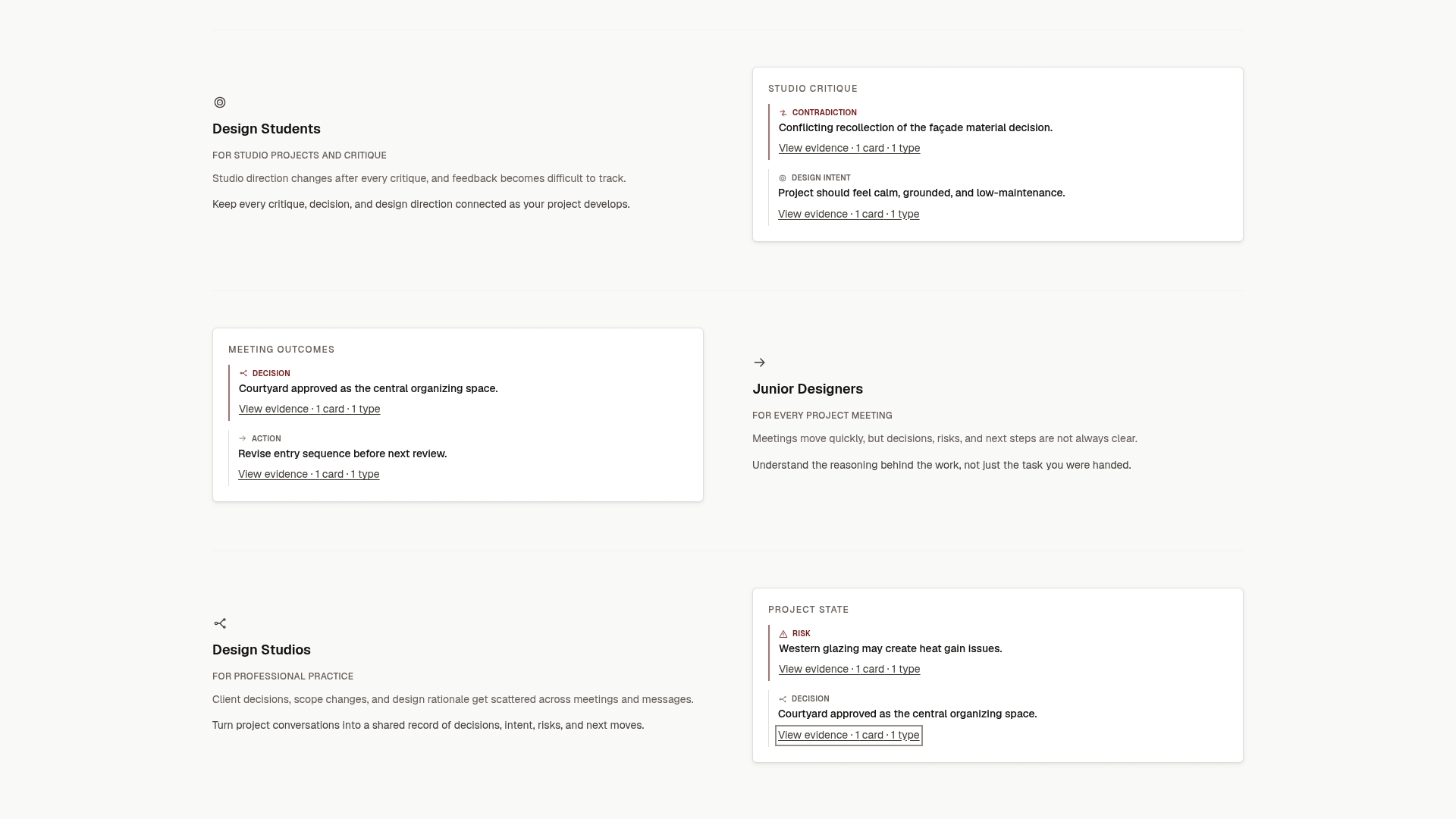
This is the problem we built The Intent Ledger for. It turns meeting notes, audio recordings, transcripts, critique feedback, and client comments into ILM Records: structured, source-backed records of decisions, design intent, risks, actions, commitments, and unresolved questions, each traceable to the conversation it came from. Instead of asking a busy project manager to write up every call, the conversation becomes the starting point of the record.
For more on building the habit, our blog collects articles on decision records, architectural design documentation, and design documentation best practices.
Start paying down the debt
Pick the project where context is most at risk, whether that is a handover coming up, a client who changes direction often, or a studentship final review. Run its recent meetings, notes, and critiques through ILM Records and see which decisions, risks, and open questions surface.
If you want a single project captured, the Project Record pack is a one-off $29, and the smaller Working Set is $12. For a studio’s accumulated history, Practice Memory is $59 one-off and Studio Ledger is $119 one-off. If you create records continuously, the monthly plans are Working Memory at $29 per month, Living Record at $79 per month, and Shared Ledger at $149 per month. See everything on the pricing page, or visit The Intent Ledger to learn more.
Our perspective
Most teams think their problem is that they do not write enough down. We think the problem is that the “why” is spoken once, in a room, and never lands anywhere durable.
Decisions are easy to find: they are in the drawing set, the model, the build. The reasoning is what evaporates. That is the part a new teammate, a client, or your future self needs when something is questioned.
So we built The Intent Ledger around preserving the why. Every ILM Record connects a decision to the conversation it came from, so the record is not a summary you have to trust, it is a pointer you can follow. We designed it for architecture studios, project managers, junior designers, students, and freelancers because they all lose context in the same way.
Documentation debt is not paid off in one heroic cleanup. It is prevented by making capture the natural by-product of the conversations you are already having.
Rajas
FAQ
What is documentation debt in design?
It is the accumulated cost of design reasoning that was never written down, was left incomplete, or is too scattered to find. The result is repeated discussions, rework, and slow onboarding. It is the documentation counterpart of technical debt.
How is documentation debt different from design debt?
Design debt describes shortcuts in the design itself, such as inconsistent components or skipped testing. Documentation debt describes missing or outdated records of why things were designed that way. A team can have one without the other, but undocumented reasoning makes design debt harder to fix.
Which decisions should a design team document first?
Start with decisions that had real alternatives, affect several parts of the project, or are likely to be questioned later. Skip taste-based choices and anything obvious from the design. Record the decision, the alternatives and why they lost, the rationale, and the date.
How soon after a meeting should a decision be recorded?
As soon as possible, ideally in the meeting itself or the same day. Research on engineering projects recommends documenting decisions immediately, because context and nuance fade quickly and are hardest to rebuild months later.
How often should decision records be reviewed?
Review them periodically and at the start of each new project phase. At those points, check which decisions the next phase depends on, which questions are still open, and whether the constraint behind an older decision still applies.
Sources
- Documentation Debt, Peter Morlion
- What is Technical Debt?, IBM
- Why Design Debt Is a Liability Your Product Cannot Afford, Built In
- The documentation of design decisions in engineering projects, University of Twente
- Design rationale documentation and exchange in the Danish AEC industry, Aalborg University
- A Design Rationale Capture, NASA Technical Reports Server
- A practical guide to design documentation, Everyday UX
- How to Document Design Decisions, UIGuides
- ADR-Driven Design Systems
- How I Use Decision Logs, Matt Woods
- Landscape Design Workflow: From Brief to Planting Palette