Checklist Driven Knowledge Handover Process for Teams with ILM Records
Checklist Driven Knowledge Handover Process for Teams with ILM Records

A knowledge handover process is the structured transfer of tasks, context, and decision history from one person to another so that the receiver can operate independently. It succeeds when the receiver performs the core tasks alone, without pinging the original owner for basics. That standard, receiver independence, is the only test that matters. Every handover runs through four stages: identify, capture, share, and apply.
TL;DR:
- Effective knowledge handovers should focus on documenting critical tasks and decision rationales, verified through independent testing by the receiver.
- Building a concise plan involves defining responsibilities, mapping stakeholders, choosing appropriate artifacts, and setting milestones with verification checkpoints.
- Combining documentation with shadowing, live walkthroughs, and stakeholder introductions ensures practical transfer of explicit and tacit knowledge.
- Sign-off relies on running live tests, tracking time-to-independence, and monitoring post-handover escalations to confirm transfer success.
- Common mistakes include starting late, over-documenting without focus, neglecting tacit knowledge, and lacking a designated transfer owner.
Table of Contents
- What are the four stages of a knowledge handover process?
- How do you build a compact knowledge transfer plan?
- What should a handover checklist and template include?
- How do you capture explicit and tacit knowledge?
- Which transfer techniques actually move knowledge into practice?
- How do you test and sign off a knowledge handover?
- How long should a knowledge handover take?
- Where should you store handover documentation?
- What are the most common handover mistakes?
- How do you measure and improve your handover process over time?
- Applying these practices to design teams
- Built for handovers that actually stick
- Sources
What are the four stages of a knowledge handover process?
Every reliable knowledge transfer follows the same lifecycle: identify, capture, share, apply. This four-phase structure shows up across government succession-management guidance and most corporate handover playbooks, because it maps to how people actually lose and rebuild expertise.
Identify means triaging what actually matters. Not everything deserves documentation. A priority-based approach sorts knowledge into critical, important, and nice-to-have, so you don’t burn a week documenting a task nobody will touch for a year.
Capture turns what’s in someone’s head into something durable. Some things need a written procedure. Others need a five-minute video or a note explaining why a decision was made a certain way.
Share is where the transfer actually happens. Walkthroughs, shadowing, live Q&A.
Apply is proof. The receiver does the task, unsupervised, and it holds up.
- Identify: rank knowledge by frequency and risk if lost
- Capture: match format to knowledge type (write, record, log)
- Share: pair documentation with a live session, never one or the other
- Apply: test the task before calling it done
How do you build a compact knowledge transfer plan?
A knowledge transfer (KT) plan doesn’t need to be elaborate. It needs to be specific enough that two people could execute it without asking you what you meant.
- Define scope and owner. Name exactly which responsibilities are transferring and who owns the plan end to end, not just who’s leaving.
- Map stakeholders. List everyone the receiver will need to work with, and flag who introduces them.
- Pick artefacts and storage. Decide upfront where documents live and what format each piece of knowledge takes.
- Set milestones. Break the timeline into checkpoints, not a single deadline.
- Assign verification checkpoints. Build in moments where someone other than the sender confirms the receiver can perform the task.
Pro Tip: Assign the transfer owner role to someone other than the departing person whenever possible following this business scaling outsourcing checklist for SMB owners. A neutral owner catches gaps the sender is too close to notice, and enforces the sign-off step instead of letting it slide.
What should a handover checklist and template include?
A working handover checklist needs a small set of sections that cover the current state, what’s unresolved, and how to reach anyone who matters.
- Overview and purpose: what this role or project exists to do, in one paragraph
- Current status: what’s in progress right now, with dates and next actions
- Open items: anything unresolved, blocked, or waiting on someone
- Contact map: names, roles, and how to reach each stakeholder, plus who introduces the receiver
- Access list: every system, credential, and permission the receiver needs, verified working before day one
- Tacit knowledge notes: the judgment calls, workarounds, and “why we do it this way” context that never make it into a formal spec
Store credentials in a password manager or your organization’s secrets vault, never in a shared document. For the relationship map, don’t just list names. Schedule three-way introductions, sender, receiver, and stakeholder, so the relationship transfers along with the task.
How do you capture explicit and tacit knowledge?
Explicit knowledge (procedures, configurations, steps) belongs in SOPs and runbooks. Write them in second person, “you’ll click here,” not “one clicks here,” because that’s how a real person reads instructions under pressure. Separating what to do from why it matters keeps the document usable months later, when the original context is long gone.
Tacit knowledge, the stuff that lives in someone’s head and never gets written down, needs a different approach. Short screen recordings and decision journals capture judgment far more efficiently than long prose, and they preserve tone and hesitation that text strips out.
- Record a five-minute screen capture instead of writing three pages
- Log decisions as they happen, not reconstructed weeks later
- Note relationships and rationale, not just task lists
- Link to the live version of a process guide rather than pasting a screenshot that goes stale
Pro Tip: If you catch yourself writing “just do it the way I always did,” stop and record a two-minute video instead. That sentence is a signal you’re about to lose real context.
Which transfer techniques actually move knowledge into practice?
Documentation alone doesn’t transfer anything. Pairing written artefacts with shadowing and live test tasks is what actually closes the gap between reading about a task and doing it.
- Shadowing first. Schedule the receiver to observe the highest-frequency, highest-risk tasks before anything else.
- Structured walkthroughs. Run sessions with a fixed agenda, and have the receiver perform the task live while the sender watches, not the other way around.
- Mentorship checkpoints. Set short, recurring check-ins, weekly for the first month works for most roles, where the receiver can surface confusion before it becomes a mistake.
- Warm handovers with stakeholders. Introduce the receiver to key contacts directly, with the sender present for the first exchange.
The order matters. Reverse it, walkthrough before shadowing, and the receiver has nothing to anchor the explanation to.
How do you test and sign off a knowledge handover?
Validation is the difference between a handover that looks finished and one that actually is. Running two or three live task tests before final sign-off is the clearest evidence you have that the transfer worked.
- Pick 2 to 3 core tasks and have the receiver run them without help
- Have an observer, not the sender, judge whether the receiver succeeded
- Use a written validation checklist so sign-off isn’t a gut call
- Track post-handover escalations for the first few weeks as a lagging signal
The number that matters here isn’t a satisfaction score. It’s time-to-independence, how many days pass before the receiver stops needing the sender for routine questions, and it’s the single most useful metric for judging whether your process actually worked.
Keep a support window open, usually one to two weeks, and document any follow-up questions so the next handover starts from a stronger baseline.
How long should a knowledge handover take?
A minimum viable timeline runs about 30 days for most roles, with 60 to 90 days recommended for senior, technical, or client-facing positions where relationships and judgment take longer to transfer.
- Days 1 to 10: documentation complete, access verified
- Days 10 to 30: shadowing and structured walkthroughs
- Days 30 to 60: test handoffs, receiver runs tasks independently with support on standby
- Days 60 to 90 (senior roles): sign-off, retrospective, support window closes
When overlap is shorter than that, triage ruthlessly. Access, current status, and stakeholder introductions come first. Recorded tacit-knowledge sessions can follow after the person has already left.
Where should you store handover documentation?
A handover document that lives in a static PDF is already decaying the day it’s created. Keep the working version in a searchable, editable home, a wiki, shared drive, or knowledge management system (KMS), and reserve PDFs for archived sign-off copies only.
- Assign a named owner responsible for keeping the document current
- Set a review trigger, tied to a role change or a fixed quarterly check, not “whenever someone remembers”
- Link to live process guides instead of embedding screenshots that go stale within weeks
- Verify every credential and access permission during the transfer session itself, not after
What are the most common handover mistakes?
Most failed handovers share the same handful of root causes, and each one has a fast fix.
- Starting too late. Begin documenting as soon as a transition becomes likely, not once someone gives notice.
- Documenting for its own sake. A 40-page manual nobody reads is worse than a five-item checklist someone actually follows.
- Skipping tacit knowledge. If it only exists in someone’s head, record a walkthrough or log the decision before it disappears.
- No named transfer owner. Without someone accountable for the process, sign-off never happens, it just fades out.
Pro Tip: If you can only fix one thing, fix the missing owner. Every other failure on this list traces back to nobody being responsible for enforcing the checklist.
How do you measure and improve your handover process over time?
Track a small set of numbers instead of relying on impressions. Time-to-independence, escalations in the weeks after handover, and the percentage of critical processes actually documented tell you more than any satisfaction survey.
- Time-to-independence: days until the receiver stops needing the sender
- Post-handover escalations: how often the receiver reaches back out, and about what
- Documentation coverage: percentage of critical tasks with a current artefact
Run a short retrospective after every handover, what took longer than expected, what documentation was missing, and update the templates immediately. Set a review cadence for stale docs, quarterly is reasonable for most teams, and retire anything nobody has touched in two cycles.
Applying these practices to design teams
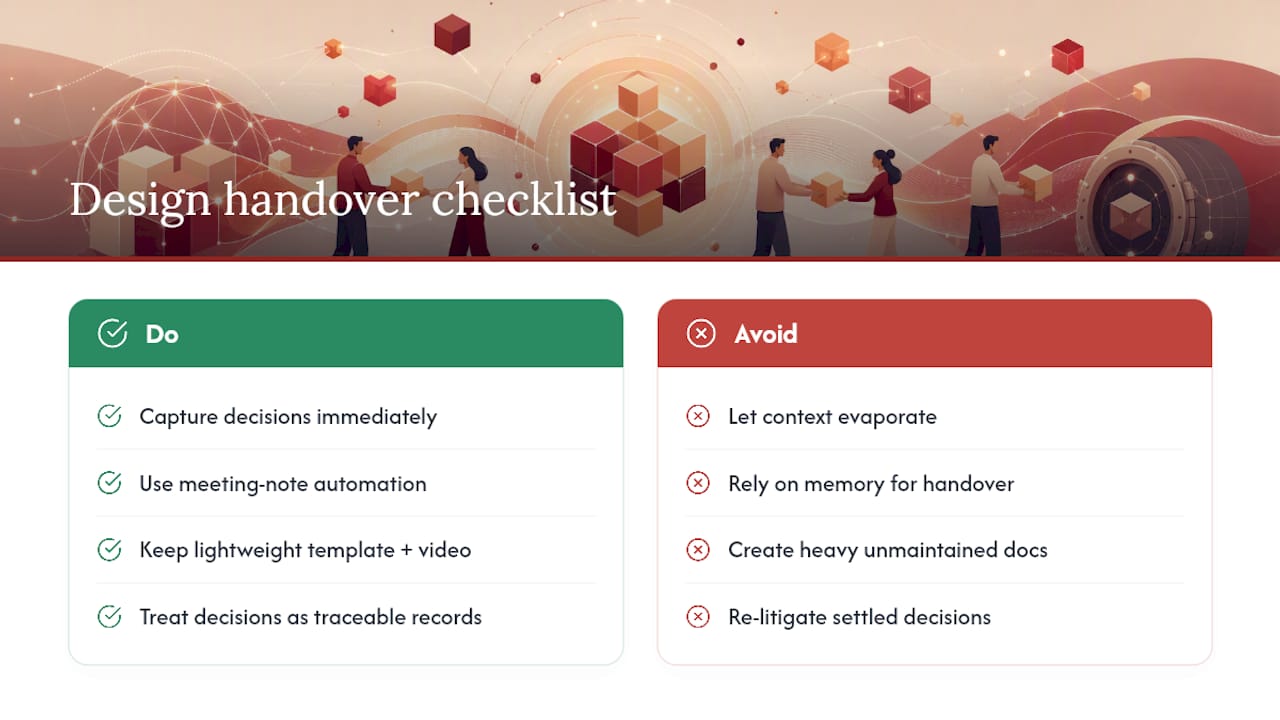
Design work loses more context than most disciplines admit. A decision made in a critique session three weeks ago, “we moved the client’s logo placement because of a brand guideline they mentioned on a call,” rarely survives into a handover document. It just evaporates, and the next person re-litigates a settled question.
Meeting-note automation and decision journals close that gap because they capture the reasoning at the moment it happens, not reconstructed from memory during a rushed handover. Small studios don’t need enterprise process. A lightweight template and a two-minute video walkthrough of an active file usually beats a formal document nobody updates. The teams that handle transitions well are the ones treating design decisions like traceable records instead of tribal knowledge that walks out the door with whoever leaves.
, Rajas
Built for handovers that actually stick
Design teams lose the “why” faster than any other kind of context, because critique feedback, client calls, and offhand decisions rarely get written down in the moment. This software turns project conversations into structured, source-backed records instead of asking someone to reconstruct it all before they walk out the door.
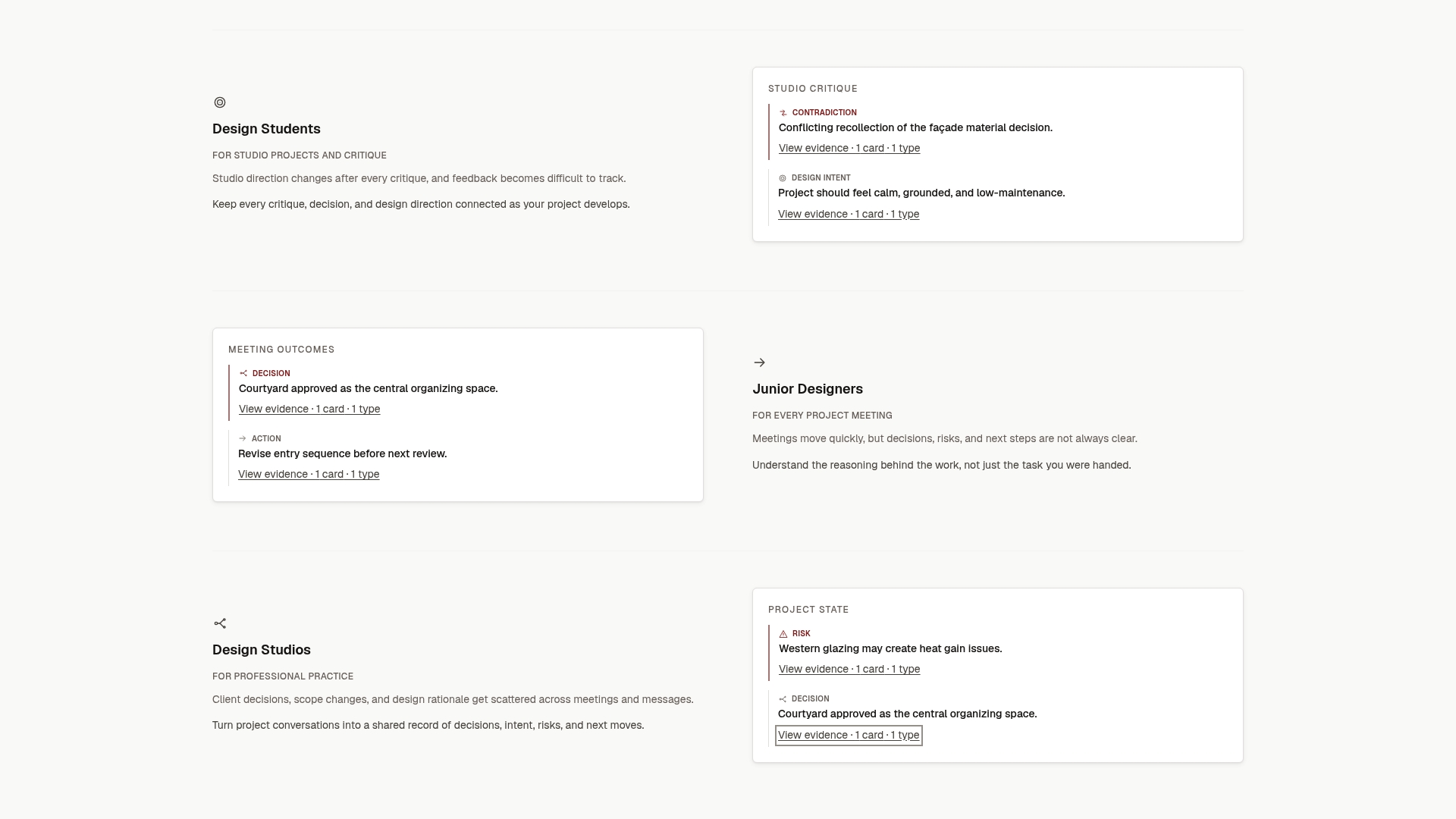
These records map cleanly onto handover checklist items, decisions, risks, open questions, commitments, traced back to the exact conversation they came from. That’s the difference between a static handoff document and a living project memory that outlasts any one team member. Pair it with a meeting-note capture workflow and a decision-focused template, and most of your capture stage happens automatically as the project runs, not scrambled together the week someone gives notice.
It’s not a substitute for shadowing or test tasks, those still matter. But it removes the weakest link in most handovers: memory. Check the pricing page or start from the product page to see which plan fits your studio’s size.
Sources
- Knowledge transfer process, Government of British Columbia
- 8 knowledge transfer strategies for a successful leadership transition, IMD