Meeting Minutes vs Notes: What Professionals Need to Know
Meeting Minutes vs Notes: What Professionals Need to Know

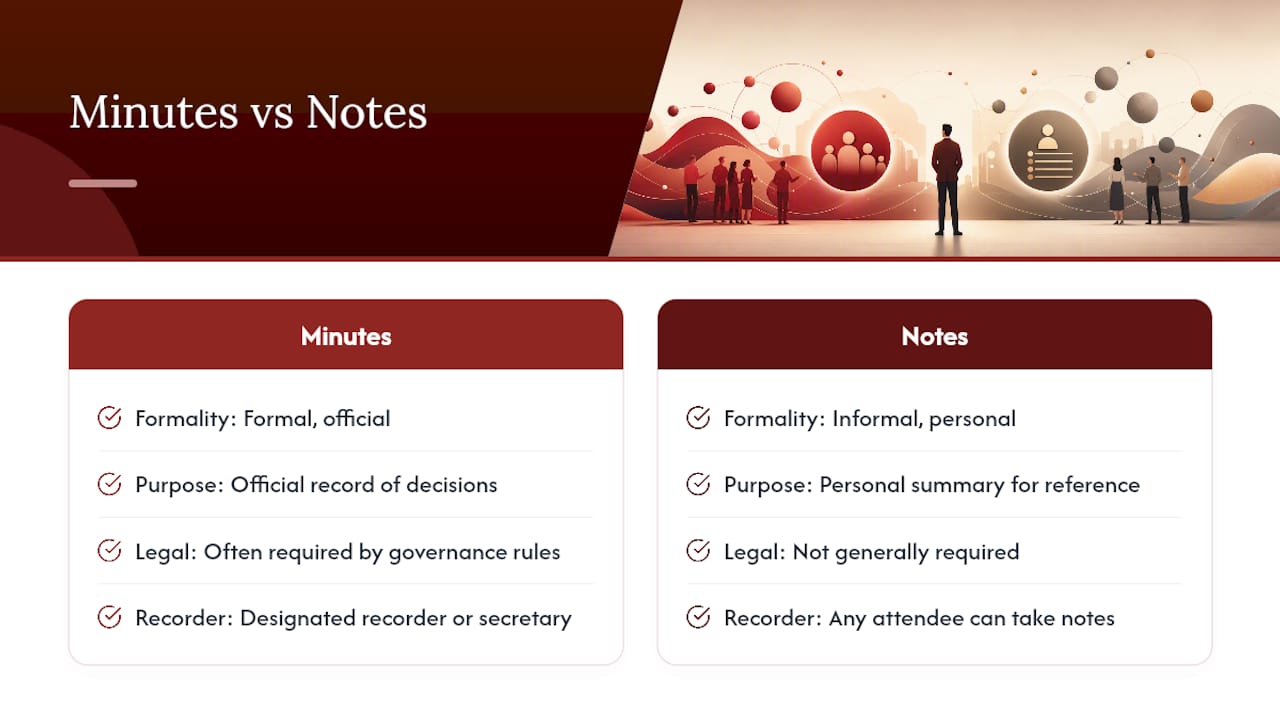
Meeting minutes are the formal, official record of a meeting; meeting notes are informal, personal summaries. Minutes get reviewed, approved, and filed. Notes get scribbled, referenced, and often discarded once the action items are done.
Here is the quick decision rule before you read another word:
- Choose minutes when: a board, client contract, or governance body needs an approved, citable record of what was decided.
- Choose notes when: it’s a team sync, brainstorm, or working session where speed and personal recall matter more than formality.
The rest of this guide covers exact templates, a short decision workflow, and how to convert raw notes into clean minutes when a meeting turns out to matter more than you expected.
Key Takeaways
Minutes serve as the approved, official record for governed decisions, while notes stay personal and flexible for everyday follow-up.
| Point | Details |
|---|---|
| Formality is the core difference | Minutes get approved and filed; notes stay informal and personal to the writer. |
| Match format to stakes | Use minutes for boards and contracts, notes for internal syncs and brainstorms. |
| Every action item needs an owner | Write Person + Action + Deadline to avoid vague, unassigned tasks. |
| Notes can become minutes | Convert raw notes or transcripts into formal minutes once a meeting turns out to matter. |
| Centralize decision rationale | Theintentledger links decisions back to source conversations, reducing context drift across a project. |
Table of Contents
- What Are Meeting Notes?
- What Are Meeting Minutes?
- What Do Notes and Minutes Have in Common?
- Meeting Minutes vs Notes: A Side-By-Side Comparison
- When Should You Use Notes vs. Minutes?
- How to Take Effective Notes and Minutes
- Templates You Can Copy for Notes and Minutes
- Do Meeting Minutes Carry Legal Weight?
- Why Preserving Decision Rationale Matters More Than the Format
- An Editor’s Take on Documentation That Actually Holds Up
- How Theintentledger Turns Conversations Into Structured Records
- Frequently Asked Questions
- Sources
What Are Meeting Notes?
Meeting notes are informal, personal documentation of key points, decisions, and action items captured in whatever shorthand works for the note-taker. Anyone in the room can keep them, and most meetings end up with several versions floating around, one per attendee, each shaped by what that person cared about.
Notes exist to help you remember and follow up, not to satisfy an outside reviewer. A useful structure keeps things to four categories: agenda, attendance, action items, and agreements, sometimes called the “first four As” in Adobe’s meeting guidance.
- Bullet-jotted talking points during a call
- Shorthand annotations on a shared agenda doc
- A quick recap message sent to the team after the fact
Notes taken by someone who missed the meeting later become raw material, the seed a designated recorder uses to draft formal minutes when the discussion turns out to require one.
What Are Meeting Minutes?
Meeting minutes are the formal, official record of decisions, votes, attendance, and action items, usually maintained as the single authoritative version of what happened. Unlike notes, minutes are not a matter of personal taste. A designated recorder, often a board secretary or project lead, drafts them, circulates them for review, and files them once approved.
That approval step is what separates minutes from every other kind of documentation, and Kuno’s comparison lays out the typical circulation and filing steps clearly.
A solid set of minutes usually includes:
- Date, time, and location of the meeting
- Attendance, including who was absent
- Motions made, votes taken, and their outcomes
- Decisions reached and the reasoning behind them
- Action items with named owners and deadlines
Boards, nonprofit governance meetings, audits, and shareholder gatherings often require minutes by law or bylaw, not just habit. Nonprofit governance guidance and the Model Business Corporation Act both expect a written record for these meetings, and personal notes don’t count as a substitute.
What Do Notes and Minutes Have in Common?
Both formats exist to capture the same underlying facts, just at different levels of formality.
- Date and purpose of the meeting
- Decisions reached
- Action items and who owns them
- The name of whoever recorded it
The overlap makes sense once you see that notes are often the raw draft minutes get built from. The real difference between minutes and notes isn’t the presence of certain facts. It’s how formal, approved, and permanent the record needs to be.
Meeting Minutes vs Notes: A Side-By-Side Comparison
Once you line up notes and minutes across the dimensions that actually matter, the choice usually makes itself.
| Dimension | Meeting Notes | Meeting Minutes |
|---|---|---|
| Purpose | Personal summary for recall and follow-up | Official record of decisions and actions |
| Formality and approval | Informal, no approval needed | Formal, reviewed and approved before filing |
| Who writes it | Any participant | Designated recorder or secretary |
| Typical contents | Highlights, shorthand, personal takeaways | Attendance, motions, votes, decisions, deadlines |
| Level of detail | Selective, whatever matters to that person | Standardized, objective, complete |
| Distribution and storage | Shared informally or kept private | Circulated for approval, filed in official records |
| When to use | Team syncs, brainstorms, internal check-ins | Boards, client contracts, audited or governed meetings |
A few edge cases are worth flagging. A raw transcript from a recorded call can become the backbone of formal minutes once someone edits it down to decisions and action items. And notes shared as an informal recap, say, a Slack message summarizing a client call, stay notes even when they get forwarded around, because nobody approved them as the record of truth.
- Transcript to minutes is a legitimate, common workflow, not a shortcut
- A widely shared note is still a note until someone formalizes it
When Should You Use Notes vs. Minutes?
Run through three questions before or during the meeting:
- Is there a legal, governance, or contractual requirement for a record?
- Are external stakeholders, clients, or regulators involved?
- Could this record be audited or referenced in a dispute later?
If you answered yes to any of those, take minutes. If not, notes will serve you fine.
Three scenarios make the pattern obvious. A board meeting deciding on budget allocation needs minutes. A team brainstorm on feature ideas needs notes. A client meeting where you agree on contract scope needs minutes, even if it feels informal in the room.
- Board or governance meeting → minutes
- Internal brainstorm or status sync → notes
- Client agreement or scope decision → minutes
When you’re unsure which a meeting will need, capture detailed notes first, then decide afterward whether the outcome warrants formalizing them into minutes.
How to Take Effective Notes and Minutes
Notes and minutes call for different processes, even when they’re covering the same meeting.
For notes:
- Skim the agenda beforehand so you know what to listen for.
- Capture key points in shorthand, don’t try to write full sentences.
- Log every action item with an owner and a rough deadline.
- Clean up your shorthand into readable form within a few hours, while it’s still fresh.
For minutes:
- Start from a pre-built template before the meeting begins.
- Assign one person as the minute-taker, not a rotating duty.
- Record attendance and quorum status at the start.
- Capture motions, votes, and decisions as they happen, not from memory afterward.
- Draft the full document and circulate it for approval before filing.
Pro Tip: Write every action item as Person + Action + Deadline. “Marketing will look into it” is not an action item. “Priya finalizes the vendor contract by Friday” is.
Avoid recording opinions or debate content in minutes. Robert’s Rules is explicit that minutes record what was done, not a transcript of what was said. A shared document template or a call transcription tool can serve as raw material, but the human editing step matters more than the capture tool.
Templates You Can Copy for Notes and Minutes
A minute template needs a header (date, attendees, absent members) followed by three sections: decisions, motions and votes, and action items with owners and deadlines. Keep it tight. Minutes describe outcomes, not conversation.
A note template works better looser: a one-line summary at the top, a short list of takeaways, an action item list, and a “parking lot” for questions that came up but weren’t resolved.
Here’s how the two connect in practice. Say a project sync produces a rough note: “Client wants faster turnaround, discussed pricing, Sam to follow up.” If that meeting turns out to set contract terms, that same note becomes the seed for a formal minute entry: decision reached (adjusted turnaround terms), action owner (Sam), deadline (next Friday), circulated for approval before it’s filed as the official record.
- Minutes template: header, decisions, motions/votes, action items
- Notes template: summary, takeaways, action list, parking lot
Do Meeting Minutes Carry Legal Weight?
For boards and many governance bodies, minutes function as the official legal record, and skipping them creates real audit exposure. Nonprofit compliance standards and corporate governance frameworks generally expect a written minutes trail for board decisions, not informal notes.
Robert’s Rules reinforces the same principle: minutes record what was done, not a transcript of the debate. At minimum, include attendance, quorum, decisions, and named action owners. Missing any of those four is the most common reason minutes get challenged later.
Why Preserving Decision Rationale Matters More Than the Format
Scattered notes across five people’s laptops create what practitioners call context drift, each person captures a different fragment, and nobody has the full picture six months later. A single, centralized record avoids that. Adobe’s guidance on notes and minutes points to the same underlying risk when documentation stays fragmented.
Pro Tip: Link every recorded decision back to the conversation it came from. When someone asks “why did we choose this?” six weeks later, you want a trail, not a guess.
- Centralize instead of scattering notes across individual inboxes
- File minutes where governance requires it; store notes wherever your team actually looks
Clear, structured communication habits help here too. Workplace communication strategies that emphasize clarity and follow-through tend to produce better documentation almost as a side effect.
An Editor’s Take on Documentation That Actually Holds Up
The failure mode I see most isn’t sloppy handwriting, it’s vague ownership. “The team will look into pricing” shows up in half the notes I’ve reviewed, and nobody ever traces back to who actually owned it. Fix that one habit, name a person and a date on every action item, and most documentation problems disappear before they start.
How Theintentledger Turns Conversations Into Structured Records
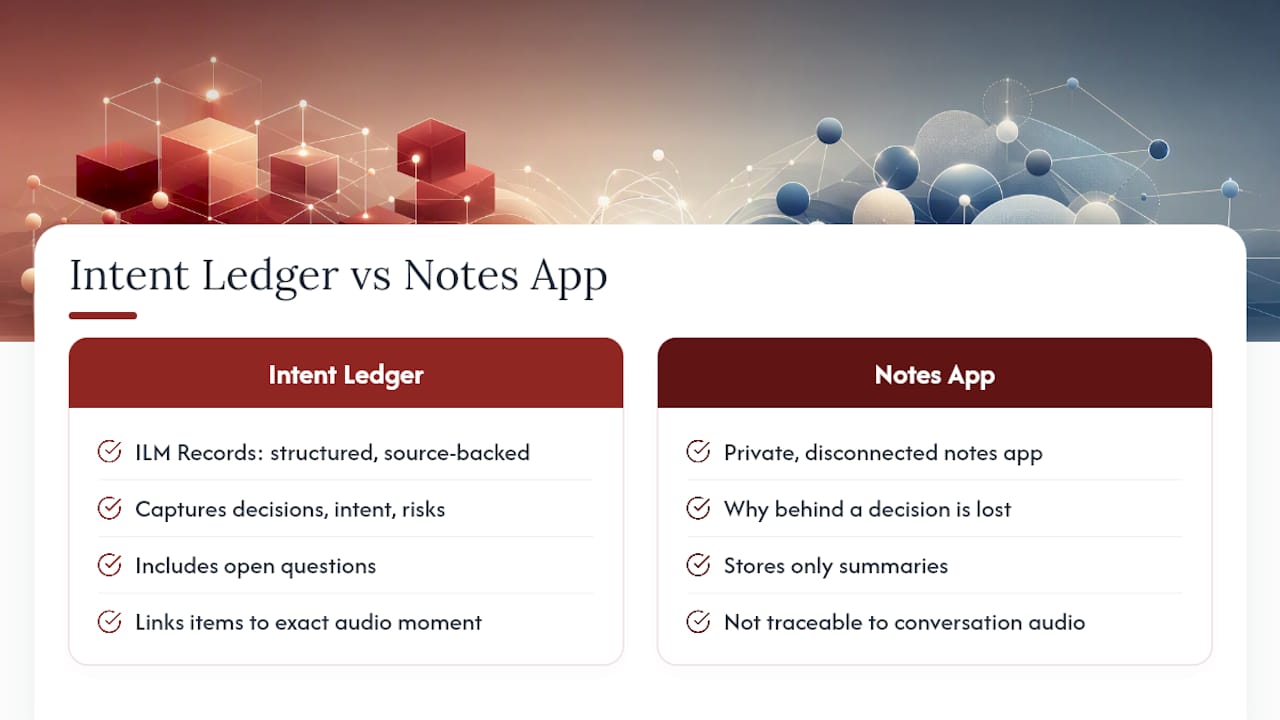
Most teams lose the “why” behind a decision within weeks, not because nobody wrote it down, but because it’s buried in someone’s private notes app, disconnected from the actual conversation. Theintentledger solves that specific problem instead of just giving you another place to type.
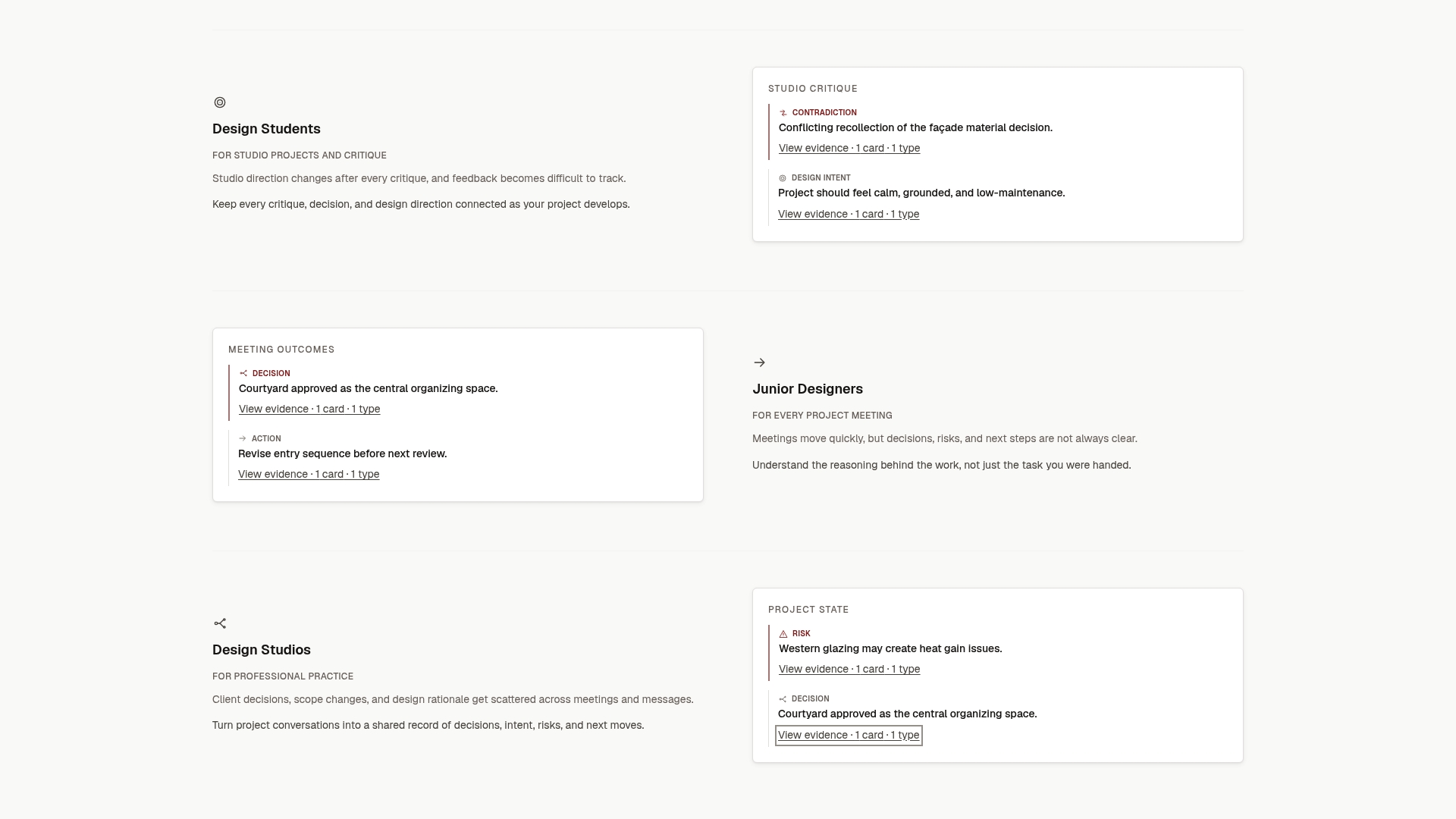
The Intent Ledger turns meeting conversations, transcripts, critique feedback, and client comments into ILM Records, structured, source-backed entries that capture decisions, design intent, risks, and open questions, each one traceable back to the exact conversation it came from. A design team lead recording a client call, for example, ends up with an ILM Record that links “extend the timeline two weeks” directly to the audio moment where the client said it, with the action assigned and dated.
That traceability is what separates it from a generic notes app: you’re not just storing a summary, you’re preserving the rationale a future teammate will need. Architecture studios, project managers, and freelance architects use it to stop losing context between meetings and start building an actual project memory. Visit The Intent Ledger to try it with your next set of project conversations.
Frequently Asked Questions
What is the main difference between meeting minutes and meeting notes? Minutes are the formal, approved, official record of a meeting; notes are informal, personal summaries anyone can take for their own reference.
Are meeting minutes legally required? For boards, nonprofits, and shareholder meetings, yes, in many jurisdictions governance rules or bylaws require a written minutes record. Check your organization’s specific bylaws or consult legal counsel for your exact obligations.
Why are they called “meeting minutes” instead of something else? The word “minute” here comes from the sense of “small” or brief, referring to a short written note, according to Merriam-Webster. It has nothing to do with the unit of time.
Can one person’s notes count as official minutes? Only if that person was the designated recorder and the notes get formally reviewed and approved. Otherwise, personal notes don’t substitute for an approved minutes record.
Who should be responsible for taking minutes? A designated recorder or secretary, ideally the same person each time, so the format and level of detail stay consistent across meetings.
What should never appear in meeting minutes? Personal opinions, side conversations, or a full transcript of debate. Robert’s Rules calls for recording decisions and actions, not everything that was said.
Sources
- Meeting notes vs. minutes: How to take notes | Acrobat for business
- minute | Definition of minute by Merriam-Webster