One Paragraph Meeting Notes Retention Policy for Design Teams
One Paragraph Meeting Notes Retention Policy for Design Teams

A meeting notes retention policy for design teams should keep decisions and their rationale, not every micro-note, and make each one traceable to its source and owner. The goal is project continuity, not a complete transcript archive. If your team can’t answer “why did we choose this?” six months later, the policy has already failed, regardless of how many notes sit in the shared drive.
TL;DR:
- Teams should retain only decision records that involve real alternatives, cross-disciplinary impact, client approval, or future questioning, avoiding unnecessary micro-notes.
- Keep decision records active during projects, retain key decisions for one to five years after delivery, and archive historically valuable decisions indefinitely.
- Use a simple, standardized template capturing decision, reasoning, options considered, consequences, date, owner, and source link, ensuring traceability and easy updates.
- Store full records in a central index with links embedded in relevant files, and assign clear ownership and responsibility for maintaining accuracy and links.
- Automate or facilitate structured capture of decisions through tools that link conversations to records, ensuring knowledge stays accessible despite software changes.
Table of Contents
- What Meeting Records Should You Actually Keep?
- How Long Should You Keep Design Meeting Notes?
- What’s the Best Format for a Decision Record?
- Where Should You Store Notes and Link Them to Files?
- Who Owns Your Meeting Notes and Decision Records?
- When Should You Review or Archive Old Records?
- How Do You Future-Proof Notes as Tools Change?
- Your 30-Day Plan to Put This Policy in Place
- Why Small Documentation Habits Save Bigger Projects Later
- How The Intent Ledger Puts This Policy Into Practice
- Sources
- FAQ
What Meeting Records Should You Actually Keep?
Most teams over-document the wrong things. Every meeting produces dozens of small calls, and trying to preserve all of them buries the handful that actually matter under noise nobody will read again. The fix is a filter, not a bigger archive.
A decision is worth keeping when it meets at least one of these tests, a framework echoed in guidance on documenting design decisions:
- It had a real alternative that got seriously considered and rejected.
- It affects multiple disciplines, phases, or downstream deliverables.
- Someone on the team pushed back on it, or the client had to sign off.
- It’s the kind of choice someone will question again in three months.
For a design studio, that looks like a client approving an exposed structural system over a concealed one, a material swap forced by a supplier delay, a scope cut that dropped a feature to hit budget, or a fire-rating workaround that shaped a floor plan. A healthy project might generate a modest number of such decisions across its life, not an overwhelming quantity. If you’re logging more than that, you’re probably capturing status updates disguised as decisions.
How Long Should You Keep Design Meeting Notes?
Retention timeframes should track how useful a record still is, not a legal mandate. Think in three buckets instead of one blanket rule.
- Active: keep everything tied to a live project, full stop, for as long as the project runs.
- Reference: after handoff or project close, retain key decision records for roughly one to five years, since that’s the window when questions about “why did we do this” tend to resurface during warranty periods, renovations, or client disputes.
- Archival: decisions with lasting design or historical value move into a project archive indefinitely. Archival guidance for architecture firms generally treats certain records as worth preserving well beyond the reference window because of their long-term historical value.
Statistic to keep in mind: knowledge-management research on construction and design projects consistently finds that context and rationale get lost fast once a project closes unless a team deliberately builds systematic processes and non-human repositories to hold onto it. A retention policy is that repository.
Some decisions deserve shorter retention. Anything tied to sensitive client data, or anything a client explicitly asks you to remove, should get flagged and cleared on request rather than defaulting to “keep forever.” Mark temporary or provisional decisions clearly and set a re-evaluation date so they don’t quietly become permanent by neglect.
What’s the Best Format for a Decision Record?
Borrow from software engineering here. Architectural Decision Records were built to solve almost the exact problem design teams face: how do you capture a choice with enough context that someone unfamiliar with the conversation can understand it later? ADRs standardize capture around Context, Decision, Alternatives, and Consequences, which maps cleanly onto design work.
A lightweight version that works well for studios:
- Decision: one sentence, stated plainly.
- Why: the reasoning, in two or three sentences max.
- Alternatives: what else was on the table and why it lost.
- Consequences: what this choice locks in or rules out later.
- Date and Owner: who made the call and when.
- Source link: the meeting transcript, Figma comment, or email thread it came from.
Add metadata that makes the record findable: project name, linked files, attendees, tags, and a status field (current or superseded). That status field matters more than it looks. When a decision changes, don’t delete the old record, mark it superseded and link forward to the replacement. This gives you a change history for free, which is exactly what decision-record best practices recommend for keeping reasoning traceable over time.
Pro Tip: Short entries get filled out; long ones get skipped. If your template takes more than five minutes to complete, your team will stop using it by week three.
Where Should You Store Notes and Link Them to Files?
Two storage patterns dominate, and each has a real weakness. A central index, a wiki page or a Notion database, gives you one searchable place to look, but it drifts out of sync with the actual work because nobody wants to update two systems. Project-embedded notes, a Figma comment thread or a ticket in your issue tracker, stay close to the work but get buried once a file gets archived or a sprint closes.
The hybrid that holds up: keep the full decision record in a central index, and drop a short link to it directly on the affected file, ticket, or Figma frame. That way, someone browsing the design file sees a breadcrumb pointing to the reasoning, without the index becoming the only place anyone looks.
Two habits protect you against future confusion:
- Record the tool, version, and export format alongside every decision (Figma file version, Notion export type, PDF vs. native format).
- Always link the decision to the specific files, tickets, or action items it affects, not just the general project folder.
This kind of version tracking is also what UX documentation best practices point to as the difference between notes that help handoffs and notes nobody trusts.
Who Owns Your Meeting Notes and Decision Records?
Every decision record needs a named owner, the person who made the call or was accountable for it, not just whoever happened to type the note. On top of that, assign one project custodian responsible for the whole archive: making sure records stay linked, statuses stay current, and nothing critical falls through when someone leaves the team.
Keep the governance simple:
- Owner per decision: accountable for accuracy and for updating it if the decision changes.
- Custodian per project: responsible for the archive as a whole, including access and structure.
- Approval flow for superseding: a quick sign-off (even a Slack thread) before marking an old decision replaced, so changes don’t happen silently.
- Audit trail: every edit logged with who changed what and when.
Owners should do a short check on their own records during each milestone review rather than waiting for a full audit to catch problems.
When Should You Review or Archive Old Records?
Records rot if nobody revisits them. Build review into moments that already happen instead of scheduling a separate meeting nobody attends.
- Milestone review: at each major project milestone, confirm active decisions still hold and flag anything superseded.
- Sprint or phase review: a lighter pass, checking that new decisions got logged and links still resolve.
- Project closeout audit: the big one. Confirm every high-value decision has a record, check link health, and decide what moves to reference or archival storage.
At each pass, check status accuracy, whether linked files still exist, whether the decision is still relevant, and whether it needs to be marked superseded. Closeout is also the right moment to fold postmortem findings back into the record corpus, since lessons learned after a project ends are worthless if they live only in someone’s memory.
How Do You Future-Proof Notes as Tools Change?
Software turns over faster than projects do. A record locked inside a tool your studio stopped using five years ago is functionally gone, even if the file technically still exists somewhere.
- Export critical decision records to open formats like Markdown or PDF, not just the native format of whatever tool created them.
- Track the original tool and version next to each export, since preserving born-digital context is what lets a future team actually re-render or reinterpret a file.
- Keep a short migration index, a single page listing where things moved and how to re-link them after a tool switch.
- Add a two-line context note to each record explaining what it meant even to someone who never opens the original software. Comparisons of ecosystems like Procore and Autodesk Build show how much interoperability varies, which is exactly why format independence matters more than platform loyalty.
Your 30-Day Plan to Put This Policy in Place
A one-paragraph policy you can paste into a project wiki right now: This project retains decision records, not full meeting transcripts. Every record worth keeping has a clear alternative, cross-cutting impact, or client sign-off attached. Each record has a named owner, lives in the central project index, links back to its source conversation, and gets reviewed at every milestone. Records move to reference storage at handoff and to permanent archive if they carry lasting design value.
- Assign a project custodian and a default owner for new decisions.
- Pick one storage location and stick to it.
- Adopt the six-field template (Decision, Why, Alternatives, Consequences, Date, Owner) for every new record going forward.
- Run your first review at the next milestone, not at project end.
New team members should get a fifteen-minute walkthrough of the decision-record fields during onboarding, not a policy document to read alone.
| Habit | Why it matters |
|---|---|
| Keep decisions, not micro-notes | Prevents documentation fatigue and keeps records worth reading |
| Name an owner on every record | Removes ambiguity about who to ask later |
| Mark superseded, don’t delete | Preserves the reasoning trail across changes |
| Link records to files and tickets | Keeps rationale discoverable from the work itself |
| Export to open formats | Protects records against tool turnover |
Why Small Documentation Habits Save Bigger Projects Later
Most design teams don’t lose context all at once. It leaks out in small amounts, a Slack thread that gets archived, a Figma comment thread that gets resolved and hidden, a client call nobody wrote down, until eighteen months later someone asks “why is this wall here” and the honest answer is a shrug. Architects have long carried a responsibility to preserve not just drawings but the reasoning behind them, and that responsibility doesn’t disappear just because the medium moved from paper to Figma comments. A project memory tool was built around this exact gap, turning scattered conversations into structured records a team can actually trust months later.
— Rajas
How The Intent Ledger Puts This Policy Into Practice
Certain software alternatives to manually rebuilding decision history from scattered Slack threads and half-remembered client calls convert meeting transcripts, critique feedback, and client comments directly into structured entries with the decision, the rationale, the alternatives considered, and a link straight back to the original conversation.
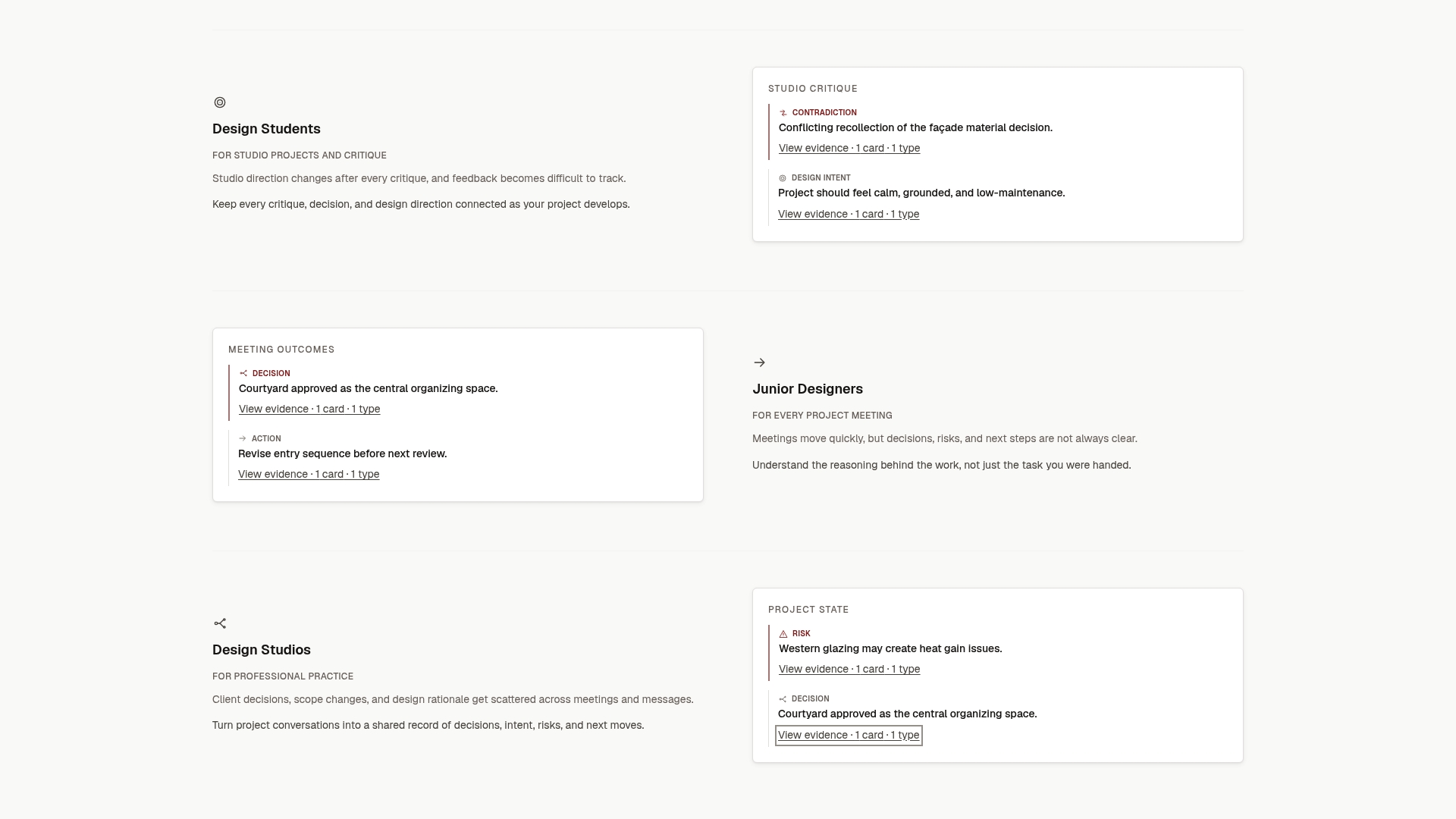
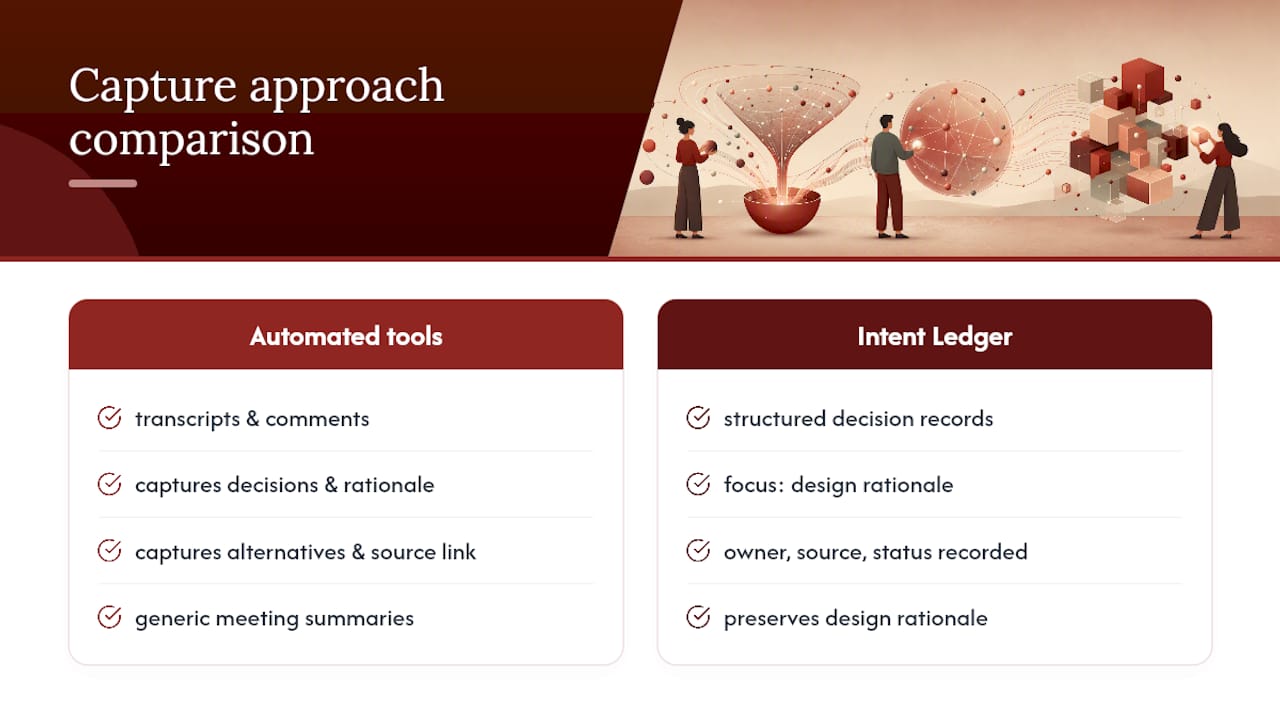
That traceability is the whole point of a good retention policy: every record has an owner, a source, and a status, without your team manually filling out templates after every call. If you’re evaluating tools for automating this capture, it’s worth comparing approaches, including automated capture methods like those from Minuted, against a system built specifically to preserve design rationale rather than generic meeting summaries.
Start with a demo of The Intent Ledger to see how ILM Records map onto your current projects, or check current pricing to find the plan that fits your studio’s size.
Sources
This policy draws on decision-record standards from Google Cloud’s ADR overview and AWS’s prescriptive guidance, design-documentation criteria from UIGuides, knowledge-loss research from Frontiers in Built Environment, and preservation standards from the Digital Preservation Coalition and the AIA.
- How to Document Design Decisions | UIGuides
- Exploring designers’ perceptions of documentation quality management and its effect on construction project success
FAQ
What Is a Meeting Notes Retention Policy for Design Teams?
It’s a set of rules defining which decisions from project meetings get preserved, how they’re structured, who owns them, and how long they’re kept, so project rationale survives staff turnover and time.
How Long Should Design Teams Keep Meeting Notes?
Keep active-project records for the life of the project, reference-level decision records for one to five years after handoff, and anything with lasting design or historical value indefinitely in a project archive.
What Should a Decision Record Include?
A minimal template covers the Decision, the Why, the Alternatives considered, the Consequences, the Date, the Owner, and a link back to the source conversation or file.
Do I Need to Keep Every Meeting Note?
No. Retention should focus on decisions with real alternatives, cross-cutting impact, or client sign-off, not every micro-decision discussed in passing.
Can The Intent Ledger Help Implement This Policy?
Yes. The Intent Ledger converts meeting transcripts and client feedback into structured, source-linked ILM Records, which matches the decision-record structure this policy recommends.