Action Item Traceability: Meeting Transcript Analysis for Design Teams
Action Item Traceability: Meeting Transcript Analysis for Design Teams
Use a grounded, audited AI pipeline to extract decisions, action items with owners, and open questions from your meeting transcript. The right setup produces a short narrative summary alongside a structured decision log, with every claim traceable back to a specific line in the transcript. This article covers the methods, the quality checks, and a workflow you can run starting with your next recorded meeting.
TL;DR:
- Detailed input quality, including speaker labels, timestamps, and clean transcripts, is crucial for AI extraction accuracy, especially for key names and facts.
- Employ topic-based segmentation rather than linear chunking to better capture complete decisions and relevant action items within long meeting transcripts.
- An audit process that verifies each claim’s source line improves trustworthiness by ensuring outputs are faithful and highlighting unsupported assertions.
- Risks and unresolved questions should be flagged with clear language patterns and categorized to prevent critical details from slipping through unnoticed.
- Structured outputs, such as decision logs linked back to original transcripts, help maintain context, provenance, and a record for long-term project and compliance needs.
Table of Contents
- What meeting transcript analysis produces and why each output matters
- Common AI pipeline patterns: segmentation, extraction, synthesis, and audit
- How to prepare transcripts so AI extractions are reliable
- How to check and trust AI outputs: evaluation metrics and governance controls
- A copy-and-paste workflow teams can adopt now
- What research and standards say about limits and best practices
- Techniques for identifying and categorizing risks mentioned in meetings
- Methods for highlighting and tracking follow-up questions or unresolved issues
- Integration of meeting transcript analysis outputs with project management or collaboration tools
- Privacy and data security considerations when using AI for transcript analysis
- Practical perspective for design and project teams
- How The Intent Ledger turns transcript outputs into living, source-backed records
- Sources
- FAQ
What meeting transcript analysis produces and why each output matters
Good meeting transcript analysis does not just compress a conversation into fewer words. It sorts the conversation into categories a team can act on, each with a distinct job.
- Decision record: what was decided, by whom, and under what condition.
- Action item: a task with an owner and a due date, not a vague intention.
- Open question: something raised but not resolved, flagged so it does not vanish.
- Risk flag: a concern mentioned in passing that deserves tracking before it becomes a problem.
- Narrative summary: two or three sentences giving context for someone who was not in the room.
These outputs serve different readers. An executive wants the narrative summary and the decision record. An assignee wants their own action items, nothing else. A project auditor six months later wants the full chain: decision, who made it, and the transcript line it came from. One transcript, several granularities, same underlying structure.
Common AI pipeline patterns: segmentation, extraction, synthesis, and audit
Most reliable systems follow the same shape, whether built in-house or bought as a product.
- Segment the transcript by topic, not by a fixed time or token window.
- Extract facts, decisions, and candidate action sentences from each segment.
- Synthesize those extractions into a short summary and a structured action list.
- Audit the output against the original transcript before anyone sees it.
Topic-based segmentation, paired with an algorithm aimed at action items specifically, captures more real action items and produces summaries closer to what a human would write than naive linear chunking does, according to research on action-item-driven summarization. That matters because linear chunking tends to cut a decision in half across two segments, losing the context that makes it a decision at all.
A related technique, multi-LLM refinement, adds a second model whose only job is to find mistakes in the first model’s summary before a third pass fixes them. Research on this mistake-identification-then-refinement approach found it improved relevance and reduced common errors, though hallucination detection stayed imperfect. Use it when the meeting carries financial, legal, or client-facing weight. Skip it for routine internal syncs where speed matters more than polish.
Pro Tip: Run the audit pass as a separate prompt from the extraction pass. A model correcting its own fresh output tends to defend its first answer rather than question it.
How to prepare transcripts so AI extractions are reliable
Extraction quality depends more on input quality than on which model you choose.
- Record in a format and at a sample rate your transcription tool recommends. Noisy rooms and crosstalk degrade accuracy before any AI touches the text.
- Capture speaker labels and timestamps during recording rather than reconstructing them later. They let the audit pass trace a claim back to a specific person and moment.
- Remove filler tokens (“um,” “you know”) before extraction so the model focuses on content, not noise.
- Normalize named entities. A client name misspelled three different ways across a transcript splits one entity into three in the output.
- Attach a short context packet: the agenda, attendee roles, and any prior decisions the meeting builds on.
Automated speech recognition systems make most of their mistakes on named entities and unfamiliar pronunciations, and transcript coherence strongly predicts how good the final summary ends up, according to research on human-assisted meeting summarization. A brief human correction pass on names and jargon before summarization catches errors that compound badly later.
How to check and trust AI outputs: evaluation metrics and governance controls
Three questions separate a trustworthy summary from a plausible-sounding one.
- Completeness: did it capture every decision and action item, or only the loudest ones?
- Conciseness: does it say what matters without padding, repeated points, or restated context?
- Faithfulness: does every claim trace back to something actually said, with no invented numbers or dates?
A practical audit pass checks faithfulness directly by building an evidence map that links each claim to the transcript line it came from, and by labeling each item as observed (stated directly) or inferred (implied but not said outright), according to an open-source three-stage pipeline built on exactly this pattern. The same pipeline treats an empty field as a valid answer: if no owner was named for a task, the system should say so rather than guess one.
NIST’s generative AI risk profile recommends content provenance tracking, pre-deployment testing, and incident disclosure as core trust controls for systems like these, per the AI Risk Management Framework’s Generative AI Profile. Applied to transcripts, provenance means every output field points back to its source line, testing means checking the pipeline against known transcripts before trusting it on new ones, and disclosure means telling your team when the audit pass flags something it cannot verify.
A copy-and-paste workflow teams can adopt now
This sequence works whether you build the pipeline yourself or rely on a tool that already runs it.
- Prepare the packet: transcript, agenda, attendee roles, and any decisions from prior meetings that this one references.
- Chunk and extract: split the transcript by topic, then run an extraction prompt on each chunk that returns structured output: type (decision, action, question, risk), owner, and the exact evidence span it came from.
- Synthesize and audit: generate a short narrative summary and an action list from the extractions, then run a separate audit prompt that checks each claim against its evidence span and flags anything unsupported.
- Archive with provenance: assign owners and due dates, then store the result in a decision log or an ILM Record so the decision stays linked to the conversation it came from rather than living as a detached bullet point.
A decision log template gives a starting structure for step four if you are building your own log from scratch. For turning the action list into tracked work rather than a static document, see this guide on connecting notes to tasks.
Pro Tip: Keep the evidence span field even after the meeting is archived. Six months later, “who said this and when” is often more useful than the summary itself.
What research and standards say about limits and best practices
AI transcript analysis is reliable enough to trust with structure and checks, not reliable enough to trust blind.
- ASR errors and summarization omissions concentrate on named entities and on facts buried in long transcripts, so verifying key names, dates, and figures against the original text catches most real mistakes, per the Minuteman research on human-assisted summarization.
- LLM evaluators themselves struggle to judge long-context dialogue summaries consistently, which is why comparison-based evaluation methods like CREAM use head-to-head ranking rather than a single absolute score, a design that better reflects how summaries actually differ in quality.
- Multi-stage mistake-identification and refinement pipelines show real gains in relevance and error reduction, but even strong versions leave some hallucination undetected, so an audit step stays necessary rather than optional, according to the refinement research above.
- Topic-based segmentation beats linear chunking for capturing action items in long meetings, confirming that how you cut the transcript matters as much as what model reads it, per the action-item segmentation study.
The pattern across this research is consistent: structure and verification close most of the gap between a plausible AI summary and an accurate one.
Techniques for identifying and categorizing risks mentioned in meetings
Risks rarely arrive labeled as risks. Someone mentions a vendor delay in passing, or a teammate says “I’m not sure that will hold up,” and the comment gets buried under the next agenda item. Catching these requires looking for specific language patterns rather than waiting for someone to say the word “risk.”
Watch for conditional phrasing (“if this slips,” “assuming the client approves”), expressions of doubt (“I’m not confident,” “we haven’t tested this”), and dependencies on something outside the team’s control (a client decision, a third-party delivery, a budget approval still pending). Each of these is a candidate risk flag even when no one names it as one.
Once flagged, categorize by type rather than lumping everything into one list. A schedule risk (a dependency might slip) behaves differently from a scope risk (the client might change requirements) or a technical risk (an approach might not work as assumed). Tagging each flag with a category and the transcript line it came from lets a project lead scan for patterns across several meetings, not just react to one mention.
The same evidence-mapping approach used for faithfulness checks applies here directly: a risk flag without a traceable source line is just a guess dressed up as an insight. Pair the flag with who raised the concern and when, since a risk mentioned by the person doing the work carries different weight than one mentioned secondhand. For design teams specifically, risks surfaced in client critique sessions often predict scope changes weeks before they are formally raised, which is exactly the kind of signal that gets lost without a structured record pointing back to the original conversation.
Methods for highlighting and tracking follow-up questions or unresolved issues
An unresolved question is different from a risk. It is something the team knows it needs to answer but has not yet, and it is the single most common thing that silently drops off a project’s radar between meetings.
Extraction prompts can catch these directly by looking for question-form statements that never received a resolving answer in the same meeting, phrases like “we’ll need to figure out” or “let’s come back to that,” and topics that were raised, discussed briefly, and then abandoned when the conversation moved on. Each of these should generate an open question entry distinct from both action items and decisions, because treating an unresolved question as if it were already assigned to someone creates false confidence that it is being handled.
The practical failure mode is not missing the question in the moment, it is losing it between meetings. An open question list that lives in one meeting’s notes and nowhere else gets rediscovered, if at all, only when the issue becomes urgent. Carrying open questions forward into the next meeting’s context packet, so the extraction pipeline can check whether they were addressed this time, keeps them visible without requiring anyone to remember to ask.
Tracking resolution status matters as much as capturing the question itself: open, answered, or abandoned, each with a timestamp. A question that sat open for eight meetings running is a different problem than one answered in the next session, and only a persistent record across meetings shows the difference.
Integration of meeting transcript analysis outputs with project management or collaboration tools
A structured output that stays trapped in a document nobody revisits does little good. The value shows up when action items, decisions, and risk flags move into the tools where work actually happens.
The most direct path is pushing extracted action items straight into whatever task system a team already uses, with the owner and due date carried over from the extraction rather than retyped. Guidance on turning extracted action items into tracked work covers this handoff in more detail, including how to avoid creating duplicate tasks when the same commitment gets mentioned across multiple meetings.
Decisions and risk flags integrate differently than action items do. They are not tasks to complete, they are context that should attach to the project itself, visible wherever someone looks up why a choice was made. A decision buried in a chat thread from three months ago is effectively lost; a decision linked to a project record stays discoverable. For teams running recurring project reviews, a postmortem-style record that pulls from accumulated meeting outputs over the life of a project tends to surface patterns a single meeting’s notes never would.
The integration choice that matters most is whether the connection preserves provenance or breaks it. Copying a summary into a task description loses the link back to the original conversation. Passing along a structured record that still points to its evidence span keeps that link intact, which is the difference between a task list and an actual project memory.
Privacy and data security considerations when using AI for transcript analysis
Meeting transcripts often contain more sensitive material than people expect: client financials, personnel discussions, unreleased designs, legal exposure mentioned in passing. Running that content through an AI pipeline raises real questions about where it goes and who can see it.
Before adopting any tool, check whether transcript data is used to train the underlying models or kept isolated to your account. These are different arrangements with different implications, and the distinction is often buried in a vendor’s terms rather than stated plainly. Also check retention: how long raw transcripts and derived outputs are kept, and whether you can delete them on request.
Access control matters as much as storage. A decision log that includes client-sensitive discussion should not be visible to everyone with a company-wide login. Role-based access, so that a junior team member sees their own action items without seeing a client’s budget concerns, is a basic control worth confirming before rollout.
NIST’s generative AI risk guidance frames content provenance and governance as core trust controls, and that framing applies directly here: knowing where a piece of transcript data ended up, and being able to trace it back if something goes wrong, is not a nice-to-have feature. It is the baseline that makes AI-assisted analysis safe to use on real client and project conversations rather than only on low-stakes internal chats.
Practical perspective for design and project teams
Design work runs on rationale, not just outcomes. A decision log that captures “we chose option B” without the conversation behind it loses exactly the information a junior designer needs six months later when a client asks why. Auto-generated summaries are fast, but commitments and decisions deserve a quick human check before they get treated as fact.
— Rajas
How The Intent Ledger turns transcript outputs into living, source-backed records
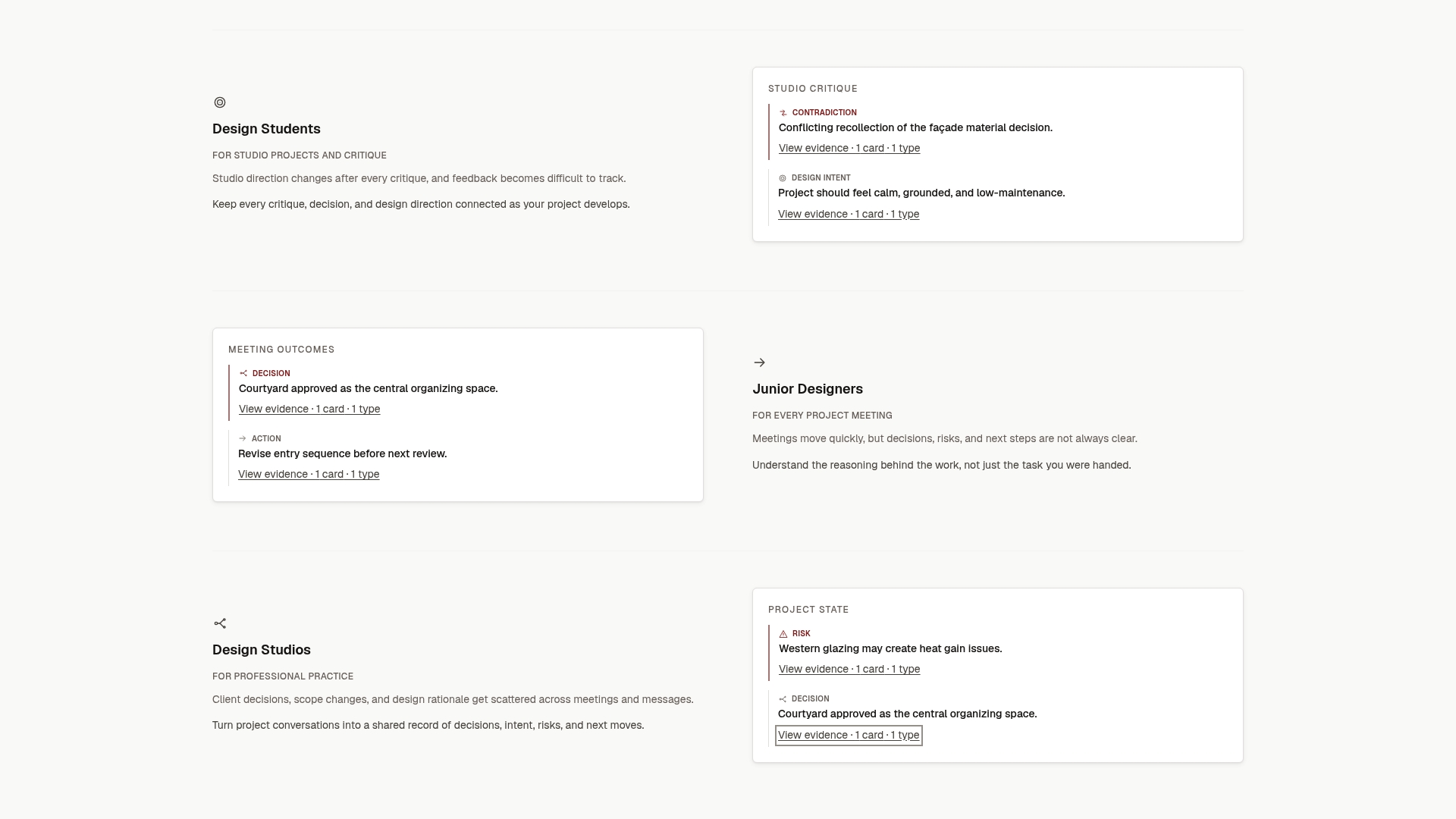
Most meeting tools stop at a summary. The Intent Ledger goes further: it takes the decisions, risks, and action items pulled from your transcripts and critique feedback and turns them into ILM Records, structured entries that stay linked back to the original conversation they came from. When a teammate asks why a decision was made, the answer is not buried in someone’s memory, it is a traceable record pointing to the exact exchange.
For design teams, that traceability solves a specific problem: lost context between meetings, handoffs, and team changes. Risks surfaced in a client critique or a design review get flagged early instead of resurfacing as a crisis weeks later, and project continuity survives even when the person who made the original call moves to a different project.
Plans include options such as Working Memory and higher-capacity tiers available for teams. Current prices are listed on the pricing page. Full details are on the pricing page.
Sources
- Minuteman: Machine and Human Joining Forces in Meeting Summarization
- Artificial Intelligence Risk Management Framework: Generative Artificial Intelligence Profile
- transcript-analysis-pipeline (three-stage LLM pipeline)
- Action-item-driven meeting summarization with topic segmentation
FAQ
What is the best way to analyze a long meeting transcript with AI?
Segment the transcript by topic rather than by a fixed time window, extract structured facts from each segment, then synthesize and audit the result against the original text. Research on action-item-driven summarization found this topic-based approach captures more action items than simple linear chunking.
Can ChatGPT transcribe meeting minutes?
General-purpose chat models can summarize text you paste in, but they are not purpose-built transcription tools and do not reliably convert audio into an accurate transcript on their own. For accurate speech-to-text, use a dedicated automated speech recognition tool first, then run the resulting transcript through a summarization or extraction pipeline.
What should a good meeting transcript summary include?
A useful summary includes a short narrative of what happened, a list of decisions made, action items with owners and due dates, and any open questions left unresolved. Risk flags should appear separately rather than buried inside the narrative, since they need different follow-up than a routine action item.
How do I know if an AI meeting summary is accurate?
Check it against three measures: completeness (did it capture every decision), conciseness (is it free of padding), and faithfulness (does every claim trace back to something actually said). An audit pass that maps each claim to its source line in the transcript, allowing an empty result when nothing was found, catches most fabricated or missing details.
What is the 40/20/40 rule for meetings?
This is not a standard or widely documented framework, and definitions of it vary depending on the source. If you have encountered it in a specific context, treat it as that source’s own guidance rather than an established meeting standard.