Project Decision Cadence: How Often to Decide and Record
Project Decision Cadence: How Often to Decide and Record
A project decision cadence is a fixed, repeating rhythm for making, recording and reviewing decisions on a project. For most design teams the working answer has three beats: record each decision right after it is made, confirm owners and open questions in a short weekly checkpoint, and revisit the whole decision trail at the start of each project phase. Our own offer fits that rhythm: The Intent Ledger turns conversations, notes and transcripts into ILM Records, structured records of decisions, design intent, risks, actions and unresolved questions, each traceable to the conversation it came from.
TL;DR
- A decision cadence is not a meeting schedule. It is the rhythm that turns discussion into decisions, owners and follow-up.
- Research on design documentation says to record decisions continuously, ideally right after they are made, review them periodically, and re-read prior decisions at the start of each phase.
- Match meeting frequency to uncertainty: weekly for fast-moving work, fortnightly for steadier delivery, monthly for governance-heavy steering.
- Every session should end with at least one decision, an owner and a recorded reason.
- A record that keeps the why and links back to the source conversation is what stops context from leaking out of the project.
Table of Contents
- What a project decision cadence actually is
- The three beats of a design decision cadence
- Match the rhythm to how uncertain the work is
- Run each decision review so it ends with a decision
- What each decision record should capture
- A worked example: a four-person studio
- Who benefits most from a steady cadence
- Where cadences break down
- Where The Intent Ledger fits
- Our perspective
- FAQ
- Sources
What a project decision cadence actually is
Most teams already have meetings. A cadence is something narrower: the repeated rhythm in which the team looks at what changed, decides what needs deciding, assigns who acts, and writes down the result.
One operations blog draws the line clearly. Meeting cadence describes when people meet, while operating cadence describes how work gets reviewed, decisions get made, and follow-up gets owned. Its advice is to start from the decisions the team must make again and again, and to remove or redesign any review that does not produce one.
Another practitioner test is what Friday looks like. After a real weekly rhythm, someone’s plan has changed, a priority has shifted or a blocker is gone. After a meeting that is not a rhythm, Friday looks the same as Monday and the only trace is a page of bullet points nobody reads.
For a design team this matters more than for most. Design decisions are made in critiques, client calls, site visits and corridor conversations. If the cadence does not catch them, they live in someone’s memory, and memory leaves when people do.
The three beats of a design decision cadence
A peer-reviewed study of design-decision documentation, published in the International Journal of Information Systems and Project Management, summarizes what the literature prescribes. Document decisions continuously, preferably immediately after they are made; review them periodically; and assess prior documentation at the start of each new project phase. That gives you a practical cadence with three beats, plus an occasional fourth.
| Beat | When | What happens | Who owns it |
|---|---|---|---|
| Capture | Right after the conversation | The decision, its reason, the source and any open question are written down | Whoever was in the room, with one named log owner |
| Checkpoint | Weekly, 20 to 30 minutes | Confirm statuses, owners and due dates; surface unresolved questions | Project manager or studio lead |
| Phase baseline | Start of each project phase | Re-read prior decisions and confirm what still holds | Project lead with the team |
| Pattern review | Monthly or quarterly | Look for reversed, outdated or repeatedly reopened decisions | Studio lead |
The fourth row is a judgment call rather than a rule. Thoughtworks’ team guidebook, for example, suggests reviewing design and technical debt items every one to two weeks in 30-minute sessions, and revisiting team principles every three months. Use the monthly or quarterly pass if your project runs long enough to drift.
Why capture comes first
The weekly checkpoint only works if there is something accurate to check. Delay is where detail dies: by the following Tuesday, nobody remembers whether the client agreed to the revised stair position or only did not object. Capture while the conversation is fresh, and the checkpoint becomes a short confirmation instead of an archaeology session.
What the weekly checkpoint is for
Keep it narrow. Three questions are enough:
- Which decisions were made since the last checkpoint, and are they recorded?
- Which actions have an owner and a date, and which do not?
- Which questions are still open, and who needs to answer them before the next checkpoint?
If a checkpoint runs past 30 minutes, it has usually turned into a design discussion. Move that to its own session.
Match the rhythm to how uncertain the work is
There is no universal interval. One meeting-cadence template ties frequency to risk: weekly for fast-moving work, fortnightly for steadier delivery, and monthly for governance-heavy steering. It also insists the slot stay fixed, with the same people at the same time, because a schedule that shifts every week stops being a rhythm.
Translated to design work:
- Concept and schematic design: weekly. Direction changes fast, and one wrong assumption can cascade through a dozen drawings.
- Design development and documentation: fortnightly, unless a consultant coordination issue or a client change forces an extra session.
- Construction administration or delivery: weekly again if site questions are frequent; otherwise fortnightly.
- Client steering or sign-off: monthly, or at each milestone.
A freelance architect with one client might collapse this into a single weekly 15-minute review of the log plus a written summary after every client call. A studio with several projects might run one short checkpoint per project and a monthly cross-project pass. For a deeper look at intervals by project stage, see our guide to how often design teams should meet to decide.
Run each decision review so it ends with a decision
A cadence fails quietly when sessions turn into updates. One project-management source says the agenda should state the decision needed, the options, the recommended choice and its owner, whether the decision is final, and what happens if none is reached. Background, risks and trade-offs go out in advance so the meeting time is for deciding.
A professional project-review checklist adds a useful opening: it reaffirms the current baseline, reviews prior action items, and walks through the decision log, including who decided, why, which alternatives were considered and who was informed.
A simple agenda
- Baseline (2 minutes): What is the current agreed position?
- Last time’s actions (5 minutes): Done, moved or dropped?
- Decisions needed (15 to 20 minutes): For each, state the options, the recommendation, the owner and the deadline.
- Newly made decisions (5 minutes): Read them back so the record matches what people think they agreed.
- Open questions (3 minutes): Name an owner for each.
The read-back in step 4 is small but valuable. It is the moment to catch the gap between “we will send revised drawings Friday” and “we will send revised drawings Friday if the structural review is done.” Those are two different plans, so the condition belongs in the record.
Give reviewers time to read first
In the architectural decision record process described by AWS, the review meeting starts with a dedicated 10 to 15 minute slot for each person to read the record and add comments. The owner then answers each comment, actions get an assignee, and only then is the decision accepted. Software teams invented the format, but the discipline carries over to a design critique: read, comment, resolve, accept.
If your reviews tend to wander, a good set of team reflection questions for retros can help you steer the conversation from discussion toward a clear outcome.
Keep reviews short on risk
One project-review framework argues that a review should surface only the two or three risks that could genuinely change the outcome and finish with an explicit decision request, including options, a recommendation and a deadline. A list of twenty risks gets skimmed. Three risks with a named decision attached get acted on.
What each decision record should capture
A cadence is only as useful as the records it produces. The IJISPM study says documentation should cover not just the decision but its rationale, the dependencies between decisions, and the context, meaning which design objects and systems are affected. It also says responsibility for documenting should sit with a specific person, using a pre-defined template in a shared place.
Thoughtworks recommends a lightweight template with decision title, status, deciders, date, context, decision and consequences, and observes that too often important context lives in someone’s head or is buried in slide decks and emails.
For design teams, we would add a few fields that architecture work specifically needs:
- Status: proposed, confirmed, conditional or unresolved. Never record a suggestion as a decision.
- The choice, stated plainly: one sentence, in the imperative where possible.
- The reason: why this option, and what it was chosen over.
- Conditions and open questions: what must be true for the decision to stand.
- Owner and date: only what was actually assigned. Leave blank what was not.
- Source: the meeting, critique, call or email where it was said.
- Superseded by: a pointer to the later decision, if one replaces it.
That last field matters. AWS guidance says that when a record is updated, the old one is marked Superseded and stays in the log, with changes noted in the new record. If a client reverses a choice in month five, you can show exactly what was decided in month two and why, instead of arguing about it.
When should something earn a record at all? UXCam suggests documenting a design decision when it is hard to reverse, affects more than one team, or is likely to be questioned again later. That filter keeps the log useful instead of exhausting.
For field-by-field detail, read our guide to the eight fields a record of decision needs, or start from a decision log template for project teams.
A worked example: a four-person studio
The following is an illustration, not a case study. A four-person studio is designing a small community library. They set this rhythm:
- Monday, 25 minutes: project checkpoint. The project manager reads the decisions logged last week, confirms owners, and lists the three questions that need an answer before Friday.
- After every client call or critique: the person who led it writes up decisions within the hour, marking each as confirmed, conditional or unresolved, and attaching the transcript or notes it came from.
- Start of each phase: a 45-minute baseline session re-reading every confirmed decision from the last phase. Two turn out to be conditional on a structural check that never happened, so they go back on the open list.
- Monthly: the studio lead scans for decisions reopened more than once. Three came up again, all about the reading-room glazing, which tells the team the original rationale was never clear enough.
Nothing here needs special software. The point is the habit: capture fast, confirm weekly, re-read at boundaries, look for patterns monthly.
Who benefits most from a steady cadence
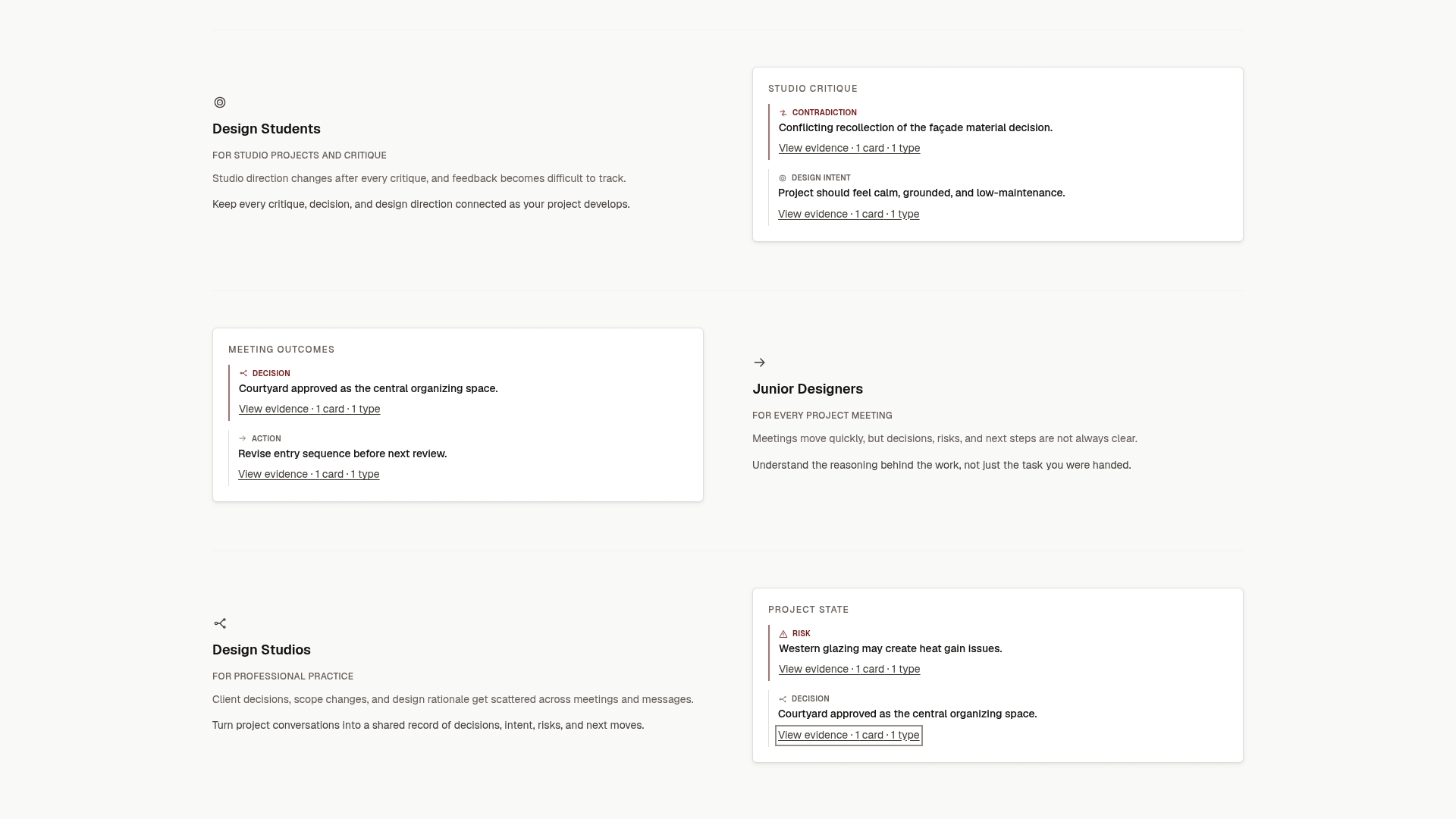
Junior designers. A task arrives with no explanation: “change the entrance canopy.” With a log that links each decision to its source conversation, a junior can see that the canopy changed because of a fire-egress comment, not a taste preference, and can make better follow-on choices.
Project managers. The weekly checkpoint becomes a matter of confirming a record rather than reconstructing one. Unresolved questions surface while there is still time to answer them.
Freelance architects. With one client and no colleague to cross-check memory, a dated record of what the client said, and what you said back, is your continuity. Review it every week and after every call.
Design and architecture students. Critique feedback arrives fast and contradicts itself. Logging each reviewer’s comment, your response and what you decided to change gives you a trail you can use in your next review, and in your portfolio write-up.
Studios. When someone leaves or a project pauses for six months, the cadence is what means the next person inherits reasons, not just drawings. AWS notes the same benefit in a software context: new teams can stabilize their decisions within a few sprints and then hold fewer meetings. A cadence should get lighter as decisions settle.
Where cadences break down
- No owner. Both the academic study and the practical templates say one person should own the log. Shared ownership usually means nobody’s.
- Capture lag. If notes are written a week later, they record what people remember, not what was said.
- Meetings with no decision. One operations writer calls a session that ends without any decision a reporting session in disguise. Set a minimum: at least one decision per session, or cancel it.
- Moving slots. A weekly review that slides around the calendar teaches people to ignore it.
- Records without reasons. “Use the oak veneer” is a fact. “Use the oak veneer because the client rejected the walnut sample on cost and the fire officer approved this finish” is a decision with intent.
Where The Intent Ledger fits
The hardest beat of the cadence is capture, because it asks people to turn a messy conversation into a clean record straight after they are tired. The Intent Ledger is project memory software built for that step. It turns project conversations, meeting notes, audio recordings, transcripts, critique feedback and client comments into ILM Records: structured, source-backed records of decisions, design intent, risks, actions, commitments and unresolved questions, each traceable to the conversation it came from.
You can start small. The Working Set is a $12 one-off pack, the Project Record is $29 one-off, Practice Memory is $59 one-off and Studio Ledger is $119 one-off. If you prefer a subscription, Working Memory is $29 per month, Living Record is $79 per month and Shared Ledger is $149 per month. See the plans and packs on the pricing page, or look at what The Intent Ledger does for design teams.
Our perspective
Most advice on decision cadence is about the calendar: which day, how long, who attends. That is the easy part. The hard part is that design decisions are made in conversation, and conversations are where the reasons disappear.
We built The Intent Ledger around one belief: a record that says what was decided but not why is only half a record. When a client revisits a choice, when a junior designer asks where a task came from, when a critique comment resurfaces two months later, the question is never just “what did we decide?” It is “what were we thinking, and who said so?”
That is why each ILM Record is tied to its source conversation. The rhythm you choose, whether weekly, fortnightly or by phase, gives the team time to look. The record gives them something worth looking at. Together they let a studio build project memory over time instead of starting from scratch every time someone changes seats.
If you take one thing from this article, take this: set the cadence, name the owner, and never let a decision leave the room without its reason attached.
Rajas
FAQ
What does a 2-week cadence mean?
It means a recurring cycle that repeats every two weeks, with the same session at the same time. For decisions, that usually suits steadier delivery work, where direction does not change daily. Pair it with immediate capture after any important conversation, so the fortnightly review is confirming records rather than creating them.
How often should a design team review its decisions?
Research on design documentation says to record decisions continuously, review them periodically and re-read prior documentation at the start of each phase. In practice, that is a short weekly checkpoint during fast-moving phases, fortnightly later, and a longer baseline review at each phase boundary. Adjust to how quickly your project is changing.
What is the difference between a decision cadence and a meeting schedule?
A meeting schedule says when people gather. A decision cadence says what must come out of the gathering: decisions made, owners named, reasons recorded, open questions assigned. If a session can end without any of those, it is a status update rather than part of a cadence.
Do freelancers and students need a decision cadence?
Yes, in a lighter form. A freelance architect can write up each client call within the hour and review the log once a week. A student can log each critique comment and the response to it, then review the list before the next crit. The rhythm is smaller but the purpose is the same: keep the reasons.
Sources
- Operating Cadence Template: What To Include Before Work Starts
- Meeting cadence template: a rhythm that ships work
- What a real weekly operating rhythm looks like
- The documentation of design decisions in engineering projects (IJISPM)
- AWS Prescriptive Guidance: Using architectural decision records
- Design as a Team Guidebook (Thoughtworks)
- Turn Project Status Meetings Into Action
- Project Review Meeting Agenda and Checklist
- The 5 Questions of a Project Review That Decides
- Design Decisions: How to make them with complete confidence
- Team Reflection Questions: 40 Prompts for Better Retros