Project Handover Notes for Managers: 5 Step Packet Test
Project Handover Notes for Managers: 5 Step Packet Test

Project handover notes are the operational packet that lets someone else run your project without calling you. The single most important thing to produce first is not a status report. It is a documented 30-day action path with a named owner for every open item. This guide gives you a copyable template and a short continuity drill to prove the packet actually works before you walk away.
TL;DR:
- A comprehensive handover packet must include clear project identity, a detailed snapshot, decision history, and an access map, with all locations specified precisely.
- Writing entries in second person with explicit next actions ensures the incoming owner can immediately act without asking questions or searching for information.
- The handover process should begin at least three to four weeks before go-live, with a staged review, sign-off, and a final drill to identify gaps and verify access.
- Linking decisions to specific conversations and maintaining decision provenance via the Intent Ledger reduces risks and increases future trust in project history.
- Avoid including passwords or credentials in the document; use a secure access map and request process to uphold safety standards.
Table of Contents
- What Goes in Project Handover Notes: Template and Checklist
- What to Include in Each Handover Section
- How to Write Handover Notes People Can Actually Use
- When to Prepare, Review, and Sign Off on a Handover
- The Handover Acceptance Test: A Five-Step Drill
- How the Intent Ledger Preserves Handover Memory
- Why Handover Discipline Actually Matters
- Try a Living Handover Packet Instead of a Static Document
- Sources
- FAQ
What Goes in Project Handover Notes: Template and Checklist
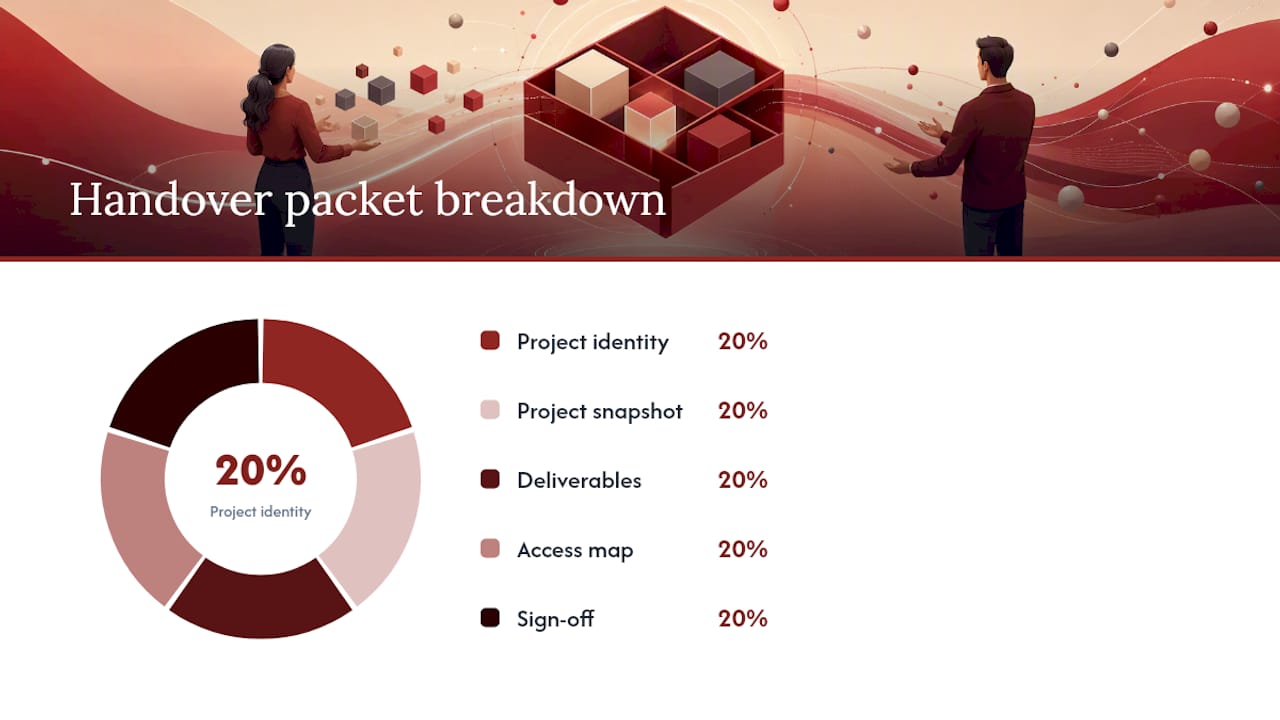
A usable handover packet has five parts. Skip one and the incoming owner spends their first week asking questions instead of running the project.
Project identity anchors the document: project name, ID or code, outgoing owner, incoming owner, and the handover date. Simple, but people forget it, and six months later nobody can trace which version they’re reading.
Project snapshot covers the objective, current phase, next milestone, and any fragile spot that could break without warning.
Deliverables need a table, not a paragraph:
The access map lists every system the incoming owner needs, who administers it, and how to request credentials through the proper channel. Never write a password or API key into the document itself.
Sign-off closes the loop:
- Define acceptance criteria in plain language.
- Name a RACI for each open task, using actual people, not job titles.
- Get signatures from both outgoing and incoming owners.
A complete handover matches this shape closely to a transition plan template, which recommends covering scope, roles, knowledge transfer, and closure criteria in one document rather than scattering them across emails.
What to Include in Each Handover Section
Every field in the template exists to answer one question: what does the incoming owner need to know to act today?
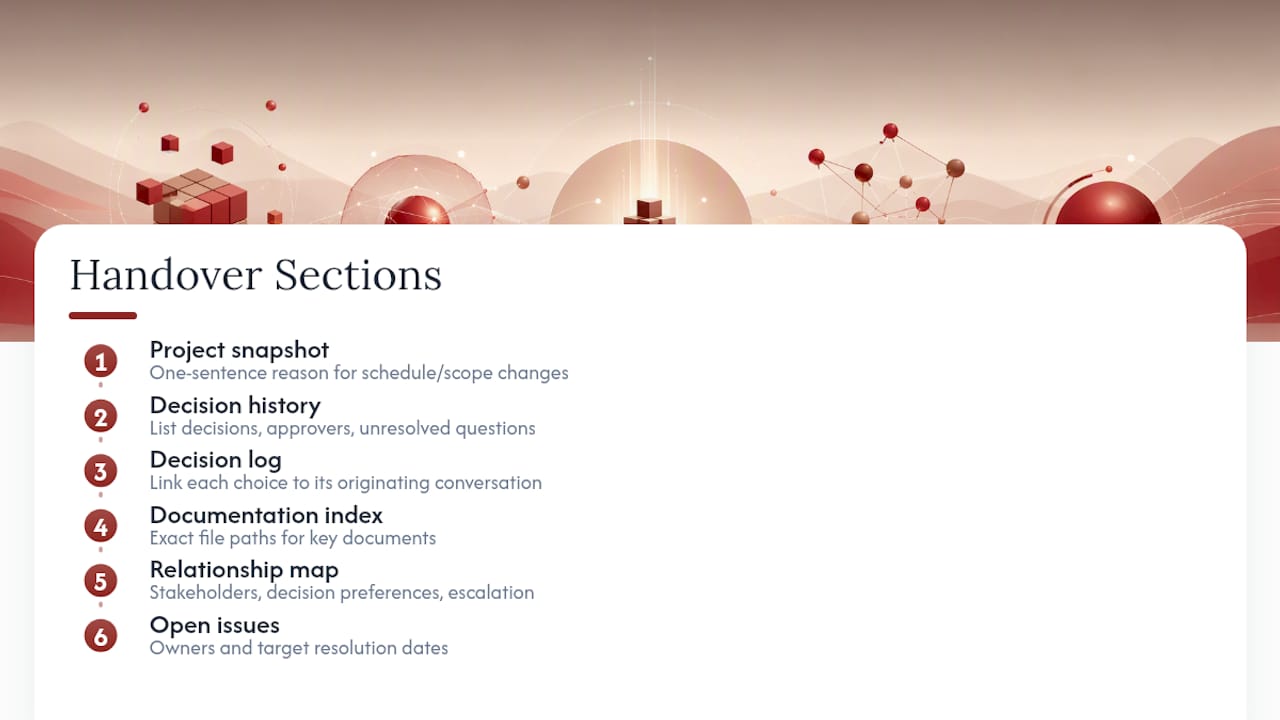
The project snapshot should explain, in one sentence, why the schedule or scope changed if it did. “Delayed two weeks because the client requested a third design round” tells the new owner more than a status bar ever will.
Decision history is where most handovers fall apart. List recent decisions, who approved each one, and any question still unresolved. A decision log that ties each choice back to the conversation where it happened saves the incoming owner from re-litigating settled arguments.
The documentation index should point to exact locations, not general folders. A thorough handover lists where to find the project charter, final plan, change register, risk register, lessons learned, test results, and technical documentation, according to Elium’s handover template. “Check the shared drive” is not a location. “Shared drive, /Project X/risk_register_v4.xlsx” is.
The relationship map names stakeholders along with how each one prefers to make decisions and who to escalate to when they’re unavailable. This single field prevents more delays than any status update.
Finally, list open issues with owners and target resolution dates.
Pro Tip: If a decision has no clear owner attached in your log, treat that as an open risk, not a settled fact. Unowned decisions are the ones that get reversed three weeks after handover.
How to Write Handover Notes People Can Actually Use
Write every entry to the incoming owner directly, in second person, with an explicit next action. “You need to renew the vendor contract by April 1” beats “The vendor contract requires renewal.”
Follow four habits when drafting:
- Give live file locations plus the person who controls access, not just a link that might expire or point to a stale copy.
- Add short provenance notes to key decisions: who approved it, when, and why. A one-line “Approved by J. Reyes, February 10, budget constraint” resolves disputes before they start.
- Never embed credentials in the document. Reference the access map instead and describe the secure request process.
- Keep entries short enough to scan in seconds.
A normative handover spec from the open-source project nativesoil goes as far as rejecting any handover file that contains secrets or private absolute paths, treating that as a hard safety rule rather than a suggestion.
Sample lines worth stealing: a status entry reads “Phase 3 complete, Phase 4 starts March 18, blocked on client asset delivery.” A decision log entry reads “Chose vendor B over vendor A, February 22, cost and timeline fit, approved by PM.” An access note reads “CRM admin: contact IT helpdesk, ticket type ‘access request’, not stored here.”
When to Prepare, Review, and Sign Off on a Handover
Handover documentation written the night before someone leaves is almost always incomplete. Start drafting during the final delivery sprint, not after it.
A workable schedule looks like this, especially in construction projects where field tickets and compliance documents are critical: Powitup.
- Two weeks out: Draft the full packet. Flag any section you can’t complete yet.
- One week out: Reviewer checks documentation completeness, verifies access paths actually work, and confirms training sessions are scheduled.
- Go-live day: Final sign-off happens, with named individuals attached to each RACI role, not just role titles.
- Hypercare end (typically one to two weeks post go-live): Confirm the incoming owner is operating independently.
Preparing the document progressively, roughly three to four weeks before go-live, leaves enough runway for access checks and training instead of a rushed handoff.
Watch three hypercare metrics as you exit support: support ticket volume, time to first response, and how confident the incoming team feels making decisions without you.
The Handover Acceptance Test: A Five-Step Drill
A handover document is not proof of anything until someone else uses it. Treat the packet as a claim and the drill as the evidence, an approach Project Management.com frames as “packet plus test” rather than a memo you hand off and hope holds up.
Run this drill with the incoming owner:
- Find the next three deadlines using only the packet.
- Locate the current live files without asking the outgoing owner.
- Identify who currently has approval authority on an open decision.
- Draft a status update to a stakeholder using packet information alone.
- Verify at least one access request path actually works end to end.
Log every gap the drill surfaces and assign an owner to close it within 48 hours.
Pro Tip: Run the drill before the outgoing owner’s last day, never after. A gap discovered post-departure costs ten times longer to fix.
Sign-off happens only after the drill passes clean. Archive the signed acceptance alongside the packet itself.
How the Intent Ledger Preserves Handover Memory
The Intent Ledger turns meeting notes, transcripts, and client comments into ILM Records, structured entries that trace each decision back to the exact conversation it came from. That provenance link is what most handover documents lack: a decision without a traceable source is a guess dressed up as a fact.
Connecting decisions to their originating conversation surfaces unresolved risks earlier, before they become the incoming owner’s problem. It also gives future team members, including junior designers reviewing past project intent, a record they can trust without chasing down the person who wrote it.
Why Handover Discipline Actually Matters
Most teams treat handover as a farewell task instead of a delivery deliverable. That’s backward. Build short continuity drills into your process now, not during someone’s last week, and documentation stops being an afterthought and starts being memory the team can actually rely on.
— Rajas
Try a Living Handover Packet Instead of a Static Document
A static handover document goes stale the moment it’s signed. The Intent Ledger keeps decision provenance alive by linking each entry back to the conversation that produced it, so the incoming owner isn’t just reading a snapshot, they’re inheriting the reasoning behind it. Plans start with Working Memory for ongoing record creation, or you can buy a one-time Project Record pack if you just need to document a single handover cleanly. Check current plans and pricing or explore how the platform works before your next transition. If you’re mid-handover right now, start building your packet today rather than waiting for the last week to catch up.
Sources
- nativesoil/handover spec — README.md
- Transition Plan Template – Project Management Formula
- Project Handover Template | Elium
- Free Project Handover Document Template — Word Download - Sikhana Seekho
- Project-management
FAQ
How Do You Write a Good Handover Note?
A good handover note states the current project state, names an owner for every open task, and points to exact file locations rather than general folders. Write it in second person, addressed directly to the incoming owner, with a next action attached to every open item.
What Are the Phases of a Project Handover?
The typical phases run drafting (two to four weeks before go-live), review (one week before), sign-off (at go-live), and hypercare (one to two weeks after go-live, per Project Management Formula). Each phase has its own checkpoint: documentation completeness, access verification, and training confirmation.
How Do You Write a Good Handover Email?
A handover email should summarize the current phase, list the top three open risks, and link directly to the full handover document rather than repeating its contents. Keep it short enough to read in under a minute, and name the person now responsible for each open item.
How Do I Acknowledge a Handover Email?
Acknowledge a handover email by confirming you’ve reviewed the packet, listing any gaps you found, and stating a date you’ll complete the acceptance drill. Formal acknowledgment should happen only after you’ve actually tested the handover, not simply after reading it.
What Should Never Appear in a Handover Document?
Handover documents should never contain passwords, API keys, or other credentials directly in the text. A normative handover spec treats this as a hard rule, requiring an access map and a secure request process instead.