For Design Teams, Stop Repeating Work: Build Project Memory in 30 Days
For Design Teams, Stop Repeating Work: Build Project Memory in 30 Days

Project memory for design is the structured, source-backed record of why a team made the decisions it made, not just what it produced. It captures rationale, rejected alternatives, and unresolved risks tied back to the conversations they came from. Start today: pick one decision from your last milestone and write down what was decided, why, and who was in the room.
TL;DR:
- Automated capture methods like meeting transcripts and file change logs minimize effort and prevent the memory system from collapsing due to manual maintenance.
- Promoting only significant decisions into durable records requires a human review step, ideally once a week, to prevent clutter and ensure relevance.
- Linking each record to its source artifact and maintaining a clear map improves retrieval speed and prevents the archive from becoming inaccessible or forgotten.
- Assigning specific roles—creators, verifiers, and owners—to handle decision logging and updates ensures consistent upkeep and relevance of the project memory system.
- Using structured formats like ILM Records enables teams to quickly find decision rationale and avoid repeating mistakes or rediscovering rejected ideas months later.
Table of Contents
- What Counts as Project Memory in Design Work
- Why Project Memory Matters More Than Most Teams Assume
- How to Capture Design Decisions Without Slowing the Team Down
- Organizing and Retrieving Design Memories So They Actually Get Used
- Who Owns the Memory and How Often They Update It
- An Example of Project Memory in Practice: ILM Records
- 30-Day Plan to Build Working Project Memory
- Try The Intent Ledger for Your Next Project
- Sources
- FAQ
What Counts as Project Memory in Design Work
Academic definitions frame project memory as the lessons, history, activities, and results a team accumulates across a project’s life, according to a Springer Nature chapter on design research. In practice, that translates into several concrete formats: event logs that timestamp what happened, Architecture Decision Records (ADRs) that document a single choice, structured records like ILM Records that link decisions to source material, and plain markdown files sitting in a repo folder.
Whatever the format, the content that actually matters rarely changes. Design teams should capture:
- The decision itself, stated plainly
- Alternatives that were considered and rejected, with the reasoning
- Constraints that shaped the choice (budget, code, client preference)
- Risks identified at the time, even if they seemed minor
- Client or stakeholder feedback tied to a specific date
- Provenance: which meeting, transcript, or document the decision traces back to
Practitioner notes on lightweight memory systems consistently flag that rejected alternatives carry more long-term value than the final artifact alone. Anyone can see what a team built. Only a record shows what they almost built instead, and why they didn’t.
Why Project Memory Matters More Than Most Teams Assume
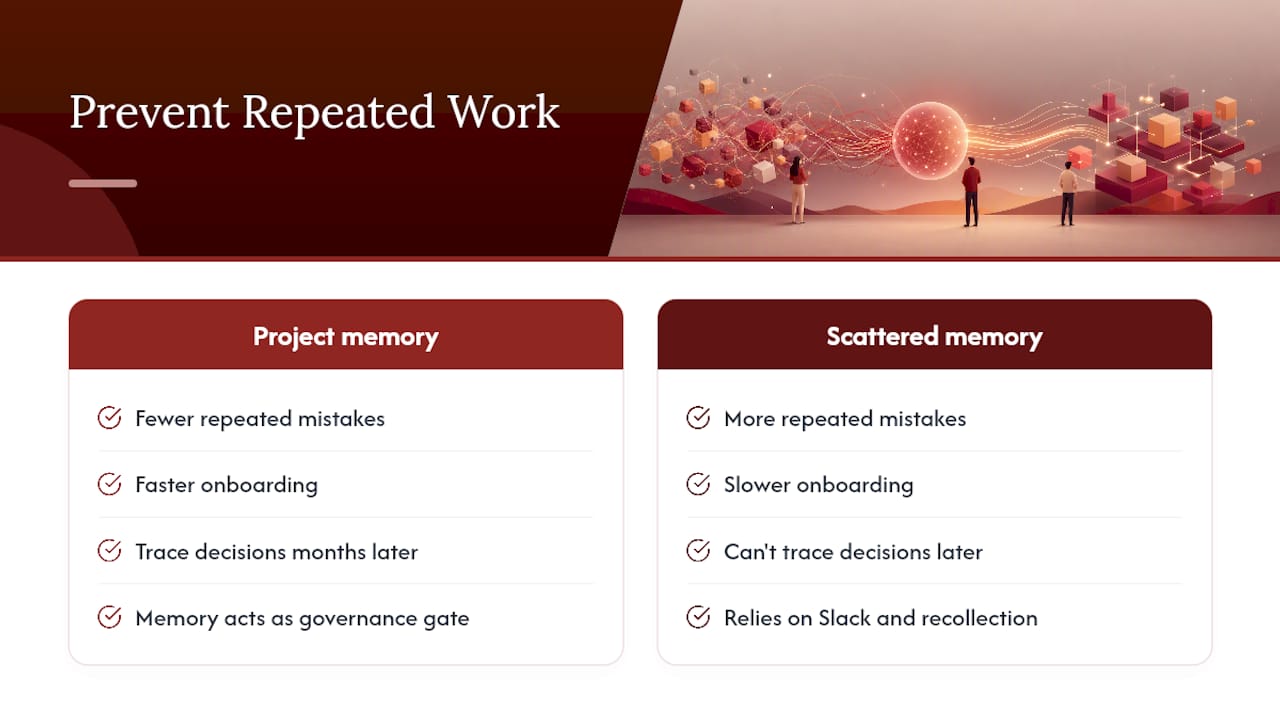
Teams that keep a real project memory make fewer repeated mistakes, onboard new hires faster, and can trace a decision back to its source months after the fact. The alternative, relying on scattered Slack threads and someone’s recollection, tends to fail exactly when it matters most: during a client dispute or a design review six months later.
The clearest framing for why this works comes from a memory-as-governance model described in research on event-sourced memory systems. Instead of memory sitting passively as an archive nobody reads, it acts as a gate: before a team repeats an approach, the record surfaces whether that approach already failed once. That shifts memory from something you consult occasionally to something that actively stops you from wasting a week.
Picture a mid-size studio revisiting a floor plan layout that a client rejected during an earlier phase. Without a record, a junior designer proposes it again three months later, and the team burns a full review cycle rediscovering why it didn’t work. With a logged decision and its rationale, that rediscovery takes thirty seconds instead of a week.
How to Capture Design Decisions Without Slowing the Team Down
Capture only works if it costs almost nothing, as demonstrated by industry best practices in the complete lifecycle of a structural engineering project. The moment a logging habit feels like homework, it stops happening. Build the system around passive capture first, then layer in active records for anything that clears a relevance bar.
Passive capture means the record gets created automatically, without anyone stopping to type. Automated meeting transcripts, git commit hooks tied to design file changes, and calendar integrations that timestamp reviews all fall into this category. Practitioner guidance on low-ceremony memory systems is blunt about this: systems that demand manual logging for every event tend to collapse within a few weeks because people stop maintaining them.
Active records are where judgment enters. An ADR or an ILM Record gets written when a decision is significant enough to warrant a deliberate summary: client sign-off, a material change, a scope shift. These records need a few consistent fields (decision, rationale, alternatives, provenance) rather than a free-form essay, or they turn into the same maintenance burden passive capture was meant to avoid.
Here’s a starter workflow that works for a small studio or a five-person in-house team:
- Capture. Record the meeting or conversation, or let a hook log the artifact change automatically.
- Tag and provide provenance. Attach the record to its source: the transcript, the pull request diff, the drawing revision.
- Surface during reviews. Pull the relevant records into the next design review or client meeting so the team checks past decisions before making new ones.
Not every note deserves to become a durable record. A quick clarification in a Tuesday check-in doesn’t need the same treatment as a client-approved material change. Set a low bar for passive logging and a higher bar, one human review step, for promoting something into a permanent lesson. That single verification gate is what keeps the archive from filling with noise.
Pro Tip: Assign one person per project the sole job of promoting notes to durable records each week. It takes ten minutes and prevents the record from becoming either empty or overstuffed.
For teams building out this workflow, a design documentation template that captures decisions instead of just tasks gives a useful starting schema.
Organizing and Retrieving Design Memories So They Actually Get Used
A record nobody can find is functionally the same as no record. Organization decides whether your project memory becomes a resource or a graveyard.
Teams generally choose between two structures. A file-based approach, plain markdown files in a versioned repo folder, works well for small teams and stays diffable and auditable, an approach demonstrated by an open-source project-memory implementation. A structured-record approach, where each entry follows a fixed schema, scales better for larger studios juggling multiple concurrent projects but requires more upfront setup. Neither is wrong. The choice mirrors trade-off frameworks used in other memory-architecture disciplines, where the right structure depends on scale and retrieval speed, not ideology.
Whichever structure you pick, a few practices make retrieval reliable:
- Link every record to its source artifact, the meeting, transcript, or pull request diff it came from.
- Maintain a short project map or summary that points to key decisions instead of forcing anyone to scroll a full log.
- Build a habit of checking the memory before a design review, not after a problem surfaces.
- Flag records as stale or superseded when a later decision overrides them, rather than deleting the history.
Design documentation guidance from Overflow frames this well: documentation only functions as a single source of truth when it’s built to be found, not just built to exist.
Who Owns the Memory and How Often They Update It
Project memory dies fastest when everyone assumes someone else is logging it. Assign clear roles from day one.
- Creators are whoever’s closest to the decision, a lead designer in a client meeting, a project manager after a scope call. They log at the moment the decision happens, or let an automated hook do it.
- Verifiers review passively captured notes on a set cadence, weekly for active projects, and decide what gets promoted to a durable record.
- Owners mark records as durable lessons or supersede outdated ones during milestone postmortems, keeping the archive current rather than accumulating dead weight.
Cadence matters more than volume. Micro-logs happen continuously through passive capture. A milestone postmortem happens once per phase. A weekly digest, even a five-minute scan, keeps the verifier role from becoming a backlog nobody wants to touch. Turning a postmortem’s findings into traceable, durable records rather than a one-off document is what makes the exercise worth repeating next time.
Automation and sane defaults matter more than intent. If logging a decision requires opening five fields and writing paragraphs, it won’t happen. A minimal schema with defaults that autofill (date, participants, linked file) removes the friction that kills most memory systems within a quarter.
An Example of Project Memory in Practice: ILM Records
A concrete pattern worth studying is the ILM Record, a structured entry that pulls decisions, risks, provenance, and unresolved questions out of raw conversation and into a searchable format. Theintentledger builds its product around this pattern, turning meeting notes, transcripts, and client feedback into records with a consistent field set: decision, rationale, alternatives considered, and linked artifacts, among others.
The mechanics are straightforward. A transcript or meeting note gets processed into a record that names the decision, links back to the exact conversation it came from, and flags anything left unresolved. Teams using this pattern report the outcome you’d expect from the governance model described earlier: less time spent reconstructing “why did we do this,” and risks that surface during a review instead of during construction. The record for the decision to swap a material sits right next to the client comment that triggered it, so nobody has to hunt through six months of email.
30-Day Plan to Build Working Project Memory
Week one: pick a minimal schema and one passive hook, meeting transcripts or PR logs. Week two: turn on capture and name a verifier. Week three: run one milestone postmortem and convert findings into durable records. Week four: count how many decisions now carry provenance, and track how many repeated mistakes you avoided.
— Rajas
Try The Intent Ledger for Your Next Project
Project memory software turns raw meeting transcripts into searchable decision records without additional wiki maintenance. It turns conversations, critique feedback, and client comments into ILM Records that trace straight back to the source.
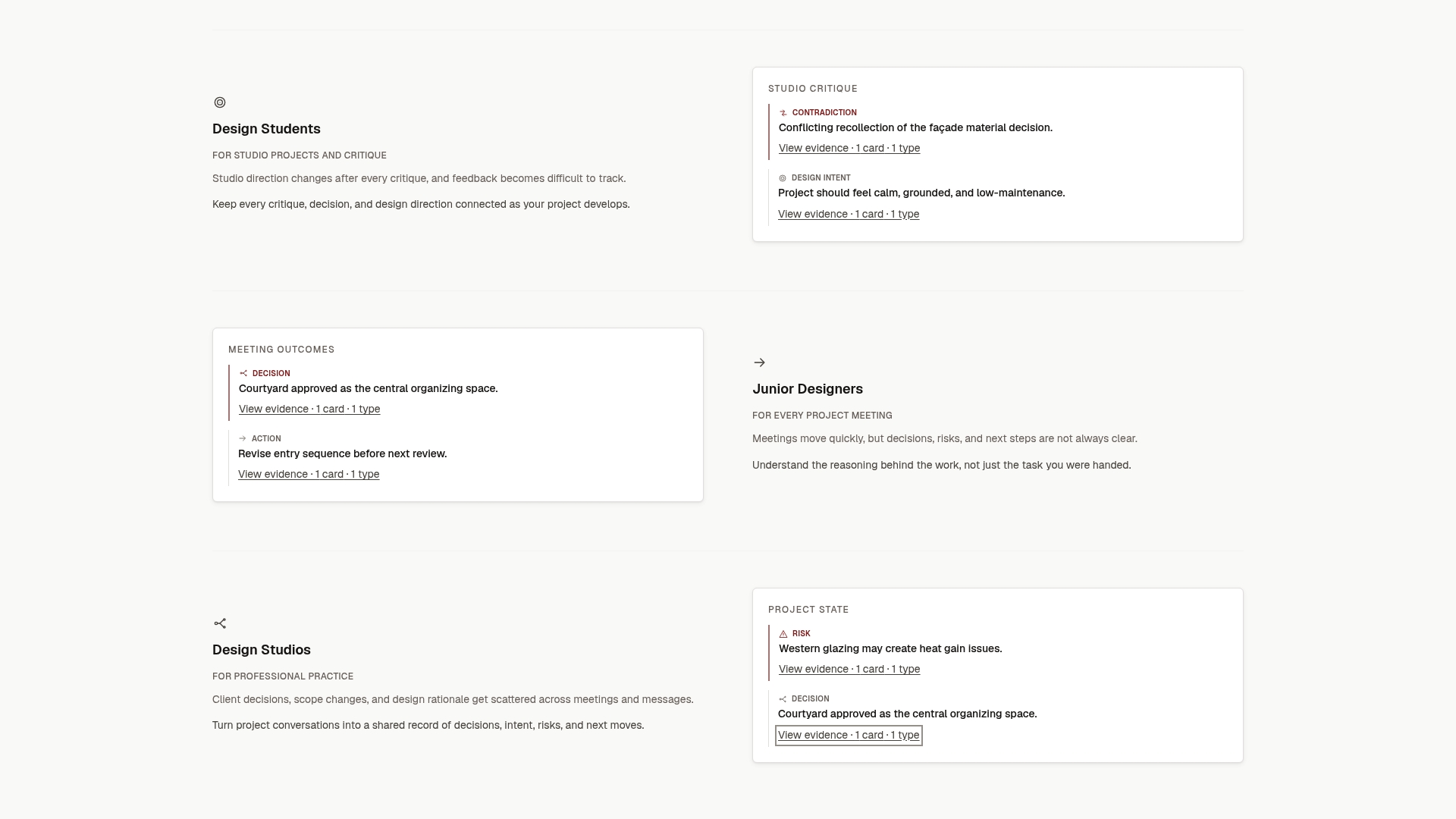
It supports architecture studios, design leads, junior designers, and project managers needing streamlined decision documentation and easy access to prior records. If you’ve ever watched a team rediscover a rejected idea the hard way, this is the fix. Every ILM Record captures the decision, the risks, and the open questions in one place, tied to the eight fields a decision record needs.
Start with the product overview to see how records get generated, then check the pricing page to find the plan that matches your team’s size.
Sources
- PROJECTMEM: A Local-First, Event-Sourced Memory and Judgment Layer for AI Coding Agents
- Project Memory in Design - Springer Nature
- Design documentation: What is it and why is it essential for product teams? | Overflow
FAQ
What Is Project Memory for a Design Team?
It’s a structured record of decisions, rationale, risks, and unresolved questions a team accumulates across a project, traceable back to the conversation or artifact that produced it.
How Do I Create a Project Memory System?
Start with one passive capture hook, meeting transcripts or file change logs, add a minimal record schema for significant decisions, and assign one person to verify and promote entries weekly.
What Is a Design Documentation Engineer or Similar Role?
There’s no standardized title, but the function, capturing and structuring decision rationale into durable records, is increasingly handled by a design lead or project manager using tools like Theintentledger rather than a dedicated hire.
Can Small Teams or Freelancers Use Project Memory Practices?
Yes. A single markdown file per project, updated after each client call, covers the basics; freelance architects and solo designers get the same traceability benefit without needing a full team workflow.
How Is Project Memory Different From Regular Meeting Notes?
Meeting notes capture what was said. Project memory captures what was decided, why, what alternatives were rejected, and links that decision back to its source for later retrieval.