Stakeholder Alignment Meetings: One Owner, One Decision Record
Stakeholder Alignment Meetings: One Owner, One Decision Record
A stakeholder alignment meeting must end with a named decision or explicit commitment, backed by a decision statement, an accountable owner, and next actions. Before anyone joins, you need published decision criteria, named decision rights, a prioritized attendee list, and a short agenda. Get those things right and the meeting becomes a working session instead of a debate.
TL;DR:
- Meet when teams cannot resolve shared tradeoffs alone; use one on ones for vetoes, briefings for settled decisions, and async review when options are clear.
- Before inviting attendees, publish the decision criteria and options, name one accountable decision owner, and separate required decision makers from consulted and informed stakeholders.
- Have everyone write ideas silently before discussion, and give remote attendees the first turn on each topic while reading chat questions aloud.
- Record the decision, rationale, rejected options, one owner, open risks, dated actions, and a review date, then publish it with links to source notes.
- Ask the accountable owner to confirm in writing, then have one person review open actions weekly and move unresolved risks into the project record.
Table of Contents
- What should a stakeholder alignment meeting achieve?
- How do you prepare: map stakeholders and set decision rights?
- How do you run the meeting?
- What should you capture and how do you publish it?
- How do you evaluate success and secure commitments?
- What does the research say about alignment meetings?
- A facilitator’s checklist and the traps to watch
- How does a project-memory tool support meeting outcomes?
- FAQ
- Sources
What should a stakeholder alignment meeting achieve?
The mission is shared understanding that supports a binding decision or an explicit commitment. If people leave feeling heard but nothing is decided, you held a discussion, not an alignment meeting.
Not every issue deserves one. A full meeting is warranted when several parties hold different views and the decision affects all of them. Lighter engagement is the better call in other cases:
- One-on-ones work when a single stakeholder holds a veto or a specific concern.
- Briefings work when the decision is already made and people only need to understand it.
- A full alignment meeting works when trade-offs cut across teams and no single person can settle them.
- An async review works when the options are clear and people can respond in writing.
Set your success test before you invite anyone: a decision that is stated aloud, accepted by the accountable owner, and logged with tracked actions. Hold that standard up afterward. If you can’t point to the record, the alignment may fade over time.
How do you prepare: map stakeholders and set decision rights?
Most alignment meetings fail before they start. People arrive unsure who decides, what the options are, or why they were invited. Fix that in advance.
- Build a quick stakeholder map. List everyone affected by the decision, then place each person on an interest and influence grid. A spreadsheet or a focused workshop is enough. Mapping guidance for project managers recommends using the grid to prioritize who gets your time and to update the plan at milestones.
- Sort people into roles. Must attend: those who decide or can block. Consulted: those with expertise or a stake. Informed: those who only need the outcome.
- Name one accountable owner per decision. PMI guidance separates who executes work from who owns a decision, and suggests defining decision rights with RACI or DACI before meetings. A RACI matrix walkthrough shows how to build a living matrix quickly.
- Circulate the pre-read. Send the decision criteria, the options on the table, and a timeboxed agenda in advance.
- State the question. One sentence: “By the end of this meeting, we will decide X.”
Pro Tip: Ask each must-attend stakeholder to reply with one concern before the meeting. You’ll learn which conflicts to plan for, and people arrive already invested.
Our post on client meeting documentation covers how preparation notes feed later records.
How do you run the meeting?
Treat the meeting as a sequence of timeboxed moves, each with a purpose. Assign roles up front: a chair who holds the goal, a timekeeper, a scribe who records the decision fields, and a tech moderator if anyone is remote.
Open with a check-in and framing. State the constraints, restate the decision question, and read the criteria aloud. Meeting design research from Chalmers found that mixing interpersonal exercises such as check-ins and tempo changes with digital tools helps multidisciplinary groups build shared understanding in limited time.
Then use these facilitation moves:
- Parallel contribution: everyone writes ideas silently first, so senior voices don’t anchor the room.
- Small-group breakouts: pairs or trios work through one option each, then report back.
- Clustering: group similar input on a shared board and name the themes.
- Rationale on every proposal: require a one-line “why” and a one-line evidence note.
- Paraphrasing: the chair restates comments so people feel understood. The CIPD evidence review links paraphrasing, encouraging participation, and ending with clear actions to better meetings.
For hybrid groups, set rules at the start: chat questions get read aloud, remote voices speak first on each topic, and the whiteboard is digital for everyone. Gatherilla’s hybrid engagement tips add activities that keep remote attendees involved.
To close, the chair verbalizes the decision statement, confirms the accountable owner, lists actions with dates, and sets a review date.
Pro Tip: Reserve time at the end for the close. Meetings that run out of time during discussion usually end with “let’s follow up,” which means no decision.
What should you capture and how do you publish it?
Alignment held only in memory erodes. Capture a minimal decision record while the room is still warm. These fields do the job:
- Decision statement: one or two sentences, in plain language.
- Rationale: why this option won, including the evidence cited.
- Options considered: what was rejected and why.
- Accountable owner: one named person.
- Date: when the decision was made and when it will be reviewed.
- Related risks and open questions: anything unresolved, so it isn’t forgotten.
- Action items: owner, task, and due date for each.
Our guide to the fields of a record of decision goes deeper on why each one earns its place, and the decision audit trail post shows how to preserve critique-driven decisions.
Choose a format your team will actually use:
- A short structured record per decision, linked to source notes or the transcript.
- A decision log entry for lightweight tracking.
- Meeting minutes that point to the record rather than replace it.
The scribe drafts the record in the meeting, and the chair reviews it promptly. Publish it where the whole team looks, store it with the project files, and link it to the original conversation so the reasoning stays traceable.
How do you evaluate success and secure commitments?
A decision isn’t real until the right people acknowledge it. PMI guidance notes that securing explicit commitment, such as sign-off on a project charter, prevents projects from stalling. Ask the accountable owner to confirm in writing, or publish the minutes and request acknowledgment from each action owner.
Then build a tracking rhythm:
- Name one person who monitors actions and reports status.
- Review open actions weekly until they close. PMI guidance on stakeholder management recommends joint action lists that include stakeholder-owned items, reviewed regularly.
- Move unresolved questions and risks into the project record, not a forgotten email thread.
Finish with a quick evaluation checklist:
- Did the meeting produce a clear decision?
- Is there a named owner and a timeline?
- Does the record show the rationale and evidence?
- Did every must-attend stakeholder acknowledge the outcome?
Several “no” answers mean the alignment is fragile. Follow up promptly, before people drift back to old positions.
What does the research say about alignment meetings?
The guidance above draws on findings from the sources cited below. PMI emphasizes stakeholder identification, engagement planning, and clear decision rights. The IFC stakeholder engagement handbook says engagement should scale to project impact, with complex projects treating it as a core function that has a plan, budget, and timeline, and that consultation activities and outcomes should be documented.
On facilitation, multiteam system research points out that chairs who fail to set goals and keep conversation on track push groups back toward individual influence, which makes consensus harder.
Competent chairpersons and facilitation are critical: when chairs fail to set goals and keep conversations on track, groups revert to individual influence and consensus becomes harder.
Leader behavior, goal clarity, and focused communication strongly correlate with perceived meeting effectiveness. In practice, that means the person running the meeting matters as much as the agenda, and a mix of digital tools and human facilitation suits multidisciplinary groups best.
A facilitator’s checklist and the traps to watch
Here is the checklist I keep next to me before any alignment meeting:
- Prep is done: map, roles, and pre-read sent.
- Decision rights are named, with one accountable owner.
- The agenda is timeboxed, with a protected closing slot.
- A record owner is assigned before we start.
- Off-topic questions go to a visible parking lot.
- Hybrid rules are stated at the start.
- The wrap-up verbalizes decision, owner, actions, and review date.
- The record is distributed promptly.
Three traps recur. Scope creep: name it, park it, return to the question. Role fights: pause and point to the decision rights document. Late surprises: ask for the concern in writing and decide whether it changes the criteria.
In one anonymized case, teams disputed a vendor choice for an extended period. A timeboxed session with written criteria and a named owner produced a signed decision in a focused meeting.
Pro Tip: If a stakeholder keeps reopening a settled point, point to the logged rationale and ask what new evidence has appeared.
, Rajas
How does a project-memory tool support meeting outcomes?
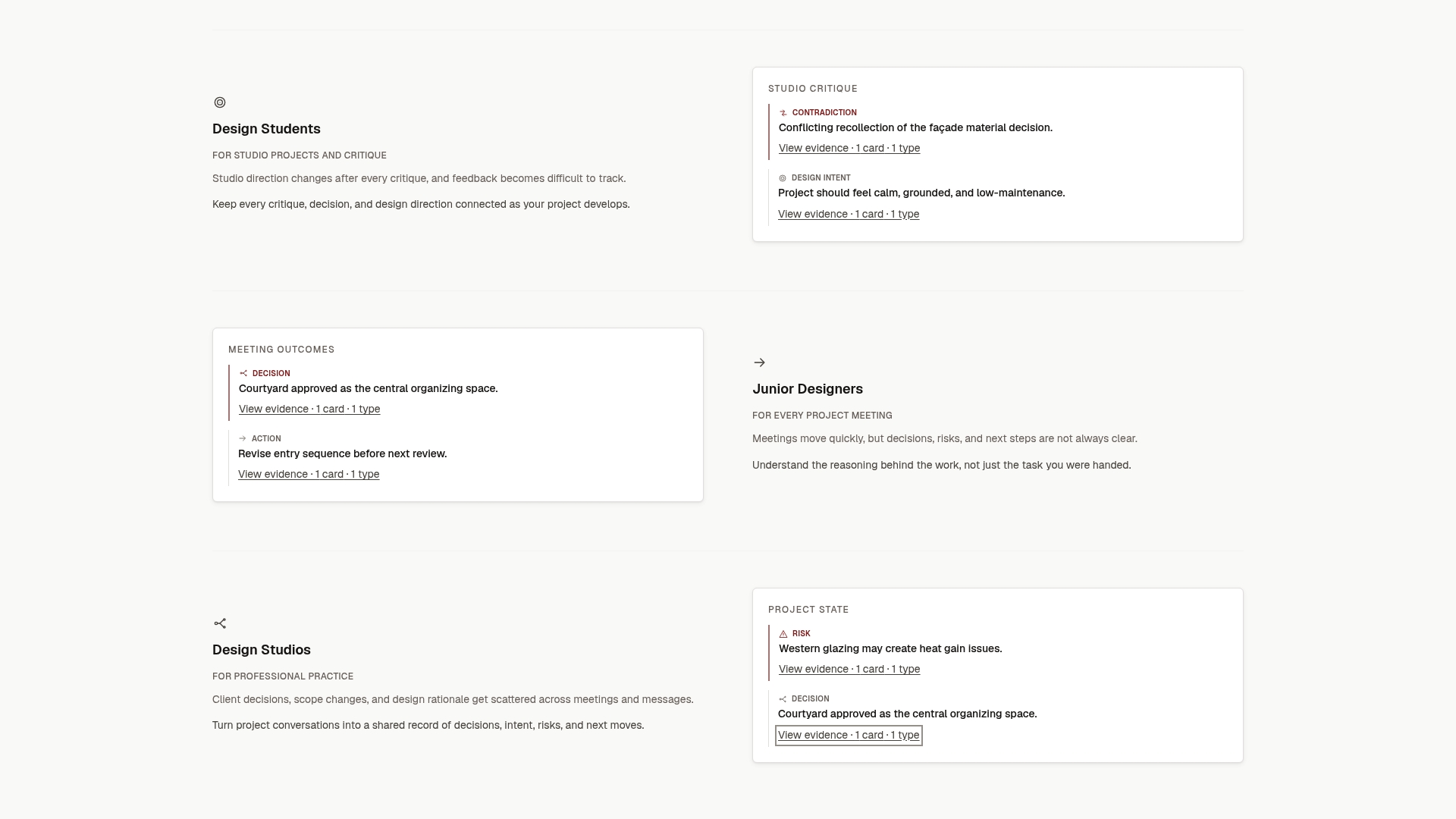
The decision-record fields above map directly to what we built into our ILM Records: decisions, rationale, actions, risks, and unresolved questions, each traceable to the conversation it came from. Our approach is built for design teams who need the why behind the work, not just the what.
A workflow that works well:
- Create the record right after the meeting, while details are fresh.
- Link it to your notes or transcript so every decision has a source.
- Use the record to drive weekly action tracking and later audits.
If you want a repeatable way to keep meeting outcomes from fading, explore The Intent Ledger and review our pricing options, including Working Memory at $29 per month. Start with your next alignment meeting.
FAQ
What is stakeholder alignment?
Stakeholder alignment means the people affected by a decision share the same understanding of the goal, the options, and who decides. It is reached when stakeholders can state the decision and their role in carrying it out.
What is the purpose of a stakeholder meeting?
Its purpose is to produce a decision or explicit commitment, not just share information. Good meetings clarify the question, surface concerns, and end with a named owner and actions, as the CIPD evidence review suggests by tying goal clarity and clear actions to effective meetings.
How should you handle conflicting stakeholder interests?
Surface the conflict early using pre-meeting concerns, then return to the published decision criteria. Parallel contribution and rationale requirements keep the discussion on evidence instead of hierarchy, and the accountable owner makes the final call.
How do you keep remote participants aligned?
Give remote voices the first turn on each topic, read chat questions aloud, and use a shared digital board so everyone sees the same thing. Assign a tech moderator so in-room conversation doesn’t drown out remote attendees.
Sources
- Stakeholder Management and RACI: Who Does What, and Who Answers for It
- StkhldrCvrSingle
- Meeting Design Supporting Sustainability in Early Planning Practice: A Combination of ‘Hard and Soft’ Characteristics
- Productive meetings: An evidence review: Scientific Summary