Convert Transcripts to Traceable ILM Records in 10 Minutes for Design Teams
Convert Transcripts to Traceable ILM Records in 10 Minutes for Design Teams

A transcript converted to meeting notes should become a concise ILM Record: a source-backed note that states the decision, the reasoning behind it, the alternatives you ruled out, and the exact place in the transcript it came from. Think of it as a lightweight cousin of the Architecture Decision Record, or ADR, adapted for design work instead of software architecture. It stays traceable and stays short on purpose.
TL;DR:
- Effective ILM Records should be created within a day of the meeting to capture decision rationale before it fades from memory.
- Records must focus on decisions made, excluding minor conversational chatter, and should link directly to source transcripts or clips.
- Each record requires clear ownership, a status of proposed, accepted, or superseded, and should never be overwritten once accepted.
- Store records in project-relevant folders as plain Markdown files with sequential numbering and link them to related tasks or models.
- Automating transcript conversion with specialized tools can save time and improve accuracy, especially for large or repeated decision documentation.
Table of Contents
- What Is an ILM Record and Why Does It Matter for Design Teams?
- Why Convert Meeting Transcripts Into ILM Records at All?
- How Do You Convert a Transcript Into an ILM Record?
- What Fields Belong in an ILM Record Template?
- Where Should You Store ILM Records So They Stay Useful?
- Who Owns an ILM Record, and When Can It Change?
- Start With One Record, Not a Backlog
- Convert Your Next Transcript Into a Record Automatically
- Sources
What Is an ILM Record and Why Does It Matter for Design Teams?
An ILM Record is a small, structured file that captures one design decision and the thinking behind it. It typically holds seven pieces: context, decision, alternatives considered, consequences, an owner, a date, and a link back to the transcript segment it came from.
Length matters more than most teams realize. Effective decision records run 200 to 500 words, roughly a single page. Longer than that, and nobody rereads them before the next meeting.
The risk of skipping this step is what practitioners call volatile memory: rationale that lives only in someone’s head and disappears the moment a team member changes roles or leaves the project. That gap is exactly where rework and repeated debates come from.
A working ILM Record includes:
- Context: the constraint or trigger that forced the decision
- Decision: the exact choice made, stated plainly
- Alternatives: what else was on the table and why it lost
- Consequences: trade-offs, risks, or downstream effects
- Owner and date: who is accountable and when it happened
- Transcript link: a timestamp or clip tying the record to its source
Why Convert Meeting Transcripts Into ILM Records at All?
Not every sentence in a transcript deserves a record. Capture one when a real decision or commitment gets made, not when the conversation is still circling an option. Retrofitting old meetings into a backlog of records is a losing project. It’s slow, and half the context is already gone.
Timing is the real lever here. Write the record within a day of the meeting, while the reasoning is still fresh and anyone can flag a risk before it hardens into a plan. Wait a month, and you’re reconstructing memory instead of recording it.
Automation helps with the mechanical parts. AI tools are genuinely good at search, retrieval, and summarization across a growing pile of transcripts, but the “why” behind a decision still has to come from a person who was in the room.
A design studio that skips this step doesn’t lose the decision. It loses the reason for it, which is the part every future disagreement actually needs.
- Capture immediately after the decision, not at project wrap-up
- Skip minor conversational back-and-forth; record outcomes, not chatter
- Let automated tools handle clipping and search, not judgment calls
How Do You Convert a Transcript Into an ILM Record?
The process takes ten minutes if you do it right after the meeting. Here’s the sequence design teams and studios tend to follow:
- Locate and clip the segment. Find the moment in the transcript where the decision actually got made, and grab the timestamp or a short audio clip. This becomes your source link.
- Draft the record in ADR-style fields. Fill in context, decision, alternatives, and consequences using the transcript’s own language where possible. Don’t paraphrase away the nuance.
- Run a short review. A second person, usually a lead or PM, checks the draft and moves its status from “proposed” to “accepted.” This catches misread context before it gets baked in.
- Store it and link it. Save the file as Markdown in your project repo, then link it to any related task, model file, or drawing set it affects.
Pro Tip: Draft the record before the meeting’s follow-up tasks get assigned. Once tasks exist without a linked rationale, teams tend to skip writing the record entirely because the “urgent” work already has a home.
This workflow works whether you’re documenting a material substitution on a renovation or a structural change flagged during a client review call.
What Fields Belong in an ILM Record Template?
A usable template has to be fillable in minutes, not a form nobody finishes. Here’s a minimal structure that covers what future reviewers actually need.
Keep the alternatives field honest. Documenting the options you rejected matters as much as the decision itself, because a team without that record tends to reopen the same debate three months later with no memory of why the first option was already killed.
- List two or three alternatives at most, with the actual reason each lost
- Link consequences to specific deliverables, not vague future risk
- Attach the transcript clip directly rather than describing it secondhand
Where Should You Store ILM Records So They Stay Useful?
Store records where your project files already live: version control or a project documentation repo, saved as lightweight Markdown rather than a locked format like a PDF or a slide deck. Markdown is plain text, which means it’s searchable, diffable, and survives tool changes better than anything proprietary.
Naming convention matters more than teams expect. Use a monotonic sequence, something like 0007-facade-material-change.md, so the order of decisions stays obvious without opening every file.
A workable layout:
- One folder per project, one subfolder for records (
/decisionsor/ilm-records) - Each file numbered sequentially, never renumbered later
- A short index file listing record titles and current status
Link each record to the task tracker item or model file it affects. That connection is what turns a static note into something you can actually use for impact analysis when a client asks why a wall moved six inches. Our connect notes to tasks guide covers the linking mechanics in more detail.
Who Owns an ILM Record, and When Can It Change?
Every record needs one owner and, ideally, one reviewer. The owner drafts and is accountable for accuracy; the reviewer signs off before status moves from proposed to accepted.
Lifecycle status is not optional decoration. Use three states: proposed, accepted, superseded. Once a record hits accepted, it never gets edited again. If the decision changes later, write a new record that supersedes the old one and links back to it. This preserves the full trail, including the wrong turns, which is often more useful than the final answer alone.
Minimalism is the discipline that keeps this sustainable. Record significant decisions only, the ones that would cause real cost or confusion if forgotten. Recording every small preference turns the practice into busywork nobody keeps up.
- Assign owner and reviewer at the moment the record is drafted, not later
- Never overwrite an accepted record; supersede it with a new one
- Reserve records for decisions with real downstream cost if forgotten
Pro Tip: If a record needs more than three sentences to explain the consequences, the decision was probably too big to have been made in one meeting. Split it into two records instead.
Start With One Record, Not a Backlog
The advice that actually works is embarrassingly simple: pick the next significant decision your team makes and write one record for it. Don’t try to backfill six months of meetings first. Teams that attempt that stall out before they build the habit, because starting with the next decision rather than retrofitting old ones is what makes the practice stick.
Connect that first record to a real task or deliverable immediately. Value only becomes visible when someone downstream notices a decision didn’t get lost. This approach focuses on capturing structured, source-backed ILM Records tied to the transcript they came from.
Junior designers and project managers tend to get the most out of this early on. They’re usually the ones fielding “wait, why did we choose this?” questions from clients or contractors months later, and a linked record answers that in seconds instead of a search through old email threads.
, Rajas
Convert Your Next Transcript Into a Record Automatically
Manually clipping timestamps and drafting ADR-style fields works, but it takes discipline most teams lose by week three. There are tools designed to close that gap: they turn a project conversation, transcript, or client comment into a structured ILM Record automatically, complete with a link back to the exact moment it came from.
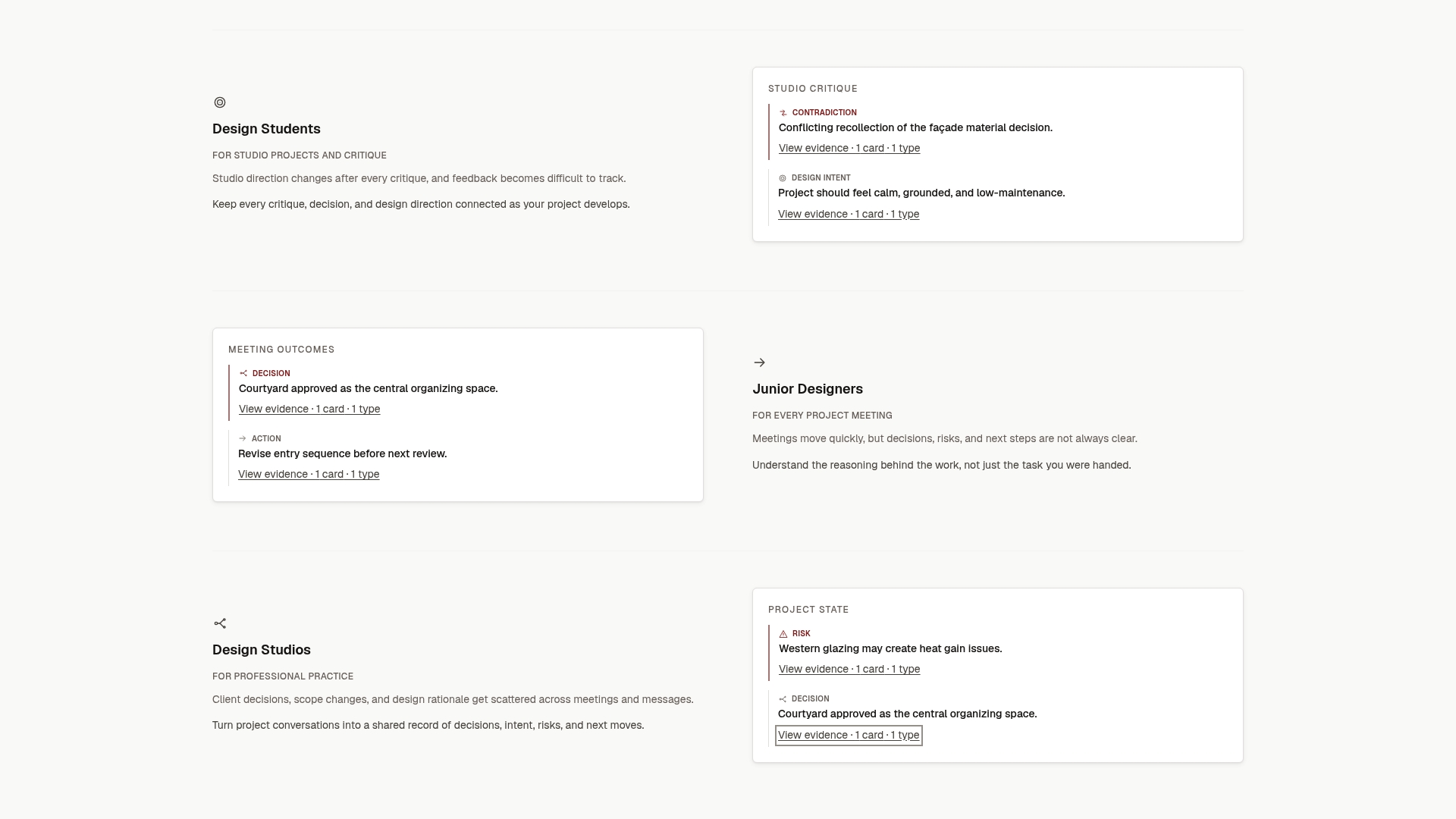
The core match to the workflow above is direct. The platform captures the decision, pulls the context and alternatives from the source conversation, and stores the result in a structured, retrievable format instead of a buried meeting note. If you’ve got a recent transcript sitting unreviewed, run it through during a trial and see what a finished record looks like next to one you’d write by hand. Check current plans and pricing or start directly at The Intent Ledger to set up your first project.
Sources
For teams building out their own record-keeping practice, a few resources go deeper than this article had room for. The AWS Prescriptive Guidance on ADRs covers status fields and repo-based versioning in more technical detail. For teams wanting to link records to design elements at scale, semantic traceability research explains how to connect decisions to models for impact analysis.
Internally, The Intent Ledger’s decision log template and record of decision field guide walk through the same fields covered here with additional worked examples. For teams comparing traceability approaches more broadly, this requirements traceability matrix guide is a useful outside reference on connecting decisions to downstream requirements.
- Architecture Decision Record