Convert Meeting Notes to Decision Logs in an Afternoon for Designers
Convert Meeting Notes to Decision Logs in an Afternoon for Designers
Meeting notes are the working record for near-term actions; decision logs are the searchable source of truth for choices and their rationale. If what happened in a meeting will shape future direction, affect other teams, or need to be justified later, it belongs in a decision log, not buried in a notes doc. Everything else can stay as meeting notes.
TL;DR:
- Only decisions with lasting impact, reversibility concerns, or future justification needs should be elevated into decision logs.
- Decision logs include comprehensive context, rejected alternatives, and are linked to original source conversations for transparency.
- Meeting notes are brief, focusing on immediate discussions and actions, and should be converted into decision logs promptly to avoid loss.
- A clear workflow involves assigning a responsible person to turn notes into decision logs right after meetings, including decision summaries and relevant links.
- Strong decision records require documenting rationale and reject options, not just the final choice, to support organizational learning and future reference.
Table of Contents
- Meeting notes vs decision logs: a side-by-side comparison
- What is a decision log? Core fields and a copyable example entry
- What are meeting notes? What to capture and formats that work
- When to use a decision log instead of meeting notes
- A repeatable workflow: convert meeting notes into a durable decision log
- Copyable templates: decision-log fields and a meeting-notes sample
- Best practices and common mistakes to avoid
- Why decision logs are durable project memory
- The Intent Ledger: built for teams that need to remember why
- FAQ
- Sources
Meeting notes vs decision logs: a side-by-side comparison
Meeting notes exist to capture what happened in a specific conversation: who said what, what got decided in brief, and who owes what by when. They serve the people in the room, and their shelf life is short. Decision logs exist to answer a different question months later: why did we choose this, what else did we consider, and who signed off? They serve anyone who joins the project after the fact.
The fields each document carries reflect those different jobs:
- Meeting notes: date, attendees, discussion highlights, brief decisions, action items with owners and due dates.
- Decision logs: decision summary, context and rationale, alternatives considered, decision maker, status, and links back to the source conversation.
Meeting notes are ephemeral. Teams skim them once, maybe reference them in the next standup, then let them fade into an archive nobody reopens. Decision logs are meant to be searched. A new hire, an auditor, or a teammate rejoining a stalled project should be able to find a decision log entry and understand the full context without pinging anyone.
The practical rule: a decision starts in meeting notes, but once it has lasting consequence, it gets elevated into its own decision log entry with the full picture attached.
What is a decision log? Core fields and a copyable example entry
A decision log is a standalone record built around one job: preserving why a choice was made, not just what was chosen. It tracks the alternatives that were rejected, who made the call, and where the reasoning came from, so the decision can be understood and defended long after the meeting that produced it is forgotten.
A decision log is a running record of significant choices with context, rejected alternatives, and the decision maker. It functions as organizational learning rather than ad-hoc meeting notes, according to practitioner guidance on decision logs. That distinction matters because chat threads and scattered notes rarely stay findable once a project moves past a certain size.
A usable entry typically includes:
- Decision summary: one sentence stating what was decided.
- Context and rationale: why this option won.
- Alternatives considered: what else was on the table and why it lost.
- Decision maker(s), date, and status (proposed, approved, reversed).
- Related artifacts or links: the transcript, ticket, or file the decision came from.
- Follow-up actions and tags for later search.
Documenting rejected alternatives and reasoning preserves organizational learning and helps future teams avoid repeating failed experiments, per research on documenting decisions.
Example entry: “Decision: Move client reviews to async Loom walkthroughs. Rationale: live review calls were missing two of five stakeholders weekly. Alternatives considered: biweekly calls (rejected, still exclusionary), written-only feedback (rejected, lost nuance). Decision maker: PM. Status: approved, March 2026. Linked source: client sync transcript, March 9.”
What are meeting notes? What to capture and formats that work
Meeting notes are the working record of a single conversation. They exist to move work forward immediately, not to serve as a historical archive. Minutes, by contrast, are formal and tied to governance: they follow a set structure, often record votes, and sometimes require approval. Notes focus on what was discussed and the immediate next steps, while minutes may require sign-off and a record of motions, according to guidance on taking meeting notes.
What belongs in good meeting notes:
- Discussion highlights: the key points raised, condensed to a few lines.
- Decisions made, stated briefly, with a pointer to a fuller entry if one is warranted.
- Action items, each with a named owner and a due date.
- Open questions or risks surfaced but not yet resolved.
A standup’s notes might be three bullet points. A weekly sync might run half a page. Board minutes, by comparison, follow a fixed template because they carry legal and governance weight that ordinary project notes don’t need.
Notes are enough when a decision is small, reversible, and affects only the people in the room. They need escalation into a decision log entry once the choice affects other teams, is hard to reverse, or someone is likely to ask “why did we do this?” later in the project.
When to use a decision log instead of meeting notes
Not every choice deserves its own entry. Use these heuristics before you decide:
- Impact: if the decision shapes project direction, budget, or scope, log it.
- Reversibility: if undoing the choice would be costly or slow, log it.
- Traceability need: if a stakeholder, client, or auditor might ask for justification later, log it.
- Decision style: decisions made unilaterally (S1) often still need a log entry for transparency; decisions requiring team buy-in (S3 or S4) almost always do.
Decision-making styles range from an individual call (S1) to full delegation (S4), and the style chosen depends on criticality, the need for buy-in, and how much information is available, per guidance on decision-making for project managers. The more collaborative the style, the more documentation stakeholders tend to expect.
A client’s choice to switch primary contacts belongs in a decision log. A debate over which font variant to test this sprint usually doesn’t.
A repeatable workflow: convert meeting notes into a durable decision log
Most decisions get lost not because nobody noticed them, but because nobody converted them into something searchable, demonstrating the key advantages highlighted in the benefits of workflow automation for professional services. Here’s a workflow that works inside a single afternoon:
- Time it right. Convert notable decisions right after the meeting, or run a short daily or weekly “distill” pass if real-time conversion isn’t realistic.
- Assign the roles. One person converts the raw note into a log entry; a second person, often the decision maker, verifies the rationale and alternatives are accurate.
- Fill the minimal fields. Pull the decision summary and owner straight from the notes; if rationale or alternatives are missing, ask the decision maker directly rather than guessing.
- Make it findable. Link the entry back to the source transcript or notes doc, tag the stakeholders involved, and use a consistent ID scheme across the project.
Workflows that include a short distill step after meetings tend to produce stronger decision records and reduce rework later, according to a knowledge management report. Automating parts of this capture removes most of the manual retyping.
Pro Tip: End every meeting with one question: “What decision did we make, and are we logging it?” That single habit catches most decisions that would otherwise slip through.
Copyable templates: decision-log fields and a meeting-notes sample
Multiple frameworks exist for documenting decisions, covering detail, relationships between decisions, chronology, and stakeholder involvement, rather than a single universal template, according to a documentation framework for architecture decisions. For most project and design teams, a compact template covers the daily need, with deeper viewpoints added only for complex, multi-stakeholder calls.
A compact decision-log template worth pasting into your tool:
- Decision ID, title, date, status
- Decision summary (one sentence)
- Context and rationale
- Alternatives considered
- Decision maker(s) and stakeholders consulted
- Related links (transcript, ticket, file)
- Follow-up actions and owner
- Tags for search
A meeting-notes sample that supports this: “Attendees: PM, lead designer, client. Discussion: reviewed homepage draft, client flagged navigation clarity. Decision: swap to a horizontal nav, revisit if bounce rate rises. Action: designer updates mockup by Friday. Open question: mobile nav pattern still unresolved.”
Best practices and common mistakes to avoid
Strong decision logging is a habit, not a one-off cleanup task. Teams that keep it alive tend to:
- Build the habit of logging at the end of every meeting, not weeks later.
- Link each entry to its source conversation or transcript.
- Assign a clear owner to every logged decision.
- Review the log during onboarding and retrospectives, not just when something breaks.
The most common failure is logging the decision without the rationale: a one-line “decided on vendor B” with no record of why vendor A lost. The second most common is letting decisions live only in chat, where searchability and links to source context are essential, and chat alone falls short, per guidance on decision logs.
A weak entry: “Switched tools.” A strong one: “Switched to Tool X over Tool Y because Y lacked API access; decided by PM on March 4, confirmed with client.”
Pro Tip: If an entry doesn’t name what was rejected, it’s a status update, not a decision log entry.
Why decision logs are durable project memory
I’ve watched new team members spend their first two weeks reconstructing decisions that were never written down, asking the same questions three different people already answered months earlier. Tracing a decision back to the conversation that produced it shortens that ramp-up and surfaces risks while they’re still cheap to fix, not after they’ve calcified into “how we’ve always done it.”
— Rajas
The Intent Ledger: built for teams that need to remember why
When templates stop scaling, when decisions span dozens of conversations across transcripts, critique feedback, and client comments, we built The Intent Ledger to turn that raw material into structured, source-backed records automatically.
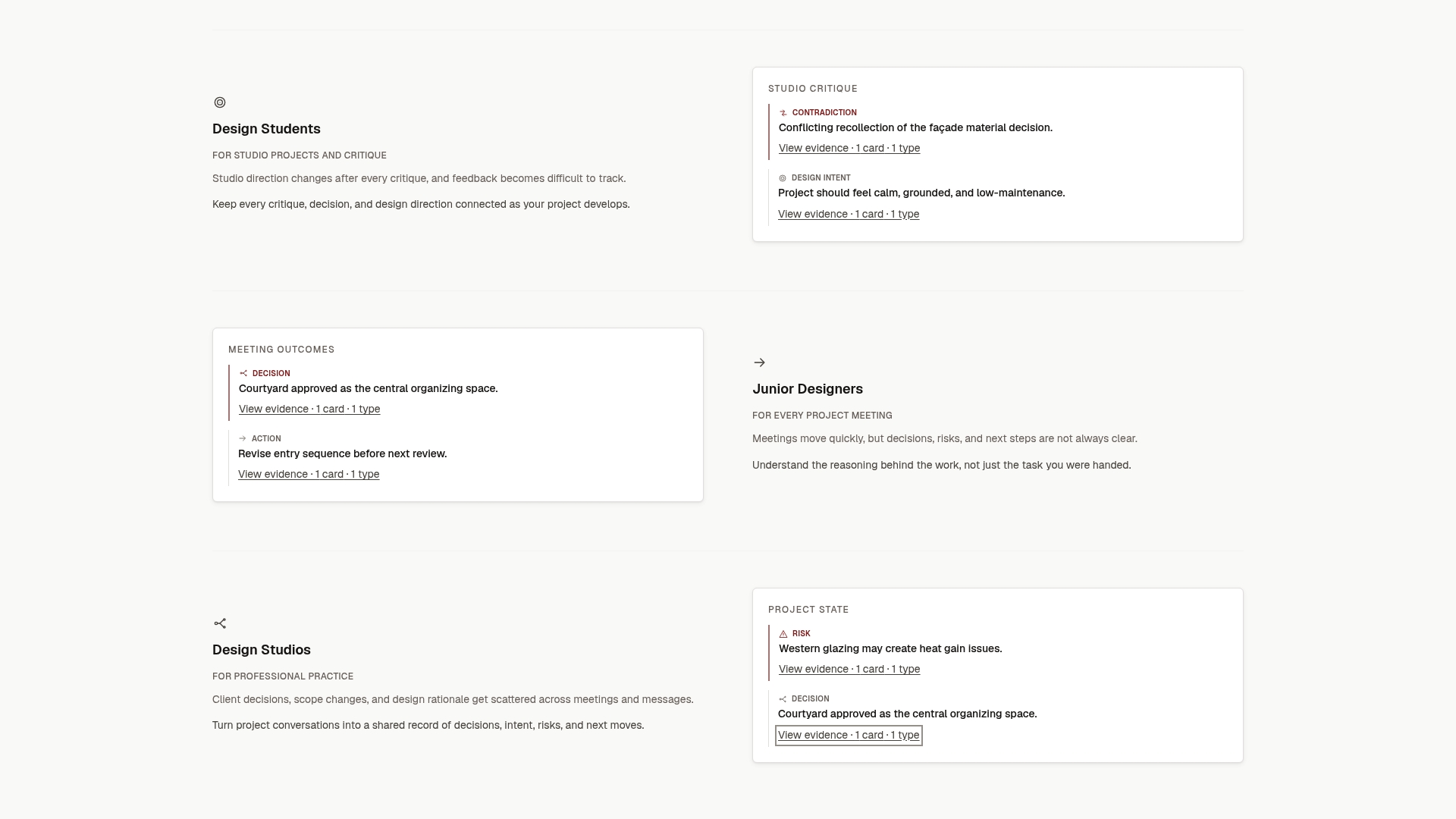
- We connect each decision directly to the original conversation it came from.
- We help design teams reduce lost context and surface risks earlier than a notes doc allows.
Our pricing offers multiple plans suitable for different team sizes and needs; current prices are on the pricing page. See current pricing to find the right fit for your team.
FAQ
What is an example of a decision?
A project decision is any choice that changes direction or commits resources, such as picking a vendor, changing a design pattern, or approving a budget shift. The example entry in this article, switching client reviews to async video walkthroughs, shows how a small operational choice still warrants a full rationale.
Is it meeting notes or meeting minutes?
They’re related but distinct: meeting notes are informal and prioritize speed and immediate action, while minutes follow a formal structure and often require approval for governance or legal purposes, according to guidance on meeting notes. Most project teams need notes; boards and regulated bodies typically need minutes.
Can you provide an example of a decision log?
A simple entry includes a decision summary, the rationale behind it, alternatives considered, the decision maker, a date, a status, and a link to the source conversation. The template and sample entry in this article follow that structure and can be copied directly into a shared doc or tool.
What are the 7 types of decision-making?
There’s no single fixed list of seven decision types; frameworks vary across disciplines. One widely referenced model describes decision styles from individual calls (S1) to full delegation (S4), with the style chosen based on criticality, buy-in needs, and available information, per guidance on project decision-making.
Sources
- Decision Making for Project Managers: When to Involve Others
- Documenting decisions to build buy-in
- A documentation framework for architecture decisions
- Decision Logs: The Lowest-Effort Documentation That Pays Off