Decision Traceability: Six AI Audit Steps for Design Teams
Decision Traceability: Six AI Audit Steps for Design Teams
Decision traceability is a structured, timestamped record that links inputs, rationale, actions, and outcomes so an organization can reconstruct who decided what, why, when, and with what data. It turns scattered meeting notes and ad hoc approvals into evidence that holds up in an audit, an investigation, or a regulatory review. Done well, it shortens root-cause analysis and gives governance teams a defensible paper trail instead of a reconstructed story.
TL;DR:
- A usable trace needs an actor, timestamp, inputs, policy and model versions, rationale, action, outcome, and source links; missing fields leave investigators guessing.
- EU AI Act rules require high risk AI logs to record use times, databases checked, matched inputs, verifier identities, and retain records for at least six months.
- Centralized logs are easy to query but easier to alter; append only event stores preserve history, while signed lineage resists tampering but requires more engineering.
- Begin with actor, timestamp, decision, and rationale, then add provenance, signatures, and access controls; automate capture and test a recent decision in an audit drill.
Table of Contents
- Anatomy of a Decision Trace: The Fields and Records You Need
- Blueprint: An End-to-End Decision-Trace Flow for Production Systems
- Data Provenance, Model Lineage, and Legally Relevant Logging
- Architecture Patterns and Telemetry: How to Capture Trace Data Reliably
- Governance, Standards, and Audit Readiness: Mapping Traceability to ISO and NIST
- Practical Checklist and Prioritized Steps for Teams
- How We Approach Decision Traceability at The Intent Ledger
- Why Traceability Fails to Stick in Design and Innovation Teams
- Build Audit-Ready Decision Traces With The Intent Ledger
- FAQ
- Sources
Anatomy of a Decision Trace: The Fields and Records You Need
A decision trace is only useful if it can answer the five questions an auditor or investigator will always ask: who acted, on what information, under what rule, with what result, and when. That means the record has to carry specific fields, not a narrative summary written after the fact.
A workable decision trace includes:
- Record ID and timestamp: a unique identifier and exact date/time so the event can be located and sequenced against other activity.
- Actor identity: the person, role, or system account responsible for the decision or action.
- Inputs and context: the data, prompt, or request that triggered the decision, including version references.
- Model or policy version: which system, ruleset, or model build was in effect at the time.
- Policy checks performed: which compliance or business rules were evaluated and their results.
- Rationale and assumptions: the stated reasoning, constraints, or tradeoffs behind the choice.
- Decision and action taken: the concrete output or step executed as a result.
- Downstream outcome: what happened afterward, including any correction or escalation.
- Links to source material: the transcript, document, or conversation the decision traces back to.
Each field maps to a common audit question. “Who approved this and when?” needs actor identity and timestamp. “What data justified the call?” needs inputs and provenance links. “Did anyone check this against policy?” needs the policy-check field. In practice, these fields show up across three record types: event logs (system-generated, high-volume), signed lineage entries (cryptographically tied to a specific model or data version), and human verification records (a reviewer’s sign-off tied to a specific action). A record missing even one of these fields creates a gap an investigator has to fill by guesswork, which is exactly what traceability is supposed to prevent.
Blueprint: An End-to-End Decision-Trace Flow for Production Systems
A decision trace is only as strong as the weakest link in the pipeline that produces it, so the flow needs to be designed stage by stage rather than bolted on at the end.
- Ingest and retrieval: capture the incoming request plus any retrieved documents or context, with source references preserved.
- Policy and identity check: verify the actor’s permissions and run applicable compliance rules, logging the result of each check.
- Decision engine: generate the recommendation or action, recording the model version and the rationale behind the output.
- Action orchestration: execute the decision, whether that’s a system change, an approval, or a design choice, and timestamp the execution.
- Logging and signed lineage: write an immutable, signed record linking steps one through four together as a single traceable unit.
- Monitoring and post-market review: periodically sample the logged decisions against outcomes to catch drift, errors, or policy gaps.
Each step has to emit something durable: ingest emits a provenance reference, the policy check emits a pass/fail result with the rule version, the decision engine emits rationale text, orchestration emits an execution timestamp, and logging emits the signed record that ties it all together. Picture it as a relay where each runner hands off a baton stamped with their leg of the race. If one leg skips the stamp, the whole trace becomes unverifiable, even if the other four legs were recorded perfectly.
Data Provenance, Model Lineage, and Legally Relevant Logging
Content provenance and decision provenance solve different problems: content provenance tells you where a piece of data came from, while decision provenance tells you which data, policies, and actors combined to produce an outcome. Both matter, but regulators tend to focus on the latter because that’s what explains accountability.
For AI systems, lineage records should capture:
- Dataset identifiers and versions: which training or reference data was active at decision time.
- Model signatures: cryptographic or version markers tying an output to a specific model build.
- Retrieval references: the specific documents or records a system pulled from to generate its answer.
- Verifier identities: who, if anyone, reviewed or approved the output before it took effect.
For high-risk AI systems under the EU AI Act, logs must capture the start and end time of each use, the reference databases checked, the specific input data matched, and the identities of the people involved in verification, retained for at least six months or longer where other laws require it. This is a concrete floor, not a suggestion, and it’s a useful benchmark even for teams outside AI Act jurisdiction who want a defensible retention baseline.
The NIST AI Risk Management Framework reinforces this by recommending that organizations document the origin and history of training and generated data, treating provenance as a core input to risk management rather than an afterthought. When an outcome goes wrong, provenance records are what let a team trace the failure back to a specific dataset version, retrieval source, or model build instead of guessing.
Architecture Patterns and Telemetry: How to Capture Trace Data Reliably
Three architecture patterns dominate decision-trace implementations, and each trades off differently on cost, searchability, and tamper resistance. A centralized log is the simplest to build and query but is easiest to alter after the fact if access controls are weak. An event store built on an append-only model preserves history by design and scales well for high-volume systems. A signed-lineage ledger, where each record carries a cryptographic signature tied to the data and model version active at the time, gives the strongest tamper-evidence but adds engineering overhead.
Whichever pattern you choose, a few practices hold constant:
- Use consistent, synchronized timestamps across every system component to keep sequences reconstructable.
- Sign or hash records at write time so later tampering is detectable.
- Index on actor, date, and record type so audits can filter quickly instead of scanning raw logs.
- Encrypt data at rest and restrict access by role, since decision traces often contain sensitive business or personal data.
Volume and privacy are the two operational headaches that surface fastest. High-frequency systems generate enormous log volumes, so teams need retention tiers (hot storage for recent records, cold storage for compliance-only retention) rather than keeping everything in one place indefinitely. Integration with existing MLOps pipelines, observability stacks, and SIEM tools matters too: a decision trace that lives in isolation from your monitoring systems is harder to correlate with incidents when something breaks.
Pro Tip: Store the signature and the record in separate systems so a compromise of one doesn’t let an attacker rewrite both.
Governance, Standards, and Audit Readiness: Mapping Traceability to ISO and NIST
Auditors rarely accept a policy document on its own. They sample live system records and ask for proof that a specific control was enforced on a specific system on a specific date, which means traceability has to produce contemporaneous evidence, not a reconstruction built after the fact.
ISO/IEC 42001 structures this expectation around a Plan-Do-Check-Act cycle, and it explicitly treats audit-ready AI tender analysis and transparent record-keeping as core benefits of an AI management system rather than optional extras. The “Check” phase in particular depends on being able to pull historical decision records and compare them against stated policy.
The NIST AI RMF organizes the same expectation differently, through its MAP, MEASURE, and MANAGE functions: MAP requires documenting the context and data a system operates on, MEASURE requires evidence that risks were actually evaluated, and MANAGE requires a record of how identified risks were addressed over time. All three depend on traceable artifacts existing before the audit starts, not being assembled for it.
To prepare for an external review, teams typically need to show:
- Logs tied to specific actions and dates, not summarized after the fact.
- Evidence that policies were enforced, not just documented.
- A mapped record set showing which ISO or NIST control each trace field supports.
Practical Checklist and Prioritized Steps for Teams
Start small and build outward rather than trying to capture everything at once.
- Capture the minimum viable trace first: actor, timestamp, decision, and rationale, even if provenance and signing come later.
- Add provenance and lineage next: link decisions back to the data or conversation that produced them.
- Introduce signed lineage and access controls: protect records from silent alteration and limit who can view sensitive entries.
- Set a retention policy: align with recognized minimums and document the schedule.
- Automate logging where possible: manual note-taking after a meeting is the most common point of failure.
- Run periodic audit drills: pull a sample trace and see if a stranger could reconstruct the decision from it alone.
The most common pitfall is chasing detail at the expense of speed, building an elaborate schema nobody actually fills in during a live meeting. A thinner trace that’s consistently captured beats a comprehensive one that’s abandoned after two weeks.
Pro Tip: Run your first audit drill on a decision from last month, not a hypothetical one. You’ll find the gaps immediately.
How We Approach Decision Traceability at The Intent Ledger
We built our product around a six-field decision audit trail that mirrors the anatomy described above: source conversation, decision, rationale, risk, action, and open question. Every ILM Record we generate pulls directly from the meeting notes, transcripts, or critique feedback it came from, so the “why” behind a decision stays attached to the conversation that produced it instead of living in someone’s memory.
This matters for design and architecture teams specifically, where decisions evolve across dozens of critique sessions and client calls:
- Each record traces back to its source, so a reviewer can verify a decision instead of trusting a secondhand summary.
- Risks and open questions surface structurally, not buried in a document nobody rereads.
- Teams build a living project memory, documented in our decision audit trail approach and our research on traceable design feedback.
Design teams, junior designers, and freelance architects can adopt the same pattern without custom engineering: capture the conversation, structure the six fields, and link every decision back to its source.
Why Traceability Fails to Stick in Design and Innovation Teams
The biggest obstacle I’ve seen isn’t technical, it’s cultural: teams default to meeting notes because they’re fast, while structured records feel like extra work until the first audit or client dispute proves otherwise. The fix is attaching traceability to rituals that already exist, like design reviews and client signoffs, rather than asking for a separate documentation step.
For governance leads trying to prove ROI, the strongest argument isn’t compliance risk, it’s the hours saved reconstructing decisions when a client asks “why did we choose this” six months later.
, Rajas
Build Audit-Ready Decision Traces With The Intent Ledger
We turn your project conversations, transcripts, and critique feedback into structured ILM Records, source-backed, traceable decision trails your team can hand to an auditor or a client without reconstruction work.
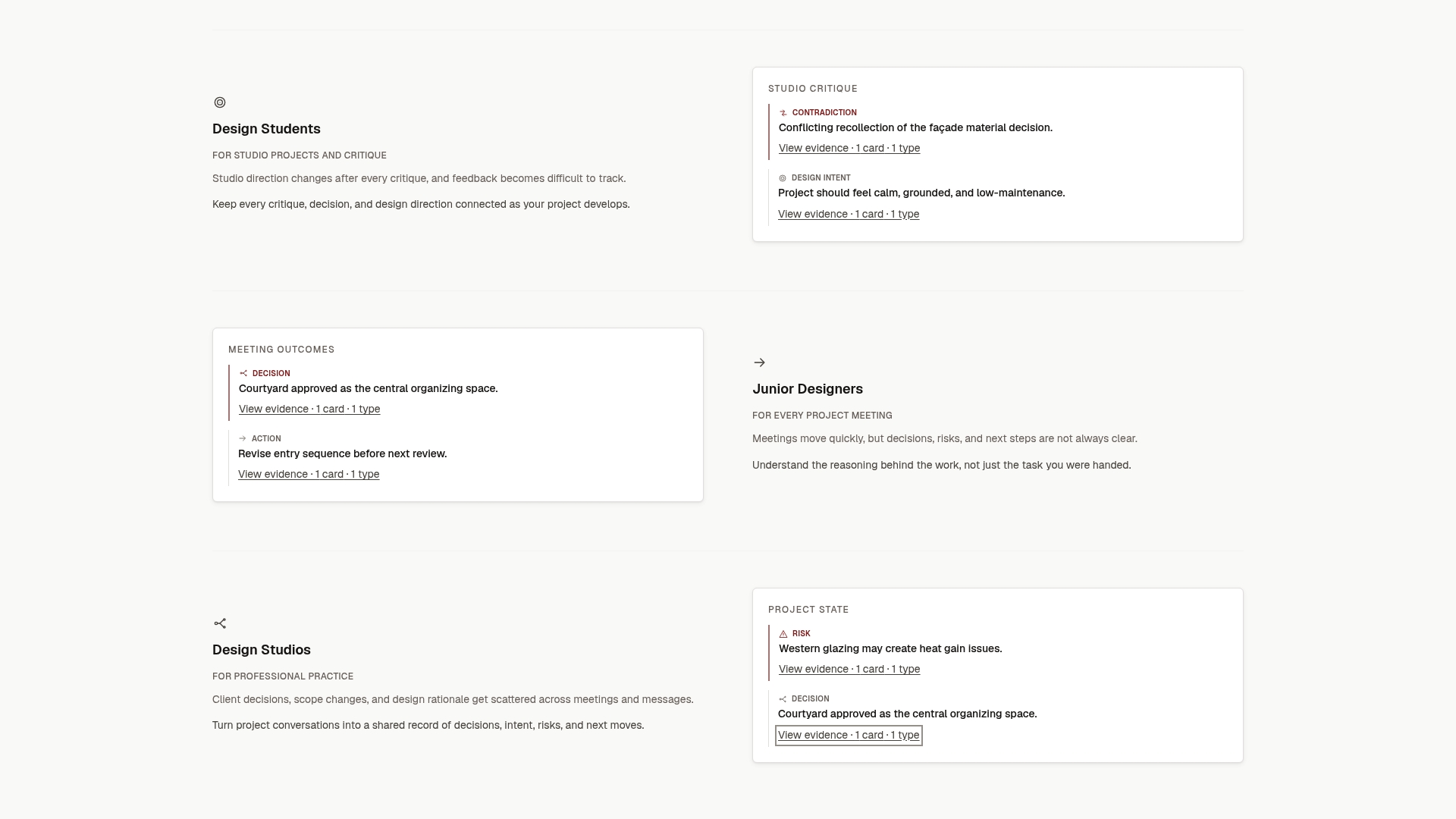
If you want to see how a six-field trace looks against your own project notes, check our pricing page for plans starting with Working Memory, or start exploring the full product.
FAQ
Does ISO 9001 require traceability?
ISO/IEC 42001, the AI-specific management standard, treats traceability as a core element of demonstrating that AI governance policies were actually enforced, as described in ISO/IEC 42001.
What does “traceability” mean?
Traceability means being able to follow an item, decision, or output back to its origin, including the data, actors, and rules involved in producing it. In AI and decision governance contexts, it specifically means reconstructing who decided what, when, and based on which inputs.
What attributes are important for traceability?
The core attributes are a unique identifier, a timestamp, actor identity, the inputs or context used, the rationale behind the decision, and a link to the source record. Standards like ISO/IEC 42001 and the NIST AI RMF both treat provenance and documented rationale as essential attributes.
What does product traceability mean?
Product traceability means tracking a product or component through its lifecycle, typically to identify its origin, components, and any changes made along the way. In software and AI systems, the equivalent is tracing a decision or output back to the data, model version, and policy checks that produced it.
Sources
- Article 12: Record-Keeping | AI Act Service Desk
- Artificial Intelligence Risk Management Framework (AI RMF 1.0)
- ISO/IEC 42001, AI management systems (ISO)