Cut Rework With Traceable Design Feedback in 90 Days, Research Backed
Cut Rework With Traceable Design Feedback in 90 Days, Research Backed
Traceable design feedback is a short structured record that links a comment, critique, or decision to the artifact and conversation it came from, along with who made the call and why. The main payoff is continuity: fewer repeated debates, faster onboarding, and decisions you can audit months later instead of reconstructing from memory. Start now by writing one short record for your next critique session: who spoke, what they decided, and why.
TL;DR:
- Linking feedback to specific artifacts and decisions with related decision IDs creates a decision graph, enabling full traceability of evolving design choices.
- Minimal fields such as actor, timestamp, artifact link, rationale, and disposition ensure clarity and ease of use, with optional fields added gradually.
- Recording decision rationales in real time during critiques or handoffs prevents memory bias and maintains accurate context for future review.
- Integrating structured feedback into existing workflows—assigning scribes, setting response windows, and establishing review gates—maximizes adoption without slowing teams down.
- Using tools like session recordings, artifact links, and LLM-assisted summarization helps preserve decision history effectively while safeguarding against attribution errors.
Table of Contents
- Why Traceability Matters for Design Teams
- Core Elements of a Traceable Feedback Record
- Methods to Collect Feedback Without Slowing Your Team Down
- Tooling and Integration Patterns for Traceable Feedback
- Research and Field Evidence Behind Traceable Documentation
- A Step-by-Step Rollout Plan for the First 90 Days
- Where Traceable Feedback Shows Up in Real Projects
- Three Mindset Shifts That Make Traceability Stick
- How The Intent Ledger Fits Into This Workflow
- FAQ
- Sources
Why Traceability Matters for Design Teams
Most design teams lose context constantly. A decision gets made in a Slack thread, a Figma comment, or a hallway conversation, and three weeks later nobody remembers why the button moved or why the client rejected an option. That gap is not a people problem. It is a recording problem.
Classroom and studio research backs this up. Reflective documentation tools used in design courses showed that when discussion gets centralized and project history stays visible, students revisit and reuse earlier work instead of starting from scratch. In one deployment, students using such a tool documented over 3,800 artifacts and left more than 1,000 pieces of feedback, and that volume of linked material became the raw material for final portfolios rather than a pile of disconnected notes.
The same logic holds outside the classroom. When design reviews lack structure, teams fall into fragmented exchanges where feedback floats free of the artifact it describes. Research on collaboration systems for design reviews found that observable affordances, shared spatial presence, in-scene indication, and the ability to navigate independently while still following a presenter, turn sessions into accountable checkpoints instead of scattered chatter.
Reflective documentation tools used in a UI design course logged thousands of artifacts and feedback items, and the deployment data shows that visible project history supported opportunistic reflection rather than forced review.
What teams can expect once feedback becomes traceable:
- Fewer rework cycles because the rationale behind a prior decision is one click away, not a guessing game.
- Faster onboarding for new team members who can read why a decision was made instead of asking around.
- A real audit trail for client-facing or compliance-sensitive projects where someone eventually asks “who approved this?”
None of this requires a complex system. It requires a habit of writing down the “why” at the moment the decision happens, not after the fact.
Core Elements of a Traceable Feedback Record
A feedback record only works if it answers a short set of questions every time, the same way, so anyone on the team can scan it and understand what happened without reading the whole conversation it came from.
The minimal fields every entry needs:
- Actor: who raised the feedback or made the call.
- Timestamp: when it happened, tied to the session or thread.
- Artifact link: a direct pointer to the frame, commit, or document in question.
- Context excerpt: a short quote or paraphrase of the triggering comment.
- Rationale: the reason behind the decision, not just the outcome.
- Disposition: accepted, rejected, deferred, or needs follow-up.
- Related decision ID: a link to the prior decision this one builds on or overturns.
That last field is the one most teams skip, and it is the one that matters most. Without it, you get a flat chronological log: useful for scrolling back through, useless for understanding how a decision evolved. Decision-provenance models solve this by treating each entry as a node in a graph rather than a line in a list. The TRACE framework records actor, disposition, rationale, and suggestion type for each decision, with an optional link to the event it revises, which lets a team reconstruct the full path a decision took rather than just its final state.
A directed acyclic graph, or DAG, of decisions beats a flat log for one simple reason: design decisions rarely happen once. A layout gets approved, then revisited after client feedback, then adjusted again after a technical constraint surfaces. If each of those moments is its own-isolated note, you lose the thread connecting them. If each one links back to the decision it revises, you can trace the whole arc in seconds. Our Record of Decision guide walks through these eight fields in more detail for teams building their own template.
Optional fields worth adding once the basics are working:
- Severity: how much this decision affects scope, budget, or timeline.
- Remediation: the fix or follow-up action tied to the feedback.
- Linked standard citation: a reference to a brand guideline, accessibility standard, or style rule.
- Audio or recording link: the original clip, when a session was recorded.
Pro Tip: Keep the required fields to seven or fewer. Every extra mandatory field is a reason why someone skips writing the record at all.
Methods to Collect Feedback Without Slowing Your Team Down
Capturing traceable feedback has to fit inside the workflow you already run, not add a second job on top of it. The method changes depending on whether feedback happens live, async, or at a handoff.
- Assign a scribe role for every critique session. One person’s job is to write the short decision record while others talk, not to also design or lead the critique.
- Apply the “resolve versus record” rule. If a question gets answered in the room, write a one-line decision receipt. If it stays open, flag it explicitly as unresolved so it does not quietly disappear.
- Write the receipt in one paragraph, not a form. Name who proposed the change, link the artifact, state the rationale in a sentence, and note the disposition. This matches the pattern researchers found most effective: a compact record, small enough to not slow the room down, complete enough to be useful weeks later.
- Use structured templates for async reviews that require a rationale field before a comment can be marked resolved. A comment that just says “change this” without a reason is the single biggest source of lost context in async workflows.
- Set a response window for async comments, typically 48 hours, so unresolved items do not pile up silently until a deadline forces a rushed decision.
- Add a human review gate at every design-to-engineering handoff. DesignRail’s approach requires a written rationale for every rejected mapping between a design file and the resulting code, plus a field-level diff showing exactly what changed, which keeps the handoff auditable instead of a black box.
- Record acceptance explicitly, not implicitly. A developer who silently implements a design change without confirming they read the rationale is a gap waiting to surface later.
The common thread across all three contexts is the same: write less, but write it at the moment of decision. A rationale captured in real time is accurate. A rationale reconstructed two weeks later is usually a guess dressed up as a memory.
Tooling and Integration Patterns for Traceable Feedback
Once the schema is set, the question becomes where it lives and how it connects to your actual design files. A few architectures show up repeatedly across teams that have made this stick.
- Session recording with a timeline UI. A recorded critique session paired with a scrollable timeline lets anyone jump to the exact moment a decision happened, rather than skimming a transcript.
- Artifact linking. Direct links from a feedback record to a specific canvas frame, Figma page, or code commit remove the ambiguity of “which version were they talking about?”
- Export formats that travel. JSON for tooling integrations, Markdown for human-readable archives, and PROV-style formats for teams that need formal provenance tracking in regulated industries.
- LLM-assisted conversion of dialogue into structured records. Prototypes have shown that synchronizing spoken dialogue with object interactions, for example in a 3D modeling tool, and layering semantic annotation on top with a language model, lets teams later query and replay the reasoning behind a design choice rather than just the final state, as demonstrated in IntraNote’s prototype.
LLM-generated annotations save time but introduce a real risk: incorrect attribution. A model summarizing a meeting can misassign a rationale to the wrong speaker or flatten a disagreement into a false consensus. The safeguard is simple and non-negotiable: a human reviews and confirms any LLM-generated record before it becomes part of the permanent trail, especially the actor and disposition fields.
Pro Tip: Never let an automated summary skip the human confirmation step. A wrong actor attribution in a decision record is worse than no record at all, because it looks authoritative.
Privacy and visibility settings matter more than teams expect. A decision log that is visible to the whole company by default will get watered down fast, because nobody wants to write an honest rationale in a space a client or executive might read. Scoping visibility to the project team, with an explicit export step for client-facing summaries, keeps the internal record honest. Our post on automating meeting notes for design teams covers practical ways to cut the manual typing without losing that nuance.
Research and Field Evidence Behind Traceable Documentation
The case for traceable feedback is not just intuition. A handful of prototypes and studies have tested specific pieces of this approach directly.
- Kaleidoscope, a reflective documentation tool deployed in a UI design course, centralized project discussion and made history visible to students throughout the term. The deployment data recorded over 3,800 documented artifacts and more than 1,000 feedback items, and the researchers found that visible history supported opportunistic reflection, meaning students revisited past decisions on their own, without being told to.
- IntraNote, a prototype for design rationale capture in 3D tools, synchronized spoken dialogue with object interactions inside Rhino3D and used a language model to generate semantic annotations, enabling designers to replay the reasoning behind a specific geometry change rather than just seeing the final model.
- CritiqueCrew, a conversational critique tool built into Figma, structured feedback into role-specialized perspectives, a UX view, a PM view, and an engineering view, rather than one generic comment stream. Two controlled studies with a combined sample of 48 participants found improvements in design quality and subjective experience compared to static automated checkers that just list problems without context.
- TRACE-style decision provenance models formalize the idea of a decision graph, recording actor, disposition, rationale, and suggestion type for each event, with an optional pointer to the event it revises, which is the structural backbone behind treating decisions as a connected history rather than isolated notes.
Together, these point in one direction: the mechanism that works is not a bigger database of comments. It is a structure that preserves the connection between a decision and the reasoning that produced it.
A Step-by-Step Rollout Plan for the First 90 Days
Rolling out traceable feedback works best as a staged process, not a mandate announced on a Monday. Here is a sequence that gives a system room to prove itself before you scale it.
- Weeks 0 to 2: Build the minimal schema and name an owner. Pick the seven required fields, write one example record, and assign a single person as the schema’s steward, not a committee.
- Weeks 0 to 2: Choose one pilot project, ideally something mid-size with a real client or stakeholder, not a side project nobody checks.
- Weeks 3 to 6: Integrate capture into your existing critique cadence. Add the scribe role to your weekly review and the rationale-required field to your async comment tool.
- Weeks 3 to 6: Train the team on the “resolve versus record” rule so unresolved items get flagged instead of quietly dropped between meetings.
- Weeks 3 to 6: Set visibility rules before the first client-facing export, so internal rationale and client summaries stay clearly separated.
- Weeks 7 to 12: Run your first export, in whatever format your team needs, and check whether anyone outside the pilot team can actually understand the decision trail without extra explanation.
- Weeks 7 to 12: Hold a short postmortem on the pilot itself. Which fields got skipped? Which ones felt redundant? A postmortem built around real records beats one built around memory, and our guide on turning postmortem findings into traceable records walks through that process.
- Weeks 7 to 12: Revise the schema once, then freeze it for the next quarter. Constant schema changes are the fastest way to kill adoption.
Pro Tip: Resist adding fields during the pilot. Collect complaints about missing fields for 90 days, then make one batch of changes, not a dozen small ones nobody can track.
Where Traceable Feedback Shows Up in Real Projects
A few scenarios come up often enough that they are worth walking through directly, because they show the gap traceability closes in practice.
- Studio onboarding. A new hire joins mid-project and needs to understand why the color palette changed twice already. A traceable record answers that in one lookup instead of a half-hour conversation with three different people who remember it differently.
- Design-to-engineering handoff. A developer flags a spacing value that does not match the design file. With a human review gate and a field-level diff in place, the rejection carries a written rationale instead of a silent override, and the designer can confirm or push back with the actual reasoning in front of them.
- Student studio coursework. An instructor reviewing a semester’s work wants to see how a student’s thinking evolved, not just the final poster. A record tied to earlier drafts and critique sessions supports that kind of assessment far better than a single final artifact, which is the exact gap classroom research on traceability as an assessment tool points to.
- Client sign-off on physical media. Teams approving print proofs or production samples face the same traceability problem in a slower medium. Structured remote approval processes, like the ones A3M outlines for print proof sign-off, apply the same logic: a recorded rationale for every approval, not just a stamp of “approved.”
Three Mindset Shifts That Make Traceability Stick
Most traceability efforts fail within a quarter, and it is rarely because the schema was wrong. It is because the team treated documentation as an afterthought, something you do once the real work is finished, instead of a byproduct of the work itself. A decision record written five minutes after the meeting is accurate. One written during a Friday cleanup sprint is reconstructed fiction.
The second shift is harder to accept: a short, consistent record beats a thorough, occasional one. Teams that aim for completeness burn out on the format within a month. Teams that commit to one paragraph, every time, build a usable archive within a quarter.
The third shift is about ownership. Designers, not project managers, are the ones who actually know the rationale behind a design choice, so they need to own writing it down. A named steward’s job is not to write every entry. It is to notice when entries get thin and push the team back toward the habit before it dies quietly.
— Rajas
How The Intent Ledger Fits Into This Workflow
Everything in this guide, the schema, the DAG structure, the source links, maps directly onto how we built The Intent Ledger. We turn meeting notes, transcripts, and critique comments into ILM Records: structured entries with the actor, rationale, and disposition fields this guide describes, each one linked back to the conversation it came from.
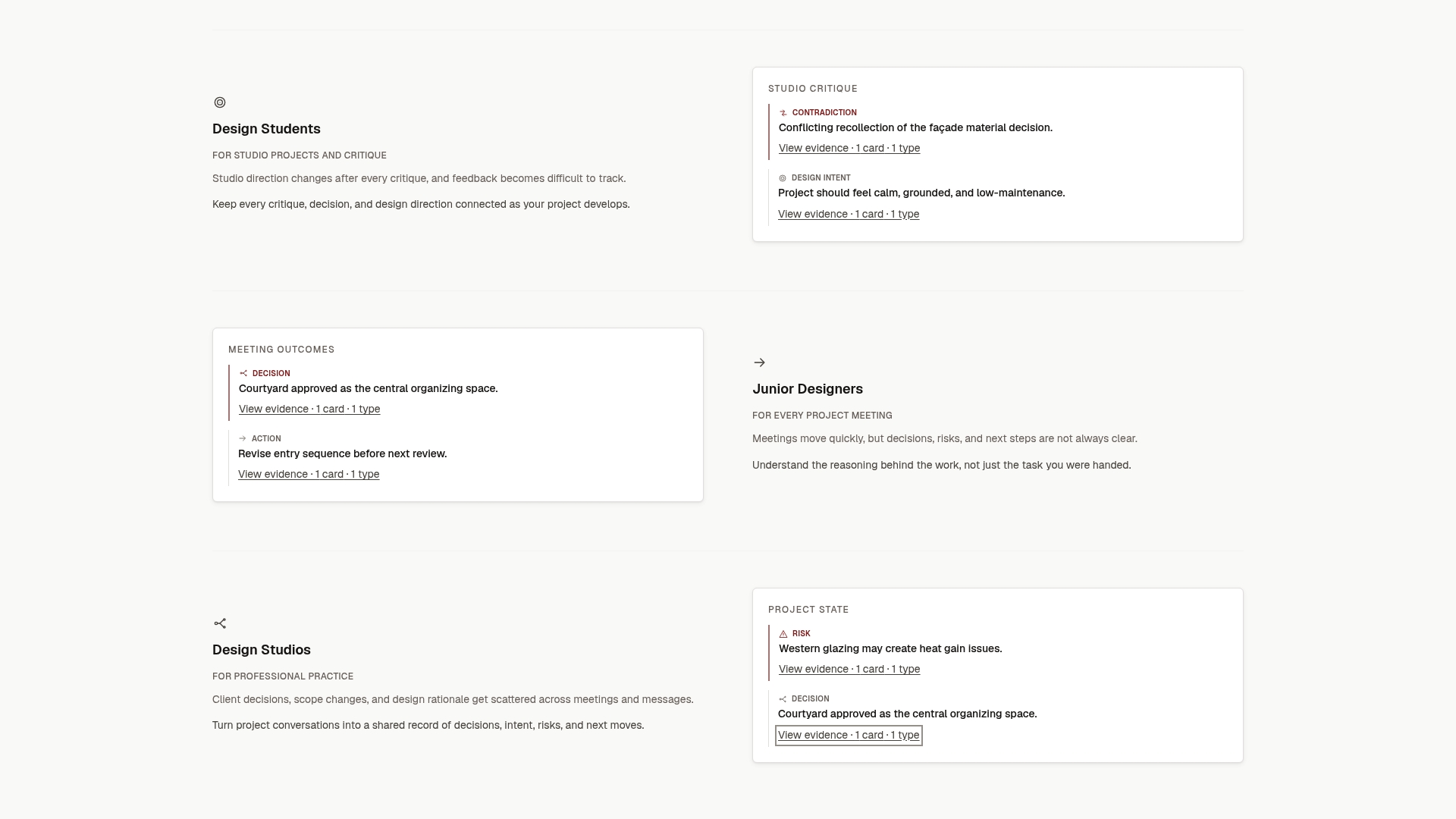
A studio using our Practice Memory product line, a one-time purchase at $59 (pricing details here), can turn a full project’s worth of scattered client calls into a searchable decision trail without building a schema from scratch. For teams that want ongoing capacity, our Living Record plan is available; current prices are on the pricing page. If your team needs help structuring the engineering side of a handoff, Sentient Concepts offers product and application development support worth pairing with a traceable record system. Check our pricing page to see which option fits your team’s size.
FAQ
How do you write feedback in design reviews?
Good design feedback names the specific element, states the reason for the concern, and suggests a direction rather than just flagging a problem. Writing it as a short record with the artifact link and rationale attached, rather than a loose comment, makes it usable weeks later instead of forgotten.
What is the 60-30-10 rule in user experience design?
The 60-30-10 rule is a color distribution guideline, not a feedback or traceability framework: 60% dominant color, 30% secondary color, and 10% accent color across an interface. It originated in interior design and gets applied to UI work to keep color schemes balanced rather than chaotic.
What are the five elements of good website design?
Definitions vary across sources, but a common version includes usability, visual hierarchy, consistency, accessibility, and clear navigation. None of these replace the need for a documented rationale behind the choices made in each area, which is where a traceable record adds value beyond the design itself.
What is interaction design?
Interaction design focuses on how a person and a digital product communicate through actions like clicks, taps, and gestures, shaping the flow between what a user does and how the system responds. It sits alongside visual and content design as one of the core disciplines feeding into an overall product experience.
Why does a flat feedback log fall short compared to a decision graph?
A flat chronological log shows what happened in order but loses the connections between related decisions made weeks apart. A decision graph, where each entry links to the one it revises, lets a team trace how a choice evolved, which decision-provenance research identifies as the structural piece a simple log is missing.
Sources
- Kaleidoscope: A Reflective Documentation Tool for a User Interface Design Course
- CritiqueCrew (preprint) — conversational critique tool integrated into Figma
- DesignRail (GitHub)
- Towards Advanced Collaboration Systems for Design Reviews in Product and Production Development