Client Comment Tracking for Design Teams: 11 Fields, 30–60 Day Rollout
Client Comment Tracking for Design Teams: 11 Fields, 30–60 Day Rollout
Client comment tracking means capturing every piece of client feedback as a source-backed record linked to the document or model version it affects, not just a line in an email thread. Done well, it gives a design team an auditable decision trail that cuts late-stage rework and keeps handovers clean. Guidance from bodies like RIBA and RICS backs this up, and tools such as The Intent Ledger exist specifically to make it practical.
TL;DR:
- For high impact feedback, preserve the original email, markup, or transcript and link it to the exact drawing or model revision.
- Every actionable record should identify the author, date, source, affected design element, proposed action, priority, decision owner, and current status.
- Assign separate recorder, verifier, decision owner, and implementer roles; triage active projects daily, while lower intensity work can use a weekly digest.
- When feedback becomes a scope change, feed its source record into formal change control, and tie any RFI to the specific model or document version.
- Pilot the template on one project phase, capture comments during reviews, and require a linked source for every item marked high impact.
Table of Contents
- Why tracking client comments matters for design teams
- What to capture for every client comment
- Practical workflows to capture, assign, and resolve comments
- Tying comment tracking into BIM and formal change control
- Governance, versioning, and auditability
- Quick checklist and 30 to 60 day rollout plan
- Why disciplined comment tracking changes how teams work
- How The Intent Ledger helps preserve comment-to-decision traceability
- FAQ
- Sources
Why tracking client comments matters for design teams
When client feedback lives in scattered emails, meeting notes, and verbal asides, the reasoning behind a decision disappears long before the project closes out. A team remembers that the client asked for a change but not why, and later someone reverses it without knowing what problem it solved. That gap is where rework starts.
RIBA Plan of Work 2020 guidance requires that documentation at the end of each stage record the basis for decisions, so the next stage can build on clarity rather than guesswork. Understanding cost drivers, manufacturing methods, and installation constraints early in design helps protect the original intent and avoids forcing changes back in during construction.
Teams that track comments systematically tend to see:
- Fewer late value-engineering reversals because the original rationale is still visible.
- Faster, cleaner handovers between design phases or between firms.
- Less time spent reconstructing “why” during disputes or audits.
What to capture for every client comment
A comment is only useful later if it carries enough context to stand on its own. The fields below turn a passing remark into a record someone can act on and defend months later.
- Comment text, captured close to verbatim.
- Author, the actual person who raised it, not just “the client.”
- Date and time of the comment.
- Source, the specific email, markup, meeting, or transcript it came from.
- Linked document or model version the comment applies to.
- Affected aspect, the drawing, system, or design element in question.
- Proposed action, what the team plans to do about it.
- Priority or impact, how much it changes cost, schedule, or design intent.
- Decision owner, who has authority to resolve it.
- Status, open, in review, resolved, or deferred.
- Attachments, the marked-up PDF, photo, or recording itself.
Lightweight comments, like a preference for a lighter paint tone, can stay in a simple log. High-impact ones, a structural change or a scope shift, deserve a fuller record that names the originating RFI or marked-up sheet and the revision in force, so nobody relies on a paraphrase later.
Pro Tip: Attach the original document instead of retyping the comment. A screenshot of the marked-up PDF is more defensible than a summary six months later.
Practical workflows to capture, assign, and resolve comments
Capture has to happen where the conversation happens, or it gets lost. In meetings, a recorder takes quick structured notes or works from a transcript, assigning an action the moment a comment is raised rather than reconstructing it afterward. Outside meetings, attach the original PDF, email, or markup to the record instead of copying text into a summary.
Cadence matters as much as the capture itself. Active projects benefit from a quick triage to sort new comments by priority and owner. Lower-intensity projects can run on a weekly digest instead.
A workable setup assigns distinct roles:
- A recorder captures the comment and its source at the moment it happens.
- A verifier checks the record against the original document or markup.
- A decision owner has authority to resolve or escalate it.
- An implementer carries out the agreed action and updates the status.
Three tool categories cover most of this: a structured decision-record system for the comment itself, version control for the documents it references, and model-annotation tools for BIM-linked markups. Teams that want a deeper look at capture patterns in practice can see one approach in this post on client feedback tracking, and agencies running stage-based review cycles may find this client feedback workflow a useful complement.
Tying comment tracking into BIM and formal change control
Comment records only earn their keep when they connect to the formal processes that actually change scope. RICS change-control guidance describes a lifecycle: a scope is agreed, an instruction is issued, the change is evaluated, and the outcome is written into a register with substantiating documents attached.
A client comment tracked from the start can feed directly into that lifecycle instead of triggering a separate scramble for context when an RFI lands. The same guidance notes that BIM-based RFIs can reference model elements directly, which speeds up impact assessment because reviewers see exactly which component or system a comment affects.
A few habits keep this reliable:
- Reference the specific model or document version in every RFI, not just the project name.
- Engage only the stakeholders who actually need to weigh in, to avoid diluting accountability.
- Keep the register current. Check the applicable contract for deadlines on submissions.
Governance, versioning, and auditability
A comment log is only as trustworthy as its weakest field. Four rules make the difference between a usable record and a liability.
- Every high-impact record must reference an exact document or model version, not “the latest drawing.”
- Preserve the exact source snapshot, the email, markup, or transcript excerpt, rather than a paraphrase.
- Use a short, consistent status taxonomy (open, in review, resolved, deferred) across every project.
- Always record a decision owner and a date, so authority and timing are never in question.
RICS guidance describes recording changes in a register and sharing substantiating documents.
Pro Tip: Treat unstructured email threads as raw material, not as the record itself. Pull the relevant text into a structured log tied to a version reference.
Quick checklist and 30 to 60 day rollout plan
Rolling this out works best in phases rather than all at once.
- First phase: Map where client comments currently come from (email, meetings, markups) and note where context is already getting lost.
- Weeks 1 to 2: Adopt a comment template with the fields above and start capturing new comments against it.
- Following phase: Assign recorder, verifier, decision owner, and implementer roles, and connect the log to version control or your BIM environment.
- Final phase: Settle on a triage cadence and update the change register on a consistent schedule.
Fast wins come early: capture comments live during every design review instead of after, and require a linked source document for any comment tagged high impact. Teams building their own version can start from this decision log template.
Why disciplined comment tracking changes how teams work
Recording the reasoning behind a decision almost always costs less than reconstructing it after the fact, usually during a dispute or a late redesign. The habit itself matters more than the tool. I’d suggest piloting this on one project phase, a single stage or a single client relationship, and watching whether rework drops or handovers get cleaner. Adapt the template, keep what works, and let the practice spread from there.
, Rajas
How The Intent Ledger helps preserve comment-to-decision traceability
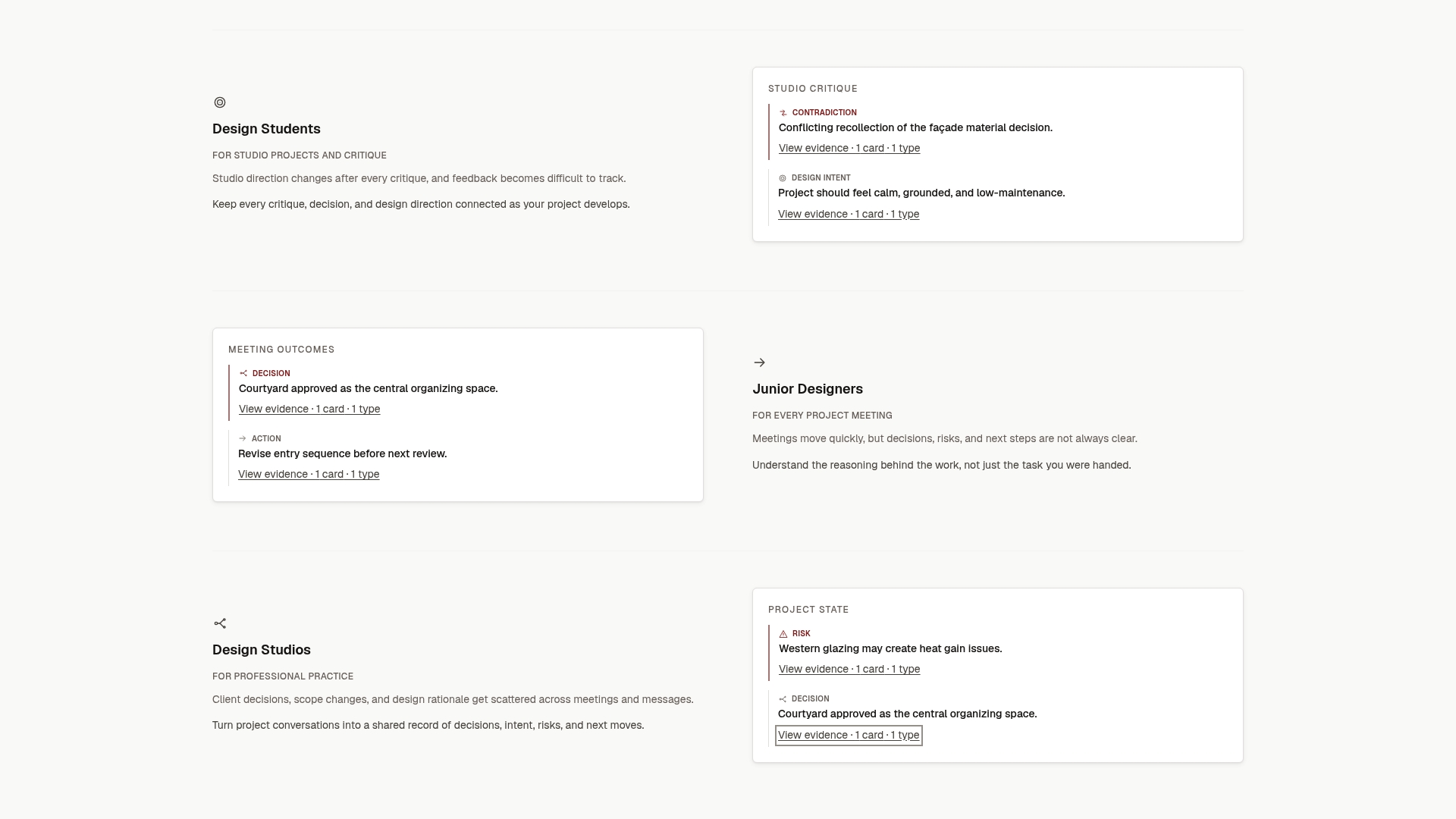
We built The Intent Ledger around exactly this gap. Instead of leaving client comments scattered across email and meeting notes, our platform turns conversations and transcripts into structured ILM Records that trace straight back to the source they came from.
- We fit architecture studios, project managers, and freelance architects who need a living record of design intent, not just a meeting log.
- Our records trace decisions back to their original conversations, helping teams retain project context.
- Our plans range from one-time Working Set packs at $12 to ongoing subscriptions like Working Memory at $29 a month, so a solo practitioner and a full studio can both start small.
See the full lineup, including Living Record and Shared Ledger, on our pricing page.
FAQ
What counts as a client comment worth tracking?
Any feedback that could change scope, cost, schedule, or design intent is worth tracking, even an informal remark in a meeting. Lower-stakes preferences can stay in a lightweight log, but anything tied to a structural, cost, or schedule decision needs a full record with its source attached.
How is a comment log different from a change register?
A comment log captures feedback as it happens, while a change register tracks the formal lifecycle once a comment becomes an agreed scope change. The RICS change-control process moves from instruction to evaluation to register entry, and a well-kept comment log feeds that process with context instead of starting from scratch.
How often should a team update its records?
Active projects benefit from a daily quick triage, while lower-intensity work can run on a weekly digest. Teams can use RICS change-control guidance to inform how they maintain change registers.
Can The Intent Ledger link comments directly to drawing versions?
Yes, ILM Records are built to connect a comment to the specific document or model version it affects, so the record stays accurate even as drawings change. Teams can see a worked example in this guide to linking drawings to decisions.
Do structured decision logs actually reduce rework?
Structured communication may support project performance, while poor early communication can contribute to duplicated work. A consistent comment-to-decision record addresses that gap directly by reducing duplicated work tied to lost context.
Sources
- Change control and management
- Plan of Work 2020 Overview
- Influence of client involvement on internal organization and performance of architectural design offices