Commitment Tracking: 7 Fields That Let Design Teams Verify Promises
Commitment Tracking: 7 Fields That Let Design Teams Verify Promises
Commitments tracking means recording every promise with its owner, due date, and source, then monitoring it until evidence confirms it is actually done. The single next action is simple: capture the promise right now, in whatever system your team already uses, before it disappears into a chat thread or someone’s memory. Everything else builds from that first habit.
TL;DR:
- Each record needs the promisor, exact wording, source, specific due date, confidence tier, ticket link, and tags for project, client, or category.
- Mark commitments open, nudged, or fulfilled, and require evidence from messages, tickets, or delivered files before closure; self reports alone can create false completions.
- One documented system uses a threshold around 0.6 for automatic closure, leaving weaker evidence in progress rather than prematurely marking commitments fulfilled.
- When deadlines change, retain the original wording and date, record the revision and reason, and close obsolete commitments with an explanation instead of deleting them.
Table of Contents
- What commitments tracking is and why it matters for teams and projects
- Key elements of an effective commitment record
- How to build a workflow: manual first, then tickets, then dedicated software
- Automation and evidence-based verification: capture, verify, escalate
- Metrics, reporting, and audits that show whether tracking works
- Common challenges and practical fixes
- Practical setup steps to start tracking commitments
- Integrating commitment tracking with your other project tools
- Maintaining the commitment log across a project’s lifecycle
- Handling changes and updates to commitments
- Why commitment tracking matters for design-team risk management
- Author perspective: applying commitment tracking in design teams
- How The Intent Ledger makes commitment tracking reliable
- FAQ
- Sources
What commitments tracking is and why it matters for teams and projects
A commitment is different from a generic task. A task might sit on a backlog indefinitely, but a commitment is a specific promise someone made out loud, tied to a person who agreed to it and a moment when they said it. It is also distinct from a formal contractual obligation, which usually carries legal weight and a defined penalty for missing it. Commitments tracking sits between the two: informal enough to happen in every meeting, important enough that losing track of it damages trust.
For teams, the payoff shows up in several places:
- Context survives staff turnover and long project timelines instead of living only in someone’s head.
- Accountability becomes visible, so follow-through stops depending on who remembers to ask.
- Audits and reviews get easier because there is a record to point to.
Common scenarios include design critique follow-ups (“I’ll revise the floor plan by Thursday”), procurement commitments from vendors, contract-adjacent obligations between studios and clients, and the small promises made during weekly planning that rarely get written down anywhere formal.
Key elements of an effective commitment record
A commitment record only works if it captures enough detail to verify later, not just enough to remember it was said. Build your template around these fields:
- Owner: the person who made the promise, not the person who requested it.
- Statement: the commitment in the speaker’s own words, ideally a direct quote.
- Due date: a specific date, never “soon” or “next sprint.”
- Confidence tier: whether the promise was firm, hedged, or aspirational.
- Source: the meeting, message, or document where the commitment originated.
- Ticket ID: a link to the task if one exists.
- Tags: project, client, or category labels for later filtering.
Confidence tiers matter more than teams expect. A firm commitment (“I will send the drawings by Friday”) deserves a different follow-up cadence than a hedged one (“I might have time to review it this week”). Treating both the same way either nags people unfairly or lets real promises slip.
For status states, use something more granular than open and closed: open, nudged, and fulfilled works well, since it shows where a commitment sits in its lifecycle rather than just whether it is done.
Pick one place to store all of this. Splitting commitments across someone’s notebook, a shared doc, and a project tool guarantees some get lost.
Pro Tip: Store the source quote verbatim, not a paraphrase. When a commitment is disputed later, the original wording settles the argument fast.
How to build a workflow: manual first, then tickets, then dedicated software
Start simple. In your next meeting, adopt this habit:
- Capture the commitment the moment it is spoken, in the speaker’s own words.
- Assign it to the person who said it, not the person who asked for it.
- Set a specific due date on the spot, even a rough one.
- Note the source: which meeting, which message thread, which document.
A spreadsheet or shared doc handles this fine for a small team. The next step is linking each commitment to a ticket in whatever project tool you already use. This matters because tickets carry status updates, comments, and a history that a spreadsheet row cannot. Syncing due dates to a shared calendar adds a second layer of visibility so deadlines do not rely on someone checking the tracker.
The switch to dedicated software, whether a contract lifecycle management (CLM) platform or a project-memory tool, becomes worth it once manual tracking starts failing in predictable ways: commitments made in meetings never get written down, nobody can tell which promises are overdue without opening five different tools, or disputes arise about what was actually said. Contract obligation tracking at scale is exactly this problem: fragmented manual tools create blind spots that centralized platforms and automation are built to close. For design teams specifically, connecting notes to tasks directly turns a scattered conversation into traceable work without a second data-entry step.
Automation and evidence-based verification: capture, verify, escalate
The biggest weakness in manual tracking is the false “done.” Someone marks a commitment complete because they assume it happened, not because anyone checked. Automated systems fix this by reconciling commitments against actual evidence: scanning Slack, email, and ticket systems for completion keywords and matching the author of that evidence to the person who made the promise. One documented approach, Follow-Through, extracts spoken commitments from meeting transcripts, polls Slack, email, and Linear for proof of completion, and escalates to a manager’s inbox only when a commitment goes silent.
A related system, the Commitment Decay Engine, scores evidence using at least three signals, keyword recall, completion keywords, and author match, before marking anything fulfilled. A conservative threshold around 0.6 for auto-marking a commitment done, as used in that system, keeps weaker matches in a separate progress state rather than closing them prematurely.
Good escalation design avoids notification fatigue:
- Wait a minimum age before sending the first nudge.
- Cap total nudges before escalating further.
- Escalate to a manager only after the cap is reached, with context attached.
Extraction rules matter too: keeping only first-person, future-intent language (“I’ll,” “I will,” “I can”) and filtering out phrases like “we should” avoids tracking vague intentions as if they were real promises.
Metrics, reporting, and audits that show whether tracking works
Tracking commitments is only useful if you can measure whether the system is working. Four metrics cover most of what teams need:
- Fulfillment rate: the share of commitments completed on time.
- Percent Plan Complete (PPC): the percentage of weekly commitments the team meets on schedule, a standard measure in planning-heavy project environments.
- Average time-to-fulfill: how long commitments typically take from promise to evidence of completion.
- Nudge counts: how many reminders a commitment needed before resolution, a proxy for friction.
Run periodic audits on a sample of closed commitments to confirm the evidence behind each “fulfilled” status actually holds up, rather than trusting every closure at face value. When fulfillment rates drop, look at the system before blaming the person: a vague due-date format, an unclear owner field, or a missing ticket link usually explains more missed commitments than individual unreliability does.
Common challenges and practical fixes
Three problems come up constantly, and each has a direct fix.
Verbal promises never get written down. The fix is a mandatory capture policy: assign a note-taker role in every meeting whose job includes logging commitments as they are spoken, not after the fact.
False completions pile up when people self-report. Evidence-based verification against Slack, email, or ticket activity, paired with mandatory ticket linkage, closes this gap.
Notification fatigue drives people to ignore the tracker entirely. An empathetic, rate-limited nudge policy, with a minimum wait before the first reminder and a hard cap on total nudges, keeps the system useful instead of annoying.
- Capture policy: assign a dedicated note-taker in every meeting.
- Verification policy: require evidence, not self-reporting, before closing a commitment.
- Nudge policy: limit reminders and escalate only after a clear threshold.
Pro Tip: If a commitment gets nudged more than twice without movement, treat that as a signal to renegotiate the deadline, not just to nudge harder.
Practical setup steps to start tracking commitments
Getting started does not require new software on day one. Begin with a single shared document, a spreadsheet, or a table inside whatever tool your team already uses for notes.
First, pick the seven fields from earlier (owner, statement, due date, confidence, source, ticket ID, tags) and build a simple template around them. Second, assign someone in every recurring meeting to own capture, rotating the role if needed so it does not fall on one person permanently. Third, set a weekly review cadence, even just fifteen minutes, where the team scans open commitments and updates statuses based on actual evidence rather than memory.
Fourth, decide your escalation rule before you need it: how many days overdue triggers a nudge, and how many nudges trigger a conversation with a manager. Writing this down in advance keeps the policy consistent and removes the awkwardness of deciding case by case.
Fifth, pick one source of truth. If commitments live in a spreadsheet, meeting notes, and someone’s inbox simultaneously, the tracker fails regardless of how good the template is.
Sixth, revisit the system after a month. Look at which commitments slipped, why, and whether the template or the review cadence needs adjusting. A working action-item system for project managers typically treats this first month as a calibration period rather than expecting the process to be perfect on day one.
Starting small and manual is not a weakness. It is the fastest way to learn what your team actually needs before committing to a heavier tool.
Integrating commitment tracking with your other project tools
A commitment tracker that lives in isolation from your other tools creates duplicate data entry, and duplicate entry is where tracking habits break down. The goal is to make the tracker a natural extension of tools your team already touches daily.
Linking each commitment to a ticket in your project management system is the highest-value integration, since it means status updates, comments, and history accumulate in one place instead of two. Calendar sync is the second priority: pushing due dates into a shared calendar means deadlines surface where people already look, not only inside a tracker they have to remember to open.
Chat tools deserve attention too, since most verbal commitments originate in meetings or get reaffirmed in Slack or email threads afterward. Reconciling commitment status against those channels, rather than asking people to update a separate tracker by hand, is what makes evidence-based verification possible in the first place. Automating meeting capture for design teams specifically addresses this gap by pulling commitments directly out of transcripts instead of relying on someone to retype them later.
For teams working across language or regional boundaries, integration sometimes extends further. Global teams managing commitments across markets benefit from structured workflow automation that keeps translated or localized communications aligned with the same tracking discipline used internally.
The practical rule: every tool your team already uses for communication or task management should feed the commitment tracker automatically, or at minimum require only one extra click, not a parallel data-entry process.
Maintaining the commitment log across a project’s lifecycle
A commitment log is not a one-time setup. Projects change shape over weeks or months, and the log needs maintenance habits that match that pace.
Early in a project, the log tends to fill quickly with commitments tied to scope definition and initial planning. This is the phase to confirm your template fields are working before volume builds up. Mid-project, the log shifts toward execution commitments, design revisions, vendor deliveries, client sign-offs, and this is when a weekly review cadence matters most, since the volume of open items is highest.
Toward project close, the log should shrink naturally as commitments resolve, but this is also when old, stale entries tend to linger unnoticed. Build a habit of archiving fulfilled commitments rather than deleting them, since a resolved log doubles as a record for post-project reviews or disputes.
Periodic housekeeping matters regardless of project phase. Dead commitments, ones overtaken by scope changes or decisions made elsewhere, should be marked closed with a note explaining why, not left open indefinitely. An open commitment that no longer matters erodes trust in the tracker just as much as a missed deadline does.
Treat the log the way regulated industries treat recordkeeping: with timely updates and the ability to retrieve any record on demand. Device tracking rules in regulated manufacturing require written procedures and periodic audits precisely because records degrade without routine maintenance, and the same discipline, scaled down, keeps a project-level commitment log trustworthy from kickoff to handover.
Handling changes and updates to commitments
Commitments change. Deadlines slip, scope shifts, and priorities get reordered, so the tracker needs a clear way to handle updates without losing the original record.
The first rule: never overwrite a commitment’s original statement or due date. When a deadline moves, add a new entry noting the revised date and the reason, while keeping the original intact. This preserves the audit trail and prevents disputes about what was actually promised versus what was later renegotiated.
Second, treat a renegotiated commitment differently from a missed one. If someone proactively says, “I need until next Friday instead of Wednesday,” that is a healthy update, not a broken promise, and the tracker should reflect that distinction rather than flagging it as a failure.
Third, when scope changes make a commitment irrelevant entirely, close it explicitly with a reason rather than letting it quietly expire. A commitment that becomes obsolete because a feature was cut is different from one nobody followed through on, and the record should say which happened.
Fourth, batch review changed commitments during your regular cadence rather than updating them ad hoc as messages come in. This keeps the log consistent and avoids a scenario where some updates get recorded carefully and others get lost in the shuffle of a busy week.
Finally, confidence tiers should shift alongside the commitment itself. A firm commitment that gets delayed twice should probably be re-tagged as hedged, since that changes how urgently it needs follow-up and how much weight to put on the next stated deadline.
Why commitment tracking matters for design-team risk management
Design work carries a particular kind of risk: decisions made in a critique session or a client call often do not get written down anywhere, yet they shape everything that follows. A revision promised verbally and forgotten can cascade into missed deadlines, rework, or a client dispute about what was actually agreed.
Commitment tracking addresses this directly by creating a traceable link between a decision and the conversation that produced it. When a client asks why a layout changed, or a junior designer needs to understand why a material was swapped, the commitment record points back to the original discussion instead of relying on someone’s memory of a meeting from three weeks earlier.
This matters most during handoffs. When a project moves between team members, or a freelance architect picks up work mid-project, a traceable commitment log replaces hours of context-gathering with a quick scan of open and resolved items. It also protects against a subtler risk: decisions quietly reversed without documentation, which can resurface later as confusion about what the current plan actually is.
For risk management specifically, a commitment log doubles as an early warning system. A cluster of overdue commitments from one person or one phase of a project often signals a deeper bottleneck, whether that is unclear ownership, an unrealistic timeline, or a dependency nobody flagged. Catching that pattern early, through the kind of decision audit trail design teams increasingly rely on, is far cheaper than discovering it after a deadline has already passed.
Author perspective: applying commitment tracking in design teams
The conventional wisdom treats commitment tracking as a task-management problem: capture it, assign it, check it off. For design work, that framing misses the point. What actually matters is the reasoning behind a commitment, why a deadline was set, why a revision was promised, because that context is what gets lost first and costs the most to rebuild. Project memory software that preserves the “why” alongside the “what,” turning scattered meeting speech into structured, source-backed records, closes a gap that a simple checklist never addresses. Teams that connect commitments directly to the conversations that produced them spend far less time reconstructing decisions after the fact.
, Rajas
How The Intent Ledger makes commitment tracking reliable
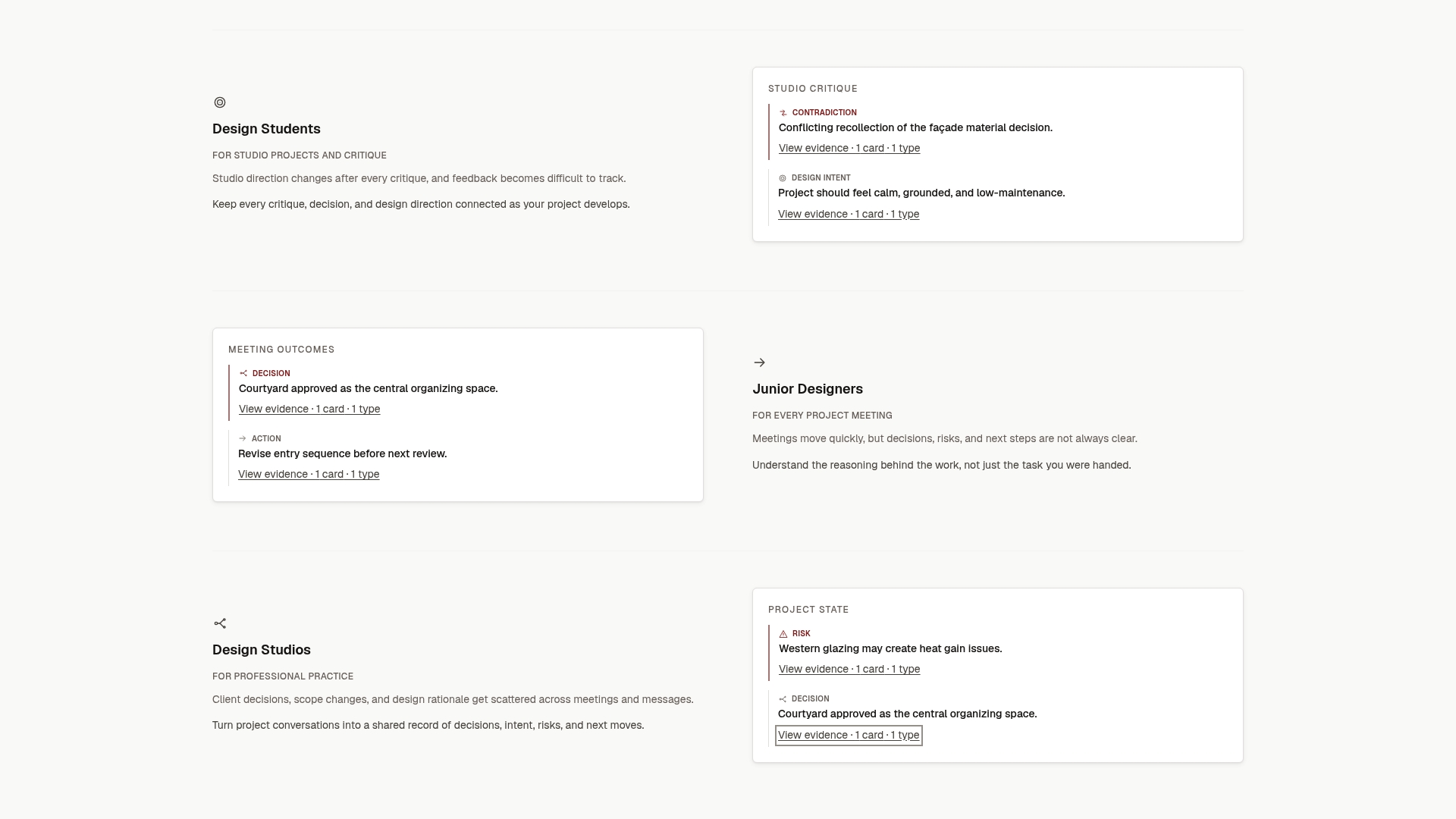
We built The Intent Ledger around a simple idea: a commitment is only as useful as the context behind it. Instead of a flat task list, we turn meeting conversations, transcripts, and client feedback into ILM Records, structured entries that trace every commitment back to the exact moment it was made.
- We preserve the source conversation alongside every commitment, so disputes about what was said get settled in seconds.
- We tag confidence and ownership automatically from the language people actually use.
- We give design teams a living project memory that survives staff changes and long timelines.
Spreadsheets work until commitments start living across a dozen scattered threads. When your team needs source-backed records and traceable decision history rather than another checklist, we offer plans starting with Working Memory at $29 per month, with Living Record and Shared Ledger available as your team grows. Check pricing and plans to find the right fit.
FAQ
How do you follow through on commitments?
Follow-through starts with writing the commitment down immediately, with an owner, a due date, and the source it came from. From there, verify completion against real evidence, a message, a ticket update, or a delivered file, rather than relying on self-reporting, and use a rate-limited nudge policy if a deadline passes without proof.
What do commitments mean in a project context?
A commitment is a specific promise someone makes, in their own words, to deliver something by a given time, distinct from a general task or a formal contractual obligation. It carries personal accountability because a named person agreed to it out loud or in writing.
What is commitment status?
Commitment status describes where a promise sits in its lifecycle, commonly open, nudged, or fulfilled, based on evidence rather than assumption. A status only moves to fulfilled when there is a documented sign of completion, such as a merged ticket or a confirming message.
What are examples of commitments in design and project work?
Common examples include a designer promising to revise a floor plan by a specific date after a critique, a vendor committing to deliver materials by a set deadline, or a project manager agreeing to send client-ready drawings by end of week. Each becomes trackable once it is logged with an owner, a date, and the conversation it came from.
Sources
- Contract Obligation Tracking: Why It Matters and How to Do It Right - Lexology
- ionfwsrijan/FollowThrough
- eCFR :: 21 CFR Part 821 – Medical Device Tracking Requirements