Constraints Log for Small Studios: Assign Owners, Review Weekly
Constraints Log for Small Studios: Assign Owners, Review Weekly
A constraints log is a short register of the blockers that keep a planned task from being executable. Its job is to make sure every blocker has one owner and a promised resolution date, so work is not started before it can finish. This guide covers what to record, how often to review it, and a template you can copy today.
TL;DR:
- Treat a fixed, already blocking limit as a constraint; keep uncertain events in the risk register and negotiable stakeholder needs among requirements.
- Give each entry a brief description, category, single named owner, identified date, resolution date, and status; link evidence and record the rationale when useful.
- Review open constraints weekly within the six week look ahead, set resolution dates before planned starts, and release tasks only after blockers are cleared.
- Use hard schedule constraints sparingly because fixed dates consume float; prefer soft constraints when activities can move, and check whether an item is an assumption.
Table of Contents
- What a constraints log is and how it differs from risks, assumptions, and requirements
- Common constraint categories with practical examples for design and construction teams
- What to record in a constraints log
- How to use the constraints log in your weekly planning cadence
- A quick constraints log template with one example row
- Best practices and scheduling cautions
- Why preserving the rationale behind constraints matters
- How we help you track constraints as traceable records
- FAQ
- Sources
What a constraints log is and how it differs from risks, assumptions, and requirements
Think of the log as a working list of things standing between you and a task that is ready to run. In PMI-style language, a constraint is a restriction that limits your options or forces a specific course of action. That makes it different from the other items teams tend to mix into the same list.
A risk is an uncertain event that might happen. A requirement is a stakeholder need, and most requirements can be negotiated. Engineering guidance on requirements versus constraints suggests a simple negotiability test: if the item can be traded off, it is probably a requirement. If it cannot move, it is a constraint. Systems engineers go further and treat constraints as requirements that cannot be traded off and should be written clearly enough to verify.
A quick rule of thumb: if it is certain and already blocking a task, log it as a constraint. If it might happen, it belongs in your risk register.
Common constraint categories with practical examples for design and construction teams
PMI lists six common constraint categories: time, cost, scope, quality, resources, and risk. Here is how each tends to show up in a design or construction project:
- Time: a permit approval window that closes before the planned start of work.
- Cost: a client-approved budget cap that rules out a specified finish.
- Scope: a mandatory spec the client will not waive.
- Quality: a code or acceptance standard a drawing set must meet before release.
- Resources: a senior designer assigned to multiple deliverables at the same time.
- Risk: a known supplier problem that must be cleared before ordering.
Dependencies deserve their own attention. An internal dependency, such as a drawing that must be finished before a consultant can review it, becomes a constraint the moment it blocks a task. An external dependency, such as an authority or a supplier, works the same way but is harder to control. FF&E lead times are a classic sector example. Our partners at Faura describe how phased architect and interior designer collaboration handles this kind of coordination.
What to record in a constraints log
Keep the schema small, or nobody will fill it in. Last Planner System standard work says each entry should contain, at minimum, these fields:
- Brief description: one line that says what is blocking the work.
- Category: time, cost, scope, quality, resources, or risk, so you can spot patterns later.
- Owner or champion: the one person responsible for removing the blocker, not a team.
- Identified date: when it was first raised, which shows how long it has been sitting.
- Need-by or resolution date: the date it must be cleared for the task to proceed.
- Current status: open, in progress, or resolved.
Optional fields add useful context: the linked task or work package, an evidence link to a meeting note or transcript, severity, and the rationale behind the constraint. Recording rationale helps because systems engineering sources advise documenting why a constraint exists, so you can tell when it has gone stale and should be removed.
The step teams skip most often is naming a champion and a date. Last Planner materials flag that omission as a common mistake that disrupts workflow.
How to use the constraints log in your weekly planning cadence
The log works best inside a rhythm you already have. Last Planner System materials describe a six-week look-ahead plus weekly work planning, and the log slots into both. The standard work calls for weekly updates during the look-ahead review, so constraints surface before they hit the flow of work.
Here is a workflow for your planning meeting:
- Walk through the tasks planned for the coming weeks and ask of each one: what would stop this from starting?
- Log every blocker as its own line, using the fields above.
- Assign one champion per constraint, a named person rather than a group.
- Set a need-by date that falls before the task’s planned start.
- Review open items at the next weekly meeting and update their status.
- Move resolved items out of the active list, and only then release the task to the weekly plan.
Pro Tip: Ask each champion to put the resolving action on their own calendar during the meeting, and to report its status first thing at the next look-ahead review.
A quick constraints log template with one example row
Use these columns, in this order:
- ID: a running number so entries can be referenced in meetings.
- Description: what is blocking the work.
- Category: one of the six types.
- Linked task: the activity that cannot start.
- Owner: the single champion.
- Identified date and need-by date: when raised and when it must be cleared.
- Status: open, in progress, or resolved.
- Source link and notes: a link to the meeting note or transcript, plus context.
A filled example: “Fabric samples not yet approved by client,” category scope, linked task “Order sofa upholstery,” owner Priya, identified on a sample date, with a sample need-by date, status open, source link to the review notes, notes “Client reviewing two alternates.”
Store the log wherever your team already looks: a shared spreadsheet, a project memory tool, or a linked document. For a related format, see our decision log template for project teams.
Best practices and scheduling cautions
A log stays useful when it stays small and current. Give each item a single owner, a clear need-by date, and a link to its evidence. Review it weekly and archive resolved items so the active list shows only what still needs attention.
Scheduling tools add a trap. PMI scheduling guidance warns against over-constraining a baseline schedule, because it eats float. A hard constraint pins an activity to a specific date and should be kept to a minimum in a valid baseline, while a soft constraint lets the schedule flex. If you find yourself forcing dates everywhere, your log probably holds assumptions, not true constraints.
A short health check before each review:
- Does every open item have a champion and a date?
- Is anything past its need-by date without an update?
- Can any item be reclassified as a risk or a negotiable requirement?
Why preserving the rationale behind constraints matters
Most design teams lose time when the reason behind a constraint disappears. Someone leaves, a meeting is forgotten, and later the team is redoing work or arguing about a decision nobody can explain. A constraint recorded without its rationale is just a rule, and rules get broken or kept long after they stopped mattering.
Linking each entry to the conversation it came from fixes both problems. The champion can see exactly what was agreed, the team can challenge a stale constraint with evidence, and accountability stops depending on memory. That is the habit we build in our own work, and it is why we wrote about building project memory for design teams. Our decision-log template collection is a good place to start.
, Rajas
How we help you track constraints as traceable records
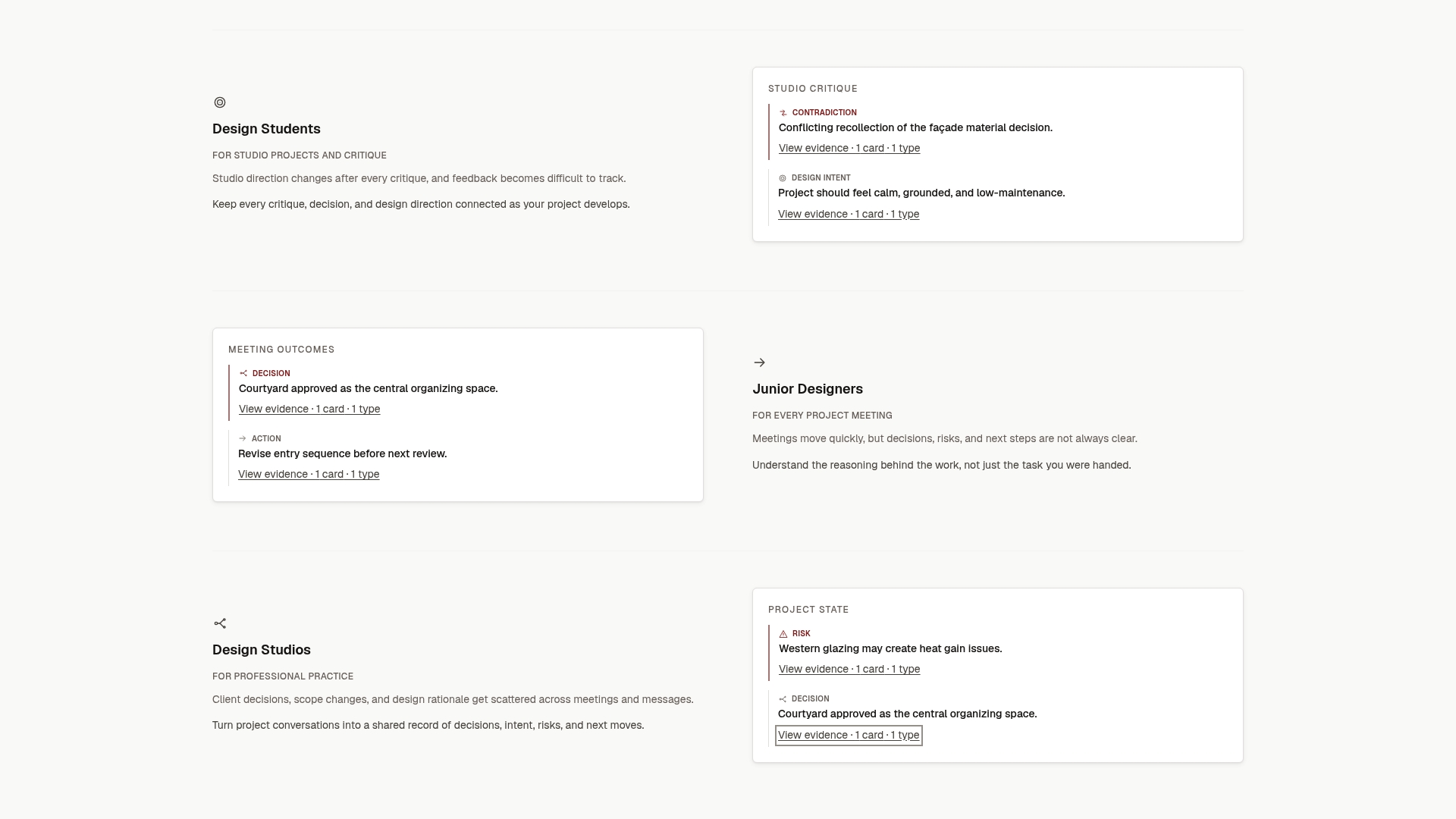
We built The Intent Ledger to preserve project context in source-backed records linked to the conversations they came from. You can trace the rationale behind project decisions back to the conversations they came from. Plans start at $29 per month, with one-time record packs from $12; see the details on our pricing page, then try it on your next look-ahead meeting.
FAQ
What is a scope constraint?
A scope constraint is a fixed limit on what the project must deliver or include, such as a mandatory specification the client will not waive. It narrows your options in the same way a deadline or budget does. If the limit can be negotiated, treat it as a requirement instead.
What are some examples of project risks?
Risks are uncertain events that might affect delivery, such as a supplier missing a delivery date or a permit authority requesting changes. Unlike constraints, they have not happened yet. Once a risk occurs and blocks a task, it moves into your constraints log.
What do constraints mean in simple terms?
Constraints are limits you cannot easily change that shape how a project is done. Common ones include time, cost, scope, quality, resources, and risk, the six categories PMI lists.
What is a constraint log in construction?
In construction, a constraint log records the blockers that keep planned work from starting. Last Planner standard work treats it as a living tool reviewed weekly, with each entry given an owner and a resolution date.
Sources
- Last Planner System® Standard Work 8_Constraint Log
- Six (yes six!) constraints
- Difference Between Requirements and Constraints | bmf-tech