Requirements Traceability Matrix: Delivery Teams’ Living Record
Requirements Traceability Matrix: Delivery Teams’ Living Record
A requirements traceability matrix (RTM) is the artifact that maps each requirement to its source, its implementation and its verification, so nothing ships untested and nothing gets built without a reason. Authorities such as INCOSE and NASA treat bidirectional traceability as standard practice for regulated and complex deliveries.
TL;DR:
- Use bidirectional traceability to catch both requirements without tests and artifacts without parent requirements; forward links alone can miss scope creep.
- Define verification method, level, and phase when each requirement is created; vague requirements often lack a clear, testable acceptance criterion.
- Record test case IDs, run outcomes, evidence links, and evidence status; represent each requirement to test relationship separately rather than packing IDs into one cell.
- Use a spreadsheet for a bounded component or release, but adopt requirements management software when links grow, concurrent editing begins, or automated reports are needed.
Table of Contents
- What a requirements traceability matrix actually is
- Forward, backward and bidirectional traceability
- Key components every RTM should capture
- How to build and keep your RTM current
- A spreadsheet-friendly template with one worked example
- Practitioner best practices and standards
- Why we treat the RTM as project memory
- When a spreadsheet is not enough, we offer another route
- FAQ
- Sources
What a requirements traceability matrix actually is
A plain requirements list tells you what the project must do. A requirements traceability matrix tells you where each requirement came from, what design and build work answers it, and which test proves it. The value sits in the links: needs connect to requirements, requirements to design, design to implementation, and implementation to verification.
That makes the RTM a living record, not a document you assemble the week before an audit. INCOSE guidance recommends defining verification attributes such as method, level and phase when a requirement is created. Starting then removes ambiguity early, because a requirement you cannot describe a test for is usually a requirement that is still vague.
Create the matrix at the start of requirements definition. Every project benefits from some version of it, but a formal RTM becomes essential when the work is regulated, technically complex, or split across several teams. In those settings, handoffs multiply, people rotate, and the reasoning behind a requirement disappears unless something captures it. The RTM is that something. It also gives you a fast answer to the question every stakeholder eventually asks: if this requirement changes, what else is affected?
Forward, backward and bidirectional traceability
Each direction answers a different question.
Forward traceability starts at a requirement and moves toward delivery. It asks: which design elements, code, work items and tests satisfy this requirement? If the answer is “none,” you have found a gap before the customer does.
Backward traceability starts at an artifact and moves toward its origin. It asks: which requirement justifies this piece of code, this design element or this test? If the answer is “none,” you have found work nobody asked for, which is often scope creep in disguise.
Bidirectional traceability combines both. NASA’s engineering guidance requires project managers to maintain bidirectional traceability to verify that all requirements for a delivery are met, approved changes are implemented and defects are resolved before delivery. Its handbook also recommends bidirectional links between software test procedures and software requirements. Regulated and safety-critical teams generally need both directions because auditors ask both questions.
Consider what happens when you only trace forward. Every requirement has a test, so the matrix looks complete, but an extra feature slipped in during a sprint with no parent requirement. It consumes testing time, adds maintenance cost and creates risk nobody budgeted. Trace only backward and the opposite happens: every artifact has a parent, yet a requirement quietly lost its test when a plan was reorganized. INCOSE notes that RTMs are used to diagnose orphaned requirements and missing coverage, and you only catch both failure modes by looking both ways.
Key components every RTM should capture
The right fields depend on your delivery model, but a matrix that supports verification, change impact analysis and audits typically needs these:
- Requirement ID, description and acceptance criteria: a unique, stable identifier plus a testable statement of what “done” means.
- Source or parent ID: the stakeholder need, regulation or higher-level requirement this one comes from.
- Owner, status and status date: who answers for the requirement and how current the information is.
- Design and build links: design ID, build or code reference, and the WBS element or work item that carries the effort. A project management textbook example uses columns such as requirement ID, associate ID, description, current status, WBS, design ID, build ID and test case.
- Verification links: test case ID, test run ID, observed outcome and a link to the evidence.
- Evidence state: missing, stale or current. This single field turns the matrix from a map into a warning system.
- Revision, priority or criticality, and rationale: these make the record reusable and defensible when someone asks why a requirement exists.
- Trace to stakeholder or regulation: the external anchor that justifies the requirement.
Plan for many-to-many relationships from the start. One requirement can need several test cases, and one test can verify several requirements. A flat table handles this by repeating the requirement row for each linked test, or by keeping a secondary link table that pairs requirement IDs with test IDs. Either approach works. A single “test case” cell holding a comma-separated list does not, because you can no longer filter or count coverage reliably.
How to build and keep your RTM current
Follow this sequence and the matrix stays useful instead of decaying:
- Choose a bounded scope. Pick a component, release or subsystem, and write down what you are excluding so nobody assumes coverage you do not have.
- Set ID and revision rules. Decide how requirements are numbered and versioned, and make the required attributes mandatory at creation time, including verification method.
- Assign owners and a cadence. Name who updates traces, who reviews them at gates, and how often. NASA’s handbook guidance suggests assigning responsibility and reviewing the matrix at major phases.
- Pick a tool approach. A spreadsheet is fine for a small, bounded scope. A requirements management tool earns its place when link counts grow, several people edit at once, or you need automated reports. Look for automation such as importing test results into the evidence columns.
- Trace to verification. Link each requirement to test procedures, cases and results, and record the evidence state. NASA’s verification guidance says planned and modified requirements should map to test procedures, with traceability confirming tests exist for safety-critical functions.
- Use it for change impact. When a requirement changes, filter the matrix for everything linked to it, then mark affected design, tests and evidence as stale until someone rechecks them. Model-based test guidance notes that RTMs help teams see the ripple effects of change and remap coverage as plans evolve. Pair this with a disciplined change process; change request templates with scoped estimates can help you size the impact before approving it.
Pro Tip: Give every link its own revision date and flip it to “stale” automatically or by checklist whenever either end changes. Link decay happens silently, and a dated link is the cheapest defense.
A spreadsheet-friendly template with one worked example
You can start today in Excel or Google Sheets. A minimal column set looks like this:
- Requirement ID
- Description
- Source or parent ID
- Acceptance criteria
- Owner
- Status and status date
- Design ID
- Build or code reference
- Test case ID
- Test run ID and outcome
- Evidence link
- Evidence state (missing, stale, current)
- Revision
If you would rather adapt than build, a government playbook RTM template maps requirements to test cases in a ready-made spreadsheet.
Here is a worked example, labeled illustrative. Say requirement REQ-A reads “The application ends an inactive user session after a period of inactivity.” Its source is a security policy, SEC-A. The design ID is DES-A, the implementation reference is the session-manager module in the main branch, and the work item is the sprint ticket that built it. The linked test is TC-A, and the last run, RUN-A, passed. Because the session-manager module was refactored after that run, the evidence state reads stale until TC-A runs again.
Two habits keep a flat sheet honest. If REQ-A also needs TC-B for the logout message, add a second row for the same requirement instead of cramming both IDs into one cell. And scope the sheet to one component or release, recording exclusions on a separate tab, so a green sheet means what you think it means.
Practitioner best practices and standards
The recommendations in this guide line up with two bodies of practice. INCOSE guidance says traceability should begin when requirements are written, with verification attributes defined at inception. NASA’s software engineering handbook, written for projects where failure is expensive, treats bidirectional traceability as a core control for avoiding orphaned requirements and confirming that every requirement is verified before delivery.
Maintain the matrix electronically so it can be sorted and reported on, assign a named role to keep it current, and review it at each major project phase.
That is our reading of NASA’s handbook guidance, which recommends creating the matrix at project start, keeping it electronic, assigning responsibility and reviewing it at major phases.
For regulated projects, the practical consequence is simple: if an auditor asks how you know a requirement was met, the matrix should answer in one lookup, not prolonged archaeology. When a requirement or design changes, reassess every dependent artifact rather than only the one you touched. Skipping that step is how links decay: the matrix still shows a trace, but the trace no longer describes reality. Our own decision traceability audit steps apply the same discipline to design decisions.
Why we treat the RTM as project memory
I have seen requirement tables that were perfectly formatted and still useless, because they recorded what was decided and never why. When a designer inherits the project later, the missing rationale costs more than any missing row. Linking each requirement to the conversation or feedback behind it lets the next person understand intent, not just compliance. That continuity is where rework disappears, and it is why traceable design feedback matters as much as traceable tests.
, Rajas
When a spreadsheet is not enough, we offer another route
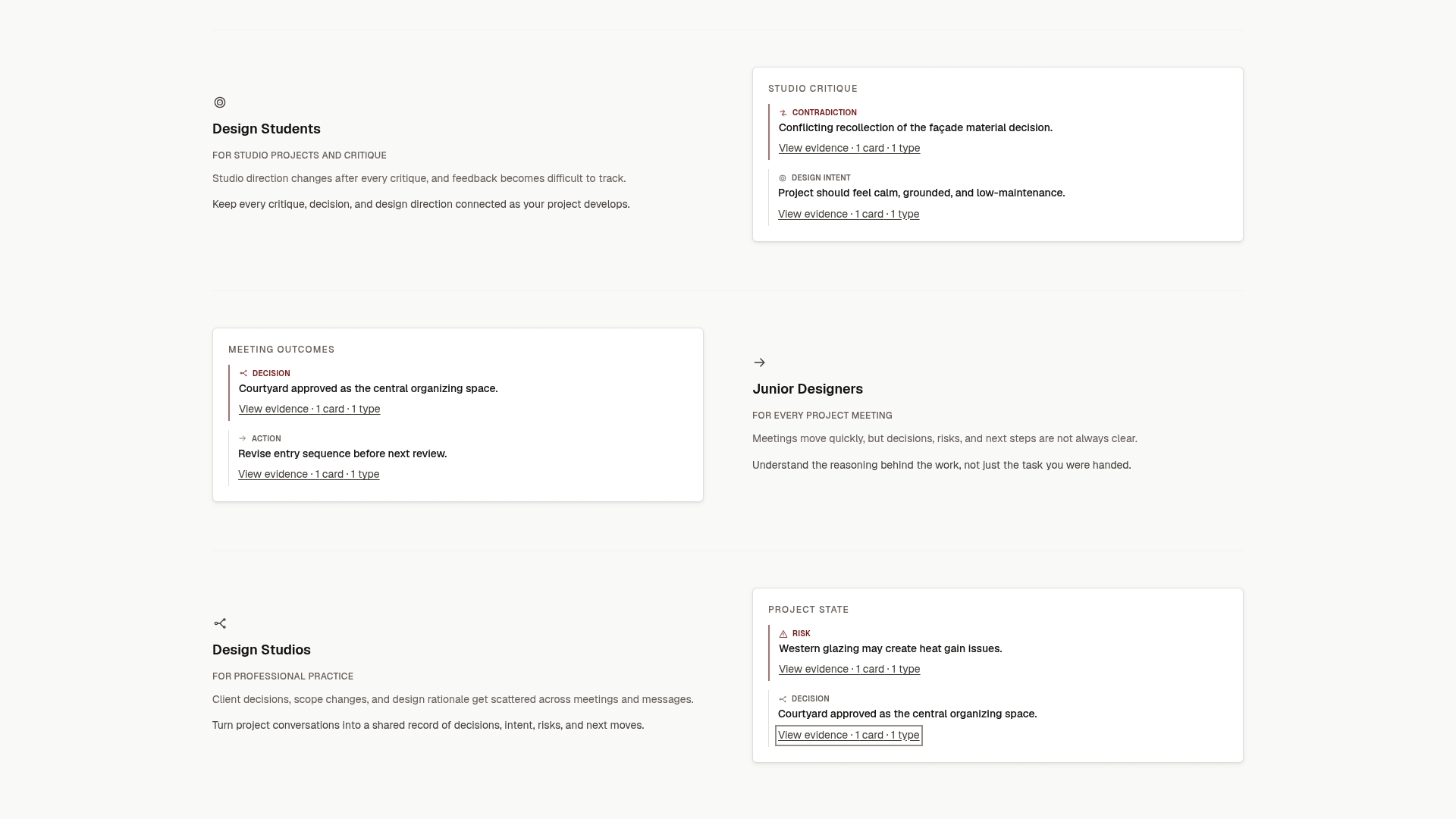
Spreadsheets track links. They rarely hold the reasoning. With The Intent Ledger, we turn meetings, transcripts, critique and client comments into ILM Records: structured, source-backed records of decisions, design intent, risks and unresolved questions, each traceable to the conversation it came from. Teams that outgrow a spreadsheet RTM, or need stronger continuity across handoffs, can compare options on our pricing page.
FAQ
What is the requirement traceability matrix?
A requirements traceability matrix is a table or database that links each requirement to its source, its design and build artifacts, and its tests. Its job is to show coverage and expose requirements that nothing implements or verifies.
What is an RTM with an example?
An RTM row might link requirement REQ-A (end inactive sessions after a period of inactivity) to its security policy source, a design element, the session-manager code and test case TC-A. If the code changes after the last test run, the evidence state flips to stale.
Who is responsible for the requirements traceability matrix?
Responsibility should sit with a named role, commonly a business analyst, systems engineer or project manager, who coordinates updates. NASA’s handbook guidance recommends assigning that responsibility explicitly and reviewing the matrix at major project phases.
Is an RTM used in Agile?
Yes, in a lighter form. Teams link user stories or backlog items to acceptance criteria and tests, usually scoped per release or component, and update the links as stories change rather than rebuilding a large document at the end.
Sources
Start with the INCOSE verification guidance, the NASA handbook pages and the template linked above, and review them closely if your project is safety or compliance critical.
- Swehb
- Verification and Validation
- 4.3 Requirements Traceability Matrix – Project Management, 2nd Edition