10-Field Client Approval Record Design Teams Can Make in Two Minutes
10-Field Client Approval Record Design Teams Can Make in Two Minutes
A client approval record is a conversation-linked ILM Record that captures a decision, its rationale, and the source evidence behind it, so your team can trace who decided what, when, and why. Done well, this kind of record cuts rework and protects design intent across the life of a project. We built The Intent Ledger specifically to make this practical for design teams.
TL;DR:
- Capturing approvals immediately during meetings ensures source-backed records with transcripts, timestamps, and links that verify decisions without reliance on memory.
- Documenting decisions right after meetings reduces reconstruction effort, decision debt, and helps prevent disputes by maintaining clear, traceable trade-offs.
- The client approval record should include a decision summary, rationale, source link, responsible owner, and next steps, all captured consistently in minimal time.
- Automating record creation through tools like The Intent Ledger saves time, links decisions directly to project tasks, and preserves source conversations with minimal manual work.
- Delayed documentation, vague reasoning, or unlinked evidence are common pitfalls that weaken traceability and increase risk of disputes or rework.
Table of Contents
- What a client approval record includes and what it is not
- Why capture approvals this way: practical benefits and research evidence
- The client approval record template: 8 to 10 fields to capture every time
- How to build approval capture into your weekly workflow
- Examples that show the cost of skipping this step
- Making the ritual actually stick
- Turning this workflow into practice with The Intent Ledger
- FAQ
- Sources
What a client approval record includes and what it is not
A client approval record is not a signature line or a legal sign-off stamp. It is a structured entry that ties a decision back to the moment it happened: the meeting, the email thread, or the critique session where the client actually said yes. Each record needs source-backed evidence, meaning a transcript excerpt, a timestamp, and a link back to the original conversation, so anyone on the team can verify the decision without relying on memory or secondhand retelling.
This distinction matters because enterprise approval workflows and marketing sign-off systems solve a different problem: tracking proofs, revisions, and compliance checkpoints. A client approval record, in the sense design teams need, is about preserving the reasoning behind a design choice, not routing a document for stamps.
A few examples of source material that typically becomes a record:
- A meeting transcript snippet where a client approves a material substitution and explains the budget reason behind it.
- A critique note where a design lead resolves a layout disagreement and documents the trade-off.
- A client email confirming a scope change, quoted directly and linked to the thread.
Why capture approvals this way: practical benefits and research evidence
Teams that delay documentation pay what practitioners call a reconstruction tax: hours spent later piecing together who agreed to what from scattered Slack messages, half-remembered calls, and old email chains. That tax compounds into decision debt, where unresolved or undocumented choices resurface weeks later and force the same conversation twice.
A study of design decisions in infrastructure projects found that documentation is more complete when teams record it immediately during meetings rather than afterward, and that a shared documentation environment improves traceability across the project team. The study of engineering design documentation also found that current practice often postpones documentation because of time pressure, which is exactly the habit a meeting-close ritual is meant to break.
Beyond traceability, the operational payoff is real:
- Faster onboarding, because a new team member can read the record instead of asking around.
- Clearer client communication, since both sides can point to the same documented rationale.
- Fewer disputes, because the record shows the trade-off that was discussed, not just the outcome.
The client approval record template: 8 to 10 fields to capture every time
A usable record does not need to be long. It needs to be consistent. Our Record of Decision field guide outlines the fields design teams should capture, and the core set looks like this:
- Title and ID: a short, searchable name so the record can be referenced in tickets and files later.
- Decision summary: one or two sentences stating exactly what was approved.
- Rationale: why this option won over the alternatives, including the trade-off that was accepted.
- Source: a link to the conversation, transcript, or email the decision came from.
- Timestamp: when the decision was made, not when it was written down.
- Responsible owner: who is accountable for acting on or defending this decision.
- Actions and next steps: what needs to happen as a result.
- Risks and assumptions: what could change the decision later, named plainly.
- Unresolved questions: anything still open that the team should revisit.
- Attachments and references: supporting files, sketches, or specs tied to the choice.
Our decision log template for project teams maps each of these fields directly to actions and owners, which keeps the record from becoming a static document nobody opens again.
Keep the language plain. Record what the team actually reasoned through, not contractual phrasing borrowed from a legal template.
Pro Tip: Write the rationale field as if explaining the trade-off to a teammate who missed the meeting, not as if defending it to a lawyer.
How to build approval capture into your weekly workflow
The habit that makes this work is small and repeatable: capture the decision before the meeting ends, not after.
- At the close of every client meeting, one person reads back the decision summary and rationale out loud for confirmation.
- That person attaches the relevant transcript snippet or timestamp before the call disconnects.
- The record gets linked to the task, pull request, or design file it affects within the same day.
- A designated owner checks weekly that open records have been resolved or updated.
Store records somewhere your team already works, not in a separate archive. Our guide on connecting notes to active work covers why decision logs lose value fast when they sit apart from tickets and design files.
A simple mapping helps this stick:
- Meeting minutes become a draft record within minutes of the call ending.
- The draft becomes an ILM Record once the owner and rationale are filled in.
- The record links into the relevant ticket so the next person who opens that ticket sees the reasoning, not just the task.
Our piece on automating meeting note capture walks through tools that reduce the manual work of pulling transcripts and timestamps into this flow.
Pro Tip: Assign the confirm step to whoever runs the meeting, not whoever takes notes. The person speaking the decision back out loud catches ambiguity the notetaker might miss.
Examples that show the cost of skipping this step
A studio team once faced a client dispute over a finish change midway through construction. Because the original approval lived in a timestamped record linked to the client’s email, the team traced the decision back in minutes and closed the dispute without redoing the work. Without that link, the same disagreement could have cost days of back-and-forth and a change order nobody wanted to sign.
Onboarding tells a similar story. A junior designer dropped into a project with a running decision log can read the reasoning behind a dozen prior choices in an afternoon instead of interrupting senior staff with the same questions repeatedly.
Common pitfalls worth fixing early:
- Delayed capture: waiting until after the meeting means details get softened or lost; fix it by confirming the record before anyone leaves the call.
- Vague rationale: “client preferred it” tells you nothing later; fix it by naming the actual trade-off discussed.
- Unlinked evidence: a record with no source link is just an assertion; fix it by attaching the transcript or email at the time of writing.
For teams working with physical samples, our partner resource on finish sample approval templates shows a similar approach applied to procurement decisions in interiors work.
Making the ritual actually stick
The first time I tried to enforce a meeting-close capture habit, half the team treated it as homework and skipped it the moment deadlines got tight. What changed things was cutting the ritual down to two minutes: read the decision back, confirm the rationale, attach the link. No exceptions, no extra steps.
Two shortcuts made it survive contact with a busy week: a fixed template nobody has to reinvent each time, and a two-minute confirm step built into the meeting agenda itself rather than left as an afterthought. Treat the record as something the team opens again, not something filed away.
— Rajas
Turning this workflow into practice with The Intent Ledger
We built The Intent Ledger to take the template and ritual described above and make them automatic. Our platform turns meeting transcripts, critique notes, and client comments directly into ILM Records, preserving the source link, timestamp, and rationale without anyone retyping a summary from memory.
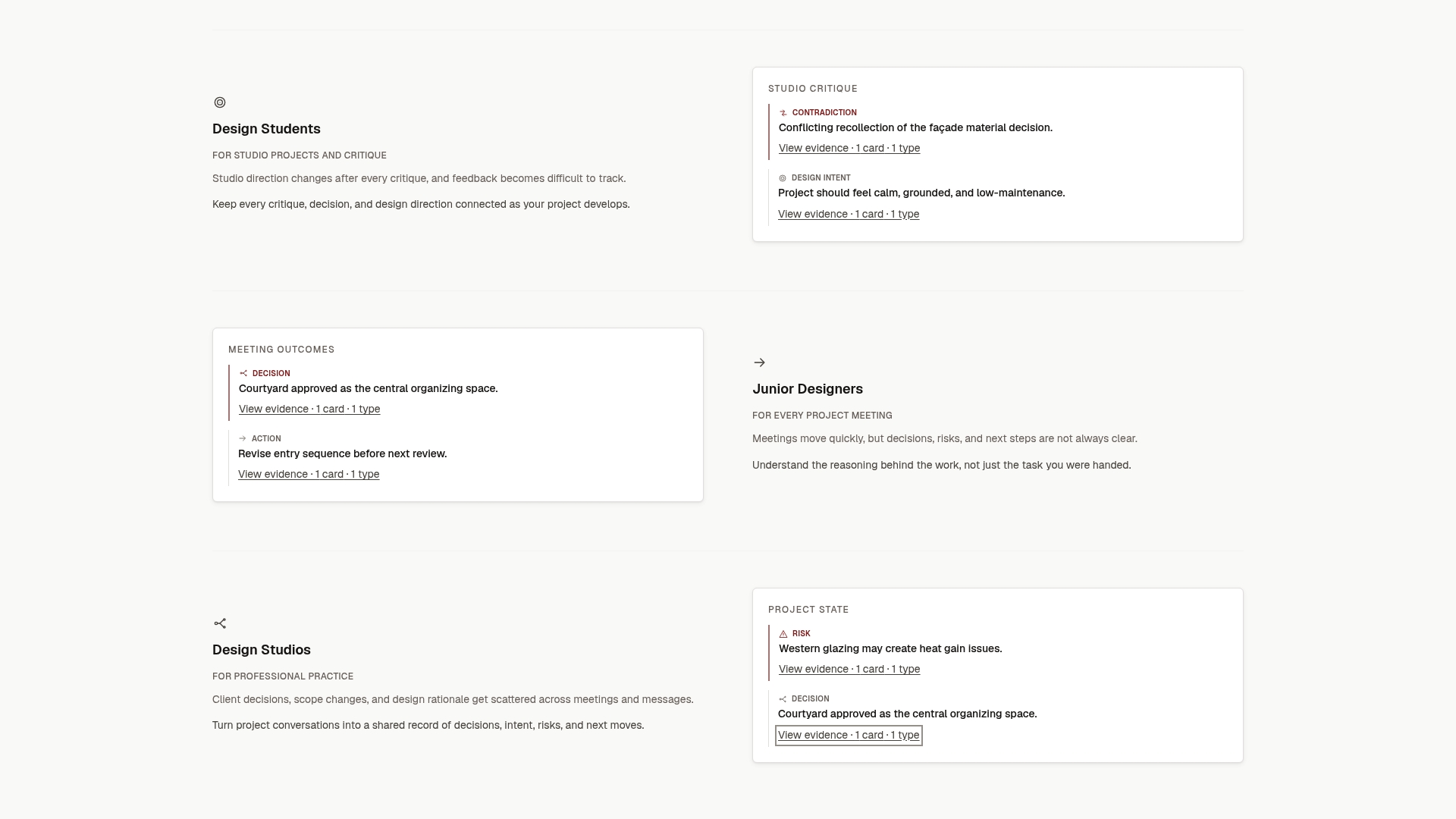
- Pre-built record templates match the fields design teams actually need, from decision summary to unresolved questions.
- Every record links back to the original conversation, so the source is never more than a click away.
- Records connect to the tasks and files your team already works in, keeping the decision log alive instead of archived.
Plans start with Working Memory at $29 per month, with Living Record and Shared Ledger available as teams scale, or a one-time Working Set purchase at $12 for a smaller start. Visit our pricing page to find the fit for your studio.
FAQ
What is a client approval record in design work?
A client approval record is a structured, source-backed entry that captures a design decision, the rationale behind it, and a link to the original conversation where the client approved it. It differs from enterprise sign-off systems because it focuses on preserving why a decision was made, not routing documents for compliance.
What fields should a client approval record include?
At minimum, a usable record needs a decision summary, rationale, source link, timestamp, responsible owner, next steps, risks or assumptions, and any unresolved questions. Our Record of Decision field guide breaks down how to populate each one.
Why does immediate documentation matter more than documenting later?
A study of design decisions in infrastructure projects found that documentation is more complete when captured during the meeting rather than afterward, and that a shared documentation environment improves traceability. Waiting until after a call tends to soften details or lose them entirely.
How does The Intent Ledger help with client approval records?
We turn meeting transcripts, critique notes, and client comments into ILM Records automatically, preserving the source conversation and rationale behind each decision. Plans begin at $29 per month for Working Memory, with details available on our pricing page.
What is the biggest mistake teams make with approval documentation?
The most common mistake is delayed capture, where teams wait until after a meeting to write down what was decided and lose the reasoning in the process. A close second is recording vague rationale, such as noting a preference without naming the actual trade-off discussed.