Shorten Onboarding: Project Context Retention for Studios, Adopt Today
Shorten Onboarding: Project Context Retention for Studios, Adopt Today
Project context retention means preserving each decision a design team makes, the reasoning behind it, and the conversation it came from, so anyone who joins later can reconstruct why something happened. Done well, it shortens onboarding, cuts rework caused by forgotten constraints, and surfaces risks while they’re still cheap to fix. The rest of this guide gives you a record template and a lightweight capture workflow you can start using on your next project.
TL;DR:
- Decisions should be documented with a clear what-how-why structure, covering alternatives considered, constraints, risks, and stakeholders for full context.
- Recording decisions during meetings through live notes, source links, and assigning owners helps prevent records from becoming outdated or incomplete.
- Regular cadence patterns such as weekly light captures, milestone reviews, and event-driven updates keep documentation manageable and relevant.
- Attaching source artifacts with timestamps and mapping decision relationships improves traceability and searchability of project records.
- Sustaining project memory requires designated ownership, periodic reviews, and embedding documentation into daily workflows rather than treating it as an extra task.
Table of Contents
- A compact record template for every decision
- From meeting to record: a workflow that doesn’t slow you down
- Cadence and scaffolding that prevent documentation fatigue
- Making records usable: links, relationships, and search
- Common pitfalls and how to avoid them
- When project context retention earns its cost
- Putting ILM Records to work with The Intent Ledger
- FAQ
- Sources
A compact record template for every decision
A record that only states what was decided tells you nothing about whether that choice still makes sense six months later. Research on architecture decision documentation recommends a what-how-why structure that captures the decision itself, how it will be carried out, and why it was chosen over the alternatives. A comparative study of student design teams found that teams using this kind of structured viewpoint explored and evaluated their options more systematically than teams that didn’t.
Build each entry around these fields:
- Decision summary: one sentence stating what was decided, written so it stands alone.
- Alternatives considered: the options you rejected and why they lost out.
- Rationale and forces: the constraints, client needs, or technical limits that drove the choice.
- Constraints and assumptions: what you’re taking for granted that could later prove wrong.
- Stakeholders and owner: who asked for it, who approved it, who’s accountable now.
- Risks and unresolved questions: anything still open or likely to resurface.
- Status and related decisions: active, superseded, or reversed, with links to dependent entries.
- Linked artifacts: the meeting recording, transcript, or file, with a timestamp.
Keep the summary under two sentences and name files consistently (project, phase, date) so searching later doesn’t become its own project. Our internal guide on fields design teams must capture walks through examples of each field filled in.
From meeting to record: a workflow that doesn’t slow you down
Capturing context only works if it fits inside the meeting rhythm you already have, not beside it. Research on architectural knowledge capture treats documentation as part of the design activity itself rather than a separate task, which is the difference between records that get made and records that get skipped.
- Capture the conversation as it happens, through a recording, transcript, or live notes.
- Identify candidates: decisions, risks, actions, commitments, and open questions worth preserving.
- Record rationale and alternatives while the reasoning is still fresh.
- Attach the source artifact and a timestamp so anyone can verify the context later.
- Assign an owner and a status so the entry has someone accountable for it.
- Surface it at the next milestone review rather than letting it sit unread.
This sequence reflects process documentation research from Fraunhofer, which supports iterative, lightweight documentation over one large end-of-project write-up.
Assign a rotating scribe for each meeting, a fixed owner for each decision, and a reviewer who checks entries at milestones rather than daily. Not every decision needs the full template: minor choices get a one-line note, while anything touching budget, scope, or client commitments gets the full record. Our decision log template offers a lighter format for teams that want a running list alongside full records, and our guide to automating meeting notes covers reducing the manual work of step one.
Cadence and scaffolding that prevent documentation fatigue
Documentation dies the moment it feels like a second job. Research on the Kaleidoscope reflective documentation tool found that showing work in progress improved reflection and gave teams material to reference later, but capture that pulled designers out of their main tools reduced how often they bothered.
Three cadence patterns work well, depending on project pace:
- Weekly light-capture: a short entry logging what changed and why, even if nothing dramatic happened.
- Milestone-triggered full captures: a complete what-how-why record at each major phase gate.
- Event-driven recording: triggered the moment a decision reverses, a risk appears, or a client commitment is made.
Scaffolded prompts, short, specific questions rather than a blank text box, keep entries from sprawling or disappearing altogether. Set a time budget (ten minutes per entry is a reasonable target), name a designated editor who checks for gaps, and build a review slot into your existing milestone meetings instead of scheduling a new one.
Pro Tip: Ask one scaffolded question per entry, such as “what changed since last week and why,” instead of leaving the field open-ended.
Making records usable: links, relationships, and search
A record nobody can find later isn’t preserving context, it’s just archiving text. Every entry should link directly to its source, whether that’s a transcript, a recorded call, or a design file snapshot, with a timestamp attached so a reader can jump straight to the moment the decision was made.
- Attach the source artifact (transcript, audio, or design snapshot) with a direct link and timestamp.
- Map relationships between decisions so dependencies are visible before someone builds on a false assumption.
- Use consistent tags, status fields, and named owners so entries surface in search instead of getting buried.
The documentation framework research describes starting with a lightweight relationship view and adding detail only where it’s needed, which keeps early records fast to produce without sacrificing traceability later. Our design documentation template includes downloadable fields built around this same linking approach. If your team runs structured meetings to reach decisions in the first place, this guide to evidence-based meeting facilitation offers techniques for making sure a conversation actually produces a documented outcome instead of a vague agreement.
Common pitfalls and how to avoid them
Most project memory systems fail the same few ways. Documentation turns into a parallel project nobody has time for, attention splits between doing the design work and writing about it, links to source conversations go missing, and once nobody updates the records, they go stale and stop getting trusted.
- Treat entries as part of the work, not an add-on, by capturing them during the meeting rather than after.
- Designate an editor who owns quality and consistency instead of leaving it to whoever remembers.
- Never skip the source link, since a decision without its origin conversation can’t be verified later.
- Run periodic hindsight reviews to catch stale entries and reconcile what actually happened against what was recorded.
A case study on hindsight reviews found that structured postmortems, when followed by a consolidation step, produced recommendations teams could act on immediately in later phases. Healthy project memory looks like recent edits, assigned owners on open items, and reviews actually on the calendar, not a folder nobody has opened in months. Our guide on making a postmortem stick covers turning those review findings into records that stay traceable.
Pro Tip: If nobody can name who owns a given risk or decision, that’s the clearest sign your project memory needs attention.
When project context retention earns its cost
Structured capture pays off fastest on projects with many stakeholders, multiple phases, or frequent handovers, situations where the person who made a decision won’t be the one answering for it later. A case study on project knowledge bases found that systems relying on voluntary, unstructured participation tended to fail, while ones with an assigned editor and integration into daily workflow held up. The lesson for a studio is to pilot the template on one active project, watch for simple signals like how often entries get updated and whether owners respond when tagged, and expand only once that pilot shows the habit sticking rather than fading after the first few weeks.
— Rajas
Putting ILM Records to work with The Intent Ledger
If the template above sounds worth doing but hard to sustain by hand, that’s exactly the gap ILM Records are built to close: structured, source-backed entries that trace each decision back to the conversation it came from.
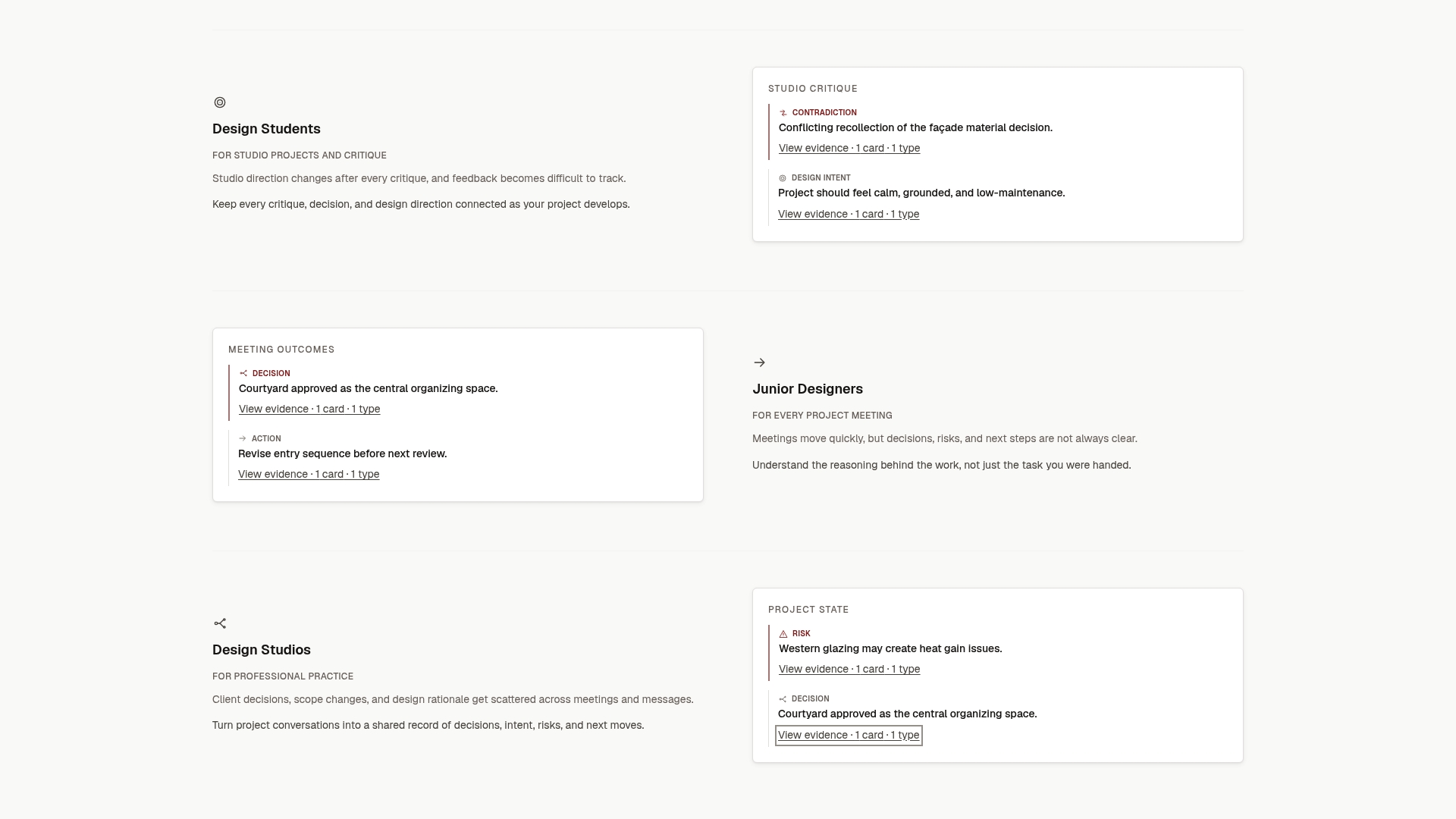
- Templates built in: what-how-why fields are already structured, so entries don’t start from a blank page.
- Artifacts linked automatically: transcripts, audio, and notes attach to the record they belong to.
- Owners, status, and search: every entry carries an owner, a status, and tags that make it findable later.
Teams ready to try this can see plans starting with Working Memory on our pricing page, which lists every available plan and one-time pack.
FAQ
What is project context retention in design work?
Project context retention means preserving a decision, the reasoning behind it, and a link back to the conversation where it happened, so later team members can reconstruct why it was made. It covers decisions, risks, actions, commitments, and unresolved questions, not just finished outputs like drawings or files.
What fields should a decision record include?
A useful record follows a what-how-why structure: the decision itself, how it will be carried out, and why it was chosen over alternatives, plus stakeholders, constraints, risks, status, and linked source artifacts. This structure is supported by research on architecture decision documentation.
How often should a design team update project records?
Weekly light-capture entries work well for steady projects, while milestone-triggered full records suit projects with distinct phases, and event-driven entries fit anything reversed or escalated suddenly. Process documentation research supports iterative capture over a single end-of-project write-up.
How does The Intent Ledger help with project memory?
The Intent Ledger turns meeting notes, transcripts, and client feedback into ILM Records, structured entries that trace each decision back to its source conversation. Plans start at $29 a month with Working Memory, with one-time record packs also available.
What’s the biggest reason project documentation fails?
Documentation most often fails when it becomes a separate task competing with the design work itself, or when records go stale because no one owns updating them. Assigning an editor and running periodic hindsight reviews, as shown in a case study on structured postmortems, keeps records trustworthy over time.
Sources
- A documentation framework for architecture decisions
- Study on decision viewpoints and student teams
- Kaleidoscope: A reflective documentation tool study
- Process documentation research (Fraunhofer)
- Architectural knowledge capture and lifecycle study