Tag Meeting Notes: 6 Required Fields for Design Teams
Tag Meeting Notes: 6 Required Fields for Design Teams
Use a short required tag set of six fields, a consistent title pattern, and one taxonomy owner: that combination is what makes meeting notes reliably searchable. Below, we walk through copyable tag examples, a one-minute live-tagging workflow you can start using in your next call, and the governance rules that keep the system from falling apart after month three.
TL;DR:
- Keep folders for stable project homes, but use tags to find decisions, risks, or themes across projects; the two systems solve different retrieval tasks.
- During calls, log D, A, R, or Q with a timestamp and a short note; record each action’s owner, due date, and completion checkbox.
- Assign one taxonomy owner, lock required fields, and review the vocabulary quarterly; retire duplicate terms and labels unused for three months.
- Make required fields mandatory in the template, then audit ten recent notes monthly for missing tags and naming drift; correct errors together.
- Review risk tags weekly across recent notes, and escalate any unresolved question after two review cycles to a named owner.
Table of Contents
- Why tags beat folders for cross-project searchability
- A copyable minimal tag taxonomy for meeting notes
- How to tag notes live and convert them in under 90 seconds
- Taxonomy rules that stop tag sprawl before it starts
- Where tags live and how they power search and reports
- Applying this for design teams: structured records in practice
- Training a team to tag consistently
- Linking tags to decision tracking and accountability
- Using tags to surface risks and unresolved questions
- A practical take and a seven-item quick start
- For teams that want this built in from the start
- FAQ
- Sources
Why tags beat folders for cross-project searchability
Folders are good at one thing: giving a project a stable home. Everything about that client, that building, that sprint lives in one place, and anyone new to the project knows where to look. Tags solve a different problem. They let you ask questions that cut across every folder at once, like “show me every decision about structural risk across all active projects this quarter.”
Information architecture practices treat this as a deliberate split: tags and folders complement each other, with folders handling stable containers and tags handling topic or status queries that cross project lines. Empirical comparisons of folder-based and tag-based organization find similar raw retrieval times between the two systems, but different strengths: folders give you control and spatial memory, tags give you flexibility across multiple categories at once.
In practice, that means:
- Pick folders first when retrieval is project-centric and you always know which job you’re looking for.
- Pick tags when you need to query a theme, risk, or decision type across many projects.
- Use both together rather than treating the choice as either-or.
A copyable minimal tag taxonomy for meeting notes
A small required set beats an elaborate one. According to tagging-system guidance for transcript metadata, the required fields should be short, mandatory, and limited to what actually supports search and reporting, with optional tags added sparingly.
Required tags:
- MeetingType: client call, internal review, postmortem, site visit.
- Project/Client: the project code or client name, one value only.
- Stakeholders: two to five names or roles present or affected.
- DecisionCategory: the type of decision made, or “None” if no decision occurred.
- Confidentiality: public, internal, or restricted.
- RetentionClass: how long the record needs to be kept.
Optional tags, used only when they support a real query: Topics (one to three), RiskTheme, ActionOwner, DueDate.
A client call tag header might read: MeetingType: ClientCall | Project: Riverside-Lofts | Stakeholders: J.Alvarez, Client-PM | DecisionCategory: MaterialSelection | Confidentiality: Internal | RetentionClass: Project-Life. A postmortem header might read: MeetingType: Postmortem | Project: Riverside-Lofts | Stakeholders: Design-Team | DecisionCategory: ProcessChange | Confidentiality: Internal | RetentionClass: 3-Years.
| Tag | Purpose |
|---|---|
| MeetingType | Filters by format so you can separate client-facing from internal records |
| Project/Client | Anchors the note to one job for folder-style retrieval |
| Stakeholders | Surfaces who needs to see or approve the record |
| DecisionCategory | Enables cross-project reporting on decision types |
| Confidentiality | Controls who can access the record |
| RetentionClass | Drives archiving and deletion schedules |
How to tag notes live and convert them in under 90 seconds
Live tagging works when the codes are short enough to type without breaking your attention on the conversation. A widely used shorthand uses single letters: D for decision, A for action, R for risk, Q for open question, K for key point, P for parking lot. Each tag gets a timestamp in mm:ss or hh:mm:ss format, matched to a single agreed recording source for the session.
Real-time tagging with short codes and timestamps speeds up minutes creation afterward because every tagged line already points back to the moment it happened in the recording. When a meeting mixes recording sources, such as a laptop mic switching to a conference room system, note an S (source) tag at the switch point so your timestamps still line up during post-processing.
The workflow:
- Keep a single running document open during the call, one line per tag.
- Type the short code, the timestamp, and a three to eight word fragment:
A 14:22 J.Alvarez to confirm tile supplier by Fri. - For every A (action) line, capture the minimum viable detail: owner, due date, and a blank check box for done.
- Right after the call, paste the tagged lines into your minutes template under their matching headers.
- Normalize the A items into a clean action list with owners and dates spelled out.
- File the record under its Project/Client tag and confirm Confidentiality and RetentionClass before closing it out.
Pro Tip: Agree on the master time source before the meeting starts, not after someone asks why two timestamps are four minutes apart.
Taxonomy rules that stop tag sprawl before it starts
A tag list grows messy the same way a junk drawer does: one exception at a time. The fix is a small set of naming rules applied without exception. Taxonomy guidance recommends building an approved, controlled vocabulary from real usage and testing it against real content rather than guessing at labels in advance.
- Use singular nouns only: “Decision,” never “Decisions.”
- Keep one approved term per concept, no synonyms living side by side.
- Offer pick-lists instead of free text wherever the field allows it.
- Cap hierarchy at two to three levels; a tag tree five layers deep defeats the purpose of a quick scan.
- Reserve hierarchical tags for genuinely nested categories, like RiskTheme > Structural > Foundation.
Assign one taxonomy owner, lock the six required fields so no one edits them without approval, and run a short quarterly check for drift: new terms that crept in, duplicate labels, and tags nobody has used in three months.
Pro Tip: If two tags are used interchangeably by different people, that is not a vocabulary problem, it’s a sign one of the two tags should be retired.
Where tags live and how they power search and reports
Tags belong in a predictable spot: a metadata header at the top of the note, the same field in transcript metadata, or a dedicated set of fields in your meeting template. Consistency of location matters more than the tool you use to store it.
A workable template shape:
- Header: date, title, required tags.
- Decisions made, each tied to a DecisionCategory.
- Action items with owner, due date, and status.
- Risks surfaced, tagged by theme.
- Open questions still unresolved.
- Links to related notes, files, or prior decisions.
Once tags sit in a consistent field, they feed simple filters (“show me all Riverside-Lofts decisions”), lightweight reports (counts of open risks by theme), and AI-assisted search that can retrieve a record by meaning rather than exact keyword match.
Applying this for design teams: structured records in practice
Design work generates more than minutes and action items. It generates rationale: why a material got swapped, why a client pushed back, why a detail changed between schematic and construction documents. A required tag set captures the what. Structured records built for design teams go further and preserve why behind each entry, linking it back to the conversation it came from.
That is the approach behind ILM Records: notes, transcripts, critique feedback, and client comments turned into structured entries tagged by decision, risk, action, and open question, each traceable to its source conversation. For teams that have tried this, the benefit shows up as less time spent reconstructing context and a living project memory that survives staff turnover.
- Traceability: every decision links back to the meeting it came from.
- Reduced rework: fewer “why did we choose this” conversations repeated months later.
- Continuity: new team members can read the reasoning, not just the outcome.
For related reading, see our posts on automating meeting notes for design teams and traceable design meeting notes.
Training a team to tag consistently
A tagging system fails most often because one person tags carefully and everyone else guesses. The fix is training that treats tagging as a two-minute skill, not a policy document nobody reads.
Start with a one-page guide, not a wiki page: the six required tags, three example headers, and the short-code legend for live tagging. New team members tag their first few meetings next to someone experienced, comparing their tags line by line against the taxonomy owner’s version. That comparison catches drift before it becomes habit.
Build a shared library of five or six fully tagged example notes covering different meeting types, client calls, postmortems, internal reviews, so anyone unsure how to tag an unusual meeting has a real precedent to copy instead of inventing a new convention on the spot. Run a short spot check monthly: pull ten recent notes at random and flag any missing required tags or inconsistent naming, then correct them together rather than silently fixing them yourself.
Make the required fields genuinely mandatory in whatever template or tool holds the notes, so a record can’t be filed without them. A soft rule that says “please tag your notes” gets ignored under deadline pressure; a required field in the template does not. Pair that with a short reminder at the top of the shared template itself, a line that says what the six fields are and links to the one-page guide, so the convention is visible at the exact moment someone is about to skip it.
Linking tags to decision tracking and accountability
A DecisionCategory tag is only useful if it connects to who owns the follow-through. The practical move is pairing every decision tag with an ActionOwner and a due date in the same record, so the decision and its accountability live in one place instead of two separate systems that drift apart.
Decision journal approaches used by teams tracking hypotheses and trade-offs over time show the value of recording not just the decision but the confidence behind it and the outcome once it plays out. A similar discipline on structured decision journals applies directly to meeting tagging: tag the decision, tag the reasoning, and revisit both when the outcome is known.
In practice this means:
- Every DecisionCategory tag gets an adjacent ActionOwner tag, never left blank.
- Decisions with no immediate action still get a status tag, “Decided, no action required,” so the record is complete.
- A monthly pass through DecisionCategory tags checks which decisions have unresolved actions attached and flags them to the owner.
This is also where retention and audit needs intersect with tagging. Teams working in regulated or audit-sensitive sectors often formalize this into a project decision log that pairs each decision with its rationale and retention requirement, which is the same discipline the RetentionClass tag is meant to support on a smaller scale. Connecting notes to tasks this way, rather than leaving decisions as free text, is also covered in our piece on turning decisions into traceable work.
Using tags to surface risks and unresolved questions
Risks and open questions tend to get buried in meeting notes because they rarely have an obvious owner at the moment they come up. Tagging them with the R and Q short codes during the live call, as covered earlier, is the first step. The second step is what happens to those tags afterward, and that’s where most systems quietly fail.
A RiskTheme tag only earns its place if someone reviews it on a schedule. A practical approach: once a week, filter every note from the last seven days for R-tagged lines, and scan them for repeated themes, the same risk surfacing in three different projects, or the same unresolved question appearing in two meetings a month apart without ever getting answered.
Pair this with a simple aging rule. If a Q-tagged item has no resolution after two review cycles, it gets escalated to a named owner instead of sitting in the notes indefinitely. This turns tagging from a passive record into an early-warning system, since a risk that shows up tagged across multiple unrelated meetings is a stronger signal than the same risk mentioned once and forgotten.
Platforms built around AI-assisted retrieval can make this scan faster by surfacing related tagged entries automatically rather than requiring a manual weekly search, which is one of the uses covered in broader discussion of meeting intelligence tools. Whether done manually or with assistance, the discipline that matters is the same: review the risk and question tags on a fixed schedule, not only when someone remembers to ask.
A practical take and a seven-item quick start
The biggest mistake teams make with tagging is starting too big, with a dozen fields and three levels of hierarchy, and abandoning it within a month. A system survives when it’s boring enough to use without thinking.
Start this week with:
- A consistent title pattern for every meeting note.
- The six required tags, no more.
- A short-code legend posted where everyone can see it.
- One agreed master time source per meeting.
- A named taxonomy owner.
- Locked required fields in your template.
- A standing quarterly review on the calendar.
, Rajas
For teams that want this built in from the start
Everything above works with a plain document and discipline. For design teams juggling dozens of client conversations, critique sessions, and transcripts at once, we built a faster path: ILM Records turn those conversations directly into structured, source-backed entries tagged by decision, risk, action, and open question, each traceable back to the conversation it came from.
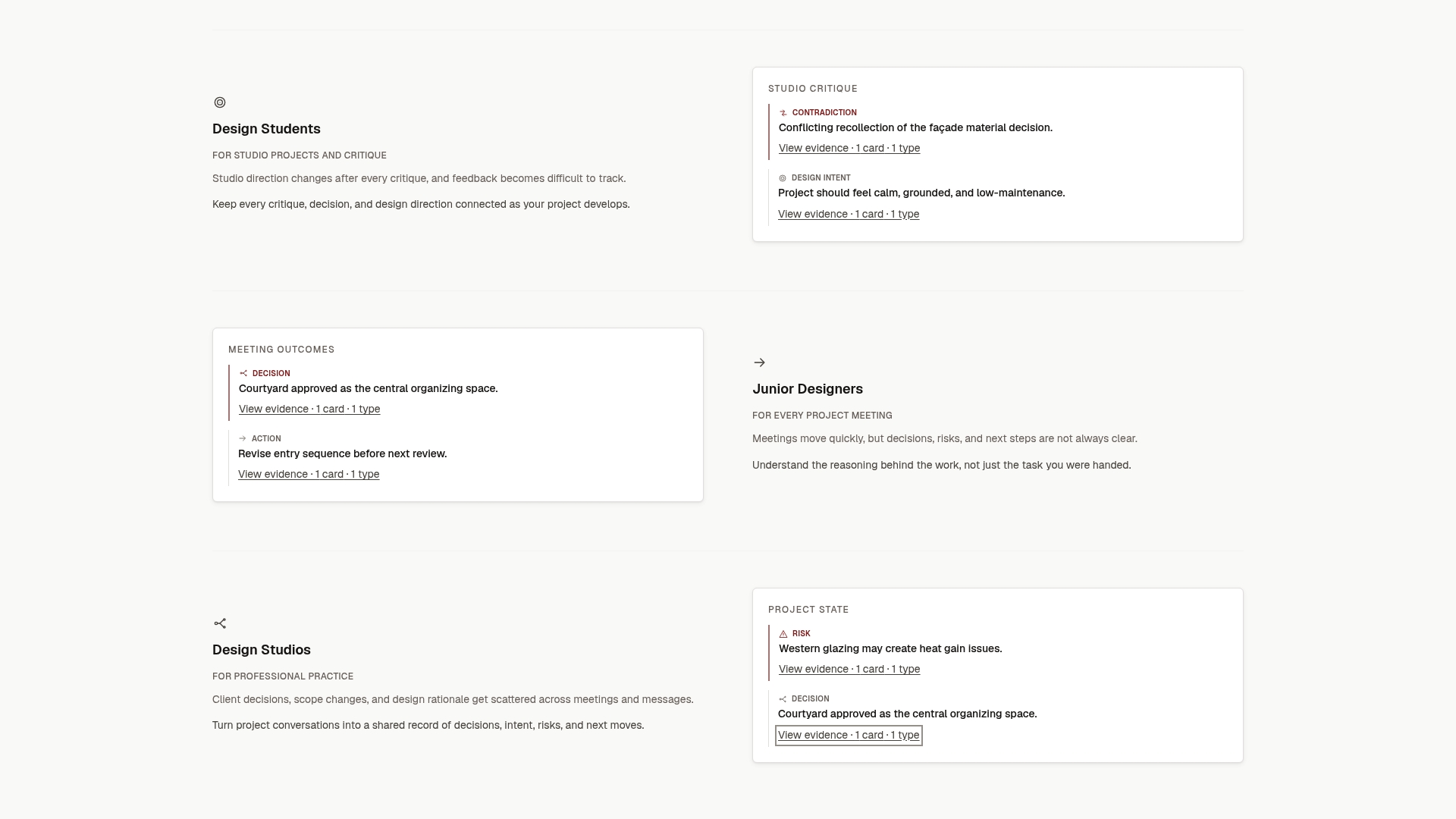
That traceability is the part a plain tagging system struggles to maintain by hand once a project runs long enough for context to get buried in old notes. If you want that structure without building and maintaining the taxonomy yourself, our pricing page lists the available plans, including options for teams just getting started.
FAQ
How do you tag your notes?
Start with a short required set, meeting type, project or client, stakeholders, decision category, confidentiality, and retention class, applied to every note the same way. Keep the fields in a consistent header location and avoid adding new tags without checking the existing taxonomy first.
What is another way to say “meeting notes”?
Common alternatives include minutes, meeting summary, meeting record, and session notes, depending on how formal the document needs to be. The term you pick should stay consistent across your team so tagging and search terms don’t fragment.
How to use tags in notes?
Add tags at the top of each note in a dedicated header, using a controlled, pre-agreed vocabulary rather than free text. During the meeting itself, short codes like D, A, R, and Q paired with timestamps let you tag live, then convert those into full tags once the note is filed.
Why can’t I lock notes with tags?
Tags organize and filter notes but most note-taking tools treat locking or access control as a separate permission setting tied to confidentiality, not to the tag itself. Setting a Confidentiality tag like “restricted” is useful for filtering and reporting, but actual access restriction usually needs to be configured through your tool’s sharing or permission settings.
Should I use hierarchical tags or flat tags for meeting notes?
A shallow hierarchy of two to three levels works best for most teams, reserved for genuinely nested categories like a RiskTheme broken into subtypes. Flat tags are easier to maintain and faster to scan, so default to flat unless a specific category clearly needs nesting.
Sources
- Information architecture - UW–Madison Information Technology
- Transcript metadata tagging system, required tags
- Better to organize personal information by folders or by tags? The devil is in the details